A better way to tie-in to the middle of a climbing rope

I’ll reckon --yet to measure-- that the butterfly
with eye reeved back through it (where it can then
be simply clipped, having adequate nip from the
knot) will come out ahead --and is certainly more
easily tied. (And required no new knot to learn.)

And [b]Xarax [/b]would no doubt point out that when untying from this composite mess, a remnant knot is still left in the line - and this too must still be untied. There is a lot to be said for using one [b]Post Eye Tiable[/b] (PET) tie-in knot ... that leaves no remnant knot when untying.
Thankfully, one need not heed X's fancies. There are two knots to untie in your double-BWL solution, and just one with the [i]butterfly[/i] --which in some circumstance one might prefer to leave available for future use!? --or just untie it, which just might be on the mind!

–dl*

per Dan Lehman:

I'll reckon --yet to measure-- that the butterfly with eye reeved back through it (where it can then be simply clipped, having adequate nip from the knot) will come out ahead
Luckily I have measured the difference...

#1053 Butterfly in combination with #1046 (derived) requires 1880mm

#1074 Bowline with a bight - secured with Yosemite finish requires 1150mm

Difference = approx 700mm

Note: There is no need to tie dual #1074 Bowlines… a singular #1074 is sufficient in the majority of cases.
I originally showed dual #1074 Bowlines purely as a novelty - to show that if one wanted to, one could do it.

Thankfully, one need not heed X's fancies.
Xarax has some really profound ideas...he was (and is) ahead of his time. Leaving a remnant knot which must also be untied is an important concept.
There are two knots to untie in your double-BWL solution, and just one with the butterfly
As stated, there is no pressing need to tie-in with dual #1074 Bowlines...I simply showed it as a novelty - and even so, if one wanted to, it is not that difficult.

So your contention could be flawed - because you appear to presume that dual #1074 Bowlines are required? One could also reach a conclusion that you are simply ignoring the fact that it is perfectly safe to tie-in with a singular #1074 Bowline (with a suitable locking maneuver), and instead choosing the dual #1074 tie-in because it supports your contention??

I would also point out that no carabiners are required when using #1074 Bowline.
If a carabiner is a necessary ingredient - this implies that is a conditional method which further suggests that it is less efficient.

The overall length of rope consumed to tie a knot is not the sole determinant of ‘efficiency’. Other metrics also must be considered. Jamming is certainly another issue.

I would remind you that #1053 Butterfly is vulnerable to jamming when eye loaded.
Surely you know this?

Omit “would” : you did.
(And another word you want is “single”, not “singular”.)

And I’ll remind you that we are talking about a different
knot* here, one that surrounds more diameters.
(And if I tie it, it won’d be the same dam ill-formed
and parroted butterfly but Wright&Maggowan’s beauty
anyway! --or, maybe the OH+Fig.8 same-rotation version.)

–dl*

Omit "would" : you did.
?
(And another word you want is "single", not "singular".)
I intended to use the word 'singular'.
And I'll remind you that we are talking about a different knot* here, one that surrounds more diameters.
Only in the sense that 4 rope diameters are now fed through the #1053 Butterfly structure - but its still #1053 Butterfly. But - I concur that having 4 rope diameters in #1053 Butterfly [i]may [/i]boost jam resistance during eye loading. Although i would point out that no one has positively tested this - it remains in the realm of theory.

The reason I previously mentioned #1046 (derived) overhand loop as a composite with #1053 is because it was suggested by bushrag - and it avoided adding a carabiner to the mix. the amount of rope consumed is about the same as what you had suggested…

I would point out that your notional concept of feeding the bight back through #1053 and then stoppering in some fashion is actually creating a noose to the climbers harness. And you had suggested using a carabiner as part of the procedure.

I would suggest to you that this whole concept is messy and inefficient.

Using #1074 Bowline is simple and efficient - and leaves no remnant knot in the rope once untied - and its also PET (Post Eye Tiable).
#1074 Bowline on-the-bight is also jam resistant and uses much less rope material to create the tie-in.
Furthermore, it requires no carabiner!

?! No, the OH of the butterfly seizes/grips the
stoppered bight tail and that’s a fixed loop.
Adding a 'biner to surely clip off the bight tail is
not the problem you make of it --simple enough.
(Now, if clipping that 'biner and they suspending
oneself thusly, then there is the (butterfly) noose
–but to the harness, not the body.

Btw, a PETiable solution --and by this I mean
"it can work at some at least small forces–
is to reeve the bight through the harness
loop en route to making that final tuck
of the knot !! (Then you might really want
the 'biner toggle!)

–dl*

?! No, the OH of the butterfly seizes/grips the stoppered bight tail and that's a fixed loop.
True - only if the stoppered end is in fact fixed/attached to the Butterfly core knot in some way. I thought you meant that the enlarged eye of the Butterfly was simply fed back through the core and then a simple overhand knot tied at the end. In which case, the doubled eye thus created to the users harness would not be a fixed eye - the only thing stopping catastrophic failure being the stopper knot to prevent it trying to work its way back through the core of the Butterfly.

In any case, it is still a convoluted concept.

Btw, a PETiable solution --and by this I mean "it can work at some at least small forces-- is to reeve the bight through the harness loop en route to making that final tuck of the knot !! (Then you might really want the 'biner toggle!)

#1074 is a PET solution.

Any method that requires an initial #1053 Butterfly as a first stage of the process isn’t PET.
And any method that further requires a carabiner to achieve security is inefficient.

Not sure where you are going with your line of argument?
Presumably you are in favor of a composite tie-in method that is built upon a #1053 Butterfly?
If this is your contention - you are perfectly entitled to form such a view.

There are no laws or on-the-spot fines for tying-in to a climbing harness using a non approved method.
Technically, a climber can choose any tie-in method s/he desires - provided it doesn’t result in tragedy (unless the climber is willfully careless and reckless).

No, the knot is fixed by the frictional nipping of
the bight-legs by the overhand component of the knot
–whichever one is loaded, or both. --think sheepshank
(not the happiest thought, agreed). The stopper is an
added assurance vs. slippage.

Btw, a PETiable solution --and by this I mean "it can work at some at least small forces-- is to reeve the bight through the harness loop en route to making that final tuck of the knot !! (Then you might really want the 'biner toggle!)

Any method that requires an initial #1053 Butterfly as a first stage of the process isn’t PET.


In my case -2 B clear–, the PET aspect comes in forming
the butterfly, in which the en-route-to-tucking
eye bight captures the harness loop(s).

–dl*

Per your nice photo, I see a problem in that if
the loaded SPart is the one on viewer’s RIGHT
side, then the knot body will be pulled INTO
the harness loops, maybe not all so happily.

(Whereas the two-knot cleverness avoids this,
as well as the simple reeve-the-eye in/out ones.)

(aside :: Agent_Smith’s photo of his dual-knot
solution IMO is a good demonstration of the better
perspective to view the bowline --the image
on the right side makes it easy to see where parts
run through the knot, while that on the left leaves
esp. SPart crossing(s) hidden and ambiguous.)

Btw, a 'biner clipped into the bight-end of the
(any) solution is hardly much “inefficiency”
and potentially a ready means to effecting
a pulley to lift a fallen person up out of the
hole.

–dl*

per Dan Lehman:

Per your nice photo, I see a problem in that if the loaded SPart is the one on viewer's RIGHT side, then the knot body will be pulled INTO the harness loops, maybe not all so happily.
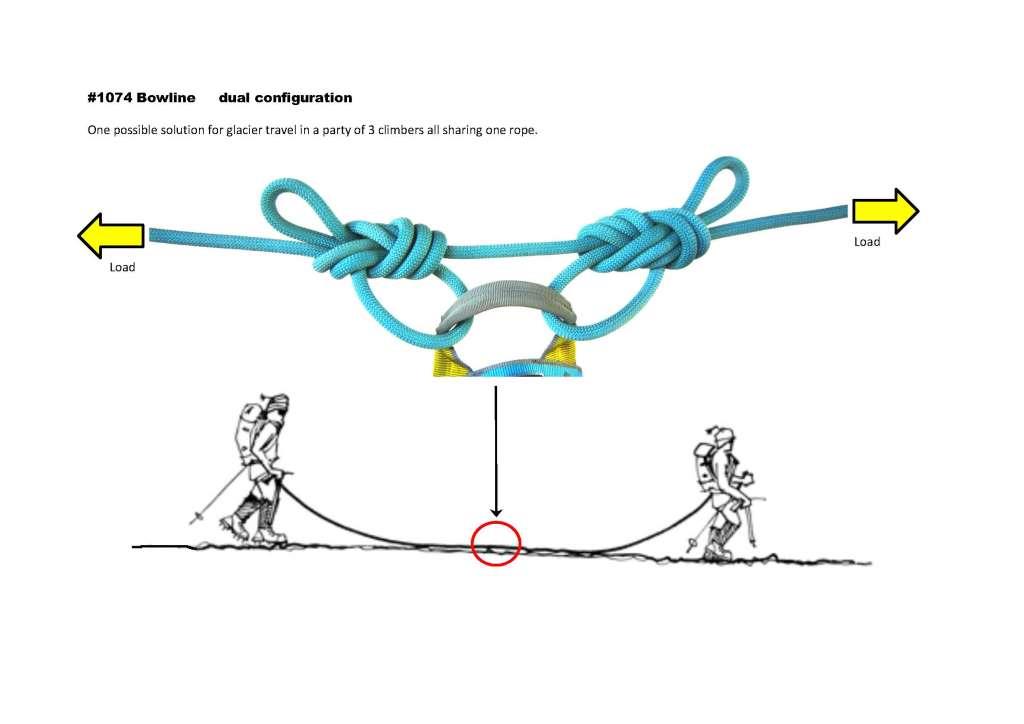
As I have already pointed out in detail, loading will never be along a perfect horizontal direction (x axis). The middle person in a party of 3 (one rope linking all 3 climbers) is something that might occur for glacier travel. If the middle guy falls [u]down [/u]into a crevasse, load on the harness will actually be directed in the vertical (y axis) direction. Also, load will never be distributed evenly from both sides. Load will always be biased on one side or the other.

For vertical rock climbing, it would be a rare event to have a 3rd person tie-in to the middle of a singular climbing rope. It just isn’t done.
IF it was done (for some kind of obscure emergency scenario) - loading will be in the vertical (y axis) direction.

In any case, as i had pointed out, it is trivial to tie a second #1074 Bowline if there really was some concern for bi-directional loading. But, I accept that IF a second #1074 Bowline was tied, this would consume more rope. For the sake of absolute safety in a party of 3 crossing a glacier, a dual #1074 tie-in would be perfectly fit for purpose.

Btw, a 'biner clipped into the bight-end of the (any) solution is hardly much "inefficiency" and potentially a ready means to effecting a pulley to lift a fallen person up out of the hole.
It depends on how you wish to define 'efficiency'. From a purely technical viewpoint, minimalist wins that argument. In that, if a tie-in requires additional equipment, how could that be more 'efficient' than the method that requires no extra equipment (just the rope by itself). Be that as it may, using a single carabiner to clip to something to boost safety is not a deal-breaker either. But, it might be in an emergency where the middle climber simply has no additional (or spare) gear. I should remind you that in a normal tie-in situation for lead climbing at the end of a rope - nobody uses a carabiner! Its just the rope by itself - and the rope is tied directly to the climbers harness.

Well Dan, where to from here?
I know that if i were faced with the prospect of tying-in to the middle of a climbing rope - I would choose #1074 Bowline - the virtues of which i had already pointed out in detail.
And i presume that you would choose a composite with the first stage being a #1053 Butterfly…?
There’s a lot going on with a composite tie-in method - and it needs to be properly managed since it relies on multiple steps. And at the end of that sequence, maybe further counter-measures need to be taken by adding a carabiner.

Why?
Which in your phrase
dual #1074 Bowlines… a singular #1074 is sufficient
is obviously quite wrong : the question is number,
not any esoteric aspect, and “single” opposes “dual”.
(which I focused on because I’d hastily read and thought
it was your solution).

–dl*

I don’t like that prospect of pulling the #1074 through
the harness loop(s), or the awkward loading on the
BWL that causes that.

As for efficiency, this tying in isn’t a major portion of
time & effort or gear for the typical party. Having a
'bner spared for they joint as I said might even be
seen “as a feature, not a but”! Who goies out with
too little gear to do that?

Put the question out to some alpine guides and see
what those-who-might-use say --maybe adding some
further insight to the pros/cons of both?!

–dl*

I don't like that prospect of pulling the #1074 through the harness loop(s), or the awkward loading on the BWL that causes that.
This of course presumes a non vertical loading profile.

I would point out that in a normal end of line tie-in procedure, the rope is in direct contact with the harness (ie direct nylon-to-nylon contact).
Also, the loading profile to the harness of the middle person is not going to be horizontal (ie directed along the x axis).

The most likely scenario for a climber tying-in to the middle of a rope is for glacier crossings.
If the middle climber falls [down] into a crevasse - the loading on that fallen climbers harness will actually be mostly in the vertical (y-axis direction).

If there was a concern with loading profile - it is perfectly reasonable to tie-in with dual #1074 Bowlines.
Tying-in with dual #1074 Bowlines solves all issues with horizontal loading profiles.

But, as I have pointed out, the loading on the middle climbers harness is never going to be in a purely horizontal (x axis) direction.

As for efficiency, this tying in isn't a major portion of time & effort or gear for the typical party. Having a 'bner spared for they joint as I said might even be seen "as a feature, not a but"! Who goies out with too little gear to do that?
Efficiency has many metrics. From a technical viewpoint, if a tie-in procedure requires a carabiner, then it cant be as efficient as a system that does not. In other words, if a the use of a carabiner is a condition to achieve security, how can it be as efficient as a system that does not require any extraneous equipment?
Put the question out to some alpine guides and see what those-who-might-use say --maybe adding some further insight to the pros/cons of both?!
That argument is what is know as 'social proof'. In other words, it hinges on the general approval of others for it to be true.

One could ask some alpine Guides if they join their accessory cords with a Zeppelin bend.
The answer would almost assuredly be “no”.
Most would answer that they use #1415 Double fishermans bend to form a round sling from EN564 accessory cord.
This doesn’t mean that a Zeppelin bend is ‘wrong’.

The same could be said of what knot do alpine Guides use to join 2 climbing ropes for a retrievable abseil.
Some would answer; “#1410 Offset overhand bend”
Others would answer differently.

Okay…

The IGKT is a place to come to discuss technical matters.
Tying-in to the middle of a climbing rope (for a 3rd person) is a technical matter.
The reality is… there is no 100% perfect answer.
It comes down to judgement and experience.

I had advanced the notional concept of using #1074 Bowline as one possible solution.
I have tendered arguments in its favour.
However, i do not dictate its use!
It is an individuals choice. There is no law or legislative directly to force a climber to use a particular mid-rope tie-in method.

The default solution has been to use #1053 Butterfly with 2 locking carabiners.
Is it acceptable?
Answer = yes

If we frame the question a little differently… Is there an alternative method that does not rely on metal connectors and yet, is also biaxially loadable?
The answer is yes - #1074 Bowline.

In terms of loading profile - which seems to be the key argument - rarely would it be in the horizontal (x axis) direction.
IF there was a concern about horizontal loading, dual #1074 Bowlines completely solves that concern.

In terms of seeking social proof by asking other Guides…I would say that the notional concept of using #1074 Bowline (single or dual) hasn’t entered into mainstream consciousness.
?? Not at all :: if one falls down (vertically) a crvasse,
one or the other side of your attached line will be
tensioned --you might be nearer one/other person
next to you. And in the case where it is from the
side of the knot’s proper tail, it will try to pulle
that knot through the attachment loop --no matter
pulling up/out/down, it is pulling on THIS end of
the structure and that runs through the ring TO
the knot and so pulls the knot back into and maybe
through the harness loop(s).

–dl*

?? Not at all :: if one falls down (vertically) a crvasse, one or the other side of your attached line will be tensioned --you might be nearer one/other person next to you.
??

Again… you appear to be assuming that load will only come from one direction (based on a glacier crossing scenario).
As I had repeatedly stated in several posts, it is a simple matter to tie a second #1074 Bowline to counter the threat of loading from the direction of the rear-end tailing climber.

There is no magic bullet solution for a mid rope tie-in.
I offered #1074 Bowline because it is both TIB and PET and EEL (either end loadable).
It also does not require any additional carabiners to achieve security.
Furthermore (again) one could easily tie a second #1074 which completely addresses and resolves any concern of loading profile from purely in the direction of the tailing climber (ie when crossing a glacier).

On a vertical wall, a singular #1074 Bowline would be sufficient since it wouldn’t matter which way the loading came from.
If the rear-end (tailing) climber slipped and fell on a vertical wall, it would have a cascading effect on the others above him - likely causing them to fall too.

EDIT NOTE: Added some images to clarify loading profiles


Bowline_1074__dual-configuration.jpg

How about what seems to be a great solution for this application? You are already familiar with it in some respect.

Introducing: zepplin in the bight! Carabiner clipped in the bight and one strand to nullify the chance of the bight backing out

https://i.imgur.com/k8mxEXZ.jpg

Here it is with me not tied in, but rather tied into and hanging on the standing parts with full bodyweight attempting to capsize the knot, it would never really be loaded like this

https://i.imgur.com/5CGUPLa.jpg

The knot distorts some, but when tied in to the bight I cannot foresee any failure via capsizing.

It is easily tied starting from an overhand like a basic zepplin loop.

If you remember I proposed the alpine butterfly combined with the bight reeved and stoppered as a kind of compound solution. The zepplin is better for bight security because the opposing overhand knot structure of the zepplin nips the bight at all times. The carabiner probably isn?t necessary.