I quite disagree : the dual turNips make the loosening
feed of ends more difficult --the “crossing part” of the
clove/larkshead(cow) doesn’t contribute (being between
the potentially loosing loops), whereas the single loop
has flow from both ends and can thus quickly loosen.
(Similarly, the “round turn / double” bowline has at least
TWO turns to consume the feed in of material and mitigate
loosening thus; but the knotted bases above I think do
rather well in this. They double the contact of rope to rope
for some securing, movement-resisting friction.
I find it really makes quite a considerable difference with low friction sheathed climbing ropes to have that extra turn. All of the complications make for a bulkier knot, but I think it makes for a much more reassuring connection to the rope.
Dom
p.s bear with me I am keen to do a test and take some pictures of a ‘green’ bowline, water bowline and I’ll try and do the same with a mirrored bowline - it may take a while before I manage to do this but, I will have a go!
Hi Folks
I have only just gotten round to responding with a rather un-scientific test.
I had a chance to take some lead falls in the gym.
Here is my usual knot after a very long fall on an indoor wall:-
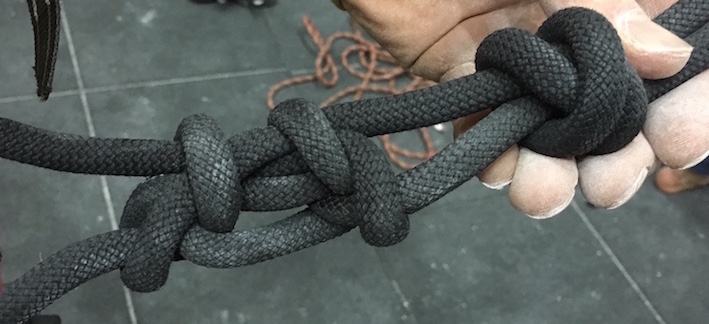
…and here’s a straightforward water bowline after the same force:
Thanks for returning w/some further insights!
While I might yet prefer the mirrored bowline to the like
knot that you have presented (the difference being that
of a cow vs. clove base structure), I admit to being
confused just now in seeing the latter in your photo of the
former --which I’ll accept as proof of ample similarity,
which I think carries beyond looks into performance.
I’ll note that your image of the fallen-upon knot shows
well enough my point of why the knot works well :
… [T]he dual turNips make the loosening
feed of ends more difficult --the “crossing part” of the
clove/larkshead(cow) doesn’t contribute (being between
the potentially loosing loops), whereas the single loop
has flow from both ends and can thus quickly loosen.
You might try this : rather than completing that “Janus”
2nd collaring (of the eye leg), simply draw the tail
back over the crossing point of the extra turNip and
tuck back --2dia in extra, 3 still in initial. This might
give some added slack security?
–dl*
Thanks for your comments Dan. I take your point about the alternative, although I like the way that the janus adds another length to the rope running up through the middle of the clove hitch component of the knot and at the same time it lies reasonably flat. I find that the janus finish prevents the knot distorting under certain “cross loads”, which I find reassuring if I choose to belay off the bight at a hanging stance. I also tend to find that the choice to run the knot in the way that you are describing makes the knot a little bit more “lumpy” and perhaps harder to check quickly and visually prior to “take off”, so to speak, although that could be habit on my behalf - I’m used to the look of my “green bowline”!
D