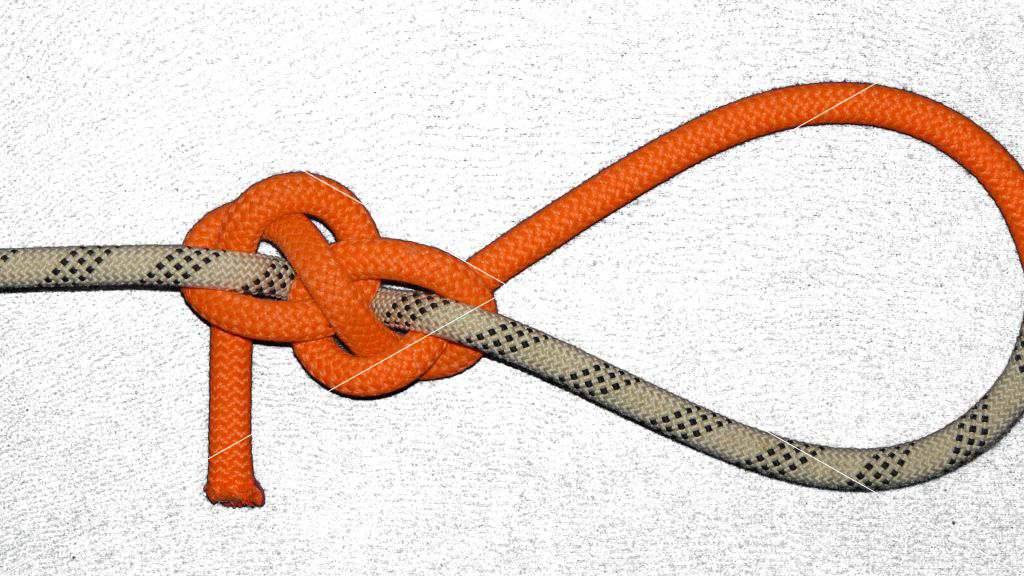
The one single overhand knot is not as convoluted a knot as it should, to serve as a “neck” for a secure noose-hitch. So, it is tempting to try two overhand knots instead ( “When one is not enough, try two”, said one of the discoverers of the double DNA helix … ). The Blimp knot is nothing but such a two-interlinked-overhand-knots compound knot.
See the attached pictures for another noose-hitch based upon a two-interlinked-overhand-knots neck. Shown are a “correct” and a wrong version . The wrong one, suffers from the danger the tail will be untucked and untied, if the upper overhand knot is not tightened adequately - and will not remain in this state ever since. That is the reason it might serve as a knot for a midlne bend, but not as a neck around the tensioned standing part of a noose-hitch.
However, I think that the purpose of this thread was a noose-hitch which will be tightened when pressed hard on the surface of the wrapped object, by the compression forces the surface of the object imposes on a nub of as simple as possible a knot…It seems that such a knot should drive the tail towards the surface of the object, so the interaction of the tail with the surface will secure it further.
There is no capsizing, it’s just that there’s more difficulty in prying and wiggling apart the underlying half hitch than I would like. I’m using 3/16" nylon braid (sometimes wet) on a small carabiner under very high strain. I’m glad that it’s not causing you problems. Hopefully most users’ conditions will not be as harsh as what I’m doing, but I’m including a note of the issue on the Gnat Hitch page.
Yeah, I don’t know if jamming is the right word here. It may require an extra step to loosen a strand here and there, but it’s not close to being rock solid like a regular Overhand tied in the middle of a rope.
I do find it difficult to untie it too in 2mm polyester, but nowhere near as difficult to untie as the Alpine Butterfly Loop in the same material.
Even though the Gnat Hitch isn’t as easy to untie as we were hoping for, it’s perhaps the best existing none slipped noose-like-hitch when simplicity, security and untie-ability are the important factors. It seems to outperform Two Half Hitches, Buntline, Hangmans Noose, Strangle Snare, Scaffold Knot and the Uni Knot.
I’ve glanced through this thread, note I haven’t read every response, but in what scenario would I choose this hitch over say a slipped Buntline Hitch or a slipped Lobster Buoy hitch? Both of those also squeeze down and trap the WE but can also be untied in the slipped version.
Sometimes you would not want a slip that could be snagged causing release or where simply having a draw loop hanging free would catch on debris or various objects.
Often when I read of some supposed easy-untying got by
slipping the finish of a knot, I wonder if the person claiming
this has ever engaged serious loads on such a knot?!
For, in many cases, it simply isn’t true that a slip-tuck
finish enables easy untying; rather, the jammed knot
jams this slip-tuck along with everything else --and if
one relies on some mechanical device to haul out the
slipped tail, there can be damage to the material.
To double-check my opinion on this, I just put some
fat-quarter-inch laid CoEx PP/PE tied in slipped buntline
hitches to a stress of, oh, perhaps 2-300# (body wgt.
on a pulley). I could at most haul down one slip-bight
until, nearly freed, the bight tip bulge was not at the
point of constricture. Then, I tied onto this tail and
probably needed about 70# of pedal force to pull
out the slip-bight. Well, why guess : I now have 112.5#
suspended from the other buntline’s slip-bight tail,
with some bit of jostling, this is holding, bight crunched
to the point of nip. A bit of shock will no doubt set it
free, but that’s hardly what I regard as an answer for
ease of untying! (Yes, after about the fifth small drop
of the 12.5# set of barbell weights, the bight pulled out.)
I think that I’d have been quicker in untying these knots
by struggling to pry out the outer nip of the hitch.
True, and you can say the same thing for any knot that has the propensity to jam, but sometimes that particular knot is the one you want. Have you been able to jam a Round Turn and Slipped Buntline? Or a Backhand and Slipped Buntline?
Anyway, I view a Slipped Buntline as a knot for situations I absolutely need the hitch to hold. For comparison, I don’t always have the same confidence in a Round Turn and Two Half Hitches.
While a normal Slipped Buntline may jam, the slip provides some hope of untying it under most conditions. By the way, for all real life tasks in my world, a Slipped Buntline has never jammed on me.
It matches what’s on that wikipedia entry, although I wonder about the name. Ashley refers to it as a high post hitch (among other high post hitches). So did someone misremember both the spelling and Ashley’s lack of naming?
To answer this “rope problem”, I’d try the Uni-knot (or something
similar), as there the heavy loading coming into the knot
part of the noose-hitch will bear upon the turns around
the noose-SPart, which themselves will be more or less
as tight as set --and not tighter per loading. To untie,
one should be able to work the knot back along the noose’s
SPart, and thereafter loosen the knot itself (as it, too, should
not be jammed).
What you’ve discovered here is roughly --but for which side
of the noose-SPart the tail is tucked-- what I’ve called a “collared half-hitch”. And inspired by this thread (and
recalling that the noose can jam), I tried forming it in the
opposite direction --i.e., as though the SPart were going
in the opposite direction, the object hitched on that side,
and the present nipping cut to become the new tail &
noose-SPart. This is similar, but maybe has some greater
resistance to jamming --a bit more amenable to working
loose.
And, beyond these, I still like the anchor-bend noose
–which amounts to something like a half-length Prohgrip
(Blake’s Hitch). It does well with relatively larger objects,
given the way the knot’s SPart enters vis-a-vis the noose’s
(natural for a right angle, i.e.).
Isn’t this fundamentally a halter hitch without the bight? If so, could you improve on the security by making it a Siberian hitch without a bight? I guess I’m not personally very clear on when a knot becomes a different knot!
No, look more closely. If you slide the standing end out, then the Gnat does not have a knot left over. The Halter and Siberian do. The knot in the Halter is an Overhand. The knot in the Siberian is a Fig 8.
 ). The Blimp knot is nothing but such a two-interlinked-overhand-knots compound knot.