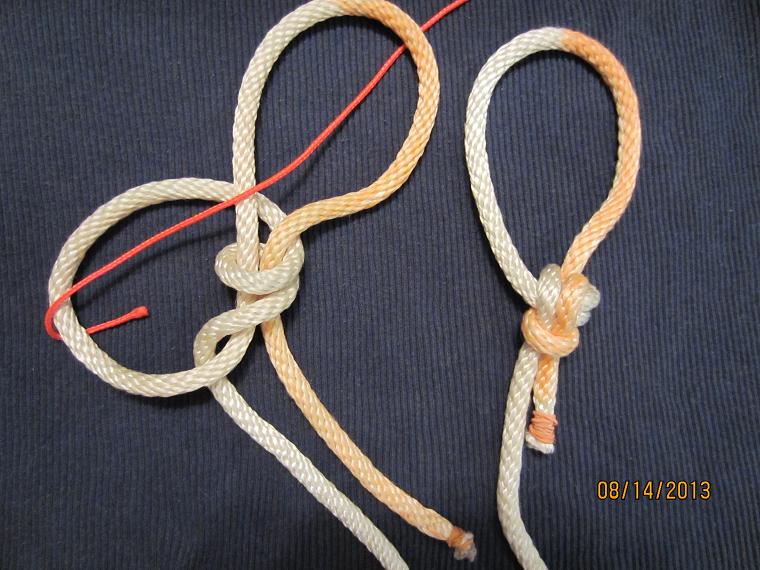
A simple TIB locked bowline

the method I have outlined above led me to believe that it was easy enough to get me to do the part of the bully and be enough facetious that I implicitly propose to move this thread in the pratical knots board: for now I continue to believe that the method I have proposed is easy and fast ;D ::), but in reality I have no serious objection to move this thread in the knotting concepts and explorations board!

                                                                                                   Bye!

To the question of moving this thread,
IMO this is not so much an exploration as is wanted
by that title as an attempt to make a practical knot
all the more so by finding a good tying method.
(An example of knotting explorations would be the
exploring of various ways in which the bowline’s
central nipping loop and working with bights tucked
through each other can produce a lode of handy
(and new) knots.)

Further to this (sub-)forum, I think that those
simple queries that come in should remain here as
evidence of work done, even though the quickly
given response might be “it is known …”; there’s
no gain by moving the thread to Practical Knots
only to sit there doing zilch --leave it here as evidence
of questions answered.


Now, to Luca’s nifty tying method I must object that
it should begin with step-3’s placement of the nipping
loop --and consequent sizing of material to form the
eye-- and continue from there with the forming of
a like loop that will be tucked through the first and
then “backflipped” (my term) around everything
to become the collar. When I tie this knot, I think
of forming a clove hitch but the spacing out the
“cross span” part --which is to become the eye–,
before tucking one loop through the other and so
one, as Luca shows. (I liken this loop-through-loop
maneuver to putting a coin into a slot.)

Note that this knot is one of four related versions.
If one begins with the line formed into the nipping
loop, vertically oriented --eye downward–, and the
crossing point of the loop at the 9:00 (West) point,
insert a bight in the tail up through the loop with
(a) tail on the right, (b) tail on the left),
(c) as for “a” and then twist this bight on the
vertical axis,
(d) as for “b” and then twist this bight … .
(If you twist “a” one way it will become “b”,
so go the opposite way, and similarly for “b”'s twist.)
I think that this discussed version looks best.

–dl*

I tried my hand at some pics and a video of this knot. The video is at: http://archive.org/details/LLockInBight

– J:P


LLockInBight03.jpg

4 more.


LLockInBight06.jpg

Closeups of the finished knot.

edit:

I (very clumsily) edited the photos to make it clear which is the tail (the orange rope) and which is the standing end (the white rope).

Hi JP,

This is exactly the 3-bights method I was talking about at the first post, and at one following post.

You see that, in this knot, you have to twist the one bight 90 degrees, indeed, before you half-pass it through the other. Also, you should pull the reeved bight towards the Standing end ( at the last stage of the dressing ), as said in :

The only thing you do differently is that you form the second bight around the neck of the first - in the 3-bights method, also followed in the Span loop, the two bights are first formed at a distance the one from the other, and at a next step the one is half-reeve through the other.
I believe that the generality and the simplicity of this method have not been appreciated, because people wish to tie only this particular knot - on the contrary, I shad tarted with the intention to tie / explore all the different knots this method could generate, so I had not been forced to do reverse engineering ! :slight_smile:

Try all the different combinations, as suggested, and see how many stable crossing knot-based bowlines, or “Common”, single nipping turn-based bowlines you can tie - it has fun ! :slight_smile:

And for me nothing? :o :cry: ;D( (James, Thank you very much for the pics and the video! :D)

                                                                                                           Bye!

I believe you should excuse me, because I have been so brain-washed by the 3-bights method, that any evaluation by me of your method would run the danger to be biased, and not as fair as it should be - so I decided I should avoid it. I tie all the 4 pet eye-knots, the Lehman s bowline and the Span loop by the same method for some time now, so I can not learn your new trick ! :slight_smile:

My new trick is identical to that of James!

I can see that James trick is identical to mine s with the 3-bights ( and, perhaps, similar to Ashley s #1037…), but I can not see that your trick is identical to James ! :slight_smile: And no one of them is identical to the trick presented at Reply#13 :
http://igkt.net/sm/index.php?topic=4476.msg29203#msg29203

I believe that the way everybody sees a knot is different, so the way one ties a knot does not have any relation whatsoever with anybody else s way ! :slight_smile: I have seen thousands of fishermen and sailors tying bowlines, and I do not remember one instance I had the impression that any one of them did exactly the same thing I use to do…Perhaps I myself “see” what I do very differently than one who sees me…because the haptic perception one has for a small object he holds by his fingers is interwoven, in his mind, with the optical perception of it, in one jammed whole !
Also, there are minor, perhaps, details in a shape that can attract one s eye and help one s brain memorize the general picture, but will not make any impression whatsoever to anybody else. The two lines that meet each other at a right angle, right at the centre of the perimeter of the nipping turn, at the third picture of Reply#13, were not placed in this position by chance… :slight_smile: but t can not estimate the mnemonic value, if any, of this detail for other people. Now that I have decided to see and show the two legs of the two bights that way, a tying sequence which follows exactly the same steps, but does not involve this particular detail, would seem very different to me !
Knots, as shapes, may be less simple than we imagine, but tying those knots is always a much more complex procedure, involving many more parts of our brain, than we can realize ! The coordinated motion of parts of our body that sets in motion parts of other objects, and re-arranges them in space according to a stored mental image, is an extremely complex thing. It is planned and controlled by obscure regions hidden deep inside our brains, from an epoch even before we developed our eyes to become able to see the light of a day, and the “view” of a knot ! :slight_smile:

If I had the chance to make a video of how to run this knot, instead of using KnotMaker, I can assure you it would be different from that by James, but this is only a matter of gestures and angles, because in the essence of the operation, I guarantee you that it is absolutely the same thing:for example,the method proposed by Dan Lehman may very well be a different alternative in that there is an exchange for the component to start the knot (I tried, but I do not feel very well (but these things are, such maybe also you hint, too, very individual and dictated by habit)).

                                                                                              Bye!

I was not trying to tie a new method. I was simply working from Luca’s diagrams. Sorry, Xarax, but I didn’t particularly like making a slipped overhand and then pulling the loop back part way. For my large hands it was a bit too fiddly. I find that I can tie Luca’s method in hand and fairly quickly. I simply wanted the video to show this method in a way that was easier for me than the diagrams.

– J:P

Hi All,
I have a few variation of this TIB locked bowlines here, hope you like it.
Thanks alan lee.


IMG_1446.JPG

This stage was meant to be an easy memorisable, not easy tied. Everybody knows and can remember how to tie a slipped overhand knot.
Do not forget that I work with climbing 10mm+ ropes, not with smaller material, where to pinch a bight of the overhand and pull it away would require some dexterity, indeed.

I believe that you and Luca still have not realized what you really do, because you do it by tyng the same things, with a different order…You make a first bight, right ? This is the first bight of the 3-bights method. See your fourth picture. There you have two bights, the one half-reeved through the other - and both of them been twisted 180 degrees around their axis. So, this is the first and the second bight of the 3-bights method, only that I form the bights separately, in different parts of the line, and only then I “wear” the one through the other half way - you make the same thing, but you form the second bight around the neck of the first in its final place, you do not form them at different places of the line, and then wear the first through the second. I believe that “my” method, which is Ashley s method, of course, is simpler conceptually, easier to memorize, and more general, since with the same METHOD. just by altering details, you can tie many knots ! At the final step, Ashley s method and your method are identical, because you reave the third bight through the opening of the half-reeved one( fifth picture ). You may not see your third bight, but its material is there, where it has been from the star : in between the first and the second bight. It is the “bridge” between the first and the second bight.
If you do the same thing, but, for the third bight you use material of the line beyond the first two, you can tie mid-line eye-knots suitable for directional pull, like what we need in Trucker s hitch. See :
http://igkt.net/sm/index.php?topic=1870.msg21210#msg21210
http://igkt.net/sm/index.php?topic=1870.msg21216#msg21216

I do not have a good memory, and I hate to be forced to memorize things that are not connected to each other with some logically coherent order. So, I prefer methods that are quite general, and where I can see some inner logic, some rationale. That is why I prefer the 3-bights method, in its “pure” form I described at the thread about the pet loops. The second, more special method I describe here, at Reply#11, was just an attempt to find something quicker, that would be as “simple” as the particular very simple knot itself.

JP, please, do what I had suggested to kd8eech :Tie all the knots the 3-bight method can generate, first with the bights as they are, without been twisted 180 degrees around their necks, and then by twisted bights, in every combination : one of them twisted clock-wise or counter-clockwise, two of them, both twisted at every possible combination of clock-wise and counter-clockwise turns, and, finally three of them, also twisted in every possible of the two twists each. If you tie all those eye-knots that you can tie this way, you will appreciate the 3-bights method, in particular, and a METHOD, that is, a general scheme of things, in general.
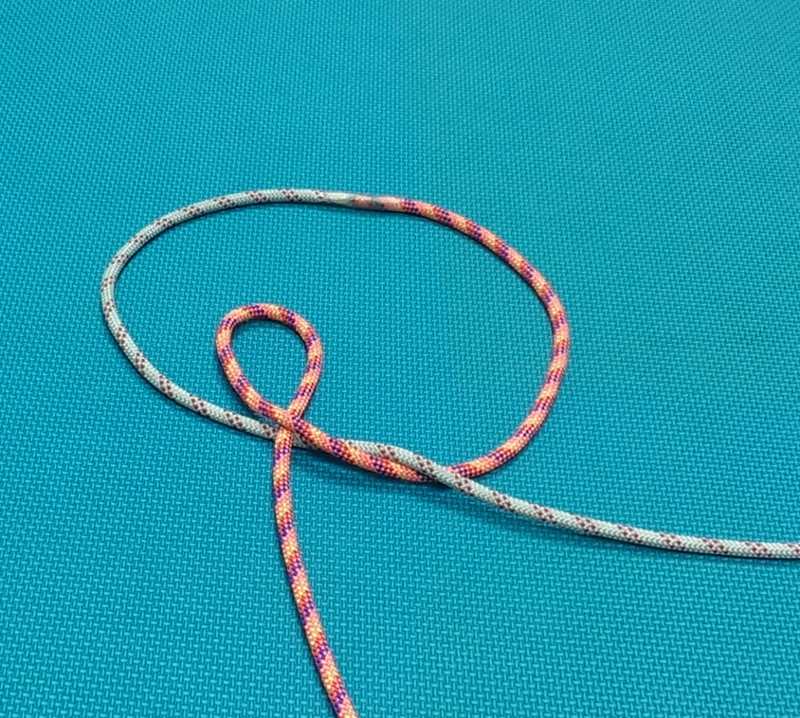
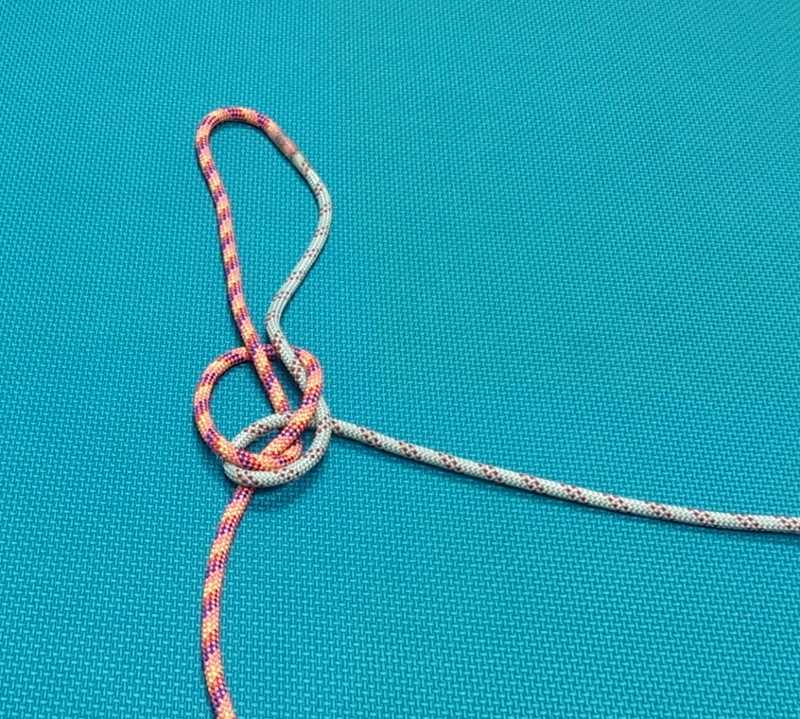
Hmmm, after JP’s further presentation of Luca’s tying method,
[Sometimes it takes more than one whack to the noggin
to get it working.]
I’m inclined to reverse my “objection” above, as I now see that
in fact the eye-sizing comes quite conveniently, and one can
see the starting with the tail’s loop as a means to ensuring
some material efficiency --i.e., no more than necessary–
in forming that. After the central nipping loop is formed,
and maybe after the tuck out of the eye bight is made,
it should be convenient to adjust it for the desired size.

Good show! (as those funny Brits like to say) :wink:

–dl*

:slight_smile: :slight_smile: :slight_smile:

Thanks alan lee

Alan, I believe you already submitted this at Reply#32 ( first picture ). Also, it would be easier to the viewer if you show the tying procedure in more steps ( without this red or yellow thin line ! :slight_smile: ).

Hi All,
Thanks for the reply X1, I am planning to make some videos how to tie the loops that I have presented here.
Can anyone tell me what is Lehman s locked bowline, with so little spare time that I have, it hurt my brain so
much try to read and find the picture of Lehman s locked bowline.

   Thanks    alan lee :) :) :)

maybe these?:

Locktight-Loop-I

http://www.knotveryinteresting.co.uk/posts/Locktight-Loop-I.jpg

Locktight-Loop-II

http://www.knotveryinteresting.co.uk/posts/Locktight-Loop-II.jpg

and more:

http://igkt.net/sm/index.php?action=dlattach;topic=3888.0;attach=7199;image

The same knot with the one shown in the first post of this thread.