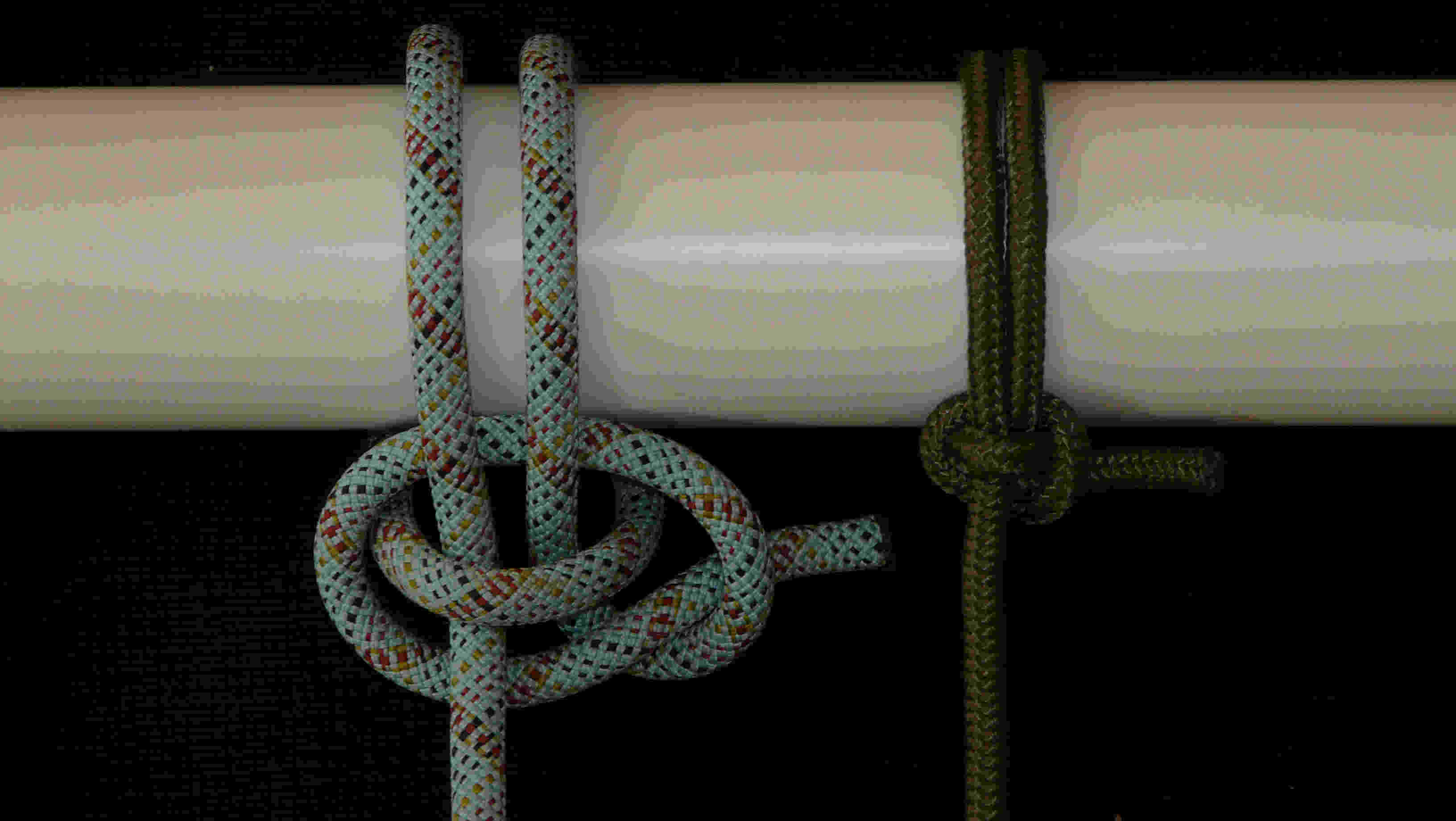
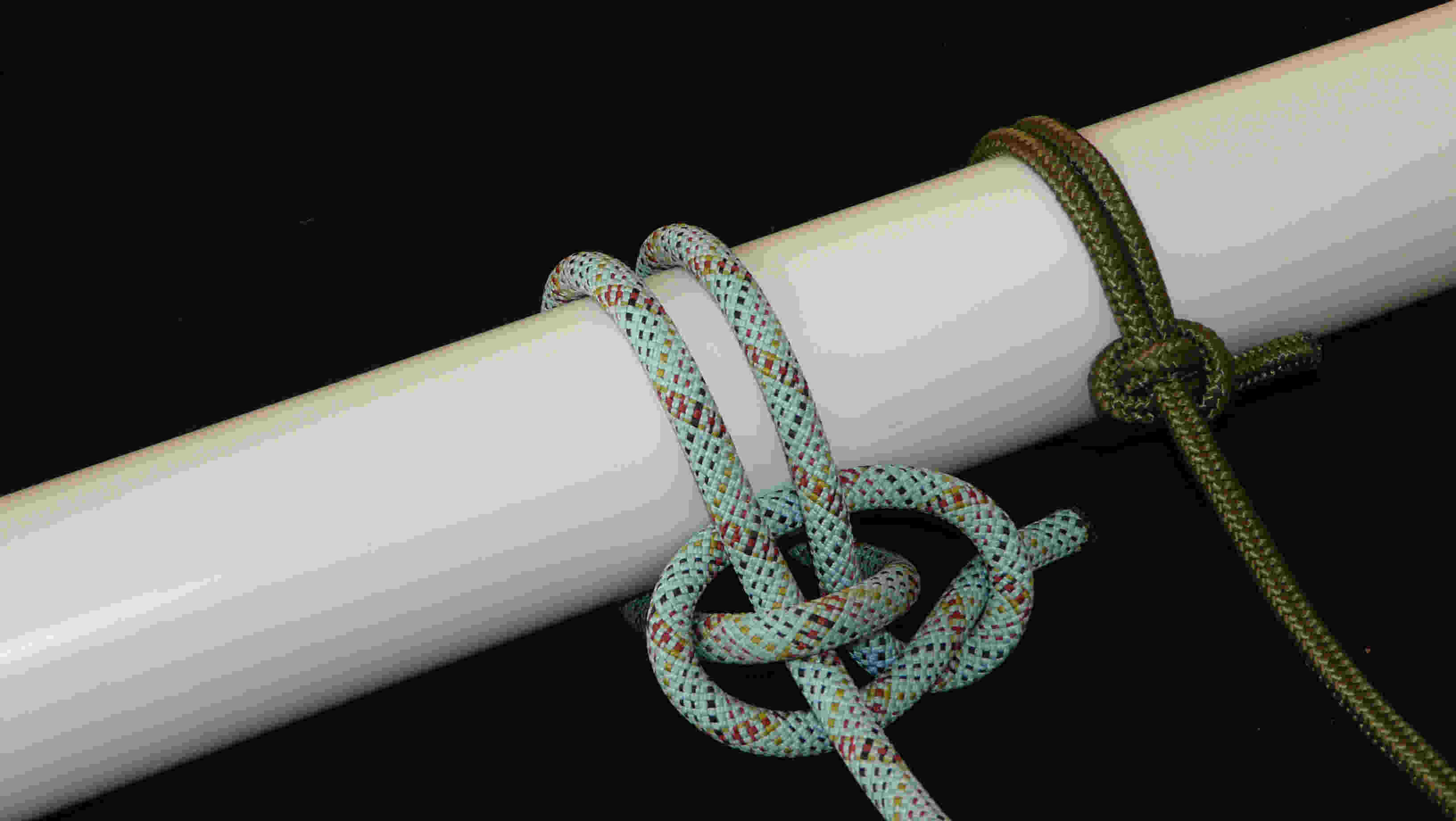
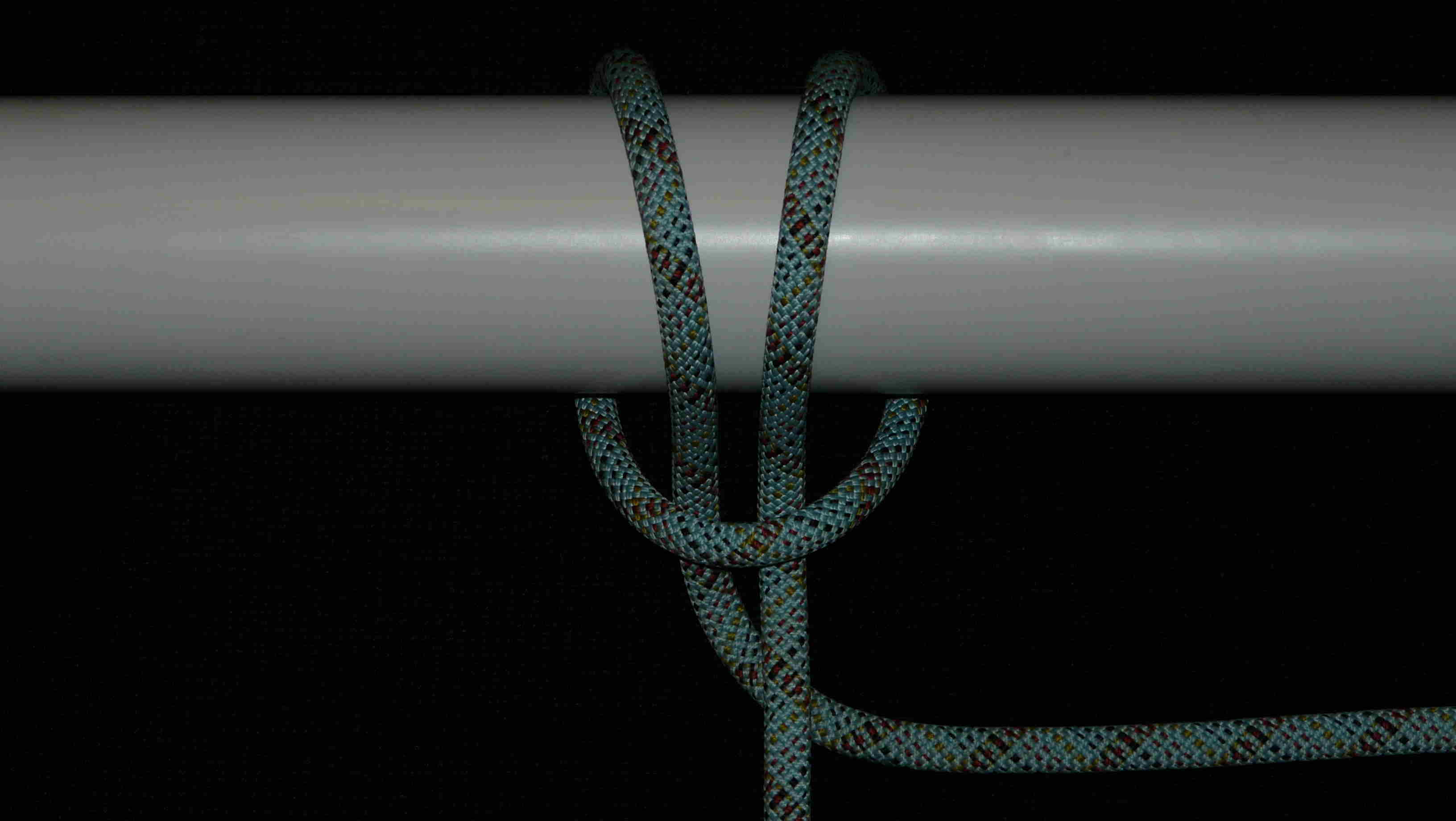
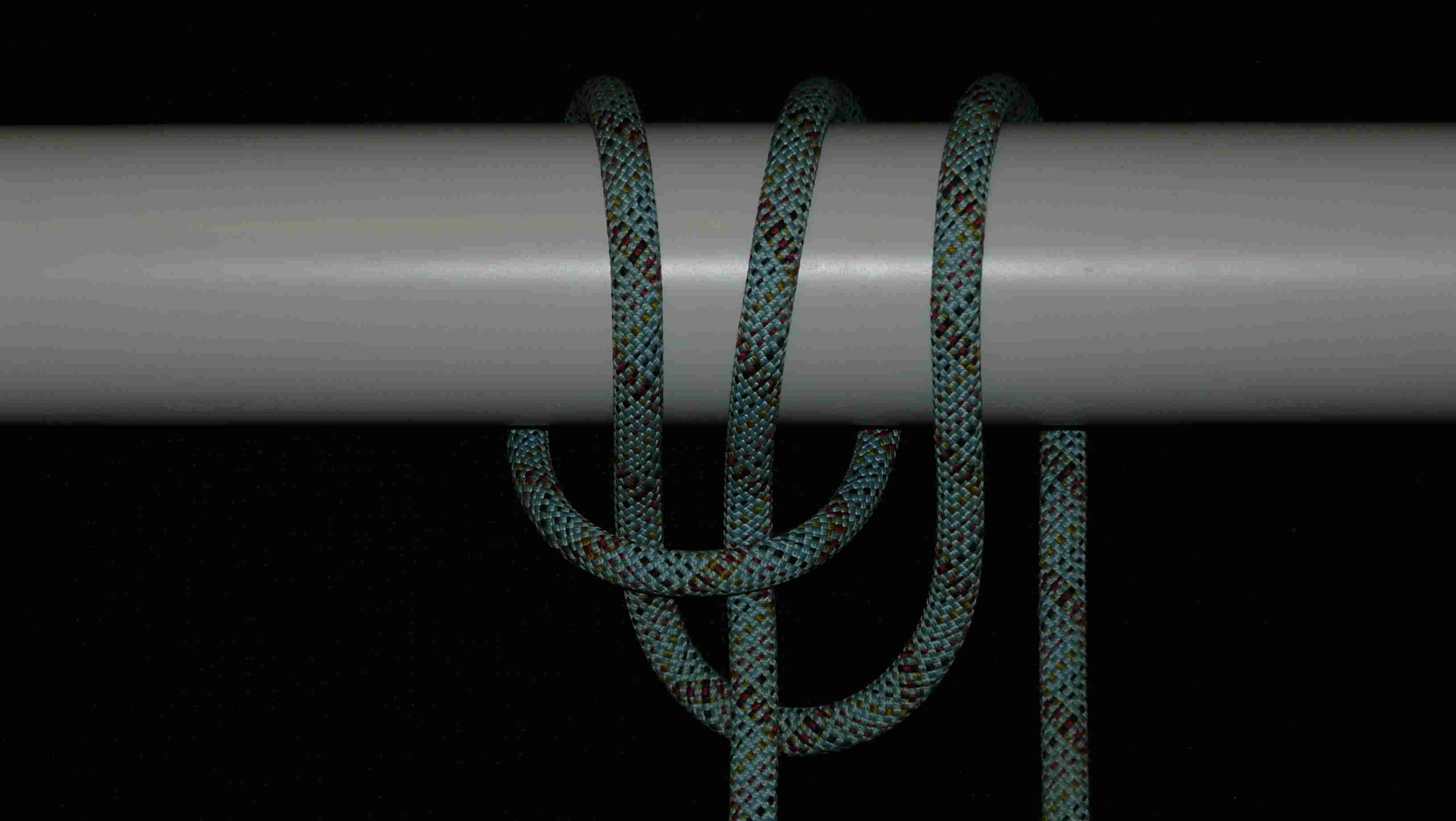
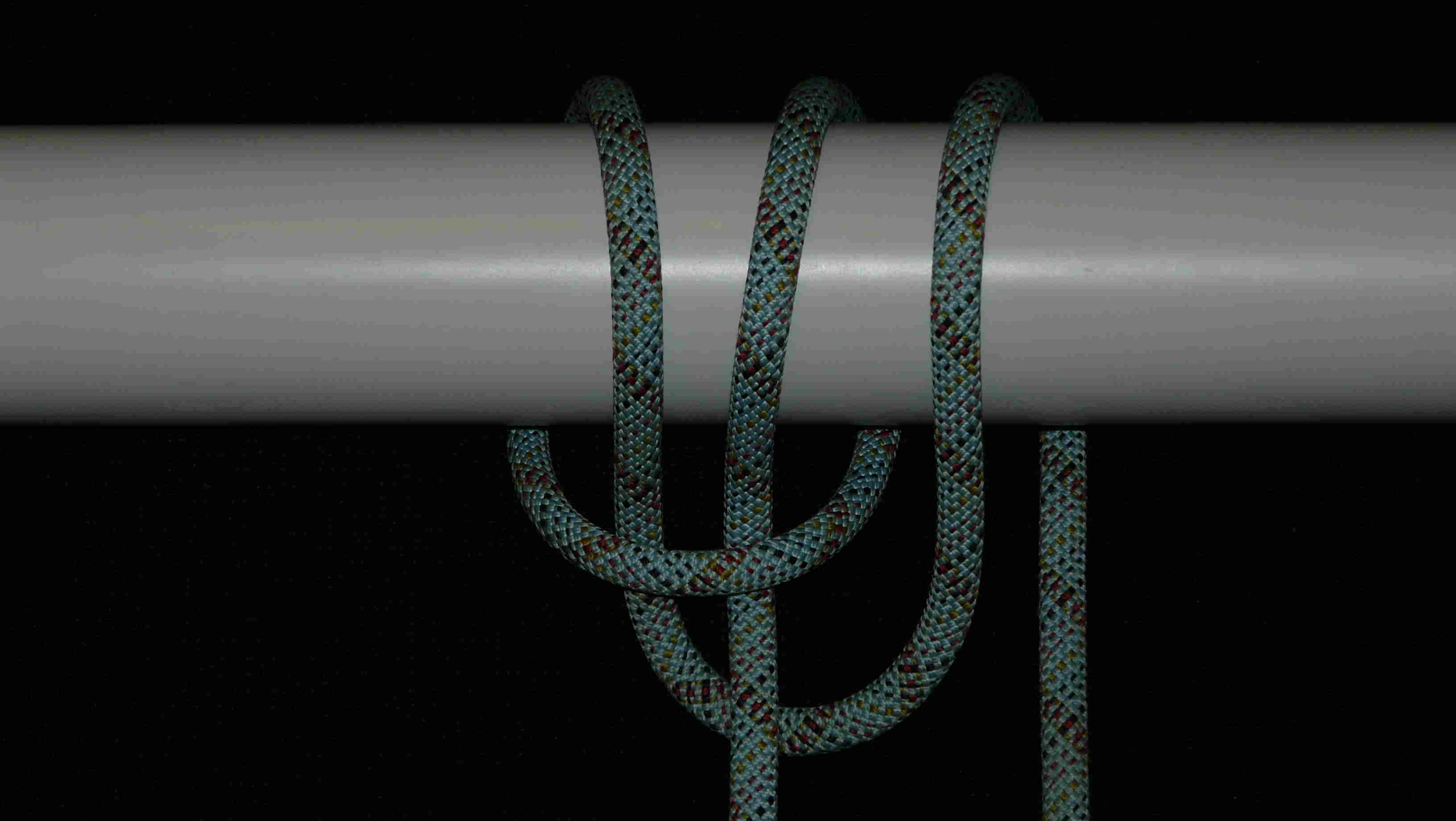
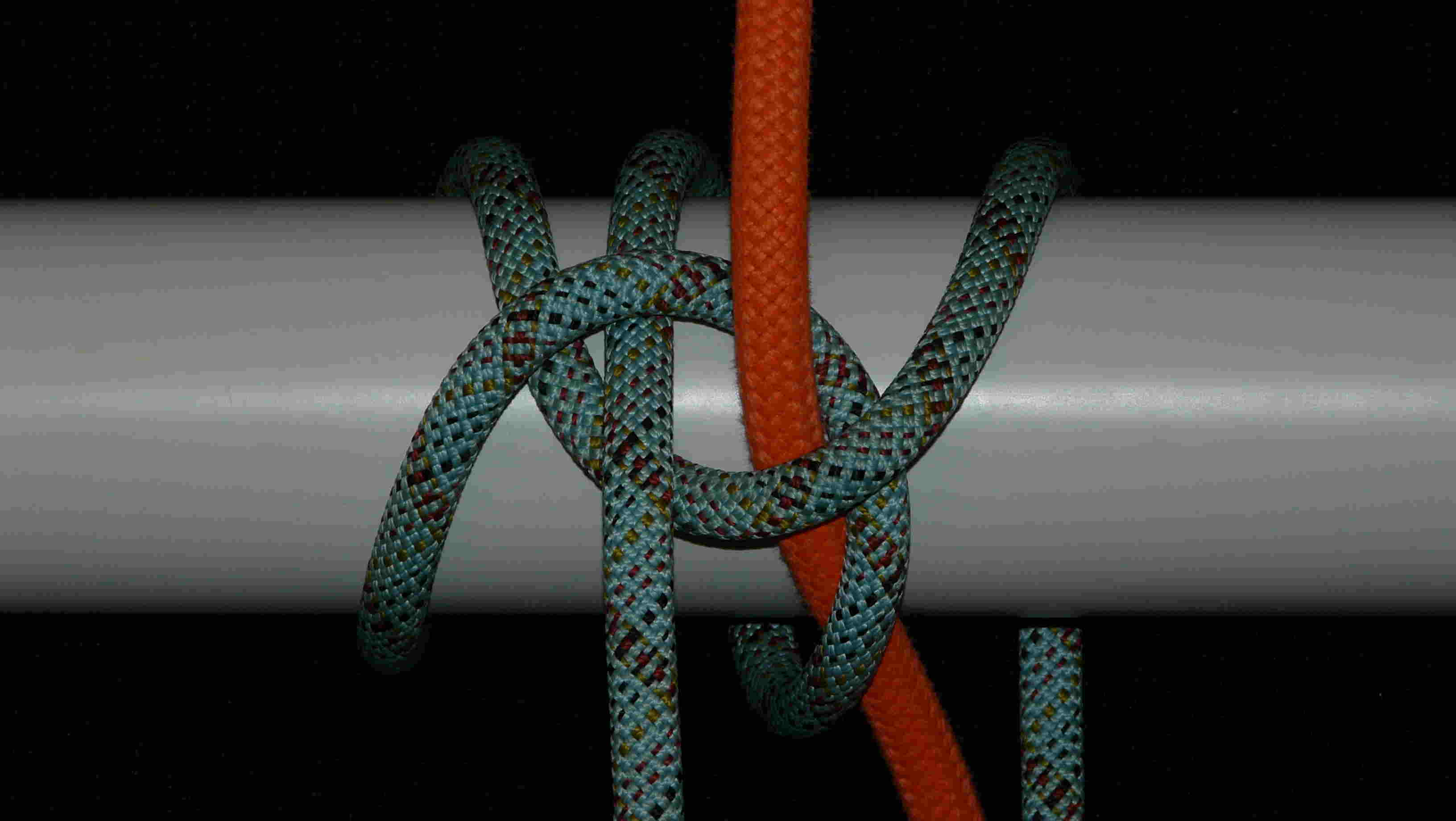
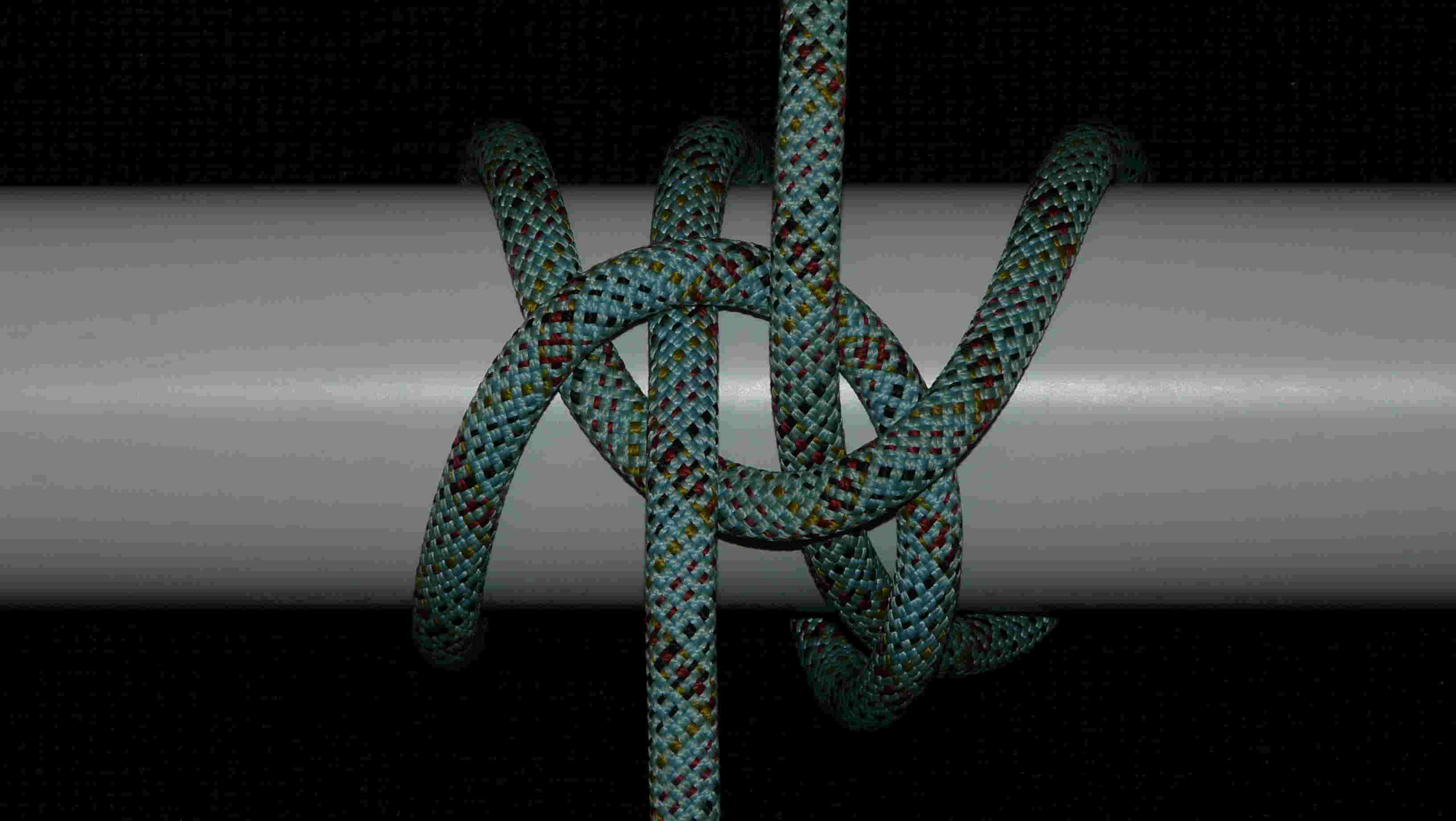
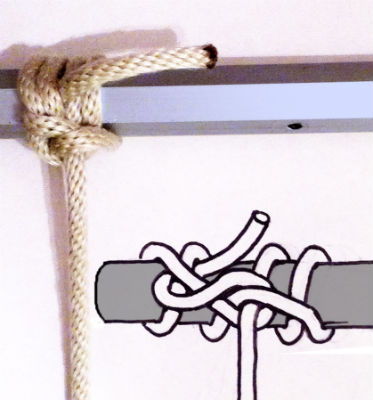
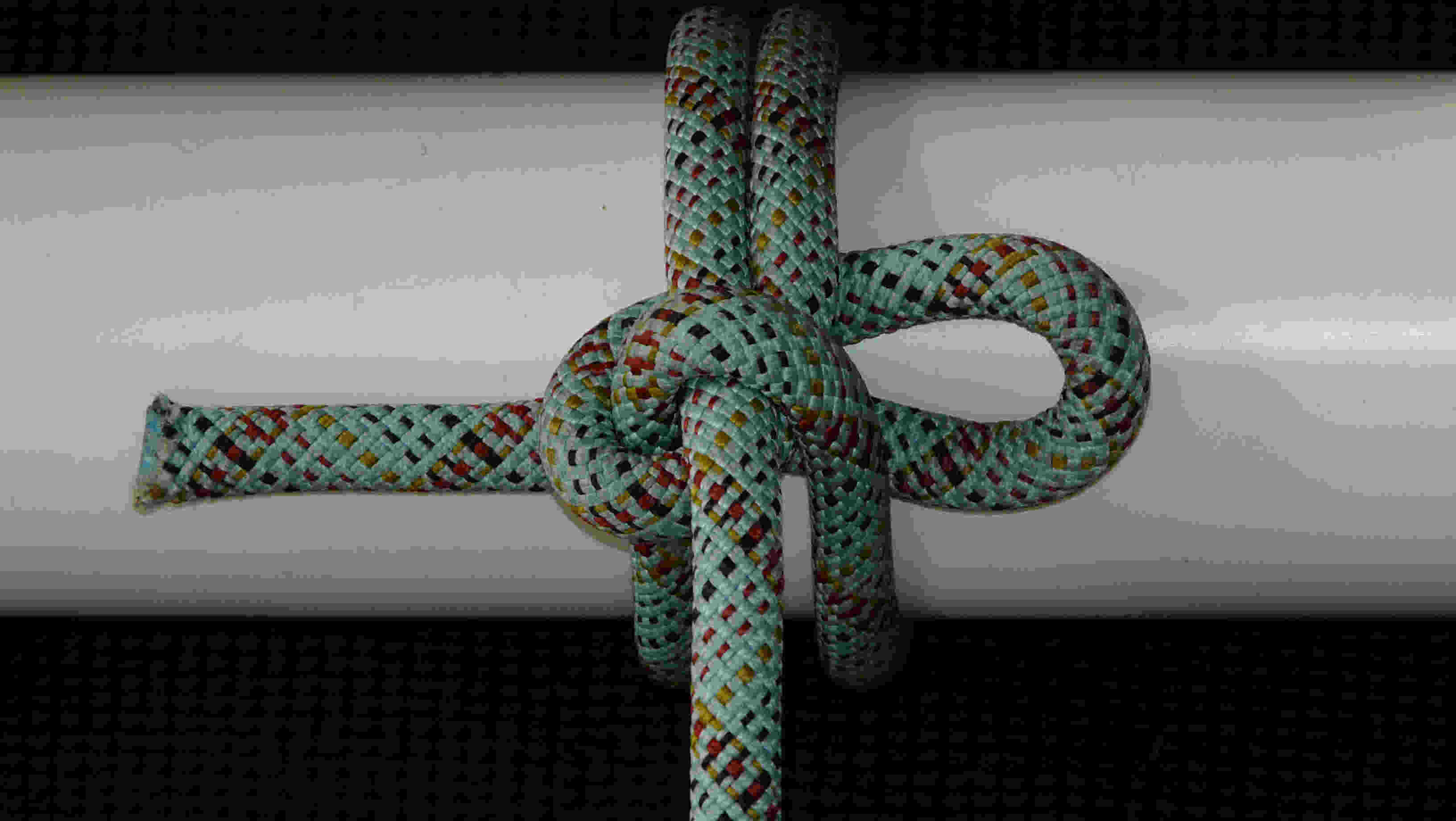
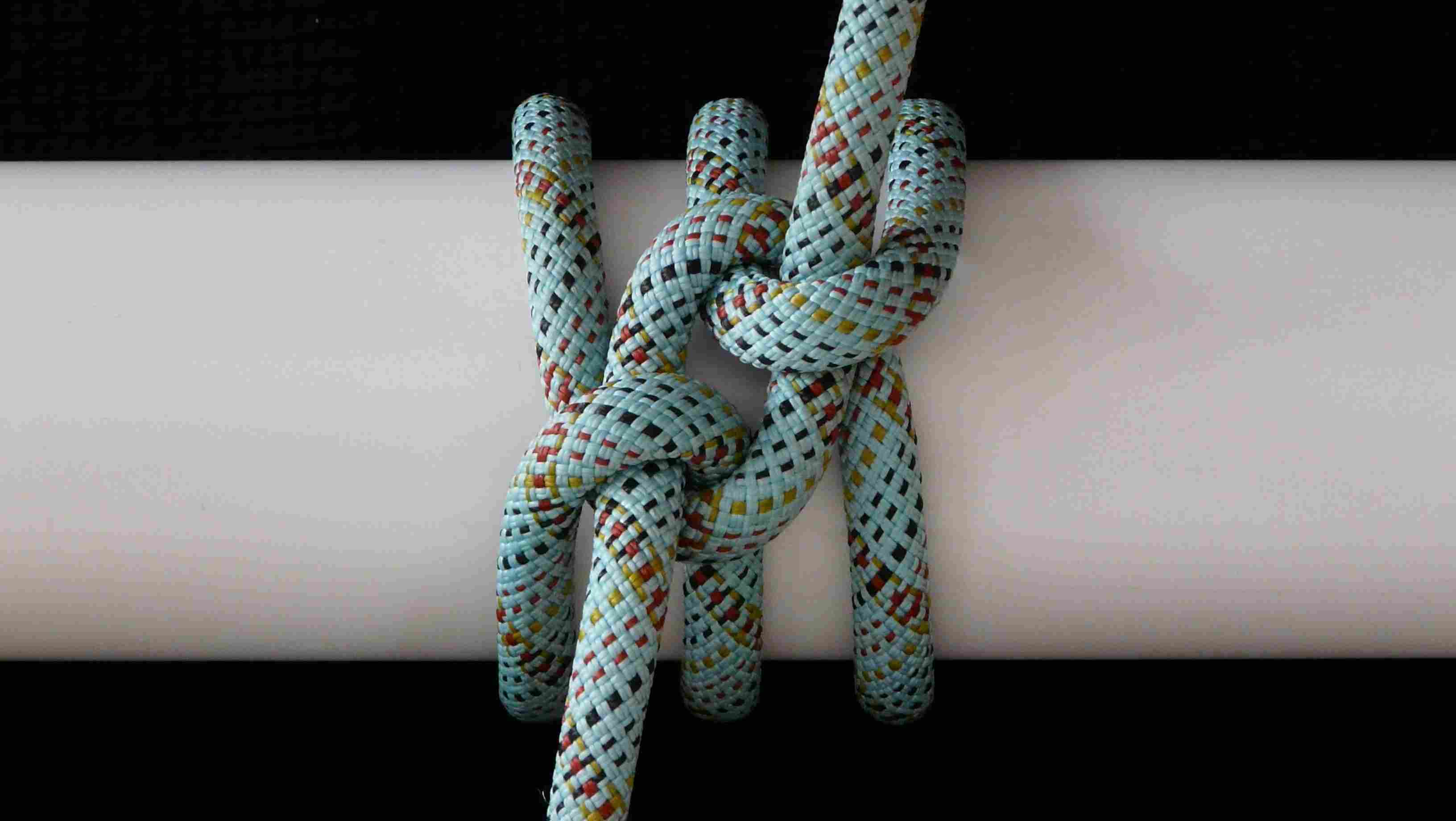
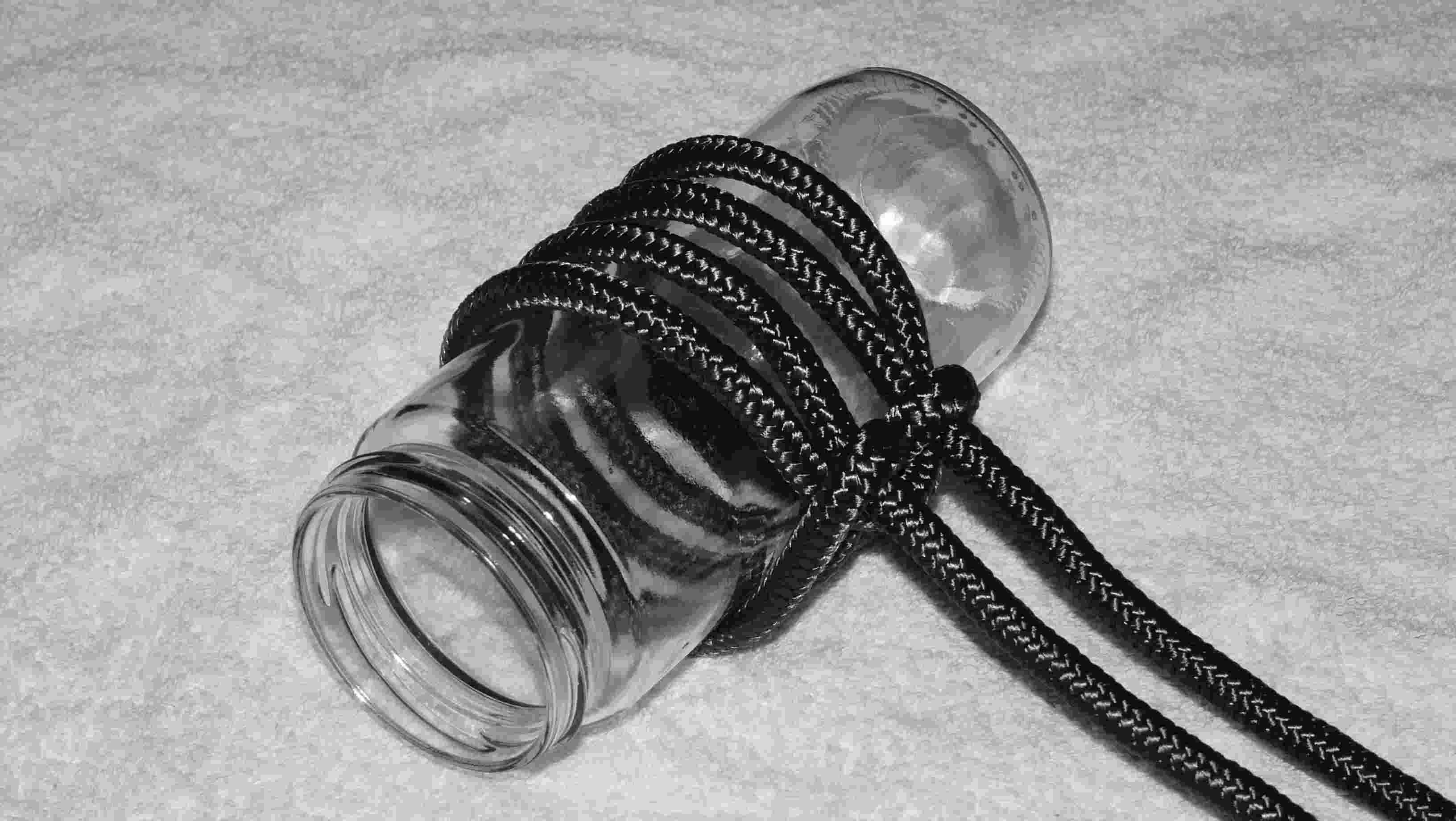
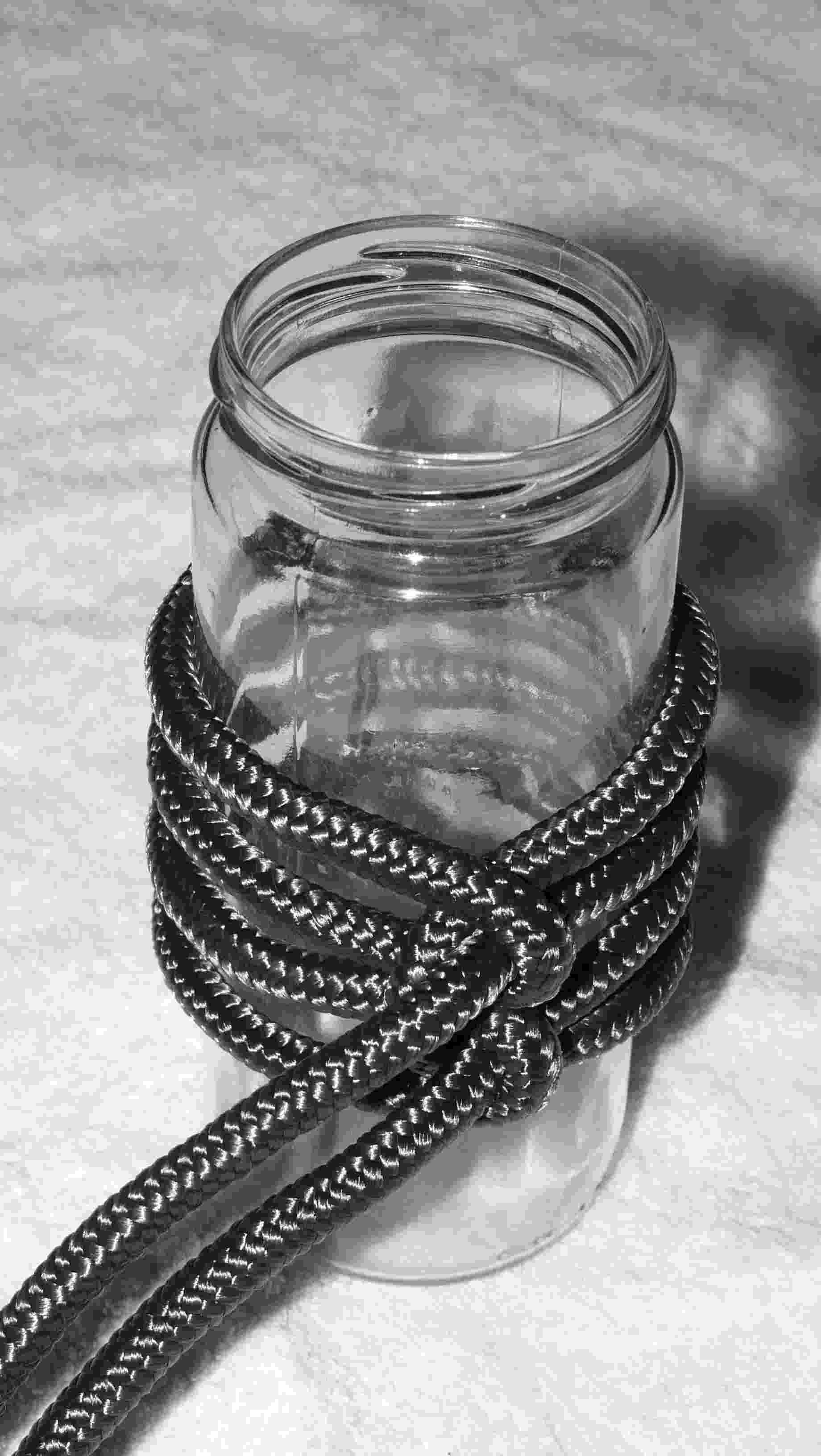
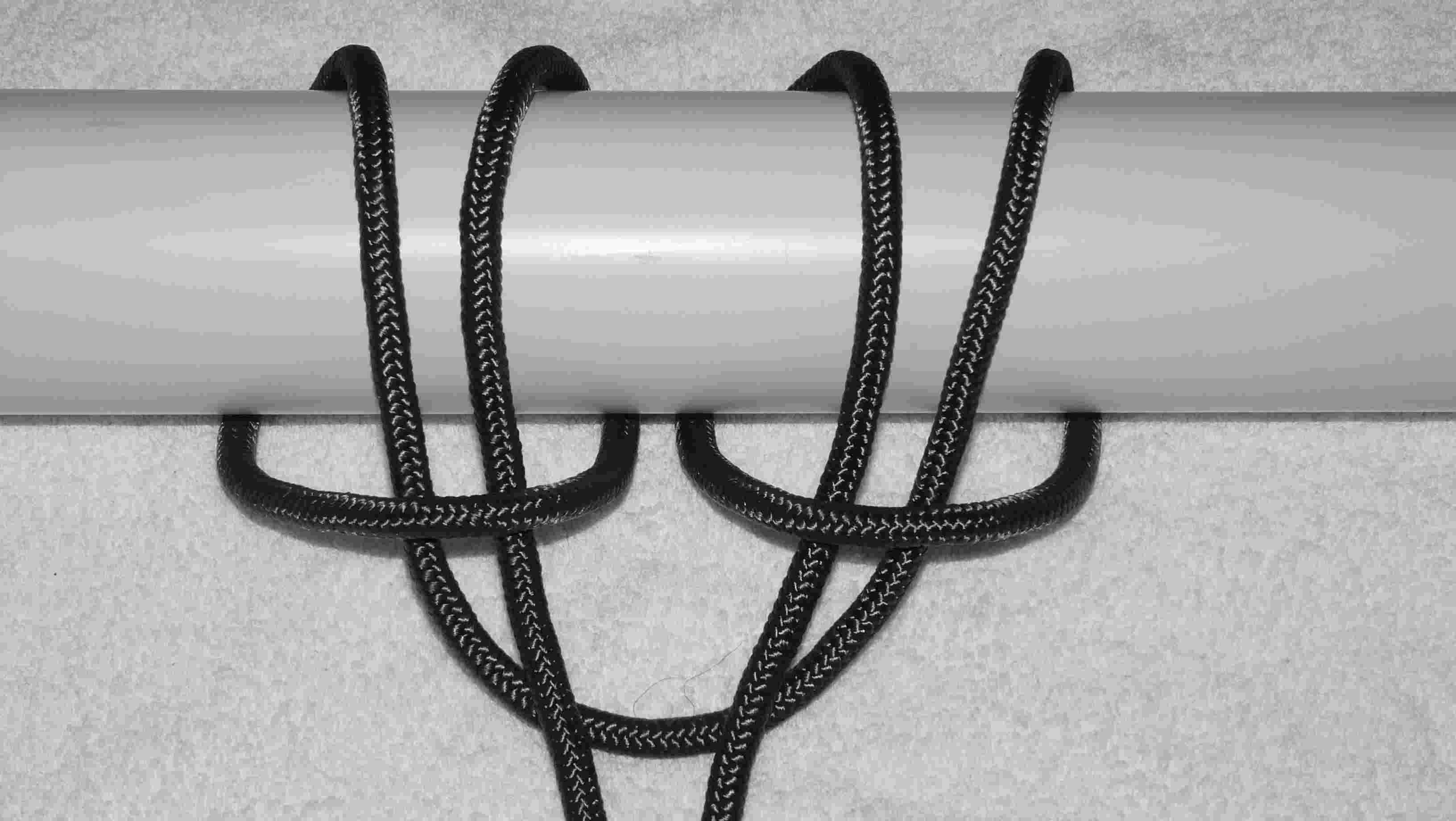
Trying to simplify the TackleClamp hitch (1), I have arrived at the hitch shown at the attached pictures. It is a very effective gripping hitch, which uses the same tail-through-two-opposed-Us “lock” mechanism. ( See (2),(3) and (4), for other applications of the same idea). The standing ends/tails can be pulled against the pole very hard, a lot of tension can be accumulated within the 4 riding turns, yet, - despite, or because, of this ? ? -, it will remain tightly attached on the pole, and firmly “locked” - so there is no need for any additional ending ( half-hitches, or whatever). (I do not know if this hitch is already published somewhere.)
Very interesting and I like that it has gotten simpler.
Your findings show that it releases easily?
Would you favor a one side loading (SP or WE) or is this better if both lines are loaded?
Any ideas as to how this can be employed?
I believe that it releases more easily than it should… :). Those hitches, that, if pulled hard, are capable of accumulating strong tensile forces ( i.e., be pre-tensioned / pre-stressed ), are not supposed to be released easily - they are not meant to serve as quick to tie and untie hitching solutions, but rather as more permanent attachments around/on slippery poles.
Due to its symmetry, I believe that it is better if both its lines are loaded - at least initially, until the knot settles to a tight, compact form, and “locks” there. After this phase, I guess one can load it from the one end only, without any consequences.
I think that all those pre-tensioned / pre-stressed hitches may be useful as means one can attach ropes on tubes, when he anticipates a lengthwise pull, and he prefers the hitch to remain tied on the same spot - and not to slip alongside the axis of the tube.
This hitch might be simpler, but it can not reach the power of the TackleClamp hitch - because there the two bights are independed, they can move towards each other, and, doing so, they load the riding turns they drag along. Here the two bights are inteconnected by the common opposing third one, so the loading of the riding turns can be achieved only through the pull of the ends.
Just one step further, we arrive at the even simpler 3-wraps hitch, shown at the attached pictures. It is still a very secure and tight hitch, able to withstand a lengthwise pull, that might be considered as a variation of the family of hitches shown at (1).
When I say " simpler", I mean “simpler to tie”, not “simpler in form”. If we compare the 3-wraps TackleClamp hitch to the hitches shown in this thread, he will see that their form simplicity is at the same lever. However, in the TackleClamp hitch one needs to anticipate the room he will lhave to leave between the two bights, at the start of the pre-tensioning procedure, and this might not happen to be achieved right from the first attempt - as the amount of slippage of the bights on the intermediate riding turn(s) depends upon the friction characteristics of the surfaces of the rope and of the pole, as well as upon the direction of the pull of the two ends. So it may happen that the first-time tyer would leave less than the required room, and the bights will approach and will " kiss" each other before he would be able to tighten the hitch to the maximum degree.
However, the mechanical advantage that is offered by the TackleClamp hitch mechanism, and/or the fact that the ends pull the bights, and the bights, by their turn, pull the riding turns that grip the pole, can not be reproduced by the " simpler" hitches presented in this thread. They are “simpler” to tie and untie, secure and tight, but less powerful than the TackleClamp hitch.
It is amusing that tenths of thousands of people ( 78.000 ! ! ) were eager to learn how NASA ties Curiosity s shoelaces ( which, incidentally, is exactly the way my son was tying the shoelaces of his sneakers, when he was a little kid - before he has leant the less ingenious common knot used by the layman... ), while, at the same time, almost nobody speared a click on this thread s pictures... :).
So, I suppose that almost nobody has noticed that the “simpler TackleClamp hitch” presented here can be tied in the bight, because it is topologically equivalent to the unknot - while the TackleClamp hitch cannot, because it is topologically equivalent to the overhand knot. We can also form it as a free quadruple loop/noose, and then pass it over an accessible end of the pole - in place of a pile hitch, for example.
At the time I had taken the first pictures, presented at the first post, I used to pass the working ends underneath riding turns, in an effort to secure them further. Since then I have seen that this may be not as necessary as I thought. It seems that the opposing bights ( two U s) locking mechanism is sufficient to secure the tails, because each of them has made a round turn around the pole already ( so the load they bear when they finally pass in between those two opposing bights ( two U s ) is greatly reduced ).
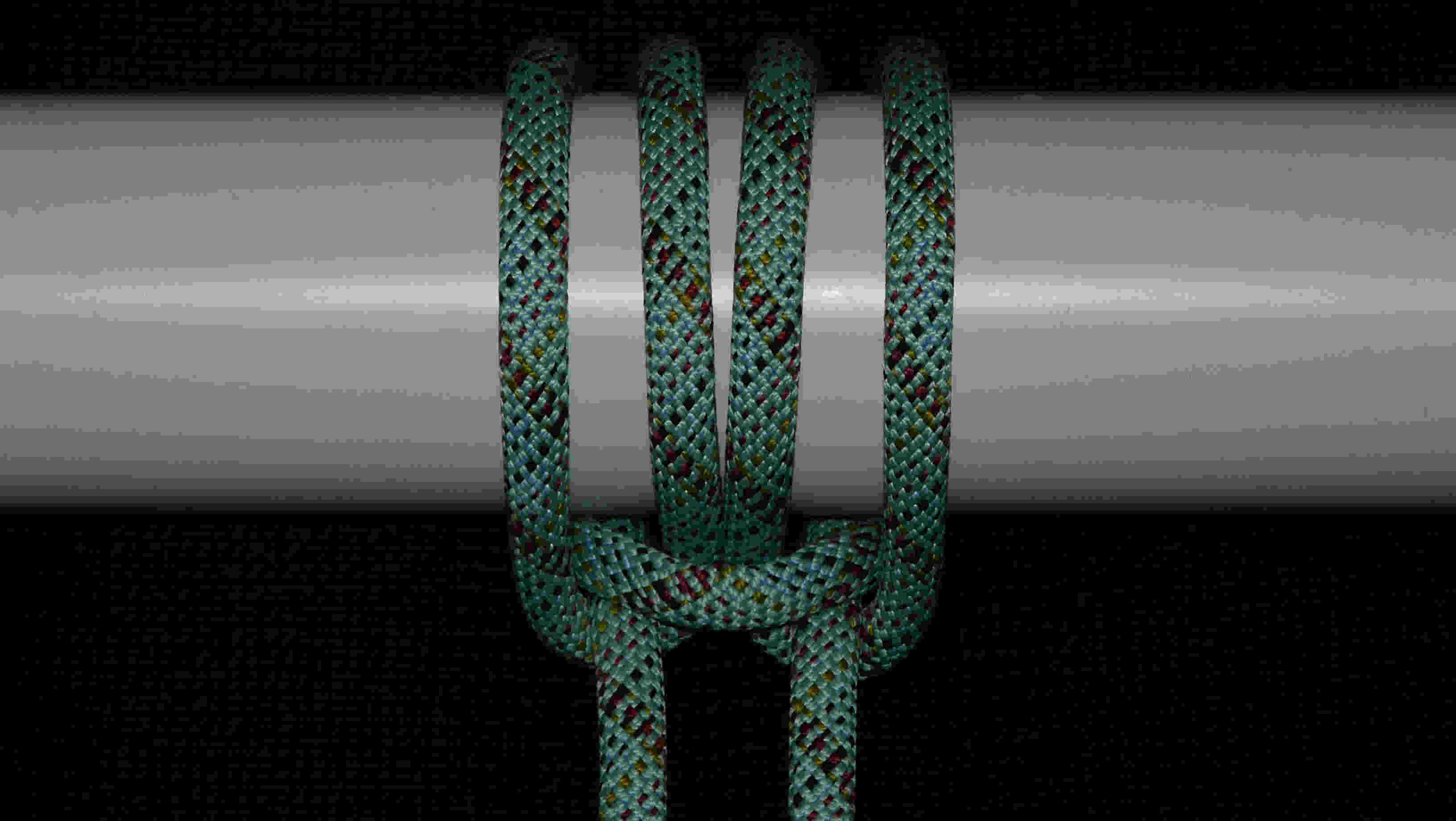
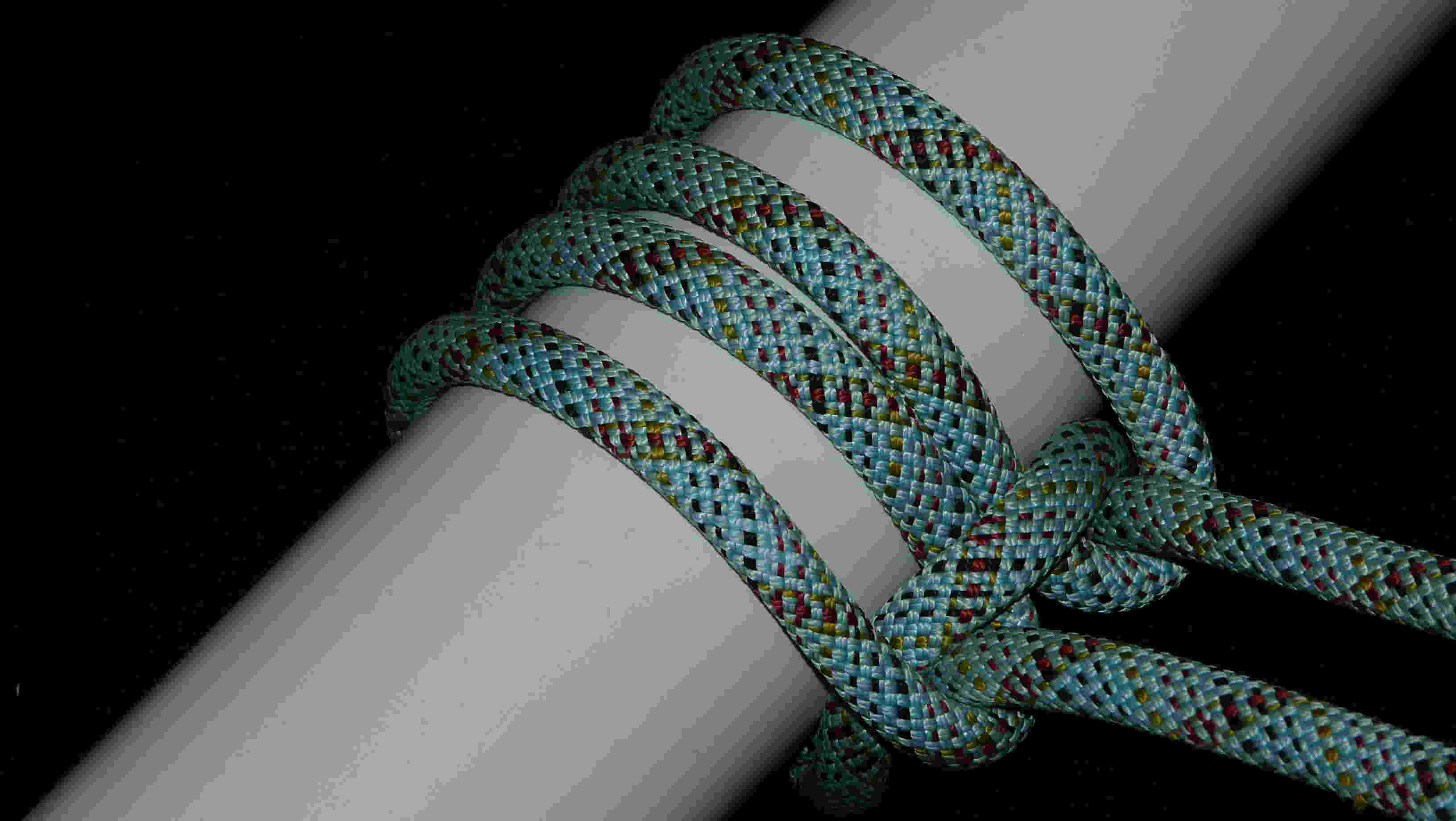
At the attached pictures, the interested reader can see that this hitch is essentially a double Cow hitch, and it can be tied in the bight as easily as the single Cow hitch. However, it can be pre-tightened a lot, much more than the Bull hitch, for example. Pulling the one end after the other, I have been able to tighten the paracord seen at the pictures to an unbelievable degree - but I guess that one needs a quite smooth pole to achieve similar results.
So far I have only tried this with a piece of 2mm polyester around a pencil while I was reading the above post but it does seem to have potential both as a clamping mechanism and possibly to suspend or carry something long, horizontally, by starting with a sling and making two double cow hitches spaced apart - there was quite good grip around a shiny hexagonal pencil. I will be interested to see how useful it turns out in the real world.
It might be easier to remember how tie it, if we tie it as a Cow hitch on/after a Cow hitch, indeed - that is, tie a “first” Cow hitch, then tie a “second” one, adjacent to the “first”, so that the continuation of the tail of the “first” passes underneath its standing end, makes a U-turn and becomes the tail of the mirror-symmetrical “second” Cow hitch ( the terms “first” and “second” denote the temporal, not the spatial order ). In other words : Each individual Cow hitch has two free ends ( four ends in total ). The Double Cow hitch described here should be tied so that the two “side” free ends are connected in a U shape, while the two “middle” free ends pass “over” this U shape and become the free ends of the new hitch. ( Just an exercise on " knottoloquence"… )
I do not know if this really simple 2-wraps hitch belongs to this series, or if it is already known or not. The " lock" remains the same, the efficient squeeze of the tail in between two opposing U s - but now the one U is a part of an overhand knot tied along the tail segment. Numerous similar solutions are possible - I show here only the one that seemed simpler to me. The interested reader will discover many others, equally secure with this one.
I have seen that this hitch is also able to be pre-stressed, and to accumulate the tensile forces that would be stored in its turns during a pre-tightening phase - in this sense it is similar to the previously posted, more complex hitches of this thread. I suppose that here is the end of the line of the " simplification" process of the original TackleClamp hitch. However, I have to say that not a single hitch of all the hitches I have tied and tried, and the few I had posted in this thread, reached the gripping power that the TackleClamp hitch can deliver - because it is the only gripping hitch that utilizes the mechanical advantage of two opposing - but not interlocked - bights, participating in a rope-made block and tackle mechanism.
Another variation of the same, 2-wraps hitch, presented in the previous post. The same old story : a standing end emerging out of a “lock” made of two opposing bights - where in place of the second bight we use a segment of an overhand knot. I believe I have tied all the possible entanglements of this overhand knot with the other parts of the " lock", and I think that the two solutions presented in this thread are the most simple, secure and easy to remember - but the interested reader should better try his own hand on this.
Tie a first Cow hitch around a pole.
With the left side free end, tie a second Cow hitch, on the right side of the first one , at two stages :
Stage 1 :
The left side free end has to pass under the right side free end.
Stage 2 :
The second Cow hitch should be mirror-symmetric to the first Cow hitch.
( Alternatively, if you wish to use the right side free end of the first Cow hitch, then you should tie the second Cow hitch at the left side of the first one.)
The interested reader is kindly requested to compose a better, brief and precise set of verbal instructions.
In the following series of pictures I will show how we can tie a variation of the symmetric 3-wraps hitch presented in this thread ( Reply#3, (1)), so it can also be tied in the bight.
The reason I tie it this way is double fold.
First, I want to tie it as a more complex Cow hitch : I call it " One-and-a-half Cow hitch" . I start from a simple common Cow hitch, and add another round turn.
Second, as the simple Cow hitch, it can be tied in the bight - although I do not show how in the present post.
I try this variation because I want to compare it with the beautiful Andalusian hitch presented recently, and another TIB hitch that can also be tightened by pulling the standing end and/or the tail against the pole, the Tom Foul s hitch (2).
The moment the reader will understands how the standing end and the tail are themselves " locked" , going through / passing in between the interlocked opposing bights, he will never forget how to tie this hitch.
We can tighten it by pulling the free ends against the pole, the one after the other. This way we can store a great sum of tensile forces into the riding turns - we can pre-stress /pre-tighten the hitch, so it can later be able to withstand a strong lengthwise pull, for example.
Start by tying a simple common Cow hitch. We have the Standing end and the Working end encircled by the first bight of the hitch. We will form a second bight, interlocked and opposed to this first one, so that, at the end both ends will be encircled by both bights - and they would be " locked" there, when those bights would be under tension.
Pass the working end UNDER the Standing end. Why under ? Because in this way the second bight that would be formed at the next step would encircle the Standing end. So the Standing end would be locked in between the first and the second bight. We will later pass the working end through the same opening those two opposing bights form, so it will be locked as well.
Pass the Working end over the poll and …
…around it, to form the additional round turn this hitch has, in relation to the simple Cow hitch. So we have completed the three round turns, another reason I call this hitch as " One-and-half Cow hitch" .
Let us mow see the pole and the almost finished hitch from another angle. We see the Standing end - that is already encircled by the two interlocked opposing bights -, and the Working end - that has just gone around the pole and has formed the additional third round turn. Now, the only thing we have yet to do, is to pass the Working end from the same opening the Standing end passes, so it, too, will be locked there by the two interlocked opposing bights, just like the Standing end.
So, which path does the Working end have to follow, to go through both the first and the second bights, and be locked there - just as the Standing end has already done ? The red line shows this path. In a sense, that is the only “difficult?” thing one has to do to tie this hitch - but it becomes really easy, and self-evident, the moment one realizes that the Standing end as well as the Working end have to penetrate the opening in between the two interlocked opposing bights, in exactly the same way ? because that will be the means they themselves would be " locked" there. When the two bights will be tensioned, they will encircle / embrace /nip the two ends from both sides, just like a single nipping loop - and much harder than a nipping loop ! The nipping action this opposing bights mechanism provides is much more efficient than the one provided by nipping loop - in the improved Cow hitch called Bull hitch, for example.
The hitch where the Working end has followed the path of the red line, and has penetrated the same opening in between the two opposing bights the Standing end does - and towards the same direction, perpendicularly and away from the pole. The fact that he two ends follow this direction means that they can be pulled against the pole, so they can be pulled harder. The harder the two free ends are pulled, the harder the nipping action of the two opposing bights would be, so the two ends would be locked in a most secure way. To pull the ends with greater force, I often pull the one end after the other with both hands, stepping on the pole with my foot. At the end of this procedure, I have a rock-solid hitch, capable to withstand a great deal of lengthwise loading.
The tightened " One-and-a-half Cow hitch" .
( I apologize for this lengthy and sometimes repetitive description. I exercise a form of knottoloquence that I hope has not degraded into a knottorrhoea ! )
In a beauty contest, either you do not participate at all, or you do as the Romans do - but you do not present a frog, and hope that somebody out there will kiss it, and transform it into a prince/ess…
So. I am obliged to compare the Double Cow hitch presented in this thread, to the second Cinderella of DL ( the first is the TIB 2+1 overhand knots loop, that is “conceptually” a “Zeppelin loop” (2) - both contenders are either barefoot, or share the same lent sandal, I am afraid…), also a 4 wraps hitch.
Enjoy !
Playing with the TackleClamp hitches and their lighter, simpler variations presented in this thread, I came upon the variation of the Double Cow hitch shown in the attached pictures. It is not as secure a knot as the original Double Cow hitch, but it has a great advantage : It can be released instantly, without any manipulation of its two ends. Moreover, to release it, we have only to use three fingers of one hand, and a minimum of force. The tied and pre-tensioned hitch can can be released very quickly and easily, indeed, even if/while its round turns are tensioned to a high degree. This is due to the fact that, as both ends pass through the same opposed bights, the final, outer bight can be pushed out of its grip around the two ends, and release the whole knot at a glance. ( I am afraid I can not explain it in a more precise way - one has to tie the knot, tighten it as hard as he can by pulling both ends against the pole, and then release it by pushing this last/outer bight, to see what I mean.)
Of course, like the single and double Cow hitches, this hitch can be tied in the bight, and used in place of the Pile hitch, for example. It can be described as an elongated Cow hitch, where the the bight that connects the two ends in the common Cow hitch makes two more turns around the pole - so the ends pass through three bights, the last one ( the " trigger" of the release mechanism…) being opposed to the other two. I call it quick/easy release (QER) Double Cow (hitch), but I can change this label if it reminds anything else…
When I first tied this hitch, I dismissed it, because I thought that the “trigger”, the last/outer bight, could easily slip over the two ends. Yes, it can, but not by itself ! It needs a light, intended, directional push- so this seemingly weak point is a hidden advantage : this hitch can serve in applications where we need a tight grip, able to withstand lengthwise pull, but we also need a hitch that can be released quickly and easily.
When, after a long journey in the KnotLand, I arrive at something that catches my eye and makes my heart beat faster, I can not help but ask myself : What would Ashley have said about it ?
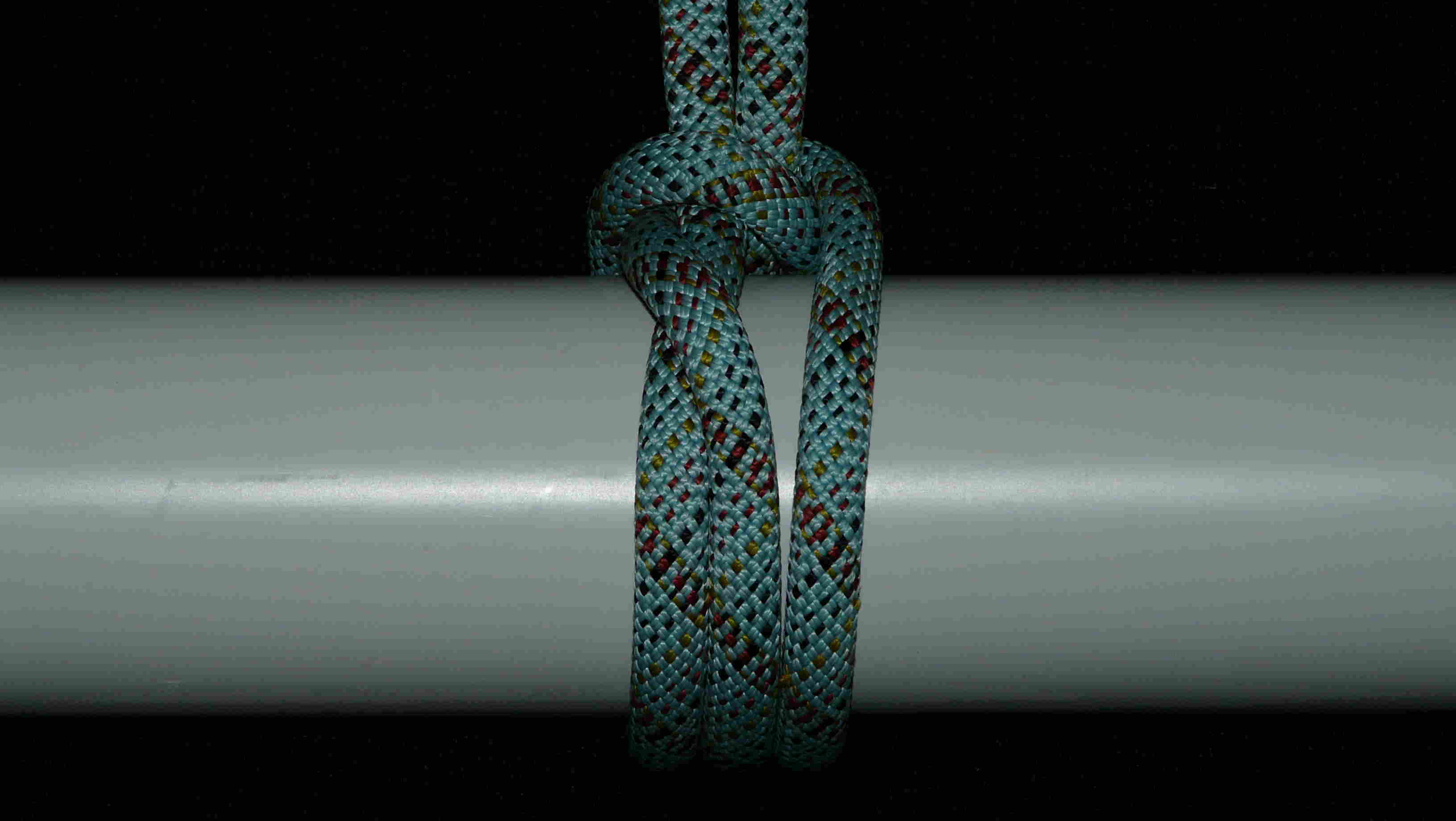
There is no need for any overhand knot at the end of the line, as I thought at Replies #8 and #9 of this thread… (1),(2). Just a simple U-turn underneath the two round turns, a strong pull of the standing end against the pole, and the hitch is locked in the same way and degree as it did at the hitches presented there.
And which hitch is this ? Holy Cow ! It is the Cow hitch. I have not seen this most simple and secure addition/lock to the humble Cow hitch, which transforms it to a Bull ! ( Unfortunatelly, the name “Bull hitch” is taken, by something much weaker than the hitch presented here. The fact that the Bull hitch can not be pre-tension-ed as hard as the hitch presented here, is a direct consequence of the fact that the opposed bights lock is stronger than the lock achieved by a double nipping loop. ) Why nobody told me about this hitch, I do not know.
The interested reader can read the previous posts of this thread, and follow the reasoning that brought us here. The “locked Cow hitch” is much simpler than the Tom Foul s hitch (3), much easier to tie and inspect, probably simpler even from the beautiful Andalusian hitch presented recently (4). I believe that is a fine, almost perfect solution for the not-easy problem of a 2-wraps pre-tension-able hitch, able to withstand lengthwise pull.
As it happens in the case of the TackleClamp hitch (1) and all those extremely tight pre-tension-able hitches, it may be difficult to untie it after it has been tightened hard, by pulling the standing end against the pole. ( I often use my hands and my feet, at the same time, like a rower :), and I obtain a very tight grip, a difficult to release hitch, and a pain in the back…) So, it may be better to tie it in its slipped form in the first place, so it can be released easily by pulling the “trigger”, and dis-placing the local paths of the segments of the rope which keep the mechanism loaded and locked.
See the attached pictures for two slightly different versions of the slipped locked Cow hitch. At the second ( the B ), the tail passes underneath itself, deeper into the space between the pole and the nub of the knot. This way it raises the bulk of the knot a litle bid, something that may be beneficial for the locking mechanism - because the locking bight meets now the standing end at a less obtuse angle- closer to the optimum right angle. However, all those depend upon the relative dimensions of the pole and the rope, and the friction coefficients of their surfaces. So the user should try both versions with the materials at hand, and judge which one is better suited to them.
P.S. I would never had imagined that we could ever discover a 2-wrap hitch that is tighter even from the Constrictor… How many other things are still there, just under our nose, waiting for us to reveal them ?
I am finding that this “locked” cow hitch stays set better than the Pedigree Cow hitch and is a bit harder to untie after an approx. 200 lbs load. (Not the slipped-untested version) This may be due to the particular rope construction I used.
Though, I have not found either of them provides a good resistance to lengthwise pulling on a smooth pole.
Thank you SS369 - it is good that there are some members of the Forum that are not airborne all the time !
It would be interesting to compare the Pedigree Cow hitch with the locked Cow hitch. I argue that, although they might look similar, they belong to two different worlds, far apart the one from the other !
I do not believe that any of those two hitches have a problem with “security”, i.e. slippage. However, the locked Cow hitch can be pre-tensioned, can accumulate any tension forces that are stored in it ( in its two turns) however strong they might be, while the Pedigree Cow hitch can not. A pre-tension-able and pre-tensioned hirtch can withstand a lengthwise pull much better than a simply tied and tightened one. To see the difference, it is better if you use nylon ropes, which can be elongated much more that the other materials. A slight slippage of the locking mechanism would release the grip on a non-nylon rope, but it would not make much difference on a nylon rope.
The Pedigree Cow hitch works just like all the common hitches, by squeezing the tail underneath a riding turn. No relation whatsoever with the locked Cow hitch. In the later, the working end is locked in place by the opposing bights mechanism - where, in the place of the second bight, we use the U-turn of the continuation of the tail. The squeezing of the tail itself plays but a minor, secondary role. If we could measure it, we would see that there are almost no tension forces arriving all way to the tail - most of them have been nipped already in the intersection of the standing end with the two rims of the two opposed bights.
One has to be careful to load this hitch in the proper longitudinal - related to the axis of the pole - orientation, so that the locking mechanism is not distorted - so, in the one way, not the other ! ( it is a highly asymetric hitch, despite the appearances…). On the contrary, it makes no difference how you are going to load the Pedigree Cow hitch, because the tail is nipped there by its position between the rope and the surface of the pole, not between the various segments of the rope itself, as it happens in the case of the locked Cow hitch.
We can not expect anything better from ANY two wraps hitch, I believe. I have tested the most tight 2-wrap hitches we have, the Strangle and the Constrictor, and I have seen that the locked Cow hitch :
can be tightened much more ( because it can be tightened by pulling the end against the pole, perpendicularly to the axis of the pole, so we can apply a much greater hand and feet force ),
its two turns are tensioned at the same time, so the elognation of the tighten segment is greater,
it keeps the tension that is inserted and stored into it as well as the Constrictor- its standing end does not slip even one mm
the direction of the loaded standing end alongside the pole does not distort the shape of the knot, as it does in the cases of the Strange or the Constrictor.
If you want more gripping power, you should rely on the 4-wraps Double Cow hitch presented at the start of this thread - I guess that a double Cow hitch can store twice as much energy as a locked (single) Cow hitch can, so grip the pole with twice as much force. I would nt use the locked Cow hitch to withstand a heavy lengthwise pull on a slippery pole, of course. We have the marvel of the original TackleClamp hitch for this purpose, or the lighter, but also very tight, Double Cow hitch - provided we hang the load from both their ends.
I have also tied the locked (single) Cow hitch with more that two turns. It seems that 3 ( at the one-and-a-half locked Cow hitch)(or even 4 ?) wraps make some difference, but after that we can not tension the turns as much as we wish, because of the friction on the surface of the pole and the reverse capstan effect.
P.S. I have noticed the quotation marks on the “locked” :). I do not give much attention to names, and I do not have the feeling of this unknown to me language that would allow a proper selection… I though that " lockable" would, perhaps, be more correct - but I had no other, better idea. I would appreciate any suggestion, because I am afraid we have to name things, even if they are tangles of ropes , i.e. pure shapes… They have become too many !
There is another test one can perform, to see how tight a locking mechanism is. Instead of pulling the standing end, drive the knot to iits limits, and see how well the lock behaves at those limits, make the opposite/reverse : Push the standing end of a locked knot, to see if it will obey to your action, or not !
I have tied the locked Cow hitch, and the Pedigree Cow hitch, on the same slippery pole and with the same slippery rope, and tensioned them with the same force ( same hands and feet ! :)). I have seen that the locked Cow hitch will not give to a push of the standing end, while the Pedigree Cow hitch was much more willing ! That is an indication ( not a proof…), that the local forces that act on the standing end of the locked Cow hitch are stronger and more efficiently applied in order to prevent its displacement, than those of the Pedigree Cow hitch.
 )