A carabiner is not required. The Bight can be secured insde one of the harness’ leg loops, if it’s the buckle closure type. Alternatively, you could finish with a Strangle in place of the second OverHand.
Regarding the make-a-big-larkshead-hitch with the
butterfly eye-bight, there has been the presumption
that the harness is part of the body, when in fact it
can be removed for the making of this attachment.
One of my concerns with this, though, is the problem of
extricating oneself from the attachment, where that might
be desired --and finding it thus too secure.
(And I echo Scott’s questioning of how 'biners got involved
in this challenge --their absence seemed quintessential!)
–dl*
Roo mentioned this in the OP.
One of my concerns with this, though, is the problem of extricating oneself from the attachment, where that might be desired --and finding it thus [u]too[/u] secure.
I’ve heard that argument before. Yes, a concern, but in what situation, I don’t know.
I have no real answer to Agent Smith’s challenge. The picture below is a mid-line hitch I was playing with a while back that is formed by passing a bight around an endless rail (or to a harness directly perhaps  ) and tying it off so you could load both ends (either just one end or both ends together). This photo was taken of the knot after load.
The best I came up with was the hitch below and is one where I deliberately tried for a Butterfly looking lock structure. I just gave it a quick trial on my rig and (rather surprisingly perhaps) it held to 100Kg without slipping in my rope material (3mm smooth 16 plait polyester braid breakload 200kg). Sure, it settled a bit, however that was not surprising.
I’m not pretending this answers the challenge, nor does it look too secure for the end-2-end application required for a middle climber with legs spread wide as my picture shows. However the ‘butterfly looking’ part (I don’t show the top of the single loop) of the the knot didn’t move even a little bit that I could see in my trial when I tested it this way. The knot was very easy to untie.
This knot might be interesting to use in other less critical applications, (mooring two boats around a tree with the same long rope perhaps!?) so I thought I would share.
I can show a tying method if anyone is interested. The knot might be new.
Cheers,
mobius
Edit: updated the image
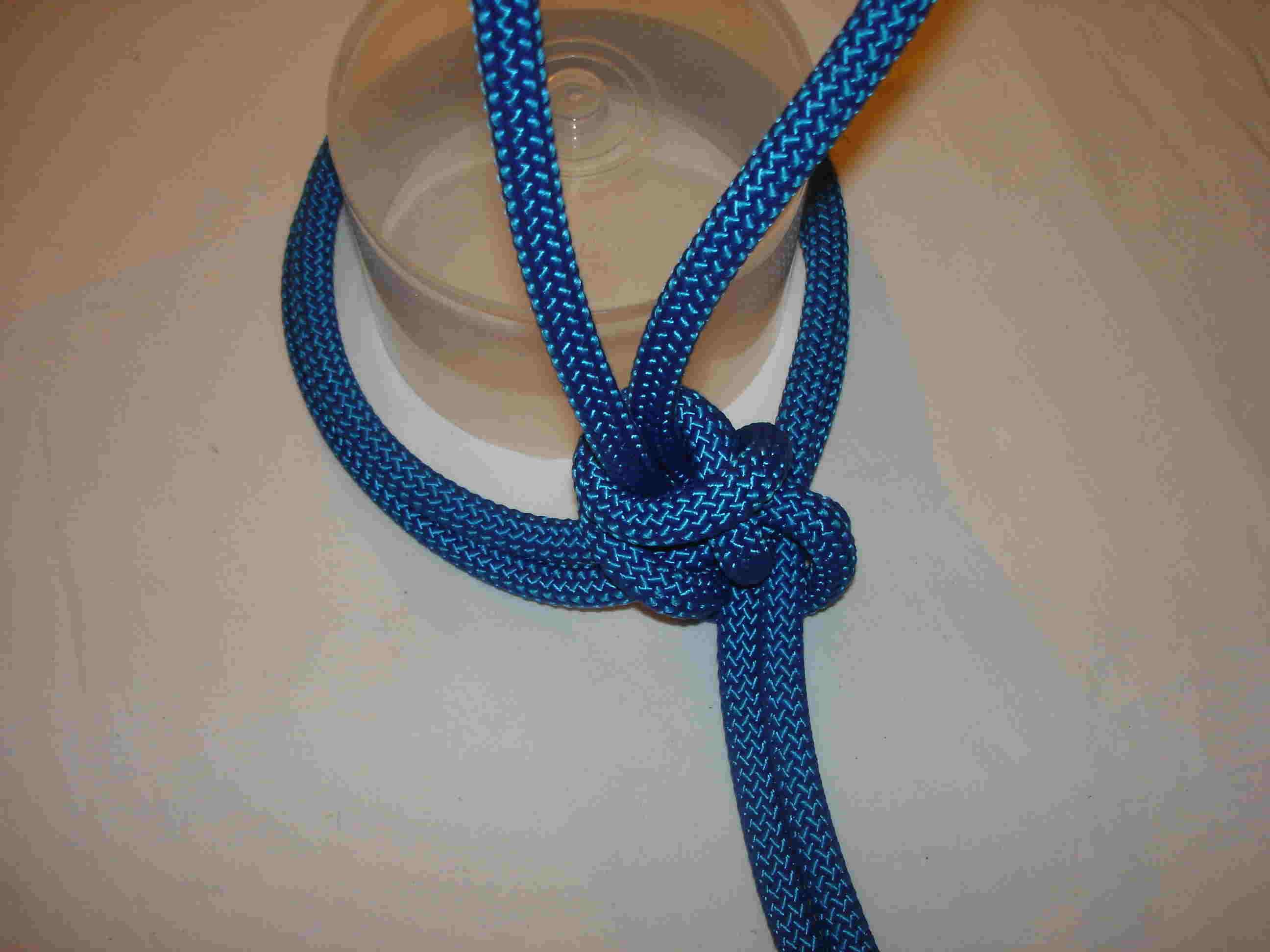
Please show the tying method.
Thanks in advance.
SS
Sure, I’ll work on some tying photos tomorrow. I haven’t bought any decent rope yet for pictures, however I’ll try to make them as clear as I can.
Cheers,
mobius
Here is a link to my Google Drive showing a tying method.
https://docs.google.com/presentation/d/12DcnLkrRs7zCimNLUUnbBg4JXg2otXtskwytC-v1ics/edit?usp=sharing
I think my knot is pretty easy to tie, apart from paying attention to feeding the bight through the two helical loops correctly. This knot is a ‘work in progress’ and is one I pick up occasionally and fiddle with trying to find what might be a better form, or variation. I don’t think it is too bad as it is, however give me some feedback please.
Note that I didn’t design it as a direct harness attachment for a middle climber, spreading the legs 1800 under load surely looks a little disconcerting, however the knot did hold when I trialled it this way. Only one trial, however if someone thinks it is useful then I can do more trials. Larger diameter rope trials would be much better of course 
Cheers,
mobius
Thank you for sharing the tying method, it helps with analyzing it.
The challenge I see with this is that it will operate as a noose and that may, most likely cinch down to the point of hard to untie. NBut, a hard loading may prove this to be a wrong assumption.
Let us know if you can verify this.
SS
Another quick trial, this time using a key as my endless rail. I took my knot to 95kg load and then untied it easily. The single locking loop structure (the ‘butterfly’) didn’t move at all under load (I was looking for the loop getting swallowed in particular) and was very easy to loosen off the key afterwards. Maybe the knot jams if my endless rail is a more compressible material and the noose really gets small and tight under load.
The picture shows the semi-untied state after load. The only other trial I could do with larger rope is tow my parked car with it and see what happens. However, that has to wait.
Cheers,
mobius.
[Edit: I should just trial the hitch under one end loading, however I am pretty sure that this is a much kinder way to load this hitch than the 1800 end-2-end loading I have already done]
Just thought I’d remark that in musing solutions to this
challenge, I tied the butterfly --let’s just call it that, for now–
in the “twirly flop” method (twist bight to make “hole”,
and then bring around and tuck tip through …) such that
my bight was taken through the (imaginary) harness
en route to making the final tuck --and maybe then
making a repeat, or tying off the bight tip with a stopper.
This knotting is offered for amusement
more than as a good solution.
–dl*
I just came across this challenge, and in spite of it being from a long time ago, I really enjoyed puzzling it out. I suggest the following to tie in to the harness in the middle of the rope:
[ol]- Tie the alpine butterfly loop
- Flatten out the loop to form two bights, one at each end, as shown below
- Pass one of the bights through the loop on the harness
- Use the two bights to tie a zeppelin bend[/ol]
In the first picture, the line at the top of the picture going out over my legs from the alpine butterfly represents the climbing rope, the green cord represents the harness loop, and you have the two bights with one passed through the harness loop. The end result is shown in the second picture. You end up with three little loops around the knot (two from tying with two bights and a third from the line between the two), but it should be good and strong, and it’s quick and easy to tie and untie.