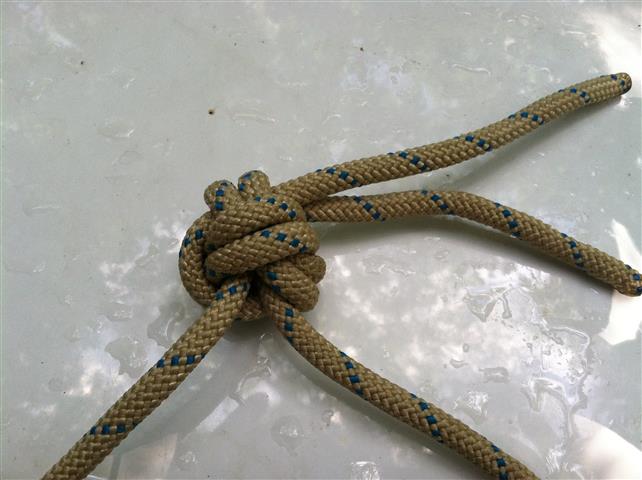
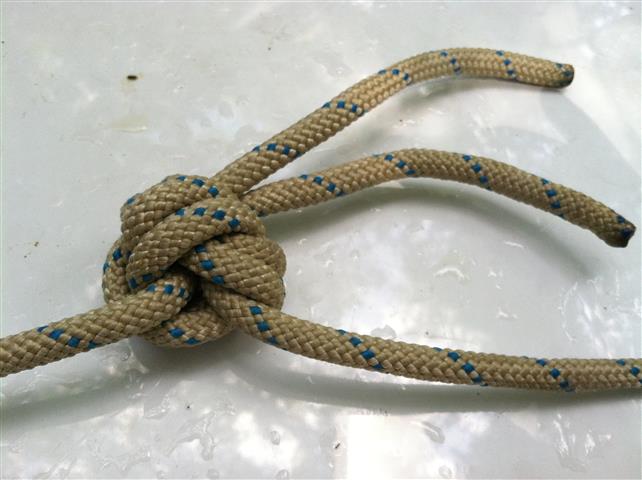
Analysis of Offset Rope Joining Knots

Just announcing that the draft paper (VER 0.5) is now uploaded and live on the PACI website.

PACI website: www.paci.com.au (click on ‘public downloads’ / ‘knots and knotting concepts’)

Direct link to page: http://www.paci.com.au/knots.php (at #3 in the table)

I welcome comments and constructive contributions…hopefully this paper will develop into a robust and technically accurate body of knowledge on offset joining knots.

As stated, it is a very rough draft that I literally punched out in a fit of energy today (+ a few cups of strong coffee).

…

Personally, I would like to set the record straight and bust a few myths along the way…
Here is a link to a website which sparked my fit… with our good friend ‘knudeNoggin’ :slight_smile: who’s excellent commentary was largely ignored.
Link: https://northeastalpinestart.com/2016/09/27/one-of-these-knots-can-kill-you/

EDIT:

Here are some more links that paint a picture of the current state-of-play around the climbing/adventure sports world…

Link: http://topherdonahue.com/blog/2016/12/7/barrel-knot-for-tying-rappel-ropes-together

Link: https://14ers.com/forum/viewtopic.php?f=4&t=50757

Link: http://www.bsar.org.au/bush-safety-resources/bwrs-research/ (scroll down for Dave Drohan report)

Link: http://www.commonclimber.com/edk.html (scroll down for more links at bottom)

Link: http://foxmountainguides.com/flat-overhand-not-edk/

Mark Gommers

VER 0.2 is uploaded for comment and contribution from interested persons.

Change log:
Preamble re-written
Acknowledgements to Dan Lehman (per different rope diameters & rotating the structure to induce a ‘choking’ effect to trap and crush the tails)
References to ensuring that tails should always be tied to identical lengths
Expanded on page dealing with different rope diameters
Added page on concept of rotating the structure to induce a ‘choking’ effect

This is still very much a rough draft and a lot of work needs to be done. The paper in its present form is likely full of grammar errors and the sequence of information is in no particular logical order…

Mark G

Good day Mark.

I am looking forward to this project and hope to contribute if and when I have anything meaningful to add.

In my personal experience, I always try to keep things as simple as possible. Easy to remember and perform.
I usually have sufficient rope lengths for the climb and return, but, have in the past had to join dissimilar ropes. One was a static, the other dynamic, both being approx. the same diameter. Using #1410, backed up with the same, snugged to the first (so easy and functional), I had no challenges with any aspects of use or undoing.
Way easy to teach as well.

I am of average weight, sometimes do a bit of wild things on the way down for fun, but I know I don’t stress the rope(s) or my gear anywhere near their limits.

So far, I’ve never had an experience with my rope getting hung. The bigger challenge is the end of rope coming down and dodging it.

SS

VER 0.3 is uploaded.

Change log:
Images corrected on page 12 (effect of rotation on security and stability)

Luckily I found this error before Dan Lehman scolded me… :slight_smile:

Mark G

VER 0.4 is uploaded.

Many changes and additions… too tired to list them all now.

Mark G

VER 0.4a is uploaded.

Changed the cover page.

Added a new page on dressing.

Added additional wording to clarify several concepts (eg flat versus offset)

Mark G

VER 0.5 (12 July 2017) is uploaded.

Many additions and alterations.

Contents page is also alive and working now…

I have completed the principle work to get this paper into shape as a working draft.
The next stage is to await for comments/feedback.

Please post your remarks in this thread or PM me if you prefer.
If you would like to be acknowledged as a contributor, please advise!

Mark G

Just announcing that the draft paper (VER 0.5) is now uploaded and live on the PACI website.

PACI website: www.paci.com.au (click on ‘public downloads’ / ‘knots and knotting concepts’)

Direct link to page: http://www.paci.com.au/knots.php (at #3 in the table)

Mark Gommers

Announcing that VER 1.0 is uploaded and available for download.

I have advanced this work faster than expected… even wrote a short conclusion.

Please note that this is intended to be a ‘living document’ - meaning that it will be continuously improved as new information and feedback is received.

I have made this document free to download and without restriction as a contribution to world knowledge.

Disclaimer: There may be errors (ie bugs) in the paper because it is new. With the passage of time and further input and feedback, these bugs will be ironed out.

Mark Gommers
18 June 2017

While my initial reaction to the so-called “EDK-backed EDK”
was unfavorable and like that expressed in this draft paper,
I’ve come 'round to realizing that in fact this arguably
needlessly bulky knot has much to recommend it in
terms of NOT needing the “IMPORTANT!” tying points
given for my once favored variations of the EDK/OOB/OWK
of how to position different diameter/nature ropes and so on
–something I’d challenged myself with, to wit : “If THESE
tying fine points make for better …, does missing them
imply worse?!” (likely so, alas)

At the very least, the OOB-backed-OOB" (to avoid “EDK”)
should be advocated as a brain-dead method for at least
stressful times (for cold & gloved hands with stiff ropes, e.g.).
Where all bets are off on assured dressing & orientation.
(I’ve yet to test the compound structure with cases of
egregiously unwell-tied knots --misoriented, crossing strands,
and NOT snugged up well (maybe slightly loose, to boot);
my contention is that, though, the knot WILL hold in such
cases. And that THAT is one BIG point in its favor,
all ugly aesthetics aside!


I am of average weight, sometimes do a bit of wild things on the way down for fun, but I know I don't stress the rope(s) or my gear anywhere near their limits.
It's important to consider the effects of such circumstance which might seem benign & well within safe tolerances, when in fact it might be that precisely the lack of force upon the knot enables it to do things re loosening! --this, at least, is what was asserted/mused/theorized for the loosening of (non-offset) [i]water knots[/i] in tape; that once hard-set, they behaved well; but without that setting, they could ratchet loose the exterior strand. (There was a death from such a knot coming untied last year, July? --an Exum guide.)

Not sure that offset end-2-end knots have such vulnerability,
but running through some combinations of ropes and dressings
might be best done first with say 50# force gently bounced,
then bump up to 100# or one’s body weight, and even some
doubling of that w/pulley assist or other means,
seeking happy upper reaches.

For my part, if I get to this, I’ll certainly not be striving at first,
at least, for seeing actual knot failure; I expect that initially I’ll
be making observations about differences that obtain, of what
forms/combinations/orientation-of-knot seem to be maybe
heading in a bad direction. And then THOSE might get some
kind of more serious test!?

–dl*

  1. What is the “safety” concern of ensuring that tails are the
    same length?! (IMO, this would be better --for researches–
    were they markedly different, and then is an offset end-2-en
    knot really did flype/roll to failure, there’s be one rope still
    tied in the base knot! --hardly the sort of happy thing to
    be hoping for, as there is no gain for the victim here.

  2. I see discussion of my point re rotation/orientation of the
    knot on the plane its offset from, but the assertions about
    no-rotation somehow differs in choking effect from “rotation”
    version is confused :: both have the choking that is cited,
    but in different strands/positions (“interior”/“exterior” strands).
    They are arc-loop & loop-arc, if this nomenclature is using
    choking-strand as first-described.
    And both of these forms have the tails at roughly right-angle
    to axis of tension; whereas the mid-rotation form is what
    aligns tails w/SParts (axis), and is in my crude understanding
    possibly the least stable orientation (sort of arc-arc). But I
    do NOT have any good testing to back this up.
    (And, no, one cannot presume that in the course of even
    a lonnng bit of usage that everything must have been tested
    by practice :: perhaps everything at some point saw SOME
    usage, but maybe natural tendencies much favor one vs.
    other orientations; maybe one of them just has a lower
    upper-bound of force --though still usually beyond what
    abseiling will generate-- than the others.
    .:. testing should be done.

  3. I remain opposed to the additional-turn knot advocated
    by the paper,
    and in favor of the offset 9-oh in which the additional
    turn is clearly made by the choking strand, done prior to
    its being tucked out beside the other (blue w/extra turn,
    in the example of the paper). It should be well clearer to
    tie this and be making the turn w/the correct strand than
    of choosing one of the two already initially tucked together!
    Moreover, the full wrap is as tight a helix as can be,
    not one that has a foreign strand spreading the turning
    ones into a milder helix!

–dl*

1) What is the "safety" concern of ensuring that tails are the same length?!

Identical tails provide a means to gauge any change in the knot structure.
For example: A party of 3 climbers descend a route. First person completes the first pitch. Second person also descends successfully. The last person notices that the tails are no longer identical - one is noticeably smaller than the other. This would alert the last climber that somethings changed, and needs to be re-checked.

If the tails are randomly set, there is no way to detect change.

It serves as a ‘tell-tale’, and alerts climbers to change.

but the assertions about no-rotation somehow differs in choking effect from "rotation" version is confused :: both have the choking that is cited,

No - they actually don’t. The bottom image on page 14 is rotated and has a choking effect with the blue rope.
The upper image is in a neutral state - at the midpoint.
I tried very hard to capture the upper image at its midpoint (neutral rotation) but its really difficult to convey the concept.

The blue rope lies closest to the ‘axis of tension’ -and can be thought of as the ‘interior’ rope segment.

I remain opposed to the additional-turn knot advocated by the paper, and in favor of the offset 9-oh
Well, I thought as much. I ran out of time to photograph the offset F9. I will have another opportunity next week to include that knot in the paper. Keep in mind that one of the design goals is to achieve a small footprint. The offset overhand bend with additional turn does not significantly increase the knot bulk.

I will also photograph some variations of the offset F8.

While my initial reaction to the so-called "EDK-backed EDK" was unfavorable and like that expressed in this draft paper, I've come 'round to realizing that in fact this arguably needlessly bulky knot has much to recommend it in terms of NOT needing the "IMPORTANT!" tying points given for my once favored variations of the EDK/OOB/OWK of how to position different diameter/nature ropes and so on

At the loads produced by a single person (up to around 130kg with gear) - I have not observed instability or security issues. Tail slippage in a properly dressed #1410 is not going happen.
However, I take your point re the ‘important tying/dressing points’ - in that the backed up #1410 theoretically mitigates such issues- albeit at the penalty of increased footprint.
The offset double overhand bend (see page 18) in my view would be preferable to a backed up #1410.

Mark G

I also need the Dan Lehman endorsed precise definition of ‘asymmetric’ versus ‘symmetric’ bends please :slight_smile:

Mark

Fair enough, and I suspected this --though it goes against
those assertions of surety w/the knot, eh! ::slight_smile:

but the assertions about no-rotation somehow differs in choking effect from "rotation" version is confused :: both have the choking that is cited,

No - they actually don’t. The bottom image on page 14 is rotated and has a choking effect with the blue rope.
The upper image is in a neutral state - at the midpoint.
I tried very hard to capture the upper image at its midpoint (neutral rotation) but its really difficult to convey the concept.


Hmmm, (a) try again, and aim for seeing the tops of BOTH
ends adjacent at the top (at present, the blue is less so);
AND (b) show rotation in the other direction as well (which
is what makes “midpoint” just that.
Taking a looking-down-upon-knot-set-upon-table persective
would clearly show tails swinging from roughly right-angle on
one side, aligned, and right-angle to opposite side triad.

(Again, my surmise is that the midpoint orientation might
be least stable; but I have no good testing done, to support
or contradict this --just some casual observation.)

While my initial reaction to the so-called "EDK-backed EDK" was unfavorable and like that expressed in this draft paper, I've come 'round to realizing that in fact this arguably needlessly bulky knot has much to recommend it in terms of NOT needing the "IMPORTANT!" tying points given for my once favored variations of the EDK/OOB/OWK of how to position different diameter/nature ropes and so on

At the loads … in a properly dressed #1410
//
However, I take your point re the ‘important tying/dressing points’ - in that the backed up #1410 theoretically mitigates such issues- albeit at the penalty of increased footprint.
The offset double overhand bend (see page 18) in my view would be preferable to a backed up #1410.


The latter knot is NOT one so easily tied under duress,
with frozen ropes, etc.; that is the entire point of the
seemingly gratuitously bulky/wasteful double-knotting.
As for “footprint”, I doubt that it makes much difference
the way things are --one shouldn’t be pulling through
an ring, and pulling into a “V” even would see the
back-up half just bobbing atop the other, not adding
bulk of any significance to it at the rub points.

.:. It’s not just the additional knotting/material of
the EDK-backed-EDK, but the WAY that material comes
–i.e., as a stopper structure to be jammed into the
base knot. (Even the variation where one only ties off the
choking strand’s tail will have less bulk to jam, and
of course necessitates making the correct choice of tail.)

The tying action is so direct & simple : Do what you just did, again.

In cases WITHOUT duress … , one is certainly happily advised
to make those helpful discriminations & tying correctnesses.

–dl*

In the interest of exploring various bends to use in climbing I’d like to offer ABoK #526 Stopper knot using two ropes tied parallel, using the ends of the ropes to be joined.

I have tied it with an assortment of climbing ropes including different diameters to each other. All within the sizes that climbers would use in this scenario.

Testing, using my body weight, as a stopper through a chain and as a bend to lengthen, I found it worthy to consider here.
Easy to tie, easy to inspect and easy to untie after bouncing with my body weight. I beat it, thrashed it and flogged it all around to find it still secure.

One must snug the parts reasonably tight.

The bulk is not so much different than the overhand bend.

SS


IMG_4271 (Small).JPG

IMG_4273 (Small).JPG

There was a previous thread on offset bends - http://igkt.net/sm/index.php?topic=4411.msg27806#msg27806 - in that thread James Peterson suggested using the Bowstring Knot (ABoK 151) tied in 2 parallel cords and collapsed rather than used as a loop -http://igkt.net/sm/index.php?topic=4411.msg28635#msg28635. Perhaps worthy of inclusion even if not to be recommended?

Sweeney

I have some spare time this week and will tie, assess and then photograph the suggestions from SS369 and Sweeney.
Thanks.

Mark

I notice only now that I didn’t know this post and I showed this knot at
http://igkt.net/sm/index.php?topic=5555.msg38903#msg38903
starting from ABoK #523,
please notice that it is a reversed of a figure 9 knot.
Ciao,
s.

Just announcing that the draft paper (VER 1.1a 01 OCT 2017) is now uploaded and live on the PACI website.

PACI website: www.paci.com.au (click on ‘public downloads’ / ‘knots and knotting concepts’)

Direct link to page: http://www.paci.com.au/knots.php (at #3 in the table)

Dan, can you please have a look a page 14?
I have re-photographed the neutral (no rotation) and rotated state…hopefully the neutral (no rotation) image is now of an acceptable standard?

Camera angles are tricky - and I am not a professional photographer - just trying my best to capture the salient features to showcase concepts.
Are you still in support of a rotation to induce a chocking effect to trap and crush the tails of #1410?

…

Scott, sweeney and ‘knotsaver’, I will be looking at your comments in detail probably tomorrow. Will try to incorporate your info as best I can and then upload another paper for comment. I appreciate any and all assistance received…thanks!

Mark Gommers

Hi Mark,
some comments/notes:

  • p.9 the knot in the picture (bottom right) is not the #1410 but (your) “improved #1410”.
  • p.13 you could specify (in the picture) the thick and thin rope (yes they are visibly different).
  • p.18 you could add an example with wrong knot and ropes of different color.
    (- p.2 l.4 " ’ " is missing: “whats in a name”).
  • please, explain why the tails should be of identical length (I think I know why but…)

Will you add/analyse other (offset) bends?

Ciao,
s.