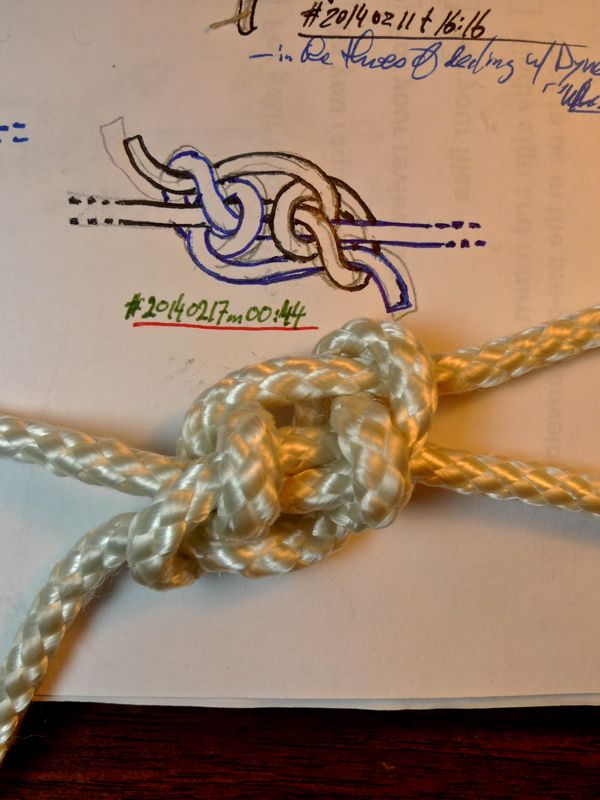
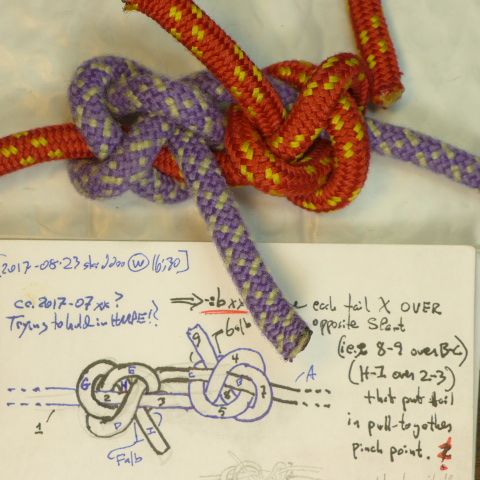
I finally figured out how to tie a “Cloverhand Bowline”. I was looking at the Water Bowline (which is like a Double Bowline except that the nipping turns form a Clove Hitch) and didn’t like how pull on the eye tends to separate the nipping turns. In looking for a similar structure that pulled the turns together instead, I inadvertently came up with a knot that I recognized as a Cloverhand with a Collar, i.e. the “Cloverhand Bowline”. My previous efforts failed because I was tying the Cloverhand as shown in Ashley’s diagram (running left-to-right, or downwards) when I needed to tie it reversely (right-to-left, or upwards). With the standing end exiting from the bottom and the working end from the top, the Cloverhand does make a stable platform for a collar.
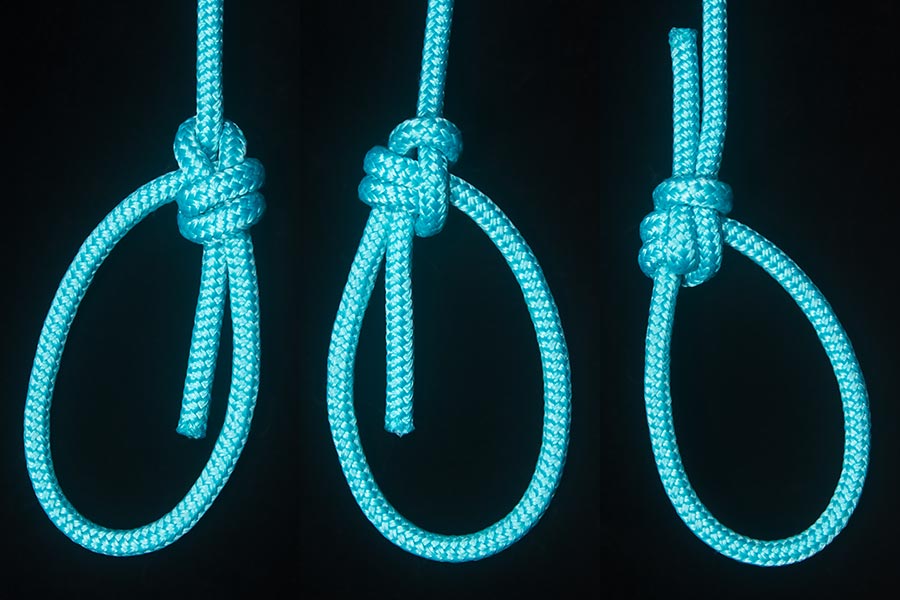
See the first image below. It shows both sides of the “Cloverhand Bowline” (left and center). The knot seemed to be crying out to have the working end tucked up through the collar (as shown on the right). I doubt that the extra tuck has much (if any) effect on the strength or security of the knot, but it fills a gap in the collar and looks nice.
The second image below is the Double Bowline (front, back, and with the working end tucked through the collar) for comparison. The two knots have a very similar appearance, but look closely and you’ll see that the “Cloverhand Bowline” has an additional part on the side of the nipping turns.
I put “Cloverhand Bowline” in quotes because a purist might argue that this knot does not belong in the Bowline family. It is not “Post-Eye-Tieable” (PET).
Anyway, I tried both the Double Bowline and the “Cloverhand Bowline” (with and without the collar tuck) in 3mm Amsteel Blue. Both eye knots held (with little slippage during draw-up) in both configurations to their breaking points, which seemed similar. I was able to untie them all without tools after loading. The Double Bowline untied easily whereas the Cloverhand took some wiggling to let go.
Twin Double Bowlines (untucked) tied in the form of ABoK 1454 drew together under load and then jammed. I was unable to untie them.
Twin Double Bowlines (untucked) tied in the form of ABoK 1455 with the eyes hitched (Reef Knotted) held without drawing together. The nipping turns did not capsize, but one of them did pull through its collar, and I couldn’t untie it. When tied with the running end tucked through the collar, the knot seemed more resistant to pull-through. I didn’t perform enough tests to be confident, but in the few I did, the Double Bowline retained its dressed geometry.
Twin “Cloverhand Bowlines” (tucked or untucked) tied in the form of ABoK 1455 with eyes hitched (Reef Knotted) held without drawing together and seemed quite resistant to changing geometry.
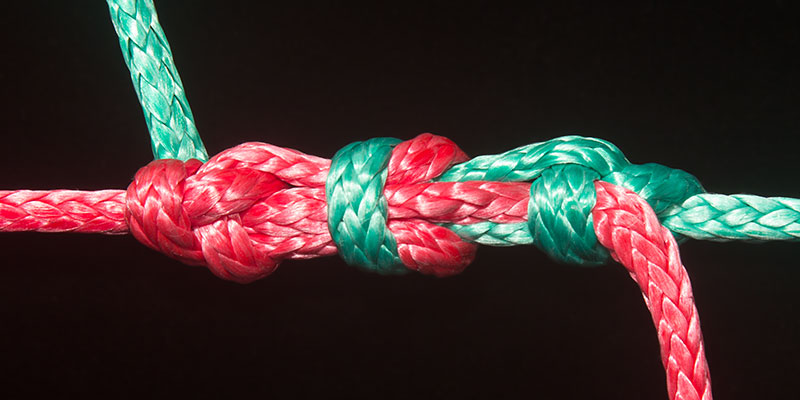
From a security/strength standpoint, the hitched twin “Cloverhand Bowline” bend seems the best so far, but the hitched twin collar-tucked Double Bowline bend is very close and is significantly easier to tie (the Double Bowline being PET) and to untie. As an aside, the collar-tucked Double Bowline is also tiable in the bight (TIB).
I’ve come to the opinion that holding without drawing together under load is preferable. You don’t want a bend that starts moving once it reaches a certain tension, even if that movement is still secure. First off, the bend may be somewhere you can’t inspect it (like at the top of a mast), and secondly, movement may cause undesirable loss of tension (like in a halyard). Therefore, I prefer these bends to my previous eye-hitched twin Bowlines with ends tucked bend. All of them, however, take a fair amount of line to tie. Given enough line, an end-to-end splice would be superior in every way. I’d only tie a bend in Dyneema if something kept me from making a splice.
I hope that makes sense,
Eric

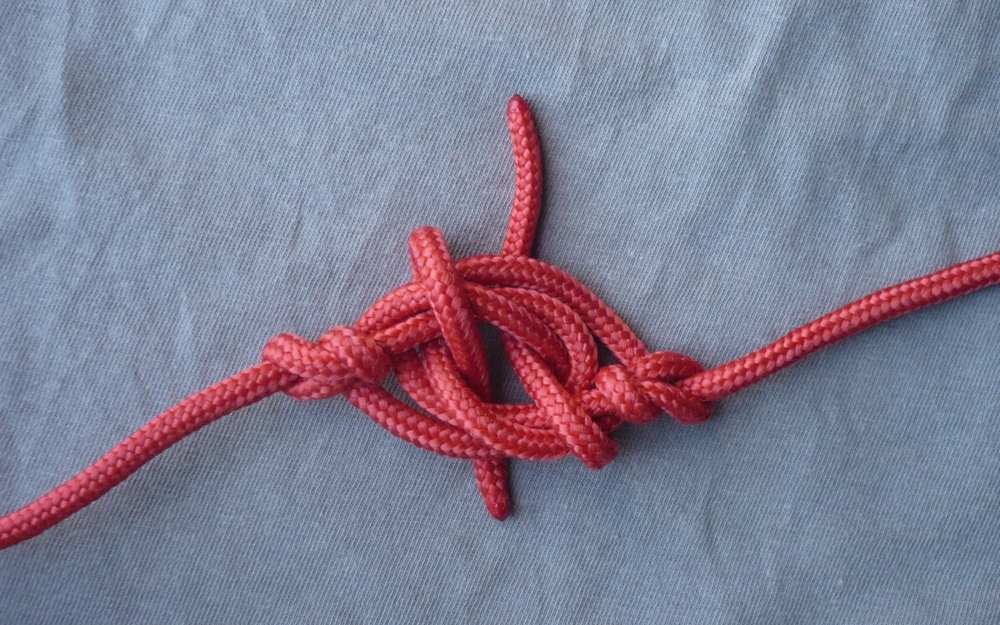

 , so if you consider them interesting you can test or not (it’s up to you obviously)…oh I’m only curious and because I appreciate the power of the 2 bights locking mechanism I think the structures I showed could perform very well. About the instability of the ends if there isn’t tension, we could tie the loops very short ( for instance just 2 rope diameters) and maybe we could only put the ends through the 2 bights without the internal hitches (maybe) …