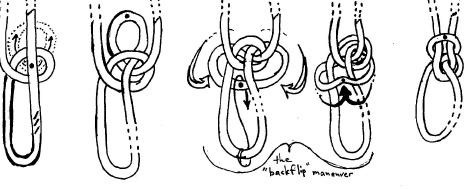
Newbie here, but have lurked on and off for the last couple of years and have moderate knot tying experience. Love this site.
I’m looking for your thoughts on the optimal slippery fixed loop that is both highly reliable under heavy, static strain and would be easily released after use (if one does exist). Naturally, I go to the trusted Zeppelin loop for critical jobs, but am wondering the following on 550 cord and braided nylon rope:
How reliable is the Kalmyk loop with very heavy static load?
What are its weaknesses?
What would be your top go-to quick-release fixed loop knot for reliability with heavy weight and ease in untying?
I’ve experimented with the Kalmyk up to about 200 lbs on 550 cord and it held up with a static load just fine as long as I dressed it properly. Just itching to know though, is there something stronger and just as convenient?
A quick search on the site as well on the internet didn’t yield much, except for the article claiming that it could unseat the bowline. Naturally, I’d tend to trust the opinions of the experts here and would appreciate your thoughts.
It is the first time I see this loop - and I like it !
( I would also like to learn about the history of this knot, by anyone who might know some things… )
It is a crossing-knot based loop - such loops can be very stable and secure, but they have remained unknown to knot tyers, I had never understood why…
Also, this slipped tail, which makes it easy to untie, almost like an “exploding” knot, is a very good idea - because, as a doubled line, it adds stiffness to the “toggle” which prevents the opening and destruction of the crossing knot itself.
I had tied two “similar” loops, the Pet loop, which is a crossing-knot based fixed loop, and the Pretzel loop, which is an adjustable loop, without a collar - and I see that both have elements reminding the Kalmyk loop.
Will it will ever “replace” the bowline ? I do not think so, because it is a more complex loop, and it has this not-loaded, functionally redundant and possibly problematic bight of the slipped tail. However, it is TIB, and this is a great advantage - so we should better compare it with simple TIB bowlines - of which we have maaany !
P.S. I had missed this thread, or I have forgotten it, I do not remember why… : http://igkt.net/sm/index.php?topic=4285.0
A similar loop, tied by Alan Lee, at the attached picture.
Noope - for two reasons :
First, there is NOT one ( “the” ) Eskimo bowline, but 4 ( four ) - but I will not keep saying the same things for ever !
Second, with this doubled line, the nipping loop does NOT work as the nipping loops of the four Eskimo bowlines, at least not all of them. Under tension, it behaves differently : more as a crossing knot loop.
One may argue that the Eskimo bowlines themselves ARE crossing knot loops - but I prefer to characterize a nipping structure as nipping structure of a crossing knot iff the Standing Part crosses itself in two points ( or passes close to itself at two areas ). In the classic, “proper” bowline s nipping structure ( the nipping loop/turn ), we have only ONE crossing point.
I believe that the stiffer “toggle” makes this loop looks more than a crossing knot-based loop, and not like an “Eskimo” loop - but this may be just a minor semantic point, which depends on how we define, and separate, the nipping loops of the classic bowlines from the nipping structures of other “similar” loops.
I’d go with the Zeppelin for this hypothetical scenario, but to answer your question.. Say I was hoisting a heavy container off the ground and decided to use the Kalmyk on sufficiently rated nylon braided rope as the anchor end up at the top of a bar. I would need to go with a fixed loop so that the rope could accommodate some light swinging of the box back an forth down below and need it slippery for quick and easy untying. I would test this myself, but don’t have the tools to put enough weight to it therefore, this might have to be an exercise in its theoretical strength/stability. The slipped component is very attractive and I’m wondering just how strong it would be.
Also, back to one of my original questions. What would be your recommended slippery fixed loop if one had to be used in the above situation?
I should note that I’ve been digging your Notable Knot site. Thanks for the work you put into it. It’s distilled and well-explained. Especially love the Trigger Bend you came up with. Brilliant!
I’m pretty intrigued with it too and would like to know more. I have much curiousity around this loop, mostly for its convenience in being exploding. Not much info out there regarding this knot. I’ve glanced through the linked thread, thank you. Will take a more studied look tonight.
Ok, I think I get the general idea. Maybe you have to use a loop knot if the anchor point is a bit high and you want the knot close. The difficulty with using slipped loop knots is that they tend to become difficult or impossible to untie while they’re still loaded. If you’re OK with only using the drawloop to untie things after the load is off, then both the loop you mentioned or even a slipped bowline could be used, and you shouldn’t have any problems with capsizing under heavy load if the knot is set properly.
My luck hasn’t been great with finding a slipped loop that can be untied under serious load.
Thanks Roo, I understand what your are saying. That would be a beauty… a slipped fixed loop that is easily untied under load. You’re always looking at the big picture with knots and frankly, I didn’t give that too much thought, so appreciate the insight.
Would the version of the slipped bowline in this image optimal? Xarax, of the many you’d mentioned, which would be your go-to?
The simplest possible TIB bowline, is the one tied by Dan Lehman, during the 19th century, shown in the attached picture. http://igkt.net/sm/index.php?topic=4476.0
Then, there is this very simple, conceptually, TIB bowline, which can also be considered as an “exploding” knot. Compare it to the Kalmyk loop : http://igkt.net/sm/index.php?topic=4712.0
My favourites are the :
However, there are dozens of TIB bowlines out there - because of that, and because most of them can be tied in the bight more easily and quickly than in the end, and because I can not find something that a not-TIB bowline can do, and a TIB one can not, personally I tie ONLY TIB bowlines… either in-the-bight, or, when this is not possible ( for example, within a ring ), in-the-end.
For just to get an idea of how maaany we have, see : http://igkt.net/sm/index.php?topic=4603.0
I sometimes wonder if, in many applications, we can replace an “exploding” fixed loop, like the Kalmyk, with an “exploding” hitch. I am sure that there are many applications where we can, but, as I am not very interested in the applications of the knots I study, I really can not tell…
Besides the loop shown at : http://igkt.net/sm/index.php?topic=4712.0
have a look, and try, the “exploding” hitches shown at :