I beg to differ on this. It is the existence of the knot that determines if there is a “problem” in the first place, before we can evaluate this knot as a probable solution of this problem. If we do not know the knot, we do not even know that we have a “problem”, and that this problem can be solved with a “knot”, in general, and with this knot, in particular. Knots are rope-made mechanisms, that can be evaluated as such, without any reference to “the problem”.
We see a heavy rock sitting on the path to the village with the pretty young women next to ours. What we will do ? We will treat it as it is, as a small mountain that was placed there at the time of the incubation of the cosmic egg. We will not consider it as a “problem”, we will just try to draw our path around it, if possible. Then, somebody that has not been married yet with any of those women, in his Eureka moment, discovers the block and tackle simple machine. So, now he has the knot, the tool. Instantly, he sees the rock as a “problem” that can be solved, by the implementation of his machine. He can now pull the rock, and open the path to the abandonment of his celebrity. He has the tool, he starts to see a given by nature situation as a “problem”, he tries to solve this problem with the tool he already has. We already had the wings or the rockets, and because it had happened we had them, we could see the trip to the moon as a “problem” that could be solved with the proper use of those “tools”.
A knot can be evaluated without any reference to a problem. It can be good or bad, stable or not, secure or not, jamming or not, strong or not, per se. There are well defined and measurable quantities in a practical knot that can be evaluated by theoretical or experimental examinations, independently of a particular problem. We have first to tie all the possible simple knots, then to evaluate them as knots, and only at the very end we can start thinking if a particular knot we already know can be used to tie the hands and feet of the husbands of those women around trees.
The issue of the speed with which a knot can be tied and/or untied by the knot tyer, is directly related to the number of the required tucks of the working end in order we tie and/or untie it. As such, it is included in the general characteristics of “simplicity” mentioned in (1). So, the following comment on the mentioned post should be judged as premature, to say the least :
You missed my point. I was not talking about the bulk, the volume of the nipping turn, but of the bulk, the volume of the whole knot. One need not be a rocket scientist to see that a nipping turn that encircles, say, three rope diameters, is wider, bulkier, than one which encircles only two !
The strands of the rope inside its nub can be arranged the one next to the other in an efficient, regarding the consumption of 3D space, way, or not - and this is not directly related to their rope length - i.e., to the consumption of 1D line. In other words, the rope segments inside the knot s nub can be interwoven to each other in a economical, regarding volume, way, even if themselves are quite long, i.e., they are not economical regarding length. See the Tweedledee bowline, and compare it to the post-eye-tiable and TIB eyeknot shown at (1) and at the attached pictures. The latter is a flat, not compact knot, of a large outline, even if it does not consume much rope length, just because of the way the strands are interwoven to each other. On the contrary, the Tweedledee knot is a very compact knot, although it consumes approximately 25 rope diameters for each link, so 50 rope diameters in total.
Moreover, there are bowlines where the collars should better not be pulled too tightly towards the central nub, because, if they are, the deflexions of the limbs of the knot that penetrate them may be severe, and diminish the strength of the knot. So, when those collars are left a little loose, the length and the outline of the whole knot remains quite large - see the “Mirrored bowline”, for example.
Uh-huh. Look, the climber seeking to be secured
to the line knows the problem plenty well; what
s/he needs to learn is the solution to it, and this
will entail learning some or several knots (perhaps
even including a hitch or two).
You, OTOH, have presented countless (oh, I’m sure
you’ve counted 'em) knots for which there is the
obvious question So what?! --as the basic jobs
they do, be it joining ends or forming an eye, are
long solved in generally satisfactory ways. And if
something “new” is to gain interest, it needs some
claim to that interest beyond existence.
–dl*
Actually, I think I missed Roo’s --which wasn’t some
great exaggeration of enclosed “diameters” but rather
a size-independent measure, by diameter, of the rope
consumed in the knot!
To this, then, I say that his notion of 50 dia. as an
appropriate constraint is way too stingy. By my
sizing --done carefully w/markers on tied & set knots–,
an end-bound (single) bowline is 37, the EBDB
51, fig.8 56 (seems high!?), locktight (w/2 extra wraps) 58,
YoBowl 40, and the bowline (1010) 26.
To my mind, many of the more complex bowlines
are deserving tie-in knots for climbers, and these
will be considerably more costly in material.
–dl*
To my mind, many of the more complex bowlines are deserving tie-in knots for climbers, and these will be considerably more costly in material.–dl*
====
The considerably more costly in material does not seem like much of an issue if the trade off is solid security. At most climbing events there is considerable waste of materials with long tails that then have to be tied out of the way. The loop is over large where the nub is solar plexus high. And for sake of having enough, the length of ropes used generally are beyond sufficiently long and lying in the soil to be stepped on, as happens.
Not always (I do realize) is this the case in more extreme unknown, first time climbs, but if the, let’s say 12 inches additional material used is going to fail someone, then that will be bad.
That said there is a thread here about the sheer number of bowlines that one member compiled. http://igkt.net/sm/index.php?topic=2897.msg19660#msg19660
And the link to his list. http://www.morethanknots.com/bowline/bowline_list.html
And the link to his pictures of some. http://www.morethanknots.com/bowline/BK_Pics_1.html
Perhaps this will generate additional ideas for the Family tree.
SS
I would luve to delegate to somebody the project of tying all those bowlines, and presenting them, with pictures, in the Forum ! 
http://www.morethanknots.com/bowline/bowline_list.html
I do not have the books, the journals, the web references…However, I have all the time in the world, and the desire to examine them all, one by one, as I do with the Alan Lee s bowlines.
If somebody sends me all the original pictures and/or the texts describing those bowlines, I would be able to tie them, take new pictures, and post those pictures in the Forum. Then, we could possibly be able to see general patterns between them, and draw a simple yet all inclusive map of the bowlinedom..
Hi 75RR.
File size limit is set for the time being and I’ll bring it up for discussion with the Admin.
I have, in the past, used the Adobe “Save as” function to reduce the document. Can’t say how much it will do for you, but it does work. Optimizing can be a pain, but it helps as well. There are freeware programs available, some limited function or time wise, that can also be helpful.
Using Google Docs is another avenue to explore and then there are free hosting sites too.
If all else fails, there is the option of splitting the file.
Good luck.
SS
Hi 75RR.
If you have searched, etc. and think this a presentation of something new, then by all means post it to the New Knots Investigation board.
SS
;D Drat, it is what sooooo slows the recording process,
for me : as soon as the subject knot to be illustrated is
laid out and regarded with an eye to best presentation
perspective, my mind tends to flow off into “what if …?”
musings about variations (or some nagging feeling
that I’ve previously recorded the knot)! And sometimes
instead of having recorded one knot and liberated some
literally “tied-up” rope for further play, I’ve tied up
MORE rope in playing with the variations, and nothing
yet is recorded! (And then along comes X. with another
lode of novelty begging considerations :: and my feet
are run over by wheels.))
:o ;D : 

(-;
75 RR. we have seen a similar idea in the Forum some time ago, where the slippage of the bight was blocked by its continuation, bight-ed again ( meaning, not the single segment of the tail, as in your knot, but the twin line slipped tail was used ) and inserted through itself, between the fist collar and the nipping turn, as a toggle. I have searched, but I was not been able to find it - I only remember dL s reply, and that I felt this type of security is depended on the stiffness of the material more than I would like. Dig a little deeper !
It seems that we all have the same collective subconscious impulses - a KnotJung thing !
P.S. I have found what I was searching for: http://igkt.net/sm/index.php?topic=4367
Yes, I think I recall your doubts, too. One way
to secure against the need for firmness is to make
a full wrap & (2nd) tuck. Something might look
okay if set and loaded just so, but then the X-feared
vulnerability could show its treachery upon some
differently made loading, or in some not-quite-so-stiff
material, and … that would be regrettable!
With the presented knot here, that bight that is
used to nip the tail could instead surround the eye
–IF one hasn’t tied through a ring or something.
–dl*
To find the loop based on a similar idea which I had seen in the Forum, I searched for the name “loop” - 14 pages of posts -, in vein. This morning, perhaps because I had not much sleep after those overnight knot-tyers-wars, , I searched for the name “toggle”. Instant satisfaction :
However, the fact that the “toggle” is made by two lines, not only one, means that it is stiffer, and it is more difficult to be dragged and “swallowed” into the nipping turn.
This is a better lock - I have used something like this in the Fontus bowline ( a Janus-like bowline ). See the attached picture.
Of course, what immediately comes to mind, is to use, as a stiff toggle ( stiffer than the single line of the Tail ) the two eye legs - and reeve the whole eye of the knot through the eye of the bight component - penetrating it from the “front” or the “rear” side. But I guess you know those two TIB bowlines already.
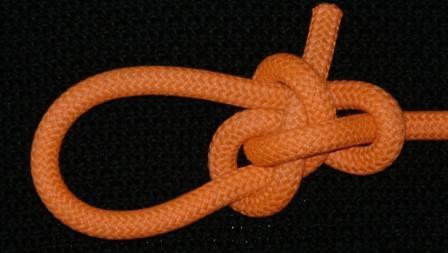
Actually, we should be chary of such things (even
by some per se analysis --backed by experience):
to expect some toggle action requires that there
is slippage in the turNip of otherwise gripped parts!
I have done things like this, which from on perspective
seemed attractive, but then the nipping-gripping effect
of the turNip frustrated the hoped-for pressure to secure
the toggle. (And, e.g., in some fiddlings to find some
slip-free hitch, there have been cases where I had the
turNip and it proved too tenacious and impeded the
spilling that was wanted, holding like a sheepshank.)
E.g., one can use a structure just like the sheepshank
with that bight-end only beside and not collaring
the SPart, and do the collaring with a like-above wrapping
of the tail (around SPart & through bight end, which is
passed through the turNip), but then that turNip grip
proves at least a little problematic in getting the sort
of strong bight-down-upon-tail-wraps effect that’s wanted!
–dl*
I understood it ! Am I getting smart, or now you are talking, and talking to be listened. Thanks.
A question about End Bound Water Bowline. Is it standard or only an attempt of generalization EBDB?
Thx, regards
ZZ
And by the emphasized expression, what do you
expect, what do you mean?
But that one is, we can say, much just an obvious
combination of things --i.p., of the “end-bound”
tail tuck on a closely dressed water bowline
(noting that in some sources this older knot is
shown with widely spaced turns, like a sheepshank).
Btw, the possibilities far exceed the mere combination
of named extensions, as the particular order or dressing
or … will distinguish one from another. (E.g., the
Yosemite finish could “end-bind” on its passage
through the turNip either coming or going.  )
)
–dl*
Firstly, the correct modifier sh/would be “left-handED”**.
Secondly, that is the pejorative; seeing such for
“cowboy” … must be fight’n’ words in some necks o’
the wood (or range), pardner!
[** Either expression has the unwanted connotations
of “handedness” arising since it’s a knotting name.]