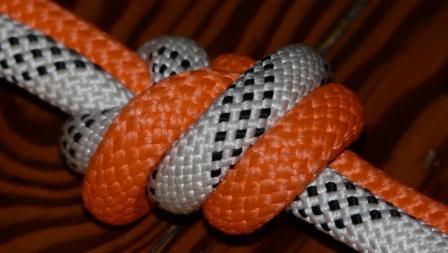
Break testing of the Alpine Butterfly Knot

Well, like I said at the end, if you are in fact talking failure vs lenght, linking together segements of length, then you are exactly right, it is a weak link problem, and for a FIXED tension, it’s the simplest 0 power (k=1) weibull distribution in length.

But that’s not what’s being tested here. He’s not testing a series of a links of rope. He’s testing one or two specific points on the rope that are under the most stress. There might be a microscopic model of deformity, that, well never mind, or there might not, it might be meter scale variances from chemical mixtures, or whatever or just small variations in knot dressing. What’s clear, even for a very pure material you eventually get to a point where you simply exceed the strength per area of the fundamental chemical bonds involved. The underlying probability function is then certainly not power-law like or increasing, there is no expected delta tension left before failure, however small, it is simply reaches 100.000% failure probability (exactly instantaneous if this were a time-like weibull problem). In a couple of ways this doesn’t seem to fit at all with the weibull concept. Anyway, this is way off on a tangent of a tangent.

What I was talking about is this -simplistic, most probably - mechanical model of the individual fibres of the rope, where the molecular bonds, arranged in a row, play the role of the links of the chain. In the microscopic scale, because of the slightly different orientations of the bonds relatively to the axis of the loading, and probably also because of the thermal energy generated by friction ( dan Lehman says that heat may also be generated by local compression ), the distance between them varies, so the ability of each of them to retain its integrity under a particular tension varies, too. It is not that the strength exceeds the strength of a bond, it is that bonds are not, regarding strength, behaving the same way, and the weakest of them will break.
Anyway, that is the simplest thing the na?ve mind of this poor ignorant knot tyer has to have, in order to have a model in the first place, because, as you said, human mind adores simple things, and hates the messy real complex things. :slight_smile:
I would be glad if somebody would tell me how scientist believe things “really” are, and why this or that probability distribution is the one which describes the behaviour of the individual parts of their model.

xarax:

the distance between them varies, so the ability of each of them to retain its integrity under a particular tension varies, too.
.. which all sounds extremely Gaussian, not weibull.

Thanks.
I got “strong form” from assertions made by Rob Chisnall’s
[u]Ontario Rock Climbing (-ers?) Association Ref. Manual
(I might’ve mis-remembered this title, egadz!), which in
at least recognizing that there is a difference (clearly, in one
loading the SParts beats into its twin, in the other it pulls
away!) gave some credence to the assertion. (Most folks
don’t seem to have a clue about this. So often, the knot
is presented without indication of SPart/tail !!) His assertion
was a difference of 10%-points (that’s “percentage points”)
–unless I’ve also mistakenly recalled this. (60 vs 70 and
not 60 vs 66, e.g.)

(You don’t say what your sources are; I’m curious. Now I’ll
name further … .)

Dave Merchant, in [u]Life on a Line, asserts a similar
difference (I’ll be similarly unsure of %-pt.s etc :-\ ) in
advocating for the not-so-easily made form that Xarax
nicely presents here (in two posts):
igkt.net/sm/index.php?topic=5268.msg34654#msg34654
[ Fig.8 IMAGES of Perfect & D.Merchant’s & other dressing ]
My guess is that OnRope1.com’s Bruce Smith’s “Mythbusters”
rebuke is directed at Merchant (though he doesn’t name names
–and maybe is reacting to heard-thru-grapevine hearsay :wink: ),
but fails miserably in citing the incredibly stupid, perfectly
impossibly “flat” image of a fig.8 in which the artist gets off
easy by just tracing one ‘8’, neverminding that round-crossectional
material cannot maintain such orientation under force !!
This image is echoed all over, no one the wiser. It’s supposed
to show a wider vs. tighter “first bend”, but that’s nonsense.
.:. If Bruce cannot see this, to heck with what follows.
Presumably, Merchant, who could illustrate his orientation,
has test data to support his claim --though I think his main
one was for easier untying?! --and he didn’t lean hard on
the difference in strength.

In the field, one can readily discern (a) much slop in the
knot, and many cases of “perfect form” loaded “weakly”
in eye knots : the turn first going around the eye legs
being slack, quite obviously so, and the other drawn
tightly into the body.
In the end-2-end knot (I avoid “bend”, yes), the “strong
form” shows by crunching --from opp. ends-- the body
into a sort of 45-degree angle to the axis of tension;
whereas the “weak form” (and I see these names mostly
now as just labels, not necessarily meaning as they sound)
the knot looks more parallel, aligned with this axis.

(My “Lehman8” was designed based on the assumption
derived from Chisnall’s assertion, aiming for the curvature
got by the 'bearing against the twin part", which occurs
before the U-turn around the legs. Maybe some test of
cordage with marked differences in surface friction would
show the slicker one weaker or at least breaking later,
at the u-turn, whereas the frictive one would gain what
is hoped, of off-loading force on the bearing-against part,
and so be less stressed at the U-turn.
ALL OF WHICH EXAMINATION/testing/study is done mainly
for edification about knot/cordage mechanics,
and not to write better rockclimbing recommendations
–which might favor ease of (un)tying over (slight) strength
differences!!

As for core breaking and then sheath : I’ve seen the opposite,
and esp. perhaps in ropes with hi-mod but slippery cores
(esp. HMPE), where slippage of the core might leave the
sheath taking the load. (Sometimes, it has been reported
that the core then pulled out of the knot!)

–dl*

After rupture??? --there will be nothing left to measure
(or it will have relaxed into a different form)!

In specimens I had tested, though, I did tie duplicate
(eye) knots (one at each end), expressly to have a
non-ruptured-but-near-100%-loaded survivor,
albeit no longer under tension. I do think that it
was close enough to rupture state --esp. in HPME,
which has so little elasticity-- to assess the position
of in-rope marking threads vis-a-vis the ruptured
other knot.

:slight_smile:

I have seen that the “broken” knots remain in one piece, even after the rupture - and this is especially true if the rupture lies outside the knot, as it happens very often. The one end may be “uprooted” from the nub, but the nub itself remains in the same form it had before the rupture - perhaps because, in complex enough knots, and after such heavy loadings, all parts have been “glued” with the parts next to them, and they form an integrated tangle, which is not loosened, even if one part is cut off.
However, it could be better if we measure the first curves just before the rupture, or during the rupture ( which takes place in milliseconds ! :slight_smile: ). But, since we can not measure them during the rupture, how long before it ? Also, I would nt ask knot rigger to go near to a knot which may break the next millisecond ! :slight_smile: That is why I had written that “after”… Of course, if it will be established, from those tests, that the nubs of those knots explode, or simply get more voluminous, after the rupture, we will have to measure them before the rupture, at, say -5% of the average maximum strength - which, probably, will still be lower of the minimum of all the recorded rupture strengths.

You don't say what your sources are; I'm curious

I thought, when I originally posted, that I should mention the sources, but I didn’t have them on hand at the time to quote accurately… As you probably guessed, my two sources are the same as yours. Merchant’s Life on a Line proposing that there is a stronger and weaker way, and Smith and Padgett’s On Rope stating that there is no difference. In hindsight, I’m happy that I neglected to cite my references, as you gave me a few further sources on the topic. Any idea where I can find a copy of Rob Chisnall’s Reference manual?

Merchant does indeed state that the “weaker” method “can” reduce the breaking strength by 10%, but he doesn’t cite any particular study or data. He also says of this 10% difference in strength: “in tests it can be difficult to prove this reliably” How about that for a caveat! He does say that the “weaker” version is harder to untie than the “stronger” version. I disagree with his picture showing the “correct” dressing of the knot. Other than disagreeing with him in small ways, I think that Dr. Merchant’s book is the best text available on the subject of rope rescue, and in the top five texts for rigging with knots.

http://igkt.net/sm/index.php?topic=2198
Xarax’s version C is what Merchant shows as the “correct” dressing, whereas I believe Xarax’s version A is the “correct” dressing of the figure 8 loop knot. (thanks for the pics Xarax)

Smith and Padgett site Neil Montgomery’s Single Rope Techniques as saying that it is possible to tie the fig 8 loop incorrectly, and that the weaker version is 10% weaker (same as Merchant) but they go on to discredit this notion. They site “knot destruction tests and Ashley” as sources. I can’t find anything in the ABOK on the topic. (ABOK #1047) I will say that I’m fairly knowledgeable about rope access and rescue rigging, and this notion that there is a 10% weaker version of the fig 8 is NOT widely known, or taught. The common wisdom is that there is no important difference in the two ways of tying the fig 8 loop. Personally, I agree with the common wisdom, but I have been tying 8s Merchant’s way since I read his book. His way certainly can’t be worse!

BTW the ABOK is on google books:
http://books.google.com/books/about/The_Ashley_Book_of_Knots.html?id=aN58gdigmy4C

Last thought about the figure 8: In the 4th edition of the CMC rope rescue field guide (I just own the field guide, currently not the full text) they state that the efficiency of the figure 8 bend is 51%, and they state this 51% is much lower efficiency that in their previous tests (which I believe are widely cited by other sources). There are certainly stronger bends out there (like the double fisherman) and also more jam-resistant bends (like the zeppelin bend).

Since I mentioned it, here are my top five texts for working with knots (in no particular order)

On Rope by Bruce Smith and Allen Paggett
Life on a Line by Dr. Dave Merchant
Knots & Ropes for Climbers by Duane Raleigh
Knots for Boaters by Brion Toss
Knots at Work by Jeff Jepson

how 'bout that for drifting my own thread off topic?

Last thought (more thread drift!): On Class 2 double braids (HMPE core, conventional synthetic jacket). On a show I worked on we used a class two double braid as guy lines, which were tensioned, and then subjected to cyclical dynamic loading (swinging of a trapeze). We found that the core would bird cage, causing bumps in the line, and eventually break at those bumps! We solved this issue by adding extra slack in the jacket (the lines were spliced either end). We think the friction of the jacket on the core was leading to the issue of the bird caging. On another show (i didn’t work on) class 2 line moved a trolley. They were heavily loaded, under constant tension, and dynamically loaded, but the D:d ratio was large. They broke-test a set of used lines and they broke at 50%! of their published breaking strength! My conclusion is that we (all of us) are still learning the behavior of these “new” HMPE ropes.

cheers
andy

This is dubiously helpful, in hoping that the state of
the world (or that vast part of it called “Amazon” :wink: )
is stable. But taking this recipe, I find …

[u][b]An Introduction to Error Analysis: The Study of Uncertainties in Physical Measurements[/b][/u] Aug 1, 1996 by John R. Taylor Paperback [b]$16.80 to rent[/b] $37.44 to buy
... and marvel at the "TO RENT" option, which is new to me!? :o

–dl*

You’re being ambiguous,
except by content of assertion --which pins both
claims I think to 2nd versions : [u]On Rope, 1st ed.
carries the assertion of difference (and the incredibly
stupid illustration (that “flat” impossible ‘8’) with
guidance to “dress & set” but how the devil is one
to know how to do that, devoid of specifics?!
(typical rubbish, I’m afraid)
And Merchant I think had an earlier version that was
publicly available for free and which has less interesting
knotty information --I think.

And, while it’s on my mind, noting that you must be
with OR-2nd, let me point out to you its mistaken
presentation --and to some danger, IMO-- of those
“3- / 4- / 5-coil Prusik [hitches]” : the 2nd edition
turned them upside-down, and it’s possible that they
will not grip at all, and otherwise do so poorly --for
the single-turn half then being on “top” will press
down upon the multi-coils beneath, and cause the
hitch to slide (just as Ashley remarks for the rolling
hitch
) !! (I see that “after Thrun” is cited, and
IIRC Bob & I --or him alone?-- tried to contact Bruce
Smith about this (or else whom?), w/o acknowledgement
for the effort. There had to be some matching alteration
of the wording, which I recall discussing --and had thought
it pretty simple–; and that should belie a claim of pure
innocence for whoever made the unjustified change :
i.e., if you confront an assertion of needing coils on TOP
and you’re putting them on the bottom, you must know
that you’re going against the rationale! And I believe
that the words ARE changed.
[Perhaps Bob can chime in re this.]

Any idea where I can find a copy of Rob Chisnall's Reference manual?
Not of any official source. It's dated (ca. 1984, from memory?), and in full might be about a $60 copying fee alone (for much more than just knots, of course). It didn't as I recall have anything beyond the "10%" claim; not sure where I might have gotten the thought that ORCA did their own testing.
Merchant does indeed state that the "weaker" method "can" reduce the breaking strength by 10%, but he doesn't cite any particular study or data. He also says of this 10% difference in strength: "in tests it can be difficult to prove this reliably" How about that for a caveat!
The first thing to ask about such claims is what the "10%" (or whatever) means --"10 %-points" or purely "10%". It won't amount to a huge difference, but, still, one should speak clearly. The [u]easy[/u] and IMO more useful value is %-points --what one can see between test values, and which works in *both directions* (if I'm 50% bigger than you --by your weight, x 1.5--, you're not 50% but 33% smaller than I by my weight :: the two "*directions*").

Again, with Smith unable to get a decent image of the
orientations, I have no confidence that he knows what
he’s talking about. AND, to those at least with the right
orientations, recall my thoughts on setting --i.e.,
to set with hard force on the TAILS, to try to give that
curvature in them against which the SPart will bear,
and have them tight so that they don’t (so easily) get
pushed out of the way (and allow the SPart to straighten).

I think that Dr. Merchant's book is the best text available on the subject of rope rescue, and in the top five texts for rigging with knots.
I can take him to task for dismissing the existence of mid-line/directional "[i]fig.9 knots[/i]", but such things are the natives of minds like mine or Xarax and hardly commonplace. There are actually a batch of directional eye knots to be played with!
http://igkt.net/sm/index.php?topic=2198 Xarax's version C is what Merchant shows as the "correct" dressing, whereas I believe Xarax's version A is the "correct" dressing of the figure 8 loop knot. (thanks for the pics Xarax)
X. posted some images more recently, too --adding the version-A after I remarked of the missing "perfect form". But here's another ambiguity (your 3rd : back to the bench!), for X. doesn't give loading. To match D.M., it would be white on right, orange left, of version-C.
Smith and Padgett site Neil Montgomery's [u]Single Rope Techniques[/u] as saying that it is possible to tie the fig 8 loop incorrectly, and that the weaker version is 10% weaker (same as Merchant) but they go on to discredit this notion. They [c]ite "knot destruction tests and Ashley" as sources.
Which begs the question of how that really "discredits" anything --as you note re Ashley, and I re their understanding of the actual orientations (as they cannot illustrate it). I don't know of Montgomery's work, and so cannot comment on what he might show (or verbally illustrate) as dressings. Do you have that?
... this notion that there is a 10% weaker version of the fig 8 is NOT widely known, or taught. The common wisdom is that there is no important difference in the two ways of tying the fig 8 loop.
?? Common wisdom? I don't see evidence of what I'd call "wisdom" --it would have to be inferred by absence of counter statements--, but rather a common ignorance of the difference : mostly, there is no discussion of it, and many times there is no indication of which end to load, for the eye knot (and maybe also the end-2-ender, which is less frequent in presentation, the [i]grapevine[/i] having much of that knotting domain). And note that we are discussing more than "two ways" of that knot : there are two [i]loadings[/i] --i.e., choice of Which End?-- per images Xarax gives, so that's six.
Personally, I agree with the common wisdom, but I have been tying 8s Merchant's way since I read his book. His way certainly can't be worse!
Why not? But as he notes the differences (in contrast to Smith & P), one can give to him (as for Chisnall) some hope of credibility! We might note simply that "ropes don't break at knots" and that the vast usage of all sorts of slop suggests at least their practical safety. Still, for our finer understanding, we'd like intelligent testing! (Here is a good point to remark at the testing of both "tied in the bight" and "rewoven" [i]fig.8 eyeknots[/i] by both CMC & the no-longer-easily available Dave Richards testing (which, alas, Smith got booted off of its host, on account of some simply explained inconsistencies (misreading data sets between two of the three ropes tested --i.e., reading A's for B and vice versa).
Last thought about the figure 8: In the 4th edition of the CMC rope rescue field guide (I just own the field guide, currently not the full text) they state that the efficiency of the figure 8 bend is 51%, and they state this 51% is much lower efficiency that in their previous tests (which I believe are widely cited by other sources). There are certainly stronger bends out there (like the double fisherman) and also more jam-resistant bends (like the zeppelin bend).
Now you scare me : how can CMC come out with such nonsense?!!! I mean that in the sense that LOTS of testing has put its strength well higher than 50% !! --i.p., their own, as pub'd in their 3rd version : it gives the [i]fig.8 end-2-end knot[/i] (of some loading (they use the easy-for-artist-but-impossible-for-rope image)) as 81% which is stronger than their [i]grapevine[/i]!! How do they explain this [u]drastic[/u] revisionism?!?!? (Oh, , they don't actually say '81%' : no, they indulge the nonsense of talking about "strength lost", so write '19%' and leave the needed arithmetic for the reader --bugs me, for its the other value that one uses in figuring systems and so on, grrrr.) Do they, e.g., claim to have been doing "youthful indiscretions" / "taking drugs" when they put out the test results in the 3rd edition?? (I forget, but think that Dave Richards didn't test the end-2-ender, but only the eye knot (tied both ways!).)
Since I mentioned it, here are my top five texts for working with knots (in no particular order)
I could suggest [i][u]Outdoor Knots[/i] by Clyde Soles (and w/help from ... ;D ) as a fresh, different treatment.
Last thought (more thread drift!): On Class 2 double braids (HMPE core, conventional synthetic jacket). On a show I worked on we used a class two double braid as guy lines, which were tensioned, and then subjected to cyclical dynamic loading (swinging of a trapeze). We found that the core would bird cage, causing bumps in the line, and eventually break at those bumps! We solved this issue by adding extra slack in the jacket (the lines were spliced either end). We think the friction of the jacket on the core was leading to the issue of the bird caging. On another show (i didn't work on) class 2 line moved a trolley. They were heavily loaded, under constant tension, and dynamically loaded, but the D:d ratio was large. They broke-test a set of used lines and they broke at 50%! of their published breaking strength! My conclusion is that we (all of us) are still learning the behavior of these "new" HMPE ropes.
Okay, not an acronym, but ... what is "birdcage" qua verb?! And "trapeze" as in the usual thing, with people swinging? --and then "would eventually BREAK" ??! What's with the swinger, then?! As for friction of jacket on HMPE core : I'd think that there'd be not much --less than for other then HMPE, anyway. One can question strength loss, or published accuracy, eh!? (Angling line seems to often come with WAY understated tensile strength, so knotted strength is high enough.)

–dl*

" adding the version A after I…" :slight_smile: :slight_smile: :slight_smile:
Your ability to distort facts and history is remarkable, indeed !
It was exactly the other way around ! :slight_smile:
I had posted two, out of the 5 (FIVE), in total, symmetric versions, as a proposal for a tricky poll with the aim to prove that knot tyers ( and especially those who work their material self in indoor gyms ! :slight_smile: ), can not say which is the “perfect” version and which is not - but the trick was that, in fact, none was ! (1) You suspected that, but you were not very sure, so you replied by a faint-hearted “I am thinking that…” - while you should had shouted or mocked at me, as you always do :slight_smile: (2).
Then, in the next post I had revealed the trick (3), and pointed out that your sight does not improve, otherwise you would nt had replied at all, or you would had replied in your usual way.
Now, I have to inform the readers that I had posted pictures of those 5 symmetric variations 5 years ago ! ! - along with all the numerous non-symmetric ones (4). And, of course, I was always speaking of three musketeers, because I had always considered the A as THE perfect fig.8 bend, that is, as the D’Artagnan of the company ( D’Artagnan was NOT one of the three musketeers : Athos, Porthos and Aramis ).
So, why 5 ? Because there is yet another symmetric dressing of the same knot ( or, perhaps, another topologically equivalent knot ), which I had called the Ring bend". See (5), and the attached pictures.

  1. http://igkt.net/sm/index.php?topic=5268.msg34637#msg34637

  2. http://igkt.net/sm/index.php?topic=5268.msg34646#msg34646

  3. http://igkt.net/sm/index.php?topic=5268.msg34648#msg34648

  4. http://igkt.net/sm/index.php?topic=2198

  5. http://igkt.net/sm/index.php?topic=2198.msg16675#msg16675

    I am sick and tired to repeat the same things over and over again ! The last time you had been pretending you do not understand, like you do now, I had deleted my relevant posts - and only later I had posted the pictures, and the pictures only, again…
    So 5 ( FIVE : one, two, three, four, five ! ) are the symmetric variations of this fig.8 bend, of which one is the perfect form, three are not-so-perfect ( but as we have seen, even experienced knot tyers often can not distinguish them…), and one, the last ( which I have not seen anywhere ), the Ring bend, is, well, the odd man out, indeed.

( Note : I am talking about 5, because I count only the geometrical “loose”, and not the actual, loaded variations, where the pair of loaded ends varies )


4-Rings bend (back view 2).JPG

Nooope, it’s your penchant for taking offense,
for seeking it in everything, and so mis-taking
the meaning intended : simply, in that particular thread
you (kindly & quickly) supplied that image (and
that thread is moREcent than the others, yes).

I am sick and tired to repeat the same things over and over again !
Unless it's the raving about a hinge in the [i]zeppelin[/i], or ... .

–dl*

Aha ! I see ! You have been swallowed by a wormhole, and you are now at the other side ! :slight_smile:
Because I HAD SUPPLIED THIS SAME IMAGE 5 ( five ; one, two, three, four, five : you can use your fingers to count, you know :)) years ago ( ago, before, in the past, then, etc : PAST tense…)

  1. http://igkt.net/sm/index.php?topic=2198.msg15419#msg15419
  2. http://igkt.net/sm/index.php?topic=2198.msg15419#msg15419
  3. http://igkt.net/sm/index.php?topic=2198.msg15419#msg15419
  4. http://igkt.net/sm/index.php?topic=2198.msg15419#msg15419
  5. http://igkt.net/sm/index.php?topic=2198.msg15419#msg15419

(Repetition is the mother of knowledge

You're being ambiguous

If I was ambiguous, it was on accident. I was merely making observations on the question of the two versions of the figure 8 loop. As I said, I’m not convinced there is a difference in strength, it is an unanswered question to me. (ie, up for debate) The question is important to me, as the figure 8 loop is part of the foundation of rope’s access work, and much of what I do. I, and my co-workers, rely on a figure 8 loop knots that I tied every day, and you can see how their strength may be of some interest to me.

which pins both claims I think to 2nd versions

correct, I have 2nd editions of both texts. If you’d like me to scan and send you the pertinent pages of Life on a Line I would be happy to.

Any idea where I can find a copy of Rob Chisnall's Reference manual? Not of any official source

I would be interested in obtaining a copy, if anyone knows where I can.

10 %-points" or purely "10%".

I agree that Merchant is could be more specific here. He just says 10%

Given that he states this can be difficult to show with breaking tests, I am dubious of performing these test, but I may proceed anyway if I feel I may obtain meaningful results. It would be an interesting challenge, if nothing else.

Do you have [Neil Montgomery's Single Rope Techniques]?

Not yet, I ordered a copy on amazon. I’ll share what I find.

?? Common wisdom? I don't see evidence of what I'd call "wisdom" --it would have to be inferred by absence of counter statements--, but rather a common ignorance of the difference

Indeed, it may be common ignorance.. but ignorance by persons, who as a group, trust this knot with their lives, and the lives of others.

Personally, I agree with the common wisdom, but I have been tying 8s Merchant's way since I read his book. His way certainly can't be worse!

Why not?

Well, that is a good question. One, an appeal to the greater wisdom of the industry at large. Two, if there is a difference, it is only 10% or less (according to the “experts”) and a fig 8 knot is still one of the strongest, secure, and easily verifiable knots for the purpose. Three, Dr. Merchants reasoning is sound IMO, that his “stronger” version has a larger radius first bend in the load bearing line. It stands to reason that a wider bend is stronger than a tighter bend. The question, to me, is if this slight difference has large, or important influence in how the knot performs.

Now you scare me : how can CMC come out with such nonsense?!!! I mean that in the sense that LOTS of testing has put its strength well higher than 50% !!

I had no intention of giving you a fright! :wink: It seems clear to me that CMC revised there assertions based on the presence of new data.

the no-longer-easily available Dave Richards testing

If anyone could provide me Mr. Richards testing, I would appreciate it.

I could suggest Outdoor Knots by Clyde Soles (and w/help from ... ;D ) as a fresh, different treatment.

Thanks for the tip, I’ll pick up a copy

Okay, not an acronym, but ... what is "birdcage" qua verb?! And "trapeze" as in the usual thing, with people swinging? --and then "would eventually BREAK" ??! What's with the swinger, then?! As for friction of jacket on HMPE core : I'd think that there'd be not much --less than for other then HMPE, anyway.

Okay, “birdcage” is a terms usually applied to a deformation of wire rope, usually due to shock loading, where the strands gain a permanent deformation, or twist, that allows you to see daylight through the lay of the line. It looks like a little metal birdcage. I used the term to describe a similar deformation, or bump, in the 12 strand core of the rope I describe.

The rig I describe has a “crane bar”, (a metal bar from which the trapeze is suspended). The crane bar is held up by two chain hoists, and has four guy wires to hold it’s position. The crane bar is first flown in (down) slightly below its final position, the slack guy lines are a then attached to achors on the ground, and the crane bar is flown out (up) to its final position, thus tensioning the guy lines. Then the artist swings on the trapeze for her act, which cyclically and dynamically further loads the guy lines.

The guy line rope is constructed of a vectran core, with a polyester jacket. The guy lines had spliced terminations on each end. The original construction of the guy lines (the ones that birdcaged) was that the jacket was stretched equally tight as the core during fabrication. The eventual failure of these lines occurred at one of these bumps. After failure the external appearance of the line was hourglasses at the failure point, indicating that the core had ruptured, while the jacket was still intact. Cutting open the line, to inspect the core, showed the rupture point to be very fuzzy and extremely elongated, signs of a failure due to abrasion. This failure mode occurred on multiple lines within a few days of each other. We initially replaced the lines with new ones fabricated the same way: with the jacket tight to the core, and the replacement lines began showing the same bird-caging within weeks. I then fabricated a new set of line, but with the jacket very slack. Even under tension, the jacket could be easily milked along the line. These new lines never exhibited any of the bird-caging the previous lines did. Also, the new lines had a much softer hand to them than the old ones. The old lines were very stiff, and coiling them was similar to wire rope, or very stiff kernmantle. The new lines felt like a soft class one double braid.

Thanks for confirmation & offer. I have the latter,
but might ask particular questions re On Rope, 2nd ed..

10 %-points" or purely "10%".

I agree that Merchant is could be more specific here. He just says 10%


As do so many others, alas.

Given that he states this can be difficult to show with breaking tests, I am [s]dubious[/s]=>[doubtful] of performing these tests, but I may proceed anyway if I feel I may obtain meaningful results. It would be an interesting challenge, if nothing else.
I would tie specimen knots in both ends. For this test, since you have a seemingly well-calibrated device, you could make them same-orientation, or otherwise you have --in addition to what the device might record, in absolute values-- A-vs-B testing. In either case, with eye knots at both ends, you get one that survives intact, for examination. Now, were the results so pure that dressing-XYZ was always breaking and leaving dressing-PQR the survivor, you might feel that you'd found a pattern, BUT would want to get a surviving weaker dressing and so need to double up on that, at least for this point of record.

And given your relatively not-so-strong material (if you
are indeed continuing to use something like that),
you should be able to get a good firm set as I specify
with pulling on tails, to try for that, baked-in, twin-part
path-shaping for the SPart to bear against. At least, this
is my theory and the best sense I can make of how that
“stronger form” (my label) could in fact be stronger
(for the turn around the eye legs seems rather sharp,
arguably worse than using the other end qua SPart).

But, another aspect of this “perfect form” (not the
Layhands form, mind) fig.8 is that maybe with
the “weak form” one gets less hard constriction of
the eye legs and therefore they bring more gripping
effect where they collar the SPart and that is
what gives strength --some frictional off-loading of
force at the entry point!? --Theory-2, which, note,
puts significance to effects coming before any hard
radius of turning is encountered. :wink:
(In any case, it is interesting to note that the eye knots
are often found stronger than the end-2-end knot!?
(E.g., one fellow used a truck to do A-vs-B end-2-end knot
testing, and all specimens were anchored w/fig.8 eyeknots
none of which ever broke (even vs. a case where effectively
the same structure was there, in the “twin fig.8s” joint
which is essentially two eyes sharing the eye strands!?).)
(CMC 3rd ed. has end-2-end & eyes equally at 80-81%.)

Do you have [N[u][i]eil Montgomery's Single Rope Techniques[/i][/u]]?

Not yet, I ordered a copy on Amazon. I’ll share what I find.


Great, thanks much! :slight_smile:

Indeed, it may be common ignorance.. but ignorance by persons, who as a group, trust this knot with their lives, and the lives of others.
Which could be a point to worry about! I recall Tom Moyer lamenting that despite his efforts to warn some group about the dangers of the [i]offset fig.8 end-2-end knot[/i] (aka "fig.8 EDK"), they seemed unconcerned about it.
Now you scare me : how can CMC come out with such nonsense?!!! I mean that in the sense that LOTS of testing has put its strength well higher than 50% !!
It seems clear to me that CMC revised there assertions based on the presence of new data.
Yes, fine, but also [u]in the face of solid other data[/u] --or did they admit to having indulged "youthful indiscretions" at prior data gathering/interpreting/recording?!? ::)
If anyone could provide me Mr. Richards testing, I would appreciate it.
Ah, it came out nicely, via Agent_Smith's hosting --voici [url=http://www.paci.com.au/downloads_public/knots/03_Cordage_Institute_Tests.pdf] www.paci.com.au/downloads_public/knots/03_Cordage_Institute_Tests.pdf[/url] And here are remarks about the mistakes in the labeling of data --a simple case of A vice B & vice versa : soooo simply noted (even w/o correction), but Smith it seems has found levels of "embeddiing" of error upon error, sadly w/o a sane reviewer to set straight. And, so it has languished in Purgatory of non-presented status, waiting for Godot. Thanks again to Agent_Smith for doing better. [url=http://www.forums.caves.org/viewtopic.php?f=5&t=12907]www.forums.caves.org/viewtopic.php?f=5&t=12907[/url]

NB : knots are identified nominally; we do NOT see images
asserted to show geometry!

I could suggest Outdoor Knots by Clyde Soles (and w/help from ... ;D ) as a fresh, different treatment.

Thanks for the tip, I’ll pick up a copy


NB: the “square fisherman’s” got mis-represented in the
photo --it there is actually a, um, “thief fisherman’s” : yeah,
tied a thief knot backed with strangles (not how the
climbing community names things, but … . (Clyde protested
that it couldn’t be, for he doesn’t know how to tie the thief;
I infer that, yes, he doesn’t, but tied what he intended (and
missed) by flipping his ropes around to tie off with the strangle
and --these being short pieces-- confused tail w/SPart !
OTOH, arguably, this shown is better, easier to untie
(just make sure that the strangles stay tied --which,
if they’re set snug to the thief, they have grounds to
be more secure, as slippage will snug them up further!)
.:. a play in double-edgedness!
(I saw photos too late for corrections to be made.)

Okay, "birdcage" is a terms usually applied to a deformation of wire rope, usually due to shock loading, where the strands gain a permanent deformation, or twist, that allows you to see daylight through the lay of the line. It looks like a little metal birdcage.
That was my surmise, except I've trouble with ...
I used the term to describe a similar deformation, or bump, in the 12 strand [b]core[/b] of the rope I describe.
... how one sees ANYthing [u]in the core[/u]?!?! What's happening with the sheath, to enable this? (If it's in postmortem cut-&-see, well, okay; but it still seems odd for the core to have such strength to birdcage within a close-fit sheath, IMO. --and more problems with Vectran, hmmm. (Used on one of rockclimbing gear-seller's hi-mod lines (5.5mm) and discontinued, for dubious results.)
The guy line rope is constructed of a vectran core, with a polyester jacket. The guy lines had spliced terminations on each end. The original construction of the guy lines (the ones that birdcaged) was that the jacket was stretched equally tight as the core during fabrication. // I then fabricated a new set of line, but with the jacket very slack. Even under tension, the jacket could be easily milked along the line.
I'm struck by "fabricated" : implying one's own making, and not a (complete) "store-bought" product. !?

I’m stumped for an explanation, other than musing that
somehow there was a segment (or few) where the original
sheath was less married to core and slipped back’n’forth
over it, and the Vectan suffered not the polyester (though
the former is much better with heat, but not so, abrasion?!)!?
With a relatively tight sheath, it could be load bearing.
But with a slack sheath, the core didn’t have such oppression.

And the failure was incomplete, not catastrophic --the sheath
was working, the guy still stabilized , the problem was seen
(before the hourglass ran out of time). --and yet, in just
some few days (or was it a longer period per line, and that
each of the quartet of guys came to grief in short order?)!

–dl*

I could suggest Outdoor Knots by Clyde Soles (and w/help from ... ) as a fresh, different treatment.

Thanks for the tip, I’ll pick up a copy

Dan, take a closer look at picture 7.21 in outdoor knots.

:o Oooops! :wink: (must be the muscle-building version!)

Good eye (and I don’t recall noticing this).

Now, putting it to test/check with 12.5# barbell metal,
I conclude that “muscle-building” is it (the right way,
i.e.) ! --for which the answer might be that there is
a further part of the hauling system which gives some
MA (even “TTAMA” --“Tex’s Theoretically Aware MA”).

–dl*

Dan, take a closer look at picture 7.21 in [[u]Outdoor Knots[/u] by Clyde Soles..

There is a great article by Dan Chisnall in Knotting Matters 97 (i think it’s 97, it’s not in front of me) about carabiner hitches with is the best treatment of the alpine clutch I’ve seen in print. Mr. Soles picture is mislabeled, but also is anchored into a webbing sling without a girth hitch. The girth hitch makes the AC much more stable.

particular questions re On Rope, 2nd ed.

I imagine the page about the figure 8 loop, and the page about asymmetrical prussics would be of interest to you. Send me a private message with any requests and I’ll scan and send to you. I’d rather not post copyrighted material, but I consider private sharing “fair use”

If anyone could provide me Mr. Richards testing, I would appreciate it. Ah, it came out nicely, via Agent_Smith's hosting --voici

Ahh.. I have seen this before, I’m sure I saw it from a link here before. My testing rig isn’t nearly so fancy as this set up. And, I’ve determined from the manufacture that using this style of dnyamometer for break testing is a no-no. I’m trying to see if my work will buy the correct type, but for now break testing is on hold.

I'm struck by "fabricated" : implying one's own making, and not a (complete) "store-bought" product. !?

On the topic of the trapeze guy lines, Yes, we did the splices in-house.. so we (I) fabricated them. Here is a quick timeline of the saga as far a I remember from a few years back. The original lines we’re quite old (a couple years?) when they started to fail. We had two fail within one week of each other, but it wasn’t catastrophic. One was found outside of a show when the measured tensions in the system we’re too low. And another was found by visual inspection. We replaced all the lines with ones fabricated in the same way, with a tight cover, (tension balanced with the core at time of splicing). This 2nd set showed the same bumpy birdcages within a few weeks, and we knew they we’er destine to fail like the first set. We then made a 3rd set with the cover intentionally very loose, and they lasted a long time, over a year until I left the show after that, and they we’re still doing fine. For all I know, they may still be in use some 3 or 4 years later.

Two things may have been going on. Vectran hates a tight bend, and in handling of these lines (especially the stiff handed first two sets) there may have been kinks that we’re put in the core, that then became weak points where the rope eventually failed. The other thought is that there was some friction between the core and cover that slowly wore through the weak points at the bumpy birdcages. We we’re using the vectran core due to it’s low stretch, but then there was the polyester jacket that has a different way or stretching. Perhaps the cyclical loading of the system was causing the jacket to stretch and rub over the core, which moved less that the jacket. I’m not 100% on the cause of the failure, but I am 100% sure that putting slack in the cover made the bumps go away.

That’s interesting kr. Rope manufacturers might be interested in hearing of this.

That's interesting kr. Rope manufacturers might be interested in hearing of this.

Hmm… It never occurred to me to tell the manufacture about it, we we’re focused solely on solving the problem. maybe I’ll drop them a line.. too bad it was so long ago, if I had thought of it at the time I could have sent the broken bits into them. alas

I could suggest Outdoor Knots by Clyde Soles (and w/help from ... ) as a fresh, different treatment.

Dan, more bad news about Outdoor Knots I’m afraid :frowning: re-read the section titled “coiling basics” the paragraph beginning with “When coiling laid rope…” (sorry I can’t provide a page number, I have an ebook version. BTW I should know better, knot books are always better in print, they always suck as an ebook) So far the errata count is up to three items, and I haven’t gotten half way through the book!

I do really like his section about rope construction, material choices, etc. It’s well put together.