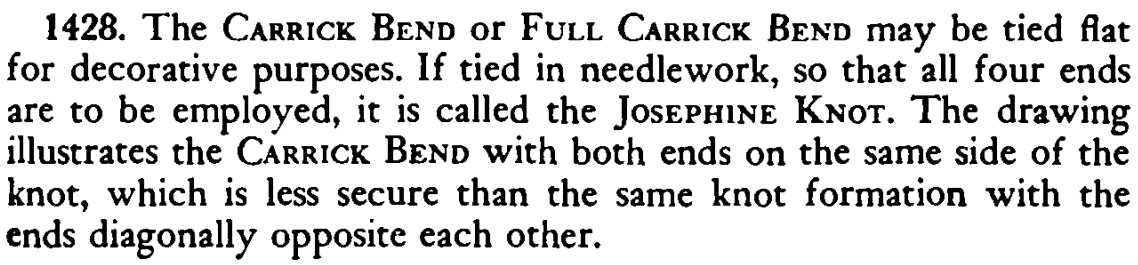
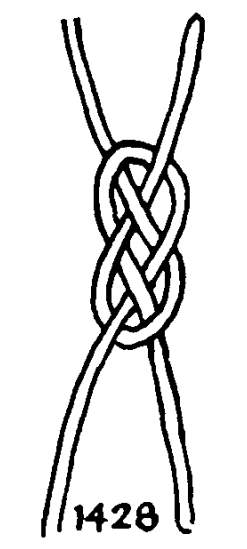
Carrick Bend (ABoK #1428)
Alternative names: Sailor’s breastplate
ABoK: #1428
Wikipedia: Carrick bend - Wikipedia
Alternative names: Sailor’s breastplate
ABoK: #1428
Wikipedia: Carrick bend - Wikipedia
This post was a demo of the ‘concept’ of a International Knot Wiki (I’m open to better names) for the Trustees meeting on 2025.09.09.
We would be able to make knot information much more interlinked and searchable, for example including knot names in other languages, which would link back to the central main article on that knot.
If we can find members of the IGKT community who are good at knot diagrams, then we can develop detailed visual tying instructions for multiple ways to tie any given knot (eg when you have access to the working end, and in the bight)
A “Global Database of Knots”
IGKT Council suggested that me may be able to speak to Clifford Ashley’s family about them letting us use content from ABoK to help build the IWOK (International Wiki Of Knots). Colin Byfleet said that IGKT has a good relationship with the Ashley family, having helped them publish some of his earlier work.
Wikipedia has some content on more popular knots, but it tends to focus on origins, namings, etc whereas we could focus on practical and more specialist aspects such as how to tie the knot in different ways, and linking to related knots.
This may a bit much. Is it something like this or similar?
Alternate Names: [List alternate names, e.g., King of Knots for Bowline]
[Concise description of the knot’s primary uses, strengths, and limitations. Focus on specific contexts, e.g., “Used in sailing to secure a line to a cleat, strong under load but may slip if not dressed properly.” Include niche applications, e.g., “Preferred by arborists for its ease of untying after heavy loads.”]
Visual Aids:
[Embed high-quality images or diagrams. Example: ]
[Optional: Link to videos, e.g., “See this tying method in action: YouTube Link.”]
Visual Aids for Variants:
[Embed images/diagrams for each variant, e.g., ]
loop, sailing, climbing, bowline]@Seaserpent I cannot fully express how amazing this is! Dead on right. This is exactly the sort of template, exactly the right sort of information. I am excited for this idea!
Discourse has at least two good ways to put such templates into the Composer, such that authors of a Wiki can follow the template but are not completely constrained by it, they could add relevant additional sections or remove sections that were not needed.
We can gradually induct and train the wiki editors to use the full formatting features of Discourse.
We should continue working on the IWOK, keeping user-friendliness and reader-friendliness in mind. For example, aim to keep it concise without losing the purpose of the International Wiki of Knots (IWOK).
I’m currently on a three-month sick leave due to a broken wrist from a deck dance in rough weather. Still, I hope to contribute as best I can.
I am going to demo the idea to IGKT Council at the half-yearly meeting and hopefully that will excite and interest them.
I hope to have a few knots described using your template by then, so we have some good examples to show. I’ll work on it when I get time.