This is similar to the Gnat Hitch, with the exception of the final tuck of the working end.
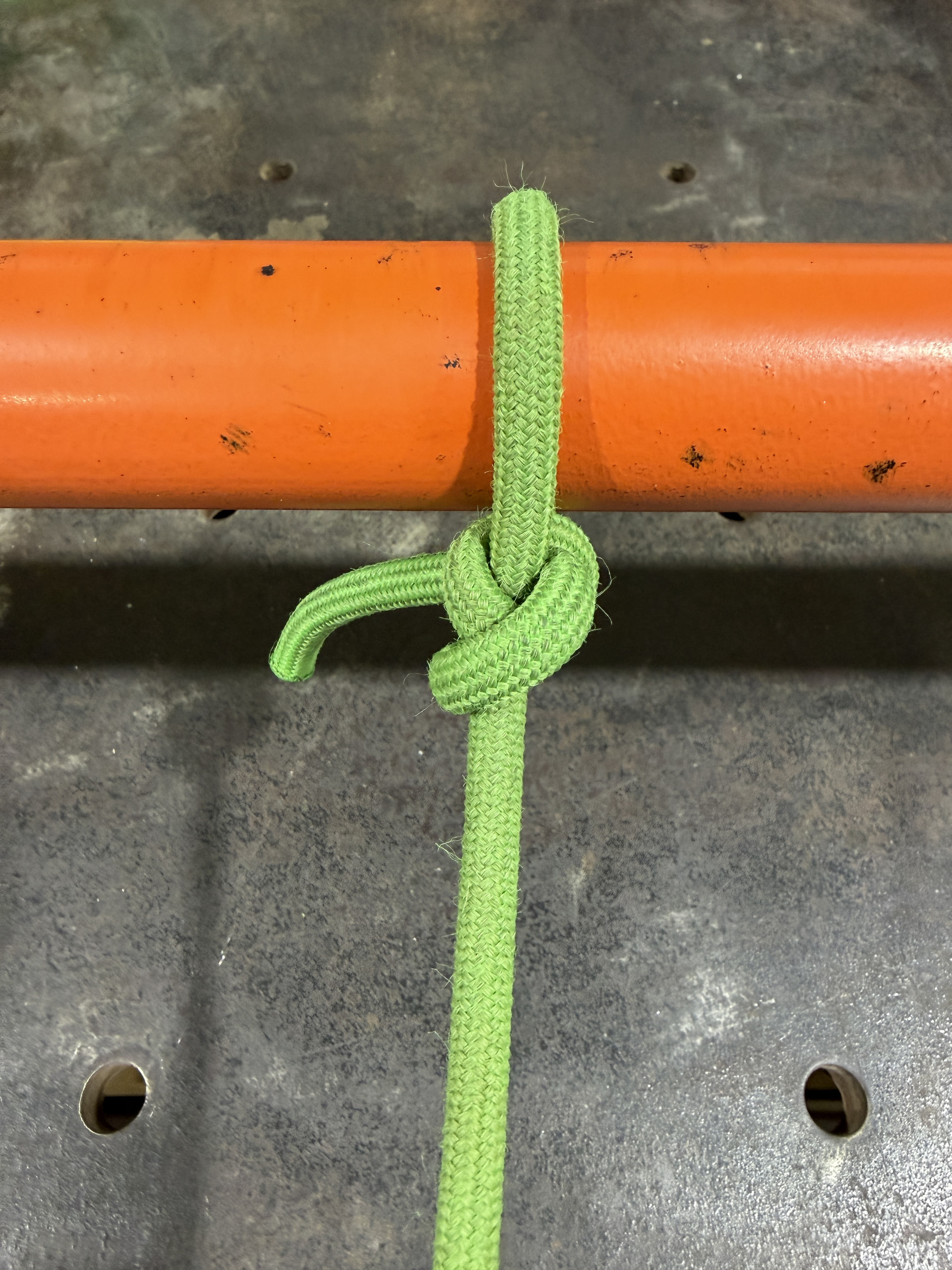
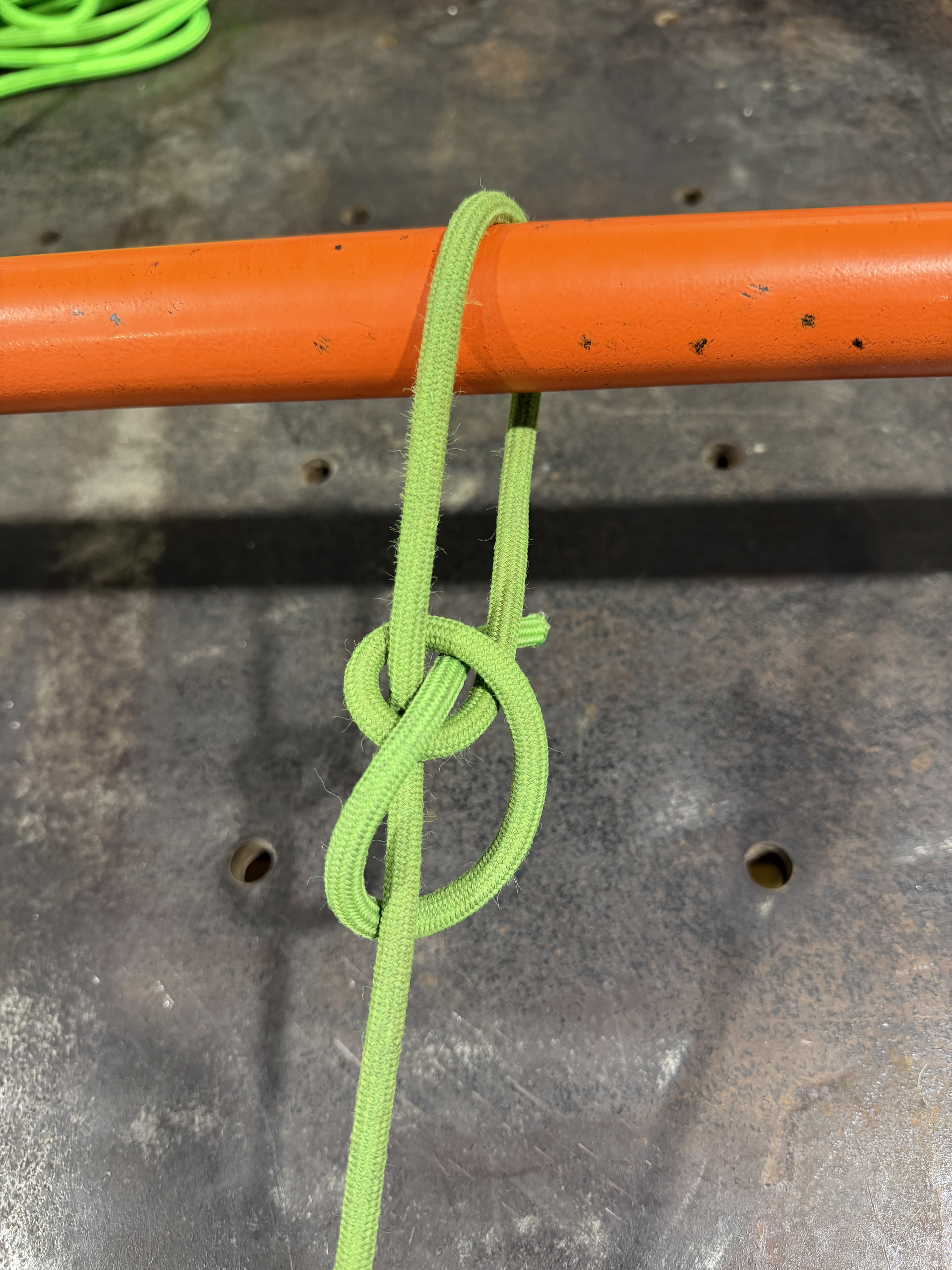
Well, I don't have a name for it, but fancied it looked
better than Roo's Gnat by tucking the Tail where it does,
but on balance I think that the Gnat might be more secure.
I have tried a variation on that by (per your lower photo)
bringing the W.End across over the S.Part,
then back around under and tucking per the Gnat
on the left side of the S.Part at that initial HHitch.
Still, they all work pretty well.
(-;
I kind of felt the opposite, It seemed to me that this hitch was slightly more secure than the Gnat Hitch, but slightly harder to untie after taking a substantial load.
I had posted this on Reddit as well in hopes that someone had run across this hitch before. A user there suggested the name Tang Hitch, which I rather liked.
I will try your version as well. Thank you for taking the time to explore this hitch.
Does anyone know the name of this hitch?
Its best described as a Gnat variant.
This comes down to how much of a geometric change is required to warrant an entirely new creation? This question has never really been answered in depth... likely because its difficult to provide a definitve answer.
In terms of the basic geometry and function, it meets the following criteria:
Its a noose - just like the Gnat noose (a type of hitch)
It has the same fundamental structure as the original Gnat noose
The position of the tail segment is shifted to the opposite side of the S.Part
I regard the 'Gnat hitch' to be a type of noose - an adjustable noose. In contrast the Poachers noose (Ashley #409) is not adjustable - it shrinks to abut and cinch to its 'host' (ie a slipping noose - analogous to a hangmans noose).
Not sure what you mean by "more secure"?
Dan also uses this phrase.. "more secure".
More 'secure' in what sense?
Do you mean the core of the hitch grips and holds its position on the S.Part?
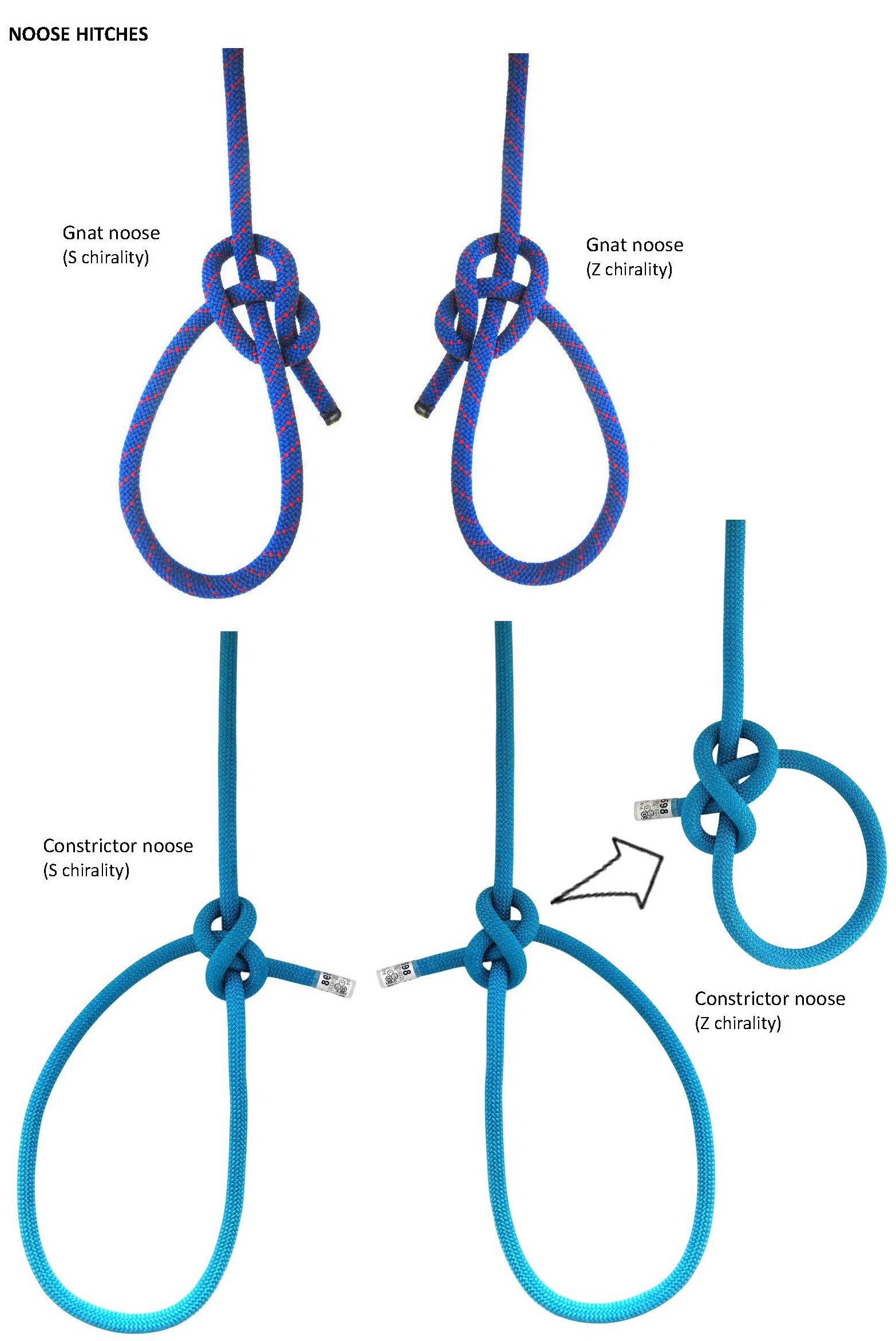
As an adjustable noose hitch, I prefer the Constrictor Noose (refer to photo). You can size adjust the 'eye' - it holds its adjusted position well.
I use it as an adjustable foot stirrup for rope ascension.
More secure - working end of the rope experiences more friction when the hitch is dressed and tightened. More friction on the working decreases the likelihood the knot structure can slip under extreme load, in other words it is more secure. Tang being the anadrome of Gnat, I felt the name was fitting.
We might be talking past each other here...
I regard this type of 'hitch' to be a 'Noose Hitch'.
It means there is an adjustable 'eye' - the size of the 'eye' can be increased or decreased as desired. When the desired size of the 'eye' is achieved - the position of the core of the hitch retains its position along the S.Part.
ie, it doesn't slip and collapse under load.
I think you envisage your noose hitch to shrink and abut its host (ie it cinches up tight against its captive host). Rather like a Poachers noose (Ashley #409).
If your intent is for the noose hitch to shrink and tightly abut to its 'host' - why not just use a Poachers noose (aka Double Overhand Noose)?
However, if your intent is to create an adjustable 'eye' - then I can see the point of a variant of the Gnat noose hitch.
Another example of an adjustable noose hitch is the "Midshipman's hitch (Ashley #1855). The 'eye' is adjustable.
A Poachers noose (Double Overhand Noose) is not adjustable - as soon as load is applied, it shrinks/collapses to abut its captive 'host'. It is very secure and stable in terms of maintaining its abutting force on its captive host.
In terms of my 'Constrictor Noose Hitch' - when I use the term 'secure' - I use it in a different sense to you. It is 'secure' in the sense that the core of the hitch retains its adjusted position along the S.Part (ie does not slip/shrink).
Again - this all comes down to your intent and possibly your definition of what a Noose hitch is...
As stated - if the intent is for the noose hitch to tightly abut and hold its host 'captive' - then a Poachers Noose (Ashley #409) is optimal. In fact, it is suitable for life critical applications because it is inherently secure.
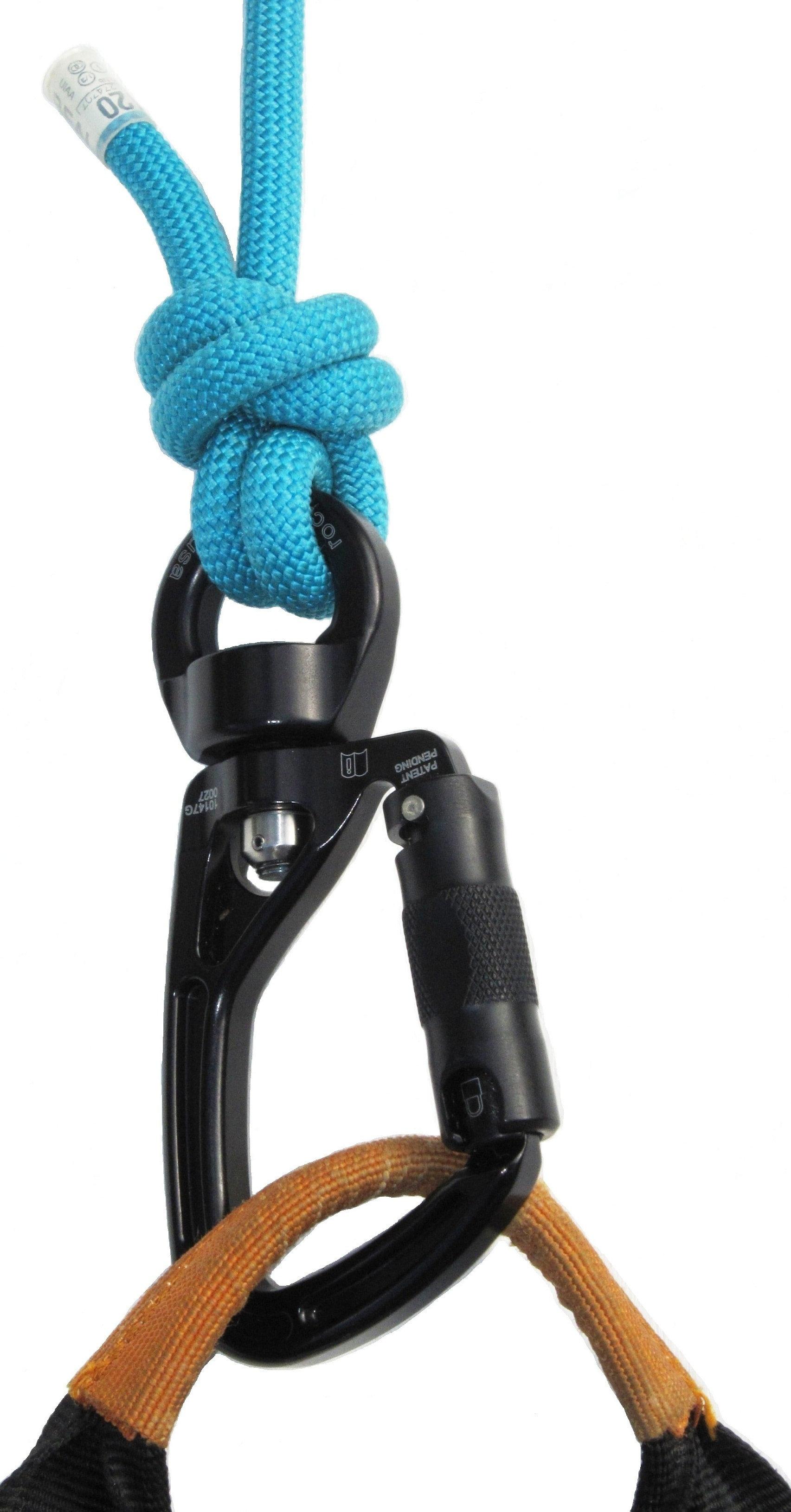
In very heavy loading contexts, we (the rope access industry) make a full 540 degree turn around the 'host' and then tie the double overhand 'strangle' around the S.Part. The 540 degree turn provides a capstan effect - which make the 'Poachers Noose' easier to untie after very heavy loading. (refer to photo below).
With just a 180 degree U turn around the 'host' - the Poachers Noose cinches up very tightly under high load - and can be difficult to untie.
For clarification, are you suggesting that the Gnat Hitch and Tang Hitch might be used as a slide and grip hitch? That’s what I am understanding, and I couldn’t disagree more. I believe both of these hitches serve a similar purpose as the Buntline Hitch, or High Post Hitch.
In order to "disagree" with something - you first need to define your terms.
Otherwise, you are disagreeing with something that hasn't been defined.
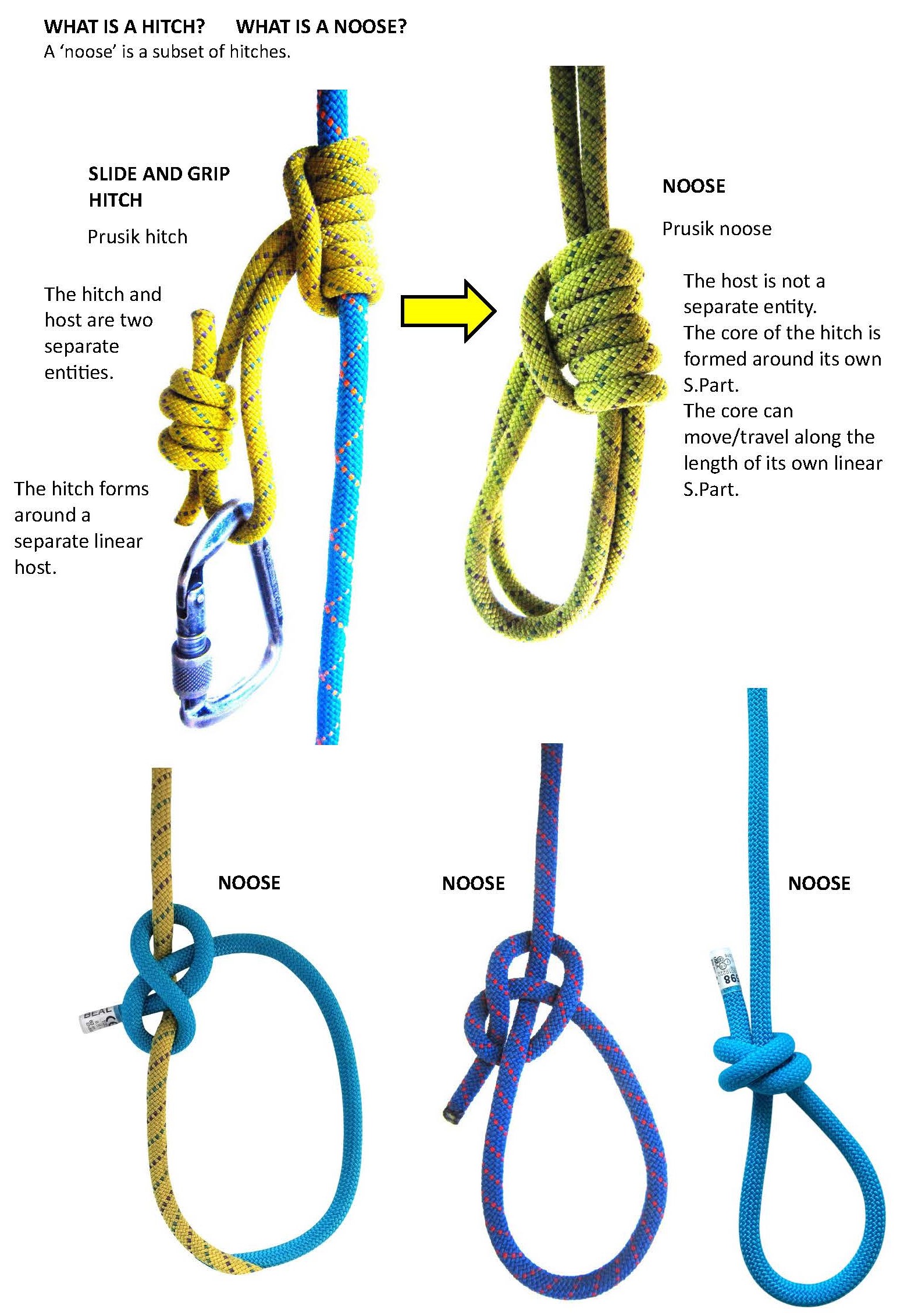
Please refer to the photo below.
A "slide and grip hitch" consists of a hitch and a separate linear host. They are two distinct entities that exist in a 'symbiotic' relationship.
The slide and grip hitch requires a host to take form and function. If the host is removed, the hitch looses structural integrity and collapses. In climbing and arborist contexts, the 'host' is a rope.
A "noose" is a sub category of hitches.
The core of the 'hitch' forms around its own linear S.Part. This forms a type of 'eye' - that can either be adjustable or slipping/collapsing.
A Poachers noose (Ashley #409) is an example of a 'noose' where the 'eye' slips/shrinks to firmly abut its captive host (it is not adjustable).
The Constrictor noose is an example of a 'noose' that has an adjustable 'eye'. The 'eye' can be set to a desired size - and it securely retains its position along the linear S.Part.
The term 'secure' in this instance means that the core of the noose hitch retains its position and does not slip apart under load.
I disagree with the premise that either of the aforementioned hitches could or should be classified as adjustable eyes that can be locked into a fixed size. Don’t get me wrong, both can be collapsed into an eye. However, the only way I can see that as possible is by half hitching or seizing their working ends to the host above the eye. Because given enough pressure, each structure will slide down the host. Is there a list of these definitions as to what constitutes a hitch, noose, etc… or is it completely arbitrary? And given the definition you provided for a slide and grip hitch, shouldn’t the noose be further defined as a structure that retains it’s form even if the host is removed? This would be the case with the Poacher’s Knot, Scaffold Knot, and the like.
As to what I was disagreeing with, it seemed fairly obvious to me. I was disagreeing with the premise that either of the aforementioned hitches could be considered slide and grip hitches. I misinterpreted what your point was. Your contention is that both of these hitches can be collapsed in a way to form into a fixed eye at a given position, if I understand correctly. I disagree with that premise as well. As I stated a little earlier, without adding half hitches or another locking structure, given enough pressure they will both slip.
My assertion is this, both of these structures should be considered hitches, in the same classification as the Buntline, Two Half Hitches, High Post Hitch, etc…
I might add that the Buntline can also be collapsed into a fixed eye. So would you consider the Buntline a hitch or a noose. In fact, the Buntline structure, once collapsed, makes a far superior adjustable loop than either of the other two hitches.
You need to be specific. Which "aforementioned Hitches" are you specifically referring to?
Once I am 100% clear on precisely what you are referring to - then it will be possible for me to "disagree".
I've defined my terms already - in my previous post - and with the accompanying photo.
In the first instance, we need to define what we mean by 'hitch'. If this term cannot be defined - then its not possible to "disagree".
Okay - so how do we define what a 'hitch' is?
I define a hitch as follows:
Means a type of 'knot structure' that requires a 'host' object to take form and function. If the 'host' is removed, the 'hitch' loses structural integrity (and in most cases, collapses).
A classic example of a 'hitch' is a Clove hitch formed around a 'host' carabiner. Removal of the carabiner (ie the host) triggers loss of structural integrity.
Now I will define what a 'Noose' is (a little wordy - but necessary to capture all the salient features):
A 'Noose' is a sub-category of hitches.
Means a type of 'hitch' where the core structure is formed around its own linear S.Part. The linear S.Part acts as the 'host' and is a type of conduit which guides the direction in which the hitch core structure slides.
The 'eye' of a noose can be adjustable or slipping/shrinking. In both cases, the hitch core structure can only slide along the S.Part - which increases or decreases the size of the 'eye'.
In the case of a slipping/shrinking 'eye', the noose will tightly abut against its host. An example is the Poachers noose (Ashley #409). This noose will tightly abut and cinch against its captive host.
In the case of an adjustable 'eye', the hitch core structure will retain its adjusted position along the S.Part without slipping. An example is the Constrictor noose - the 'eye' can be adjusted to a desired size - and it will retain its size - and will remain secure when load is applied.
...
In the specific case of a Poachers / Scaffold Noose (aka Double/Triple Overhand Noose) - if you keep sliding the core structure down its own S.Part (right to the end so the 'eye' shrinks to zero size) - it triggers structural collapse.
Based on my supplied definitions, you would now be in a position to agree or disagree. Obviously, evidence would need to be supplied to refute my definitions.
So this conversation is based on your definition of terms? I also couldn’t help but notice how you completely avoided the question as to whether the Buntline fell into the category of a hitch or a noose. It seems that your default position is to obfuscate rather than engage in a substantive debate. You’re obviously very intelligent, so the idea that that you don’t have the perception to understand which hitches we have been discussing is not only insulting, it’s disingenuous as well. It’s hard not to assume that you consider yourself the arbiter of defining knot terminology based on your responses. I’m not particularly interested in “your” definitions of a hitch or a noose, I’m interested in “the” definitions.
So let’s start here, is the Buntline a hitch or a noose in your view?
I have to say, based on the criteria you have laid out for your definitions, a reasonable person would be left to conclude that you must believe that the Buntline is a noose.
Hmmm.
Best to avoid ad hominems. I am setting out my definitional terms first - you are free to offer up your definition of what a 'hitch' is. In fact, I encourage you to define your terms - otherwise, what are you disagreeing with?
I did not avoid any questions - because we first need to define our terms. If we cant agree on definitions, then there is no debate.
For example, you might make the claim that all cats have whiskers, while I make the claim that all dogs have whiskers. There needs to be a definition of what a cat is versus what a dog is - which cant be based solely on whiskers, number of paws, number of ears, one tail, etc. Does that make sense?
This is another ad hominem - which is something that the forum moderators don't like. I personally don't care - but its the moderators who will intervene. In my personal view, words can't cause 'harm' but I know the moderators might hold a different ideology to me.
I wouldn't make a claim that I am "intelligent" - I'm just a regular curious dude.
I read through my posts - and I couldn't find any language that is insulting or calculated to insult. I also am not being disingenuous - not sure how that was imagined?
I've bolded your words to draw attention to what could be construed as ad hominem attacks. Not sure why you feel you need to react in such a way?
If you're not interested in any definitions, then why engage with me at all?
As stated, I've offered up my personal definitions - I would welcome your definitions of what a 'hitch' and a 'noose' is.
It seems you don't care what my definitions are - so I won't offer a response at this stage... unless you change your disposition in this topic post and forum.
Once again, the obfuscation. Sir, in your opinion, would you consider the Buntline a hitch or a noose?
I believe both the Gnat Hitch and the Tang Hitch fall into the category of hitches. To be considered a noose, the knot structure formed by the standing part should maintain its form whether it encapsulates the standing line or not. Such would be the case in the Running Bowline, Poacher’s Knot, Arbor Knot, etc…. Removal of the standing part from the knot structure of both the Gnat Hitch and Tang Hitch would cause their knot structures to fall apart, thus they should not be classified as a noose, but rather as a hitch. By this standard knots such as the Buntline and Two Half Hitches should be, and are classified as hitches.
I believe most people likely would arrive at the same conclusion, hence the reason these knot structures have “hitch” in their names. We don’t call the Buntline the “Buntline Noose or Buntline Knot”, we call it the Buntline Hitch. The same is true of the Gnat Hitch.
Based on your previous ad hominem, I choose to decline to answer.
Just curious to know if Have you have received a warning from the moderators? According to my understanding of the forum rules, Ad Hominem attacks are not tolerated.
Is your refusal to answer a basic straightforward question really about my disposition, or is it because my position has merit?
This topic seems to be getting a little bit away from "Does anyone know the name of this hitch?". I've set it to slow mode for a week.
Please consider de-escalating this discussion.
This forum is for all IGKT members and long-running debates that get off the original topic and start to become heated might well deter newer members or (as has actually happened) make people actually leave.
1 Like
Tang" hitch or noose" is very close to bwl 1010.
This correlation is restored by pulling the returning eye leg. Just sharing another way to form it since everyone already knows how to tie a conventional 1010 bwl.
You can also see how it relates to the Lobster bouy hitch by transposing the returning structure.
With respect to the different views that emerged about the hitch/noose issue, i always thought that forming a knot structure around the linear SPart, would give me a noose, irrespective of whether this structure equates to the unknot or not.
Additionally, maintaining a fixed eye size or cinched directly to its host during loading, never really prompted me to distinguish in terms of definition, these two loading states.
Consecutively, if the SPart was replaced by a pole, then, in my view, it would be considered as a hitch, unknot, or not (see strangle knot component of poacher's noose tied around a pole).
Your tang knot structure has a component equivalent to unknot tied around SP and it is not feasible to tie it in the bight (non-TWATE).
Now, if you perform a slight modification by threading the tail back through the collar, then the component now equates to a figure eight and does not fall apart by removing the SP, but it is now feasible to tie the whole structure in the bight (TWATE).
Obviously you consider the first one as a hitch and the second as a noose, but apart of what mentioned above, i detect no operational differences that would warrant defining them as distinct entities.
However, i could accept a noose with a shrunken and tangential to its host eye, as a "one wrap hitch" but that's only my opinion.
To delve a little deeper, we need to consider a more generalised case of this specific tang knot structure (hitch) that you have introduced in your original post.
Consider the following set up in which a long tail has been intentionally left in your original arrangement, and routed within the core in parallel alignment with the SPart.
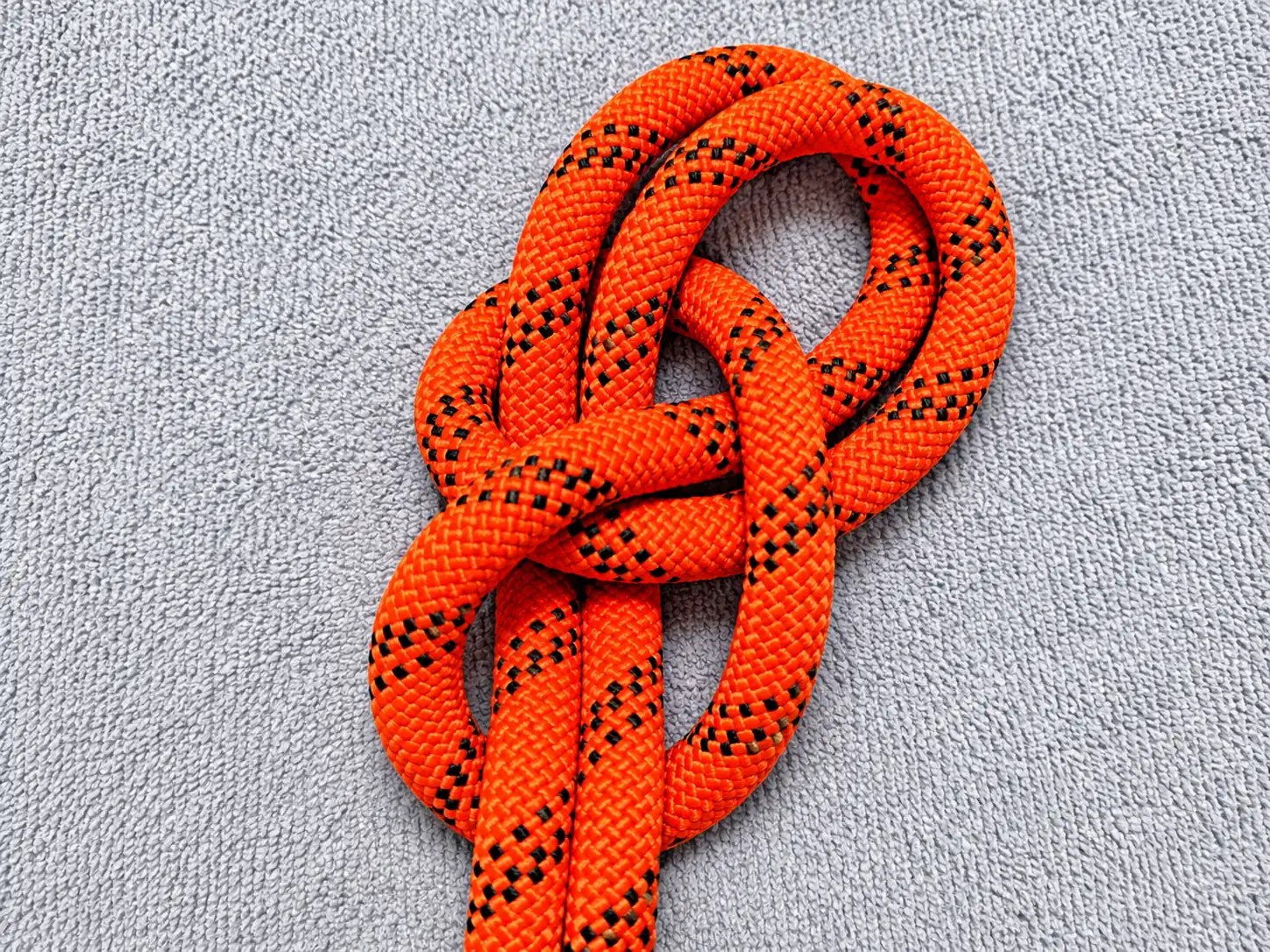
I believe we would all concur that this configuration appears to be a double wrap hitch rather than a double eye noose, and the only application i can think of, is an object inside both eyes that will serve as a host, and maintain the stuctural integrity of the core hitch.
We can extract the following cases:
- The double wrap tang hitch shown above, EEL (either end loadable), TWATE.
- Removing both SPs outside the core, we're left with the cow hitch, TWATE.
- Removing left SP it's the tang hitch of course non-TWATE.
- Removing right SP, it's the Lobster buoy hitch non-TWATE.
- The shrinking of either eye to zero size, as well as the locking of the other tangentially to a host, constitutes two more sub-cases of the arrangement i prefer to call " a one-wrap hitch" which you obviously refer to as a "noose", TWATE of course.
Perhaps the concept of a single or double wrap hitch is starting to make sense after all.