Favorite Way to Tie Trucker's Hitch

Animated Knots used to (maybe currently does, but it’s slated to be
upgraded, and the impending revision uses Dir.Fig.8) show a simple
twisted eye for the Trucker’s Hitch. I would take this twisted eye
and make one simple change : put counter-/over-wraps of the tail
around the twisted core, to stabilize that and make the point of
initial curvature-loading of the tail near the twisted eye (rather
than at its tail-end, as currently shown).
Cf. www.animatedknots.com/truckers/index.php?Categ=scouting&LogoImage=LogoGrog.jpg&Website=www.animatedknots.com

I tried this structure --the twist-eye holding a bight-eye which is
used qua sheave-- in 5/16" laid PP and stood on the secured
hitch with a 5:1 pulley --400#? It was easy to untie. I was
concerned that the twist-eye might compress/deform in some
way with heavy loading, but it seemed stable.

My prescription : make 3 half-turns (adding a cross of bight legs
each time) of a bight, then bring the tail around to wrap in 2
half-wraps (or 3) and tuck a bight through the just-formed twist-eye.
Then take the tail down to the fixed anchorage and back up through
the bight-eye and Haul Away, Joe!

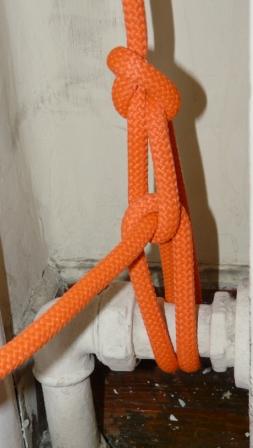
–dl*

In Geoffrey Budworth’s book, I found this loop and he calls it a overhand knot and half hitch. He also says it’s known as a packer’s knot. Budworth claims weavers use it, eskimos, and anglers for a leader loop.

I really think the knot performs well, it’s very simple to tie and has shown it’s strength in holding down my ladders. I don’t like to untie it though, that’s it’s major negative IMO. It’s hard to undo the half hitch after it’s under strain. IMO, the span loop unties much easier BUT is harder to tie, so they both have drawbacks. I’ll probably start going with the span loop in the future, although I really like the ease/speed of tying the “packer’s knot” when I’m loading up ladders at the end of a hard day.

That citation is wayyyy general --GB has about two dozen books!
Which one meets your eyes, here?

:slight_smile:

The Ultimate Encyclopedia of KNOTS and Ropework written by Budworth is the book I found it in. It’s in the very front of the book covered under ‘basic knots’. I would highly recommend this book to any person with an interest in knots. It’s simply a beautiful book from cover to cover.

I find that the Span Loop is easier to untie after hard loop load than the alpine Butterfly Loop. Do you have a picture of a jammed Span Loop for verification purposes?

“Playing” is good; but please give details of materials & loading,
so we can try to understand exactly what you’re doing.

There should be an easy selection of non-jamming knots here,
esp. those with bowline-like bases. As noted, I tried a sort of
version of what I think Knot4U calls a “Stevedore” structure,
stabilizing it with counter-wraps, and loading it pretty substantially
after hauled tight. (Though we should note that the hauling
puts more challenge to the mid-line eye-knot than the holding,
as it will be somewhat imbalanced vis-a-vis the part leading
away down to the anchor hook/ring, given friction --i.e., it
will be more an end-eye than a mid-line eye, in loading.)

:o How did you bring ropes to near breaking (and how can you tell)?!
–that’s some few thousand pounds force! Even with my (crummy) 5:1 pulley,
I figure that I’m only reaching around 800# or so if I bounce on it some.
(I have accidentally broken some cords, and Fishline, Beware!)

a [i]Butterfly[/i] tight and difficult to untie, I'll use it in a Trucker Hitch.

Noting that the butterfly is asymmetric, and has various ways to
orient the eye-legs (or tails) --crossing or not (not is usually depicted).

Above, Roo noted that a slip knot can subject a [i]Trucker Hitch[/i] to a [i]Poldo Tackle[/i] problem if there is a strong vibration or tampering: http://igkt.net/sm/index.php?topic=1870.msg12642#msg12642

No, Roo only mused that maybe something like that could happen
(and, frankly, it’s unlikely in the (dubious) Poldo tackle, for that matter)
–to wit: wondering if it might be subject to a poldo-tackle-type effect” .

And I don’t take your word for it, and …
I call BS --and let’s see some details of your test set-up.

I’ve just tried to see this in sub-1/4" soft solid-braid nylon,
and 4mm? slick soft-laid (firm strands) PP. Only with some
deliberate lifting of the haul-down side of the bight to the
anchor hook could I force some shift in the nipped sheave
bight, and only before hauling the structure tighter.
That any such de-tensioning can happen with a tied-off
structure in normal cordage is beyond belief : the slippage
will have to go through the tying-off hitch around haul legs,
around the hook, and through the strongly nipping S.Part-eye!!
That is some kind of tampering. (My lifting, to be clear, removes
any load from the “slipped” eye-sheave; normal use sees this with
tension.)

–dl*

Whether you think I was thinking is beside the point,
it is a question yet begging an answer, lacking in your reply.

Ignoring the question of your “tamper test” in which you found
slippage doesn’t shed any light on the issue, either. You claim
to have gotten a trucker’s hitch to have loosen by some mythical
Poldo-Tackle mechanism --slipping around three hard turns and
at least one strong nip–, and that certainly bears questioning,
still in the absence of any explanation (as you eliminate a
practical impossibility).

–dl*

All of this conversation and we haven’t come close to an agreement on which midline loop to use for the truckers hitch…I guess I’ll keep using the slipped OH with half hitch added to then form a fixed loop. Budworth also calls this a ‘packers knot’. The two that make the most sense to me are the span loop and the one I just described, especially if we’re worried about using a slippery hitch of some sort.

The common way on youtube and other internet sites seem to be a slippery hitch with a twist or two…many here seem to think that won’t hold properly and I can see where you’re coming from. This method would probably be just fine in most applications though, such as moving furniture from one part of town to the other etc. I’m starting to believe the most important part of the trucker’s hitch system besides the midline loop or hitch, is the final tying off method.

I’ve noted that it isn’t difficult to get the Poldo Tackle to lengthen if subjected to jostling, jolting, or other motion. I encourage you to give it a try. The only question is how difficult it is to get that effect to take place in an actual tensioned trucker’s hitch with a slip loop or a loop that communicates with the moving line. This assumes that you can see the Poldo Tackle analog in such a trucker’s hitch that doesn’t use a fixed loop.

I will kindly leave the matter to knot4u to describe the conditions by which Poldo-Loosening occurred in his trucker’s hitch testing.


http://notableknotindex.webs.com/poldotackle10.gif

I am saying this: you have made a couple of assertions without
giving any detail, which are hard to understand. How did you
bring ropes to near breaking strength (and how did you know
what the force was, that it was in fact near …)?
(That is something one usually tries hard to avoid, and with ropes
(not string/cords) it requires considerable force, posing some danger!)
And what is this “tamper test” of which you speak, and by which
you judge many common knots as being defective.

Further, I have tried to find ANY HINT of the mythical Poldo-Tackle
slippage & loosening you claim to have found; but you give no
details of your “tamper test” by which you …

I verified this when I put various slip knots through a tamper test.
I tried it with three different materials, more recently with slick, new, nylon hollow-braid commercial-fishing binding cord run through a 'biner anchor (a relatively broad, smooth, round metal), which I could *strum* for vibrations.

Now, Roo suggests trying the Poldo Tackle and seeing the behavior.
Yes, it can happen --just tried it with that hard, firm-slick-3-stranded
soft-laid PP 4?mm cord run through 'biner anchors holding 5# and
then 17.5#. Indeed, I had long ago built a low-friction Poldo Tackle
using another, maybe slicker PP cord (sent to me in frustration by the
sender and called “the Devil’s cord!”) and cut-out 2-litre bottle necks
for sheaves (broad, smoooooooth-slick); for I had come to conclude
that the Poldo Tackle was theoretically (i.e., sans friction) unstable
–and, indeed, in this latest, low-friction construction, it quickly slipped
to full-extension lock (Roo’s upper figure, eyes abutting) !!

But the P.T. is a far cry from the trucker’s hitch workings, where in
place of simple eye one has a hitched eye (i.e., it’s constricted)
–maybe two (i.e., the tied-off tail if hitched snug to the sheave-eye)–,
and possibly a constricted pair of haul lines (i.e., when one ties off
around the pair of down-to-&-back-up-from lines around the anchor.
AND one is unlikely to be using the slickest cordage available.

.:. I’m curious about what your “tamper test” was.

–dl*

There’s more than one way to skin a cat : you have some variety
presented here from both use & conjecture, and one can encounter
a variety of circumstances of tying & materials.

I guess I'll keep using the slipped OH with half hitch added to then form a fixed loop. Budworth also calls this a [i]'packers knot'.[/i]

This seems an UNdesirable knot, in that it’s not TIB (tiable in bight);
why select it?

The two that make the most sense to me are the span loop and the one I just described, especially if we're worried about using a [i]slippery hitch[/i] of some sort.

I’m not worried about many of the knots here, esp. the traditional ones,
other than the simple nipping turn i[/i] construction, which
has that air of instability, vulnerability to mischief --and esp. in some
materials. As for the span loop, from the same beginning, one can
form a single bowline in the bight, taking the short (upper, as shown)
bight end down & around all that is below it (a bight & tail), bringing
it back up into position as the bowline’s collar, and dressing. This
bowline can be seen as tucking the 2nd turn of a clove hitch through
the first and working that “backflip” (I have called it elsewhere) move
–best in this particular form of the collar, IMO, btw).

The common way on youtube and other internet sites seem to be a [i]slippery hitch[/i] with a twist or two...many here seem to think that won't hold properly and I can see where you're coming from.

The slip-knot or like (in posts above I’ve specified giving added twists
and then a counter-wrap before tucking the bight through) should be
fine, and no one but Knot4U has deemed it vulnerable to loosening
–an allegation we stand wanting details about, and which possibility
I have strongly denied.

I'm starting to believe the most important part of the [i]trucker's hitch[/i] system besides the midline loop or hitch, is the final tying off method.

For that, if you’ve room, you can initially put a half-hitch around the
two down-legs, jamming it secure; then you can tie off that with a
rolling hitch, or might only need to wrap the tail around the half-hitch
between the nipped down-legs and jam it into place, which should
give added resistance to the half-hitch slipping. Again, this will be
material-dependent in behavior. You might go down to the anchor
a 2nd time and back through the sheave and get some versatackle
mechanics, with adequate rope and accepting anchor.
–more cat-skinnings …

–dl*

If we tie a second loop, or if we pass the Working end two times around the anchor point and the (first) loop, we can arrange the tail to pass in between those two loops, and be locked there by the compression of the two U s of the two loops on it.
This is done very easily. We just pass the tail through the (first) loop, and then we pull it towards the anchor point. It will go automatically, by itself, underneath the second loop, between the first and the second loops, and it will lock there (See attached picture).
I do not know if it is a common practice, but this is the way I use to tie my trucker hitches from one anchor point on the ceiling, and one anchor point on the ground, to have a tensioned rope, ready for my “hitch around tensioned ropes” tests. The so secured tail between the two loops needs no further knotting, but, in heavy loadings, we should secure it even further. Having it locked at there, this would be now an easier task.


trucker s hitch.JPG

The interesting thing is not the presence, or not, of the second loop (versatackle). It is the way the tail locks in between the two U s, either there is a second loop (versatackle), or one loop and the Working end making another trip through this one loop. The tail is very easily put there, almost by itself, and it stays there ! Then, we can secure it further much easier, in many ways.

It’s what?
Well, nevermind, I think we can see how you hold to your positions.

1. [b]Tampering[/b]. ... grab the length of rope that extends from the slip loop down to the second anchor. Pull on that toward the second anchor such that the slip loop shortens. You can also pull the opposite strand inside the loop the opposite direction. Depending on the rope, you may have to use more force. Regardless, that strand of rope is definitely susceptible to movement.

That is some kind of “tampering”! Yes, what you say can occur.
And there’s another “tampering” test to go along with this one,
at the same level of reasonableness & aptness per tampering :
untie the tie-off knot; untie the mid-line eyeknot --not even a fixed
eye stops this tampering (or the simpler one, done with a knife).
Your method sounds like better exercise, though. ::slight_smile:

(Also note that it's common to pull on that strand of rope to help tighten a [i]Trucker Hitch[/i] before tying down.)

It is?! I don’t note that at all; I haul on the haul line. But whatever the
case, tying down is done with a tight structure, and for any slippage
to occur it would take some serious deliberate effort such as you describe.
(NB: You neglected to mention what nature of cordage this occurred in.)

2. [b]Vibrating or jostling[/b]. I have some trees around my house supported by Trucker Hitches. After a storm with strong winds, the Trucker Hitches were loosened. According to my observation, the slip loops were noticeably smaller.

Mere loosening would indicate unrecovered stretch from loading, most
probably, or some shift as you suggest; but not the shrunken slip-eyes.
Again, you don’t mention the nature of the cordage. Or the details of
your structure(s) --the then-favored “Steverdore” slip-eye, with Two
Half-hitches
tie-off?

As another example, I have homemade exercise equipment ...

Of why you care, yes, but this isn’t an example of shifting,
for you’ve not observed any.

If I tie a simple fixed loop, ..

You prove that there are many ways to skin this cat,
yes. --which can be simple to tie/untie.

There will probably be [u]misplaced replies[/u] here telling me results are off. That's OK. I trust my results more than I trust anonymous dudes on the Internet playing keyboard commando. Also, I'll be tying my knots. You'll be tying your knots. I recommend you generate your own experimental results because you'll [be] the person tying your knots in the future. People like Dan may call my prudence B.S. I call it not being an idiot.

“People like Dan” --viz., those who do read (all of) what is written
and think about it and take its measure with what they know–
called your assertion about Poldo-Tackle effects in the Trucker’s Hitch
“BS”. Your “tamper test” works to prove that point, but the tree-support
changes urge some further consideration; but we’re still short on details
here. (But I note that you made no hint about finding failing trucker’s
hitches
other than by taking Roo’s musing into a severe “tamper test”
and then deeming what has worked well for many to be suspect!?)

It didn’t seem as though your keyboard punching was done solely for
your own entertainment but was offered as anonymous-person advice;
in this forum, that’s up for challenge (even by the unanonymous).

–dl*

Ahhhh, now you’re hooked! --it IS such an intriguing structure.
But as you use it more and more demandingly you’ll find that in
fact it does NOT stay there --rather, it tends to squirm out
of the opposed-bights nip, when tensioning, that is.
This is the reason you see my added long turns around a leg of
one the opposed bights in my binder discussed here
http://igkt.net/sm/index.php?topic=1451.0
(hauling is done best by pulling tails away from each other,
especially on slippery bound objects).

I wouldn’t be concerned about the structure under heavy
loads, but under fluctuating ones, and any slackening;
as you note, the tie-off is a simple, casual affair. And the
untying is done by taking the tail back through the upper
opposed bight (in this orientation) and pulling it out of
the nip.

–dl*

Yes, I consider this “lock” between the two U s a temporary solution, to offer the tyer the time window ( and the convinience) to secure it further :

The mechanical advantage has also, a a side effect, the advandage to dampen, absorb, in a way, the dynamical loads of fluctuating forces. However, I woudnt leave the tal there without further security, in a truck ! :slight_smile:
The tails unlocks, gets out of the embacement, with the same easy way it locks, gets in there, as you describe.

I had not noticed this mechanism to this day. I might have missed the thread altogether, or confused by the linguistics. The text, just above the telling picture (See attached re-posted picture from this thread) is redundant and tends to obscure the solution, rather than enlighten it. A fine, beautiful mechanism.
Congratulations, Dan Lehman !

Are the twisting of the two tails used on purpose to offer some aditional, reef-knot-like, friction ?

As I said, but wasn’t understood --awkward to word–
“This is the reason you see my added long turns around a leg of
one the opposed bights”
:

The twist (“long turn” --well, depends on the structure how “long”)
pulls the tucked tail to one side where it can’t get into mischief
and let an nipping part crawl over and eject it. This was the only
way I found to resist that otherwise annoying problem.

I was eager to try out this binder, and one of the first uses was on
some, hmmm, bamboo poles transported on a roof rack for use in
setting up a banner, IIRC.

–dl*

Good, I understand it now. It is only to keep the orientation of the tails entering into the nipping loops right.