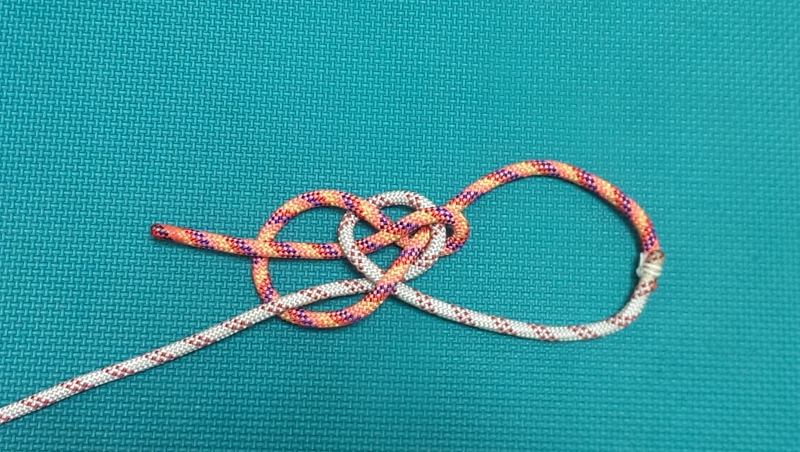
Figure out an easy TIB tying method for Scott s locked TIB bowline

JP, the left-handed bowline and the right handed bowline have different topology ! You can not change topology by re-dressing ! We call both of them with the same name, because their shape/geometry/structure is similar, indeed, although their topology is completely different ( and that is a curious instance of two knots called by the same name, although they are different topologically ). However, just imagine what will happen if I propose to call the left-handed bowline by a different name ! :slight_smile: :slight_smile: :slight_smile:

I have called it as a (slight) modification / variation of the Scot s original bowline, because that is how I had tied it, in the first place, and because the idea is exactly the same : a collar around the nipping turn s rim, and then a tucking through the opening formed by the collar. Scott himself has mentioned the difference, but never denied that it is a variation of his locked bowline, and should be named as such. If we call the one form of the bowline a variation of the other, because the structural difference can only be revealed during ring loading, why we should not call those two locked, by the same mechanism, eye-knots the one a variation of the other, when there is no structural difference, re. this ring loading, ever ?
Now, Scott noticed that the sharp turn around the nipping turn may be better suited for the intended function, which is to prohibit any slippage of the Tail, and that the wider, smoother curve around 2 rope diameters in the “slight variation / modification” of his initial knot may actually be detrimental to this purpose : the rope can perhaps flow / slip around a wide curve easier than around a sharp one. I am not sure about this, we have to measure it, to see what actually happens.

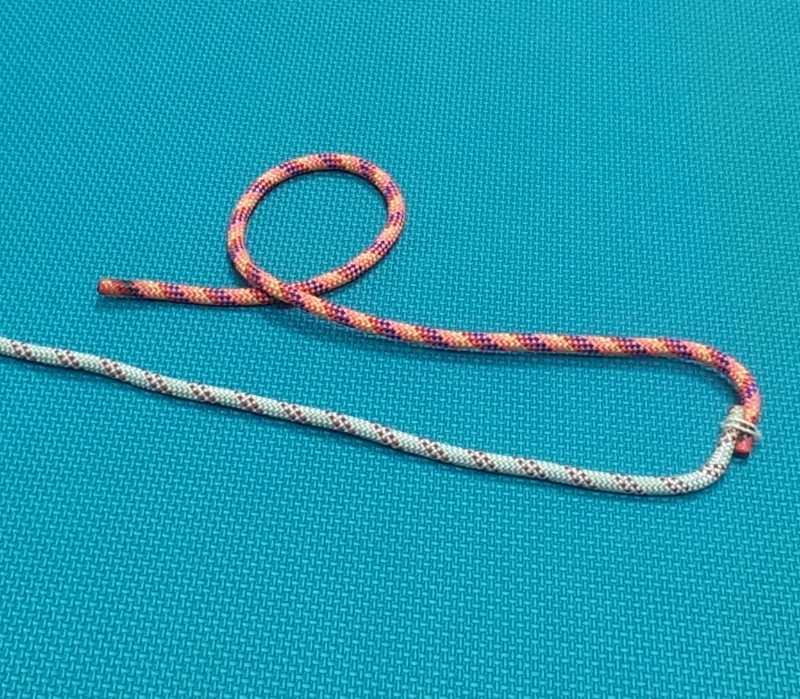
IIRC, the one is called the bowline, and the other is referred to as a left-handed/cowboy bowline. The names are already different.

I have called it as a (slight) modification / variation of the Scot s original bowline, because that is how I had tied it, in the first place, ...
I don't see how you could have managed it as "a (slight) modification / variation of the Scot s original bowline" (sic) since it is based on the cowboy/left handed bowline, not a standard bowline. Can you show the steps you went through? It could be called a "cowboy Scott". ;) But that would be better suited to the lock going around the the TurNip only, as it does in his original knot. It would be more logical to call it a variation of [i]that[/i] knot. We could even lock the Eskimo bowline in a similar way and call it an "Eskimo Scott". ;D ;D ;D
... If we call the one form of the bowline a variation of the other, because the structural difference can only be revealed during ring loading, why we should not call those two locked, by the same mechanism, eye-knots the one a variation of the other, when there is no structural difference, re. this ring loading, ever ?
Again, difference in the knot from which they are derived. The knot in this thread is [i]easily tied, remembered, and showed to others[/i] when starting from a cowboy bowline (not so TIB), and impossible when starting from a standard bowline.

– J:P

It is called “Cowboy bowline”, by whom ? By Ashley who believes that it is “dinstictivelly inferior”(sic) from ABoK#1010 ? Or by that ridiculous Wikipedia article, written by some would-like-to-be knot tyer, who believes that the “Eskimo” bowline is a “faulty, insecure”(sic) eye-knot ? :slight_smile: Personally I have never called it as such, and I am sure that billions of people had not called it as such, too… :slight_smile:
The commonly used names are right-handed and left-handed bowline. Personally, I follow this convention, which sounds OK to my ears. When we speak about the “Common” bowline, we do not mean the one or the other form of the bowline - if we do like to be specific, then we add the adjective right-handed or left-handed. Anyway, we had enough with the name game lately - let us not return to it. ( In my mind, I also call it καντηλιτσα, or noeud de chaise, and I would love to learn how it is called in Chinese, for example :slight_smile: ). The fact is that the differences between the names are slight, indeed, considered that we speak about two knots of different topology !

The idea of the lock was/is the important thing, not the underlying form of the bowline. I have tried to avoid the sharp turn around one rope diameter that I did nt like in Scott s original knot, and it seemed very natural to me to try to base the same lock on an “other” handed bowline. We do this all the time, with the various Janus bowlines, for example, trying to force the working end to follow wider curves. I do not even pay any attention or remember on which form of the bowline a particular Janus “Common” bowline or a particular Janus “Eskimo” bowline is based on !

Ask farmer Scott ! Both cows belong to him !  :)  (The "Eskimo" cow has not been born yet.)  

No, to me the main idea is the collar-around-the-rim-of-the-nipping-turn lock. The underlying form of the bowline is irrelevant. The same happens with the Janus bowlines, if we tie one that uses the same locking mechanism, based on the two collars, we do not distinguish it in Janus left-handed Common bowline or Janus right handed Common bowline…The handedness is irrelevant, it is the kind of the lock that it concerns us .
Two knots that are topologically different can not be re-dressed so the one become identical to the other, by definition. I do not understand why you pay so much attention to this primordial fact ! :slight_smile: The important thing in the Scott s locked bowline is the simple lock which does not need a second collar around an eye leg - it uses, as a post, the rim of the nipping turn, and it collars that post, not any eye leg… The TIB variation is just the same idea, where the orientation of the lock in relation to the axis of the knot has been reversed, so the working end can now encircle two strands, and follow a smoother path. I had not noticed at the time I tied this eye-knot that this slight modification / variation produced a knot which happened to be TIB - it was just a “historical accident” :slight_smile: !

By me, for one, and I don’t use the term in a pejorative sense – I grew up logging and ranching cattle. Has anyone ever stopped to wonder why cowboys tied the bowline in this manner? (It seems quite obvious, but I have never heard/seen a discussion of it.)

By Ashley who believes that it is "[i]dinstictivelly inferior[/i]"(sic) from ABoK#1010 ?
Not inferior, at least for the purpose in which it is commonly employed by cowboys.
Or by that ridiculous Wikipedia article, written by some would-like-to-be knot tyer, who believes that the "Eskimo" bowline is a "[i]faulty, insecure[/i]"(sic) eye-knot ?
I expect that Scott's lock might improve the security of the Eskimo bowline as well.
... The commonly used names are [i]right-handed[/i] and [i]left-handed[/i] bowline. Personally, I follow this convention, which sounds OK to my ears. When we speak about the "Common" bowline, we do not mean the one or the other form of the bowline - if we do like to be specific, then we add the adjective right-handed or left-handed.
I wish to be specific. I believe that it is important from the standpoint of logic and clarity. Call it a [i]modification of the knot which can be modified to tie it[/i]. Right-handed and Left handed are fine. Again, this knot cannot be tied starting with a right-handed bowline.

I agree wholeheartedly. I have made my point and will leave it at that.

– J:P

I fully agree. The lock in this thread is a modification of Scott’s lock which can be applied to the left-handed/cowboy bowline (and the respective form of the Eskimo bowline), but not the common/sailor bowline. It makes more sense to me to call this mechanism – the “collar-aound-the-rim-of-the-nipping-turn lock” – “Scott’s lock.” And the version used with the knot in this thread could be called… uh…“Scott’s LoX” :o ;D ;D .

– J:P

Neither do I ! However, the term " left hand bowline", used at ABoK#1034.5, which differs from the term “right-hand bowline” by just one hand :), describes very adequately ( the difference in ) the position of the two legs ( or hands ) of the bight component. I don not see any reason we should call the “right-hand” bowline as just THE bowline, and use an adjective only for the “other” bowline. Those “two” knots, although they have a different topology, the have a similar geometry/structure, at least until they are ring-loaded ( a rather rare situation )
Do cowboys use the bowline ? What for ? I understand they need a noose, not a fixed eye-knot …

Do not compare cows to bulls ! :slight_smile: The Scott s locked bowline is a locked bowline - if it was not distinctly superior to ANY form of any not-locked bowline, we would have not been talking about it right now…Farmer Scott had this Columbus-egg idea of using as a rigid post, as an anchor for a second collar, the nipping turn itself, its rim, and not an eye leg - and doing this, he got rid of the complications caused by the widening of the angle between the two eye legs and the ring loading.

  1. I have used this term, “modification”, many times, with the same sense : it is a procedure that changes the details of a knot, leaving the main idea unchanged. It does not matter if the modification changes something at the first stages of tying the knot, or at the last stages - as long as it leaves the main idea in place. To my view, Scott s locked bowline is just a bowline where the Working end had been forced to follow a more convoluted path after it has been tucked through the nipping loop for a second time, and, more specifically, where the Working end collars the rim of the nipping turn and then goes against the Standing part, until it leaves the knot s nub.

  2. What is the “left-hand” bowline, in relation to the “right-hand” bowline ? I believe we can say that the one is a modification to the other, indeed, because the main idea is the same, although the topology is different - which means that one can not tie any of them by a simple re-dressing of the other, or a re-tucking of the other. You seem to use the term 'modification" with a more specific meaning, that describes something added on something that exists, something tied after something else has been tied already, and should not be untied, something on top of something else. I use it in a somewhat broader sense, which is not related to the temporal sequence of the tying process, but to the spatial arrangement of the strands in the final knot. If two knots are based on the same idea ( as the two forms of the bowline, for example ), even if they are have a different topology, and neither one of those two can be tied by adding something to the other, those two knots can be considered modifications of each other, IMHO.

Scott s lox ? ? The modification of the original Scott s lock can not be considered anything more than a bell that makes a slightly different sound around the neck of a Scott s cow ! Scott himself prefers the sound of the original bell, but this bell is his, too - it is the cow which wears the bell, not the other way around ! The fact that one should first remove the one bell from the neck of the cow to put on the other, does not change the cow itself, or the relation between the farmer and the cow. :slight_smile:

Quickly and then I will retract/delete this.

I’m about ready for some steak.
:wink:

SS

Well said. But you have put the bell (a different bell that makes a different sound) on a completely different animal from the same herd. Scott is getting hungry and has to choose which one he is going to eat for dinner. If he eats the wrong one, he might be lacking for butter, cream and fresh milk in a few days, and the bull might be brokenhearted. But the steers will all be relieved. :wink:

– J:P

JP, a cow is a cow is a cow, for CowGod s sake ! A cow is not a completely different animal, it is the same animal - the DNA of the one is 99.99 % identical to the DNA of the other. To us humans ( farmers excluded…) cows are similar things…and I suspect that the same is true for a bull ! :slight_smile:

Now, it is true that we have an odd / rare situation here : We have two geometrically and structurally similar knots, at least when they are not ring loaded, that have a different topology. We call them with the same name ( “bowline”, “white” bowline or “black” bowline" - just like “cow”, white or black cow ), even after we have decided that a different topology means a different knot - and most of us don’t even notice which of the two we tie in everyday life. I have seen that most fishermen and sailors tie, as a mooring knot, the ABoK#1010, and they look at me with this " what this a.w.o.e is telling me now" look, when I try to explain to them the difference between 1010 and 1034.5… Myself I was not aware of this difference till I set foot in this Forum, a few years ago, although I was tying the bowline ( any of the “two”…) for decades !
I do not know if there is a problem here, but I suspect this is a very rear situation, and it should not force us to re-consider the basic assumption of all knots, be them mathematical, ideal or physical and practical, that two different topologies mean two different knots. We have soooo many other problems even after this stage ( certain dressings that change the geometry / structure of the underlying knots drastically, so they force us to think of two different knots, albeit of the same topology…) that it is better if we just pass this for the time being / put it under the rug, if you wish.
See, for example, the Carrick X bend, at :
http://igkt.net/sm/index.php?topic=4128
and tell me if it is the same or different knot from the Carrick bend…I had not recognised it when I first tied it, and it was Luca that had pointed to me the similarity / identity - (or what else ?) in relation to the Carrick bend.

Actually, ranchers refer to individual cows/bulls/steers/heifers as “animals”. I was using the word in this sense.

Now, it is true that we have an odd / rare situation here ....
Rare -- like trying to rubber-band a heifer. :o ::)
: We have two geometrically and structurally similar knots, at least when they are not ring loaded, that have a different topology. We call them with the same name ( "bowline", "white" bowline or "black" bowline" - just like "cow", white or black cow ), even after we have decided that a different topology means a different knot - and most of us don't even notice which of the two we tie in everyday life.
We have two geometrically and structurally similar animals -- both bovine -- and [i]most people who don't know better[/i] call them with the same name. Imagine the confusion if cattlemen referred to every animal in their herds as "cows"! Then you would have people trying to rubber-band heifers! But cattlemen know better and avoid this confusion by referring to individual animals in their herds as "animals" and being clear when talking about steers, bulls, heifers, and "cows." Then when someone who doesn't know better asks, they can easily point out the differences. :)
I have seen that most fishermen and sailors tie, as a mooring knot, the ABoK#1010, and they look at me with this " [i]what this a.w.o.e is telling me now[/i]" look, when I try to explain to them the difference between 1010 and 1034.5... Myself I was not aware of this difference till I set foot in this Forum, a few years ago, although I was tying the bowline ( [i]any[/i] of the "two"...) for decades ! I do not know if there is a problem here, ....
I feel that there [i]is[/i] a problem, and that not addressing it will lead to major confusion for those interested in learning about these knots. I fear that they will assume (as I did -- which led to a certain period of intense frustration) that the version in this thread is based on the [i]right-handed/sailors/standard/common[/i] -- take your pick -- bowline, which it is not.

– J:P

So, would you propose to call those two topologically different animals, the ABoK#1010 and the ABoK1034.5, by an altogether different name ? Say, the one as bow-line and the other as stern-line ? OK, you go for it, and you start spewing volumes of arguments in favour of it …This time, I will do the swallowing:slight_smile:
The two forms of the bowline are topologically different, but they are still called by the same noun - like eating same piece of beef, only with a different sauce on it. Same happens with the two forms of Scott s locked bowline : same lock, same key, only you have to turn the one key of the one knot clock-wise and the other key of the other knot counter-clockwise.
I do not trust the names of the knots…Too often they are misleading, indeed, and they do not help / allow people to distinguish differences or similarities which the should had noticed right away. However, the human mind works this way - and it may even be the case that the human mind can work, because it can work that way.

No. I have no desire to change the names currently used. What I do propose is calling them by the names they have now, to wit: the bowline/right-handed bowline and the left-handed/cowboy bowline, with the addition of Scott’s lock. The purpose of my proposal is to be clear about which of these can be modified into the knot which is the subject of this thread ( by using the mechanism of the lock in this thread, your modification of Scott’s lock, which can only be used as a modification of a left-handed/cowboy bowline.

... The two forms of the bowline are topologically different, but they are still called by the same noun ...
Actually cows/bulls/steers/heifers/and oxen are all different in their own ways, but are all called cows, when the distinction is unimportant. In certain instances, it is important that distinctions be made (castration, milking, and breeding, to name a few). In the case of the lock which is the subject of this thread, [i][b] the distinction is important[/b][/i]. The Scott's lock applied to a [i]right-hand bowline[/i] is not the same as the Scott's lock applied to a [i]cowboy[/i] bowline is not the same as a Scott's lock applied to [i]Eskimo bowlines[/i] (with the tail on the inside or outside).
- like eating same piece of beef, only with a different sauce on it. ...
Wrong. The beef is not the same. The meat of bulls and steers is different. Bulls (and oxen) are much more muscular and tend to have stringier, tougher meat than steers. The meat of calves (known as [i]veal[/i]) is the tenderest of all. And you can't get veal from a 5-year-old bull.
... I do not trust the names of the knots...Too often they are misleading, indeed, and they do not help / allow people to distinguish differences or similarities which the should had noticed right away.
Precisely! And what I hope to achieve by my proposal is [i]clarity[/i], not obfuscation, which I believe calling this knot simply a "simple modification of a Scott's locked bowline" causes through lack of precision. Scott did not propose that his modification be made to a left-handed/cowboy bowline, although it can be applied to that knot. The the current modification cannot be applied to a right-handed bowline, and I believe that this fact should be reflected in the name.

– J:P

I agree we should be more precise / descriptive when choosing names for new ( or even old ! ) knots - although the two forms of Scott s locked bowline are only a “detail” in this. See what is happening in the four different variations of the “Eskimo” bowline : they do not even have names ! :slight_smile:

Only a detail when referring to Scott’s modification. I am sure that when Scott goes climbing with his family/friends and introduces them to this knot, he surely says something like, “First tie a bowline (meaning a right-handed bowline) and then do this…” and he shows them how to tuck the tail and arrive at his modification. If he wanted to show them how versatile this modification is, he could teach them about right-handed and left-handed bowlines and how the came mod can be used on both.

Surely if you were showing/teaching/telling someone how to tie this knot which is the subject of this thread, your mod of his mod, so to speak – not tying in the bight mind you, that’s really complicated – you would tell them to start by tying a left-handed bowline and, continue from there.

Now my lesson would probably go something like this:

Alright, kids, do you see this rope? Well, the rope is a tree and look here (twist the rope to create a turNip) – this is the hole, and this (the working end) is the rabbit. Now watch as the rabbit runs out of the hole, runs around the tree and back into the hole. Now we have just tied a knot called a bowline.

Now look at your bowlnes. Some of you have bowlines where the rabbit is inside the loop don’t you? Well, the loop is the meadow and your rabbit is home. There are a couple of you whose rabbits are not inside the meadow, aren’t there? Well these little rabbits are out on the range with the cowboys and you have just tied cowboy bowlines.

Now when your little rabbits are running around outside of the hole, they have to be very careful and watch out for the evil X-man who will shoot them with his machine gun and feed them to his python! … ;D

– J:P

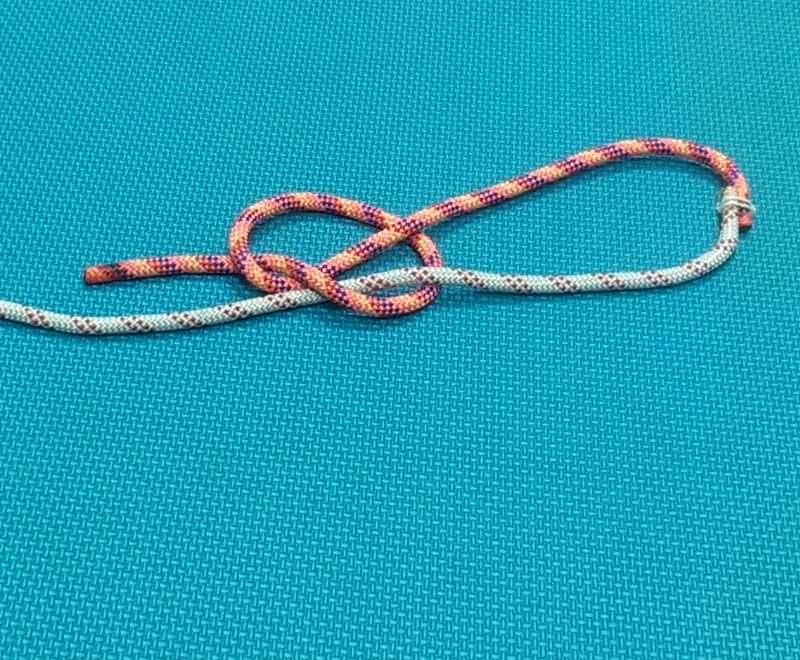
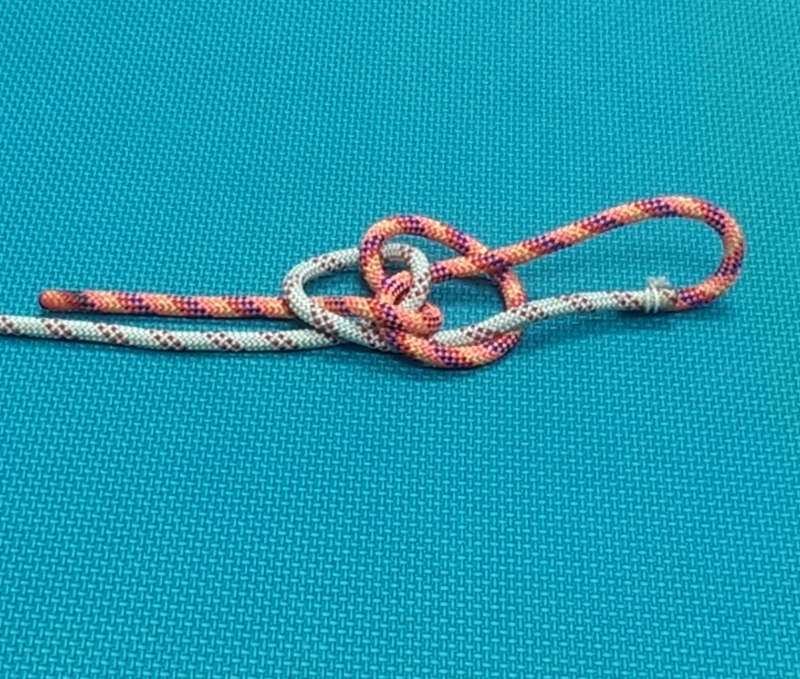
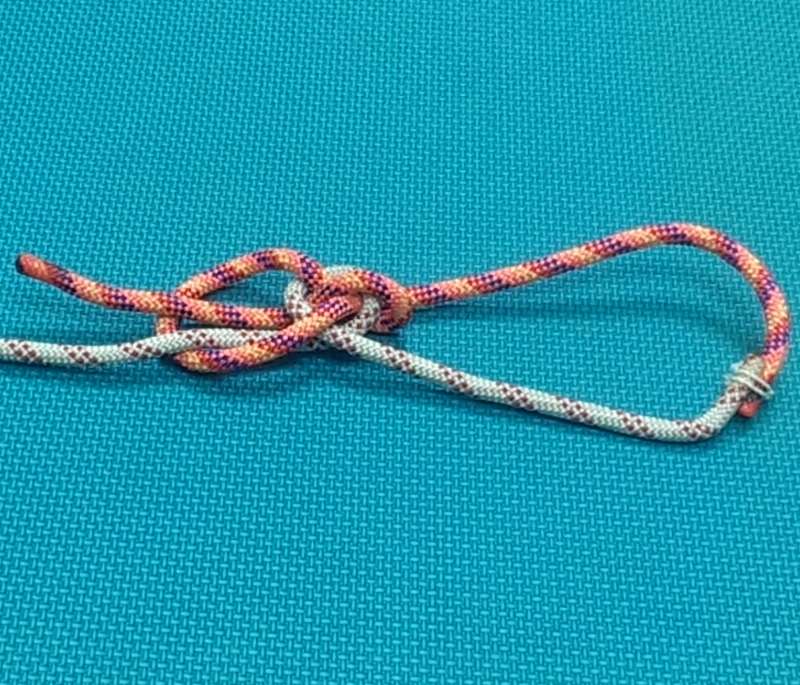
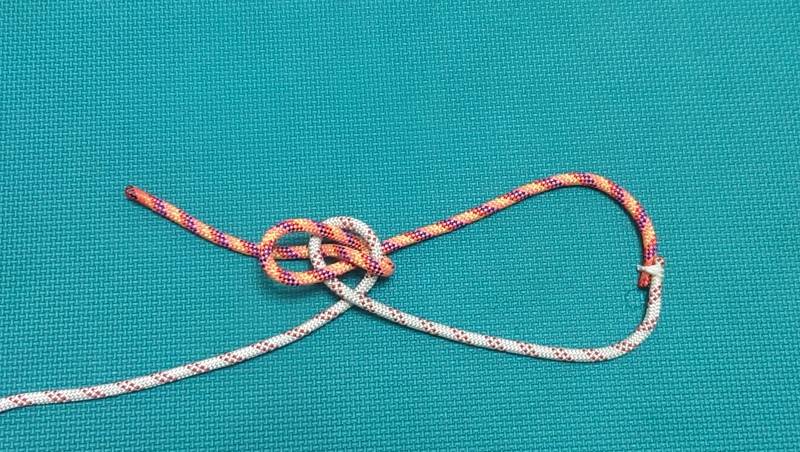
Some photos and a video of the way I do it.

Video at: https://archive.org/details/CwbyBowlineScottLoX01 .


CwbyBowlineScottLox-01.jpg

CwbyBowlineScottLox-03.jpg

5/7 – 7/7


CwbyBowlineScottLox-05.jpg

CwbyBowlineScottLox-06.jpg

Thank you James,
I like your method because, unlike as when using the methods proposed here by kd8eeh and me, the tail and the standing part they find themselves in a natural way in the right position relative to one another.

Nice.
I believe you do not need the second picture ( the third picture is enough - and it might well be the first, because it just shows a slipped bight, a very familiar image to knot tyers ). On the contrary, you should use this saving and better add another image in between the third and the fourth, when you will show the formation of the bight on the white segment, and how you put in the place shown in the fourth image. To my view, the sequence is too slow between the first and the third image, and too fast between the third and the fouth.

Another series. Any better?

– J:P


CwbyBowlineScottLox-02-05.jpg

4 more.


CwbyBowlineScottLox-02-09.jpg