You make a most important point Scott, I had forgotten it.
I will often Prusik the end of my climbing line back onto the down leg from the belay point, that is, self to self. Although it is dynamic rope and obviously the same diameter, the Prusik holds well. But of course I forgot that the principle load is taken between my belt and the top belay point, far less force remains in the returning line and that is all the Prusik has to contend with. Also my VT hitches are tied with a 60% diameter line, so again do not suffer from the mismatched diameter problem.
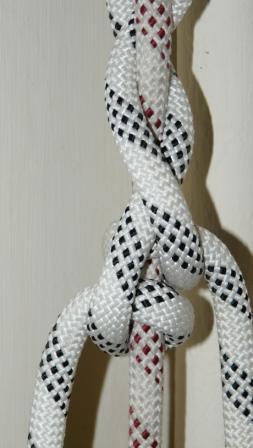
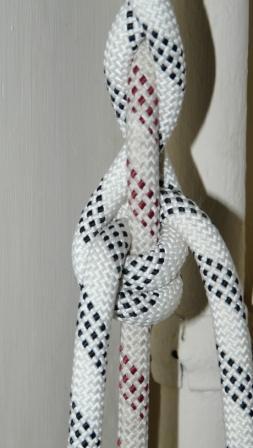
@shadowjack - the VT hitch should hold better than the rat-tail because the rat-tail has already lost its leverage by being made in the open configuration. Hitches like the VT and the KC by contrast utilise the opening of their wrappings to create leverage and gripping tension. But having said that, both are known to behave poorly when they are tied using rope of similar diameter.
About possible scenario. The most simple is following:
You are rappelling down single line. Something got sucked in rappel device (loose closing, for example) and it jammed. To unjam it is simple matter, but you must first unweight it. You are free-hanging some 20 m above the ground. It’s an emergency, and you do not have additional gear or partner to pass you something. You try to pull up the end, but it’s stopper knot snags badly on rock and you can’t free it from your position. You are stuck. All you have is several meters of bight below your rappel device. You must attach it above rappel device, tie foot loop, shift weight to it, maybe temporarily tie in with bowline-on-bight to your harness, unjam device, undo friction hitch and loops, rappel down and free stuck end. Of course you must tie “catastrophe knot” below you rappel device to attach yourself to line in case friction hitch fails (bowline-on-bight again).
Shifting weight to different rope is common operation in rescue and self-rescue. Escaping belay, untying knot, you name it. It’s usually achieved with Prusik loop, but you might not have it on hand. Ends of rope could be used for something else - lowering something, etc., so you do not have access to them during operation.
I can t imagine why GLASSES are so rare nowadays !
However, there is always the possibility to enlarge anything that a computer screen shows :
( So, I was talking about a double-linerat-tail-stopper, right from the start… Also, I stressed that, for many reasons, this is NOT a practical knot, IMHO )
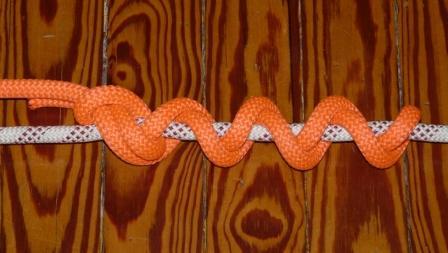
Noope ! If one joins the ends of the rat-tail-stopper properly ( as I had done (*), in the pictures shown at the thread about it - but there are also many other ways one can do the same thing ), there is no “open configuration” any more : the whole hitch works as a crossed-coils spring, that can be elongated in length = shrink in diameter, around the main line.
Derek, please, TIE one rat-tail-stopper ! It does not BITE anybody beyond the main line !
Welcome !
In contrast, the rat-tail-stopper is NOT behaving poorly - it behaves wonderfully ! However, this is only “known” to people who had actually tied and tested it. around tensioned lines of the same material and diameter as the hitching line - as I did, for example…
I do not like the use of the name “Prusik”, to denote a double-wrap Cow hitch - I think it was just a duplication of names, which made the knotting jargon even more repulsive to the general public than it already was - but to use it as a VERB, is even more odd, to my eyes… I believe we should use common language, and common terms, wherever we can.
Hmmmm, this is quite different than the vague
notion I had : here, you load your 2nd rope
from below, and I was trying to think of some
case where this rope was running beside and
needed to support … from above!
(To assume that you have just enough slack
below, yet a stuck rope to keep the end away,
is getting pretty picky! ;D In my vague scenario
it would just be so lonnnng 'til the end (thinking
of doing this exchange in caving, near upper
anchors) that one wouldn’t care to use the end.)
In your case, you need also to have sufficient
material in the lower end (aka 2nd rope) in
order to make some attachment structure
–an eyeknot, likely–; and THEN hitch that
rope into position to be effective.
Frankly, I would simply try putting in a rolling hitch
letting the one, away side of the bight used in
tying fall away, having an effective single-strand
(usual) knot until the closing half-hitch which
would be a bight. The tying becomes cumbersome
with each additional wrap of to-be-tight & fall-away
bight strands.
You can tie the second rope to the first one using a friction hitch like a prusik-style knot or a klemheist knot, which you can make even without extra gear. Just loop the second rope around the first a few times and tighten it so it grips firmly under tension. This will let the second rope take some or all of the load. If you don’t have access to the ends of the second rope, you can tie a prusik-type loop using a section of the same rope by wrapping and tucking it properly. Just make sure the knot is tight and the ropes are of suitable strength before transferring the weight.
I don’t think you’ve got the problem in full ::
one has NO ends --neither rope’s ends.
Yes, one can tie knots with a U-fold of a rope,
doubled all the way through it.
 It does not BITE anybody beyond the main line !