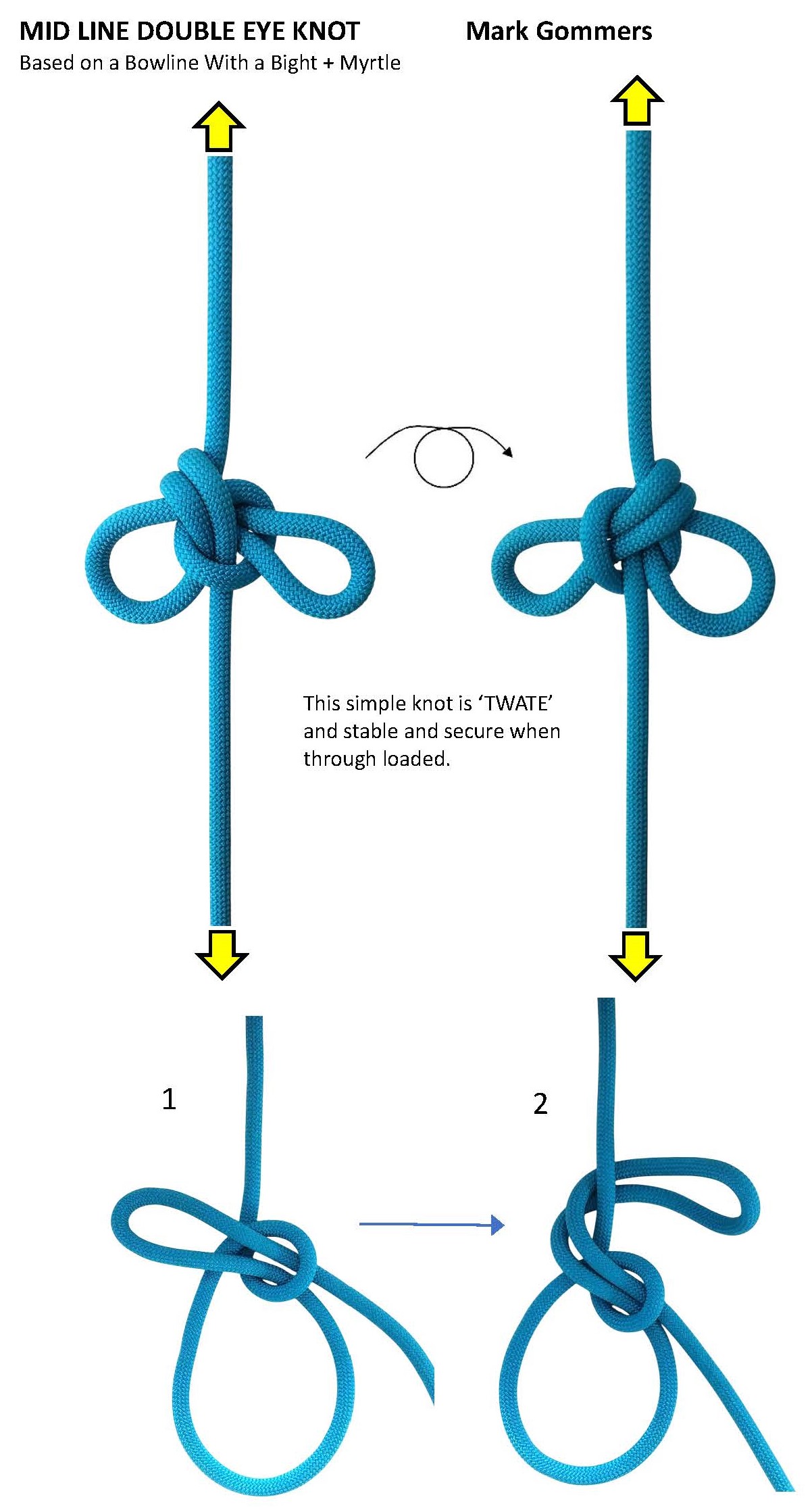
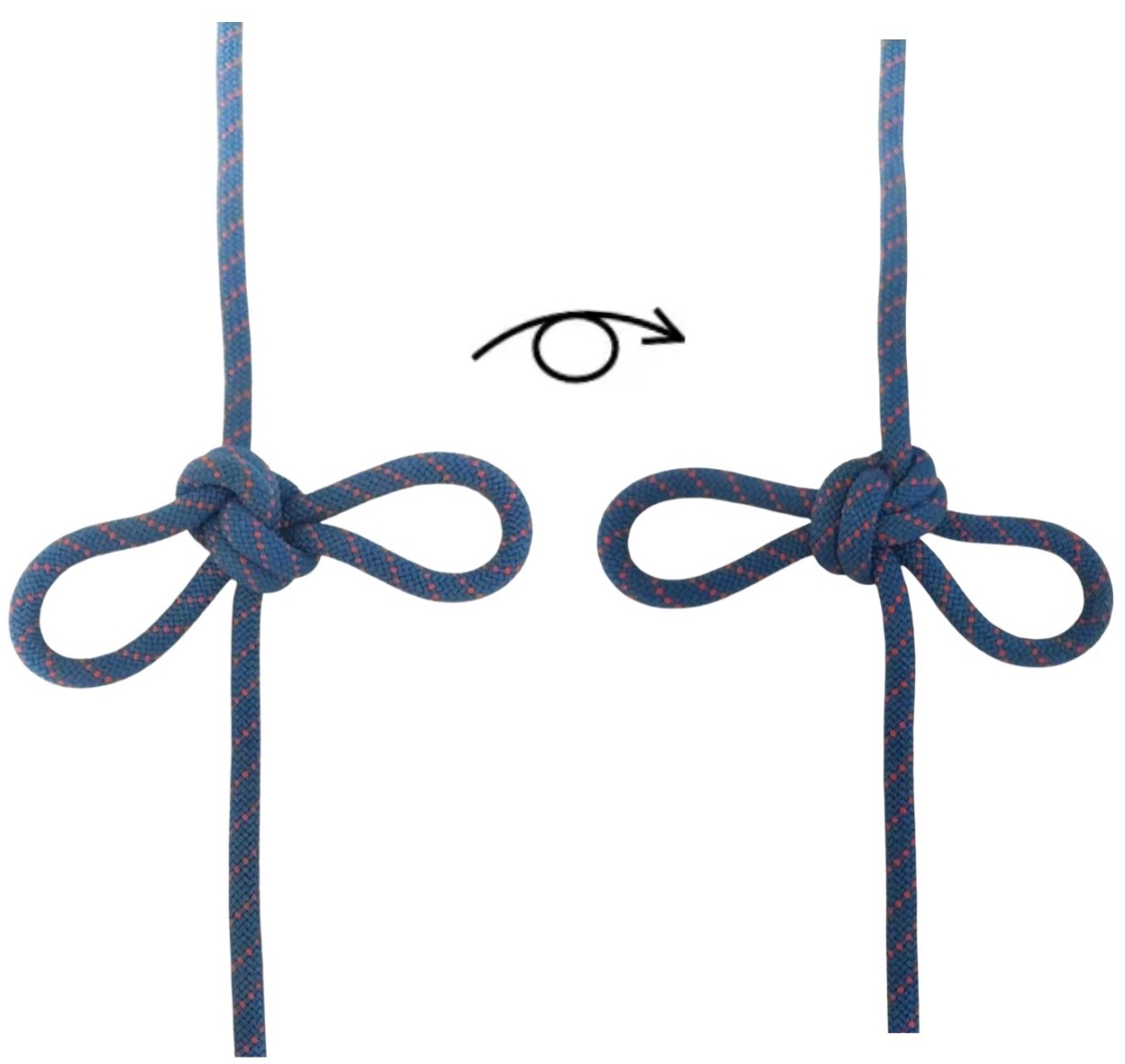
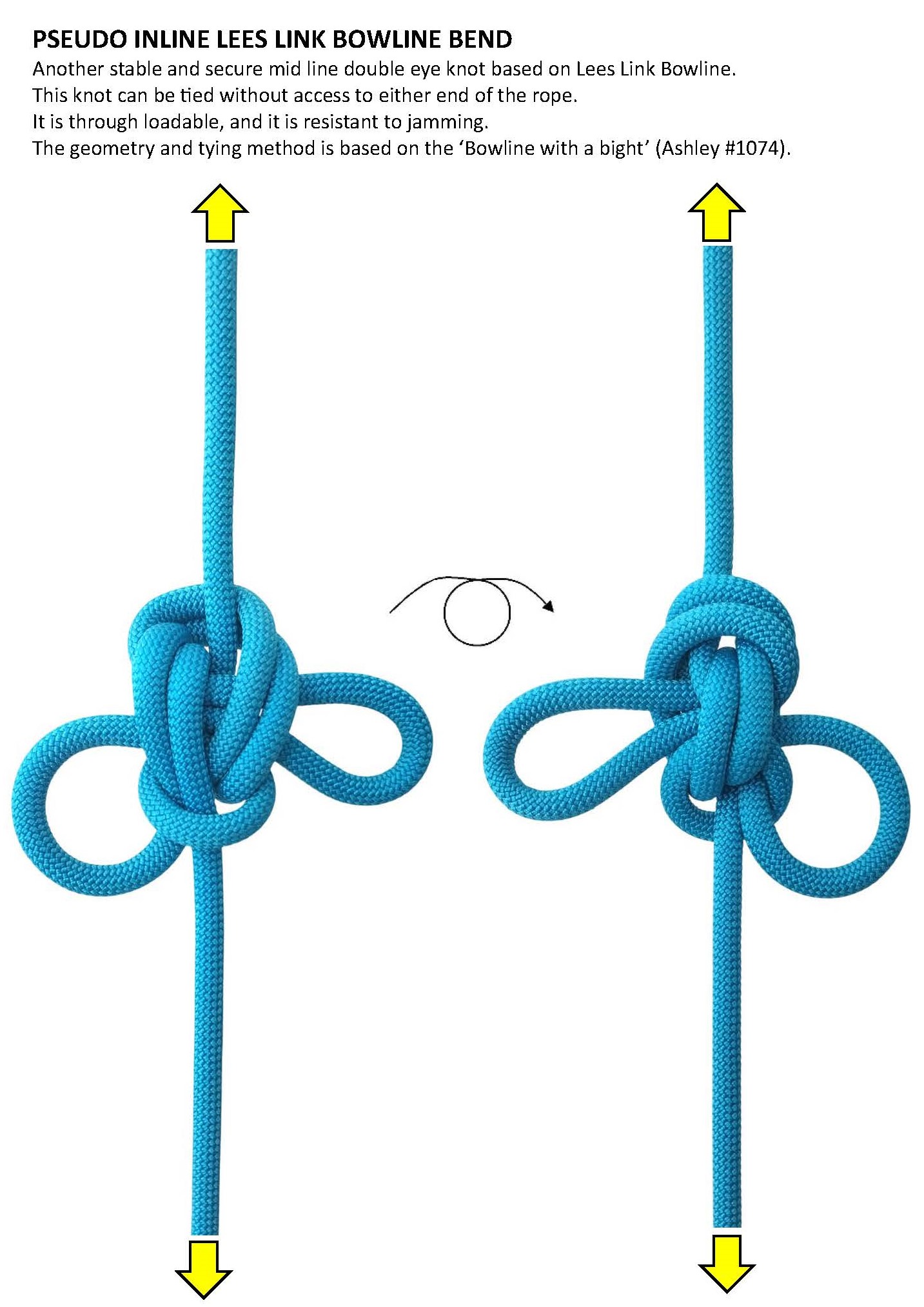
It reminds me of Lees Link Bowline (but this depends on how you choose to orient the structure and then identify the various segments).
When I tied it, the 'right' S.Part (with respect to your photo) I had positioned 'inside' the lower 'eye'. I found this dressing to be more stable.
Overall, its a fine creation and well done!
But - like you indicated, there doesn't appear to be any 'easy' way to tie it...
It got me in the mood to tinker... (but I'm not in your creative league) - that perhaps another way is via a Bowline with a bight motif.
The photo below is my offering... it is very simple and 'easy' to tie - based around a Bowline with a bight (and 'Myrtle').
It is TWATE and stable and secure when through loaded.
Note: 'Easy to tie' is a relative concept. Its hard to define what we mean when we say a knot is 'easy' to tie. An argument can be made that to deem a knot 'easy' to tie - means the least number of hand movements and manipulations to arrive at the completed structure. And that; minimal repetition is required to develop long term procedural memory to recall and recreate the knot structure.
Very correct, as far as the end of the line field is concerned, whereas, if we move to the double eye domain, it can be easily associated with Xarax's Mediterranean bwl, as the corresponding mid-line profile.
On the contrary, myrtle bwl with the bight as you have presented it, constitutes a rather innovative design, that focuses on simple "in the bight"construction with minimal maneuvering, a quality we typically seek.
However, through loading mode, or generally loading the structure from the lower SP, may induce some slippage of the directly linked eye via a helical component through the nipping loop.
Generally, those helical rope segments are somewhat questionable regarding their stability, but provided that the stucture is loaded from the nipping loop side, with the proper cinching of all individual components to remove all the slack, those four diameters inside the nip, would render both eyes less prone to displacement.
I have seen myrtle bwls with quick release, so why not a double version of it if proved to be stable?
To solve the issue of slippage when through loaded - one possible fix appears to be to initially form a double nipping loop (per Ashley #1013), then continue as for a Bowline with a bight but perform a Myrtle manoeuvre.
Once the core of the knot is very tightly set, it resists slippage = although different ropes may yield different results.
Indeed, the double loop certainly contributes to stability improvement, but it will likely affect jam resistance too.
Oh well, you can't win them all.
Another potential variation would be to transfer the helical segment to the nipping loop continuation, or in other words form with a bight a specific eyeknot shown by Alan Lee in the past.
I've just completed some extensive in-field testing of your marvellous mid-line double eye knot.
With your permission, I'd like to name it the 'PILS' knot.
PILS = Pseudo Inline Sheet bend.
I carried out a number of load tests to 3.0kN in life critical applications at height.
Through loading to 3.0kN - stable and secure and easy to untie.
Eye loading both 'eyes' in both directions to 3.0kN - stable and secure and easy to untie.
Also bounce loaded to 2.1kN (jumping my body weight as hard as I could) across multiple loading profiles with no effect.
Tested with 2 different canyoning ropes (8.0mm and 8.3mm diameter).
Also tested with a dynamic climbing rope (EN892 - 9.1mm BEAL Joker).
Stable and secure across all type of tested ropes.
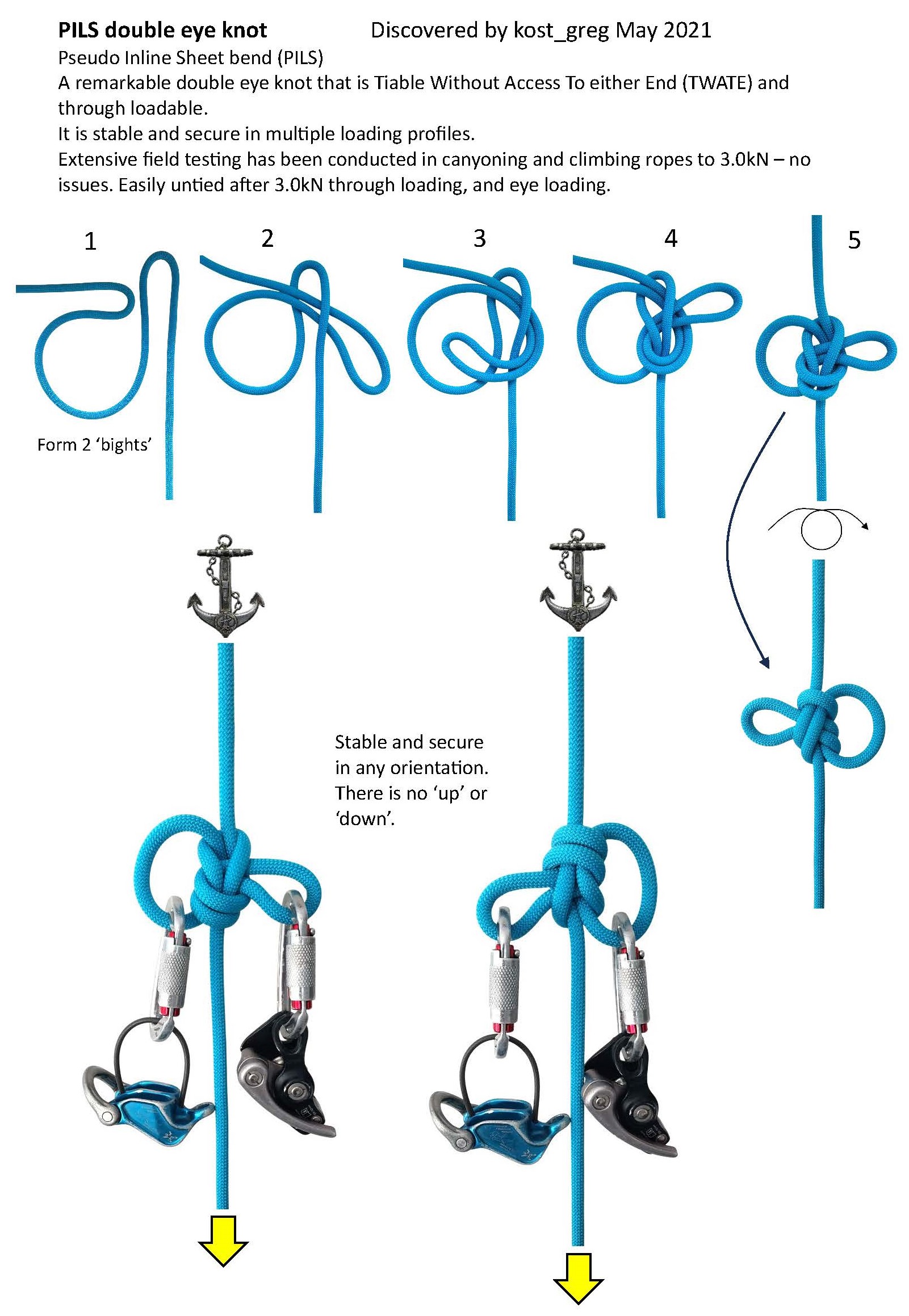
I've illustrated what I believe to be the 'easiest' tying method. Remember that 'easy' is a relative concept - which I have defined as the least number of manipulations and hand manoeuvres to arrive at the completed knot. This is in tandem with a clear pathway for building long-term procedural memory (which I devised to be the foundation of starting with 2 'bights').
I would like to start promoting this knot to the wider vertical rescue, rope access, and canyoning communities with you acknowledged as the discoverer in May 2021 (under the name 'kost_greg').
Let me know if you agree with what I have written herein... (or not).
Thank you very much agent_smith for taking the time and effort to conduct all these tests in the field, it's very much appreciated. Of course i'm very pleased to know that the knot proved to be stable and secure under various loading conditions.
It would be excellent to have some additional data regarding its response to heavy stress, for instance at about 50% of MBS, i presume ,though, that we will be able to obtain such information down the line, possibly with the assistance of other interested knot testers.
One of its greatest advantages i think, is the very simple tying method you have already illustrated (which i use as well), in fact, so simple that it can be done even blindfolded.
I was never good at naming knots, it was not among my priorities as well, but i admit that an identifier is very much needed to describe it.The term PILS knot sounds nice and catchy, as it accurately reflects the knot's actual operation, so let's go with that.
I'm not after credit, but quite frankly, presenting an existing knot from a different angle in different loading profile terms, in my view, isn't exactly a groundbreaking discovery, anyone could have done it.
Anyway, yes to all, and godspeed to it, if it's going to be deployed in the field.
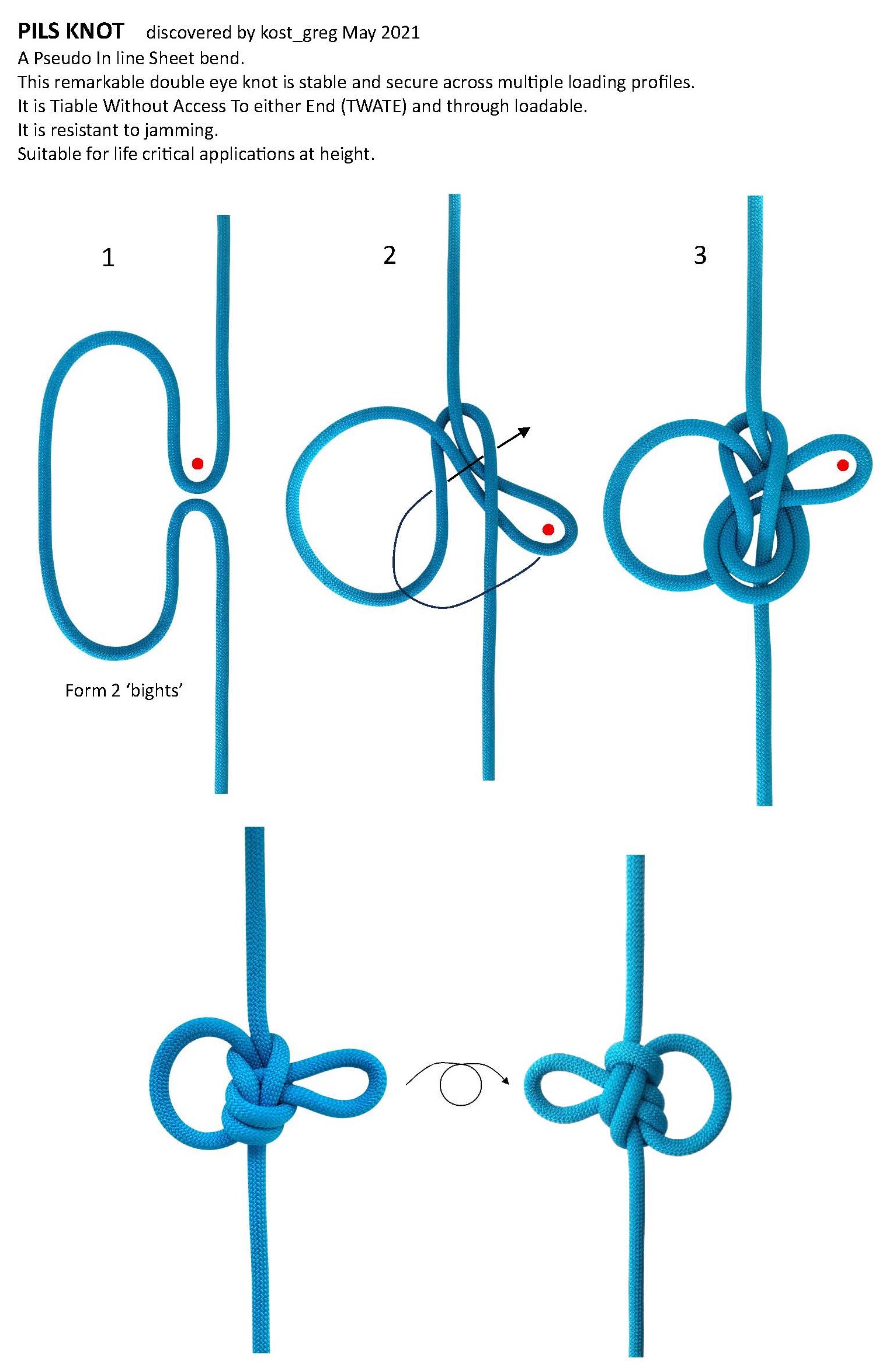
I wasn't happy with the tying method I had previously posted. I think if this knot is to gain international traction, it needs the simplest and easiest possible tying method. To that end, I've attached another photo illustrating a slightly clearer and 'easier' to remember tying sequence.
'Easy' in this sense means a tying method that:
Has the least possible number of manoeuvres and hand manipulations; and
Employs simple milestones / landmarks to aid in learning the sequence; and
Promotes the development of long term procedural memory by using simple concepts such as ; "begin with 2 bights".
I believe you deserve credit for this remarkable mid line eye knot - in my opinion it ranks up there with the best discoveries (eg Scotts locked Bowline). This knot ticks many box's... it is through loadable, it can be tied without access to either end of the rope, it has two 'eyes', it is resistant to jamming, and it has a relatively simple geometric form.
EDIT NOTE
For completeness, I've also added a photo of a Pseudo Inline Lees Link Bowline Bend. But, it is not in the same level of utility and simplicity as kost_greg's "PILS" knot.