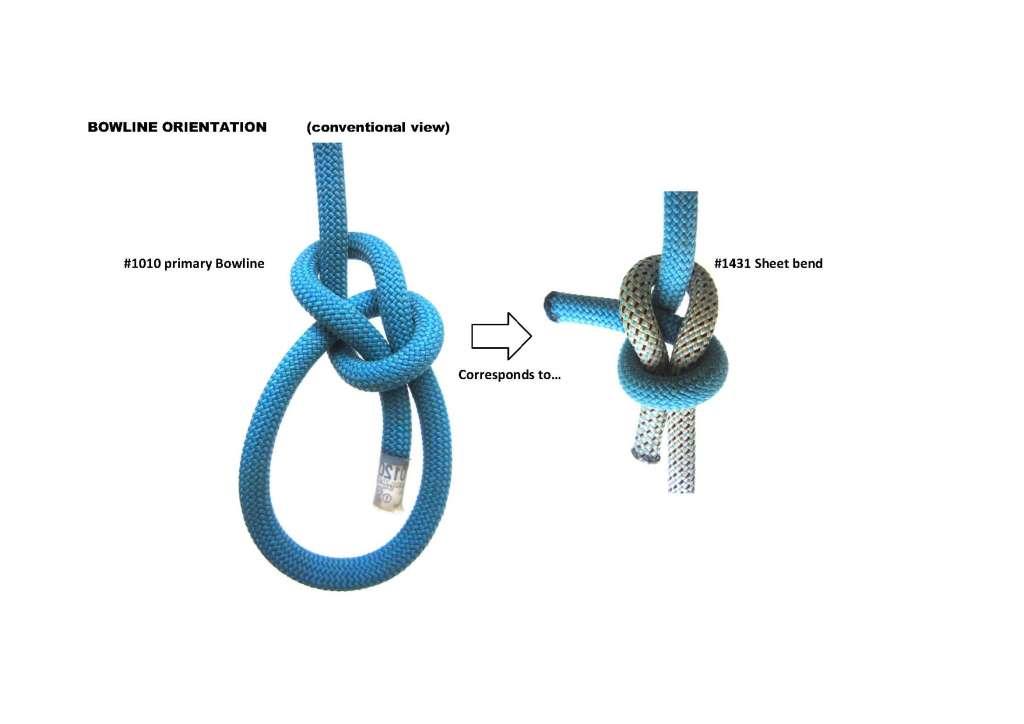
It’s already decades overdue to stop copying the
unhelpful presentation of the bowline such that
the SPart crosses under the outgoing eye leg and
over the collar. It should be the opposite, as has
been the sensible presentation of the like-structured
end-2-end knot, the sheet bend.
There is a reason why so many people find the bowline
a hard knot to remember how to tie, and this is part
of that --lousy presentation, obscuring the central
nipping loop’s crossing and making prominent the
readily envisioned in-&-back-out U-turn of the
returning eye leg / tail.
You’ve rehashed this unconvincing plea a number of times. I doubt even you tie the bowline in the manner you propose for presentation. Is there even a single quick-tie video on YouTube of a internal wrist-rotation method? Laying out a coil or coils ahead of time doesn’t count.
The traditional external wrist rotation (supination) method is ergonomic (notice the bigger “A” angle below) and keeps the critical finishing path clear and up front.
I have found that as soon as you attempt to go against long held traditions or try to change conventions, you will come against resistance.
The reason for this is basic human nature.
Nobody likes change and nobody likes to have their long held paradigms challenged.
With some people, the concept of change can evoke strong emotions - and in some cases, outrage.
Again, the question goes unanswered: Does anyone actually tie it this way? Do you?
I would like to see a video of someone effortlessly twisting the initial coil into existence with an awkward inward wrist rotation that attempts to mimic the more ergonomic outward wrist rotation of the traditional bowline quick-tie method:
The astute reader would have noticed that there were 2 different concepts advanced in Dan Lehman’s original post:
that the presentation of the primary (#1010) Bowline ought to be from the side which emphasizes the nipping loop; and
that an individuals long-term memory of how to tie the primary (#1010) Bowline may be affected by how the knot is often presented in books, drawing and photos.
…
Now, I agree with Dan Lehman’s proposition in point 1) whenever it is being presented in technical papers or for knot discussions (particularly amongst theoreticians). For the general lay public who care little little about technical detail - the traditional view is acceptable.
With regard to Dan Lehman’s second point - which was about ‘memory’ - this is open to endless debate.
Roo’s point is firmly grounded in ergonomics and what is easier in terms of observation while tying (and keeping ones hands clear so as not to obstruct vision).
I would go further…I often see people struggle when they attempt to tie a primary (#1010 based) Bowline from mirror perspective. This occurs when I ask learners to tie a #1010 primary Bowline around a tree or a boulder. When they face toward the tree/boulder, they become confused.
To specifically address Roo’s point - which is the second part of Dan Lehman’s post - a greater % of the population would find ergonomics dictating their tying method.
I would be very interested in a blind test with totally new learners (who arrive with no bias or pre-conceived ideas) - with one group taught to tie via traditional method and the other to tie via orientation which emphasizes the nipping loop function. If a multi-day school camp (or perhaps new Scouts) - the next day, the test would be repeated to measure memory recall. As far as I know, nobody has attempted such a blind test before.
I have always tied the primary #1010 Bowline with the conventional view (as in most books/illustrations) and I don’t think I have ever Used the quick tie method of forming the nipping part in actual use.
As I use the rope to tie this knot, I draw out the length I will be using and already have my hands placed. So, it doesn’t make sense, to Me, to let go of it to then grab and twist my wrist when I can just rotate the rope into the helix by rotating it between my fingers.
It is also the view I used when I devised the “lock” for that same knot. It is much easier to verify that everything is where it should be.
I am of the opinion that the “conventional view” does not obscure the nipping area so much as to cause confusion.
It may be arguable that the “conventional view” provides an easier visual for learning, imo, if you are right handed, which I am.
Or maybe I’d have to unlearn my notions to come at this differently. (?)
Does anyone tie this knot while viewing it from the “unconventional side”? Otherwise it is just academic…
You've rehashed this unconvincing plea a number of times.
Speaking for yourself, perhaps; but Xarax & I & I think/thought
Agent_Smith concur in favoring the presentation of the [i]bowline[/i]
as I urge (and as the [i]sheet bend[/i] is presented, note).
That there is such widespread confusion about the knot
is some strong hint that "the way we've always done it"
isn't so good.
I doubt even you tie the bowline in the manner you propose for presentation.
Is there even a single quick-tie video on YouTube of a internal wrist-rotation method?
Laying out a coil or coils ahead of time doesn't count.
This is going stupid. I don't validate my thoughts
by counting YouTube videos (or knots books, for
that matter : where do you think most of the YouTubers
get things from?).
And the clumsy thing that you show above is absurd.
It hardly has the vaunted movement you find so compelling,
doing work with both hands,
having to grip parts together in the right hand
(even with a supporting surface conveniently & artificially
so near!), and then, egadz, seeing this as a recommendation
for a particular wrist movement?
If someone is e.g. tying in to their harness with a rope
leading out away from their standing/upright body,
they will most surely benefit from forming the knot
if using this sort of quick-tie method from going the
opposite way to the traditional
–i.e., to righthandedly reach with ample tail out beneath the outgoing SPart (and so they
will be supporting it and not having to hold it
in place from falling as is done in your video ca. 10sec.!),
to then quickly bend (rather than much rotate)
the right wrist/hand to bring the tail back over
the SPart, and then extend/unbend (still not much
of rotation really) the right hand w/some outward
thrust to put in the nipping-turn in the SPart.
Having done this, the SPart --now PROPERLY ORIENTED–
will rest upon the outgoing eye leg and not
otherwise fall unless supported manually,
and the final tuck (or whatever various bowline finish
one desires) can be put in.
The way of quick-tying I present above is well faster
& simpler than that traditionally advocated. (There
is also the method of forming an overhand noose
and noosing the tail into a capsized knot, to which
e.g. Brion Toss took a fancy.) And, yes, I often do
use the method --always, in pref. to trad.–, and
sometimes the “slip-knot” (noose) way (where I
have no idea yet remembered of which insertion
direction begets tail-outside vs. tail-inside versions).
Really, the words here are ample : the SPart crosses under the outgoing eye leg and over the collar. It should be the opposite, as has
been the sensible presentation of the like-structured
end-2-end knot, the sheet bend.
Google “sheet bend” and then click on Images and
you’ll see the overwhelming majority of images
showing the path of the hitching line which makes
a turn in through & around the bight of the opposite end,
showing clearly the crossing point of this hitching line.
THAT is how the like-structured eye knot bowline
should be presented (so that people understand how
it works! --which isn’t a matter of memory or even a
particular hint of how to tie).
I’m not even sure the bowline is particularly hard to learn, compared to other knots of similar complexity. Maybe it just seems so, because it is one of the first knots that novices learn, and then learning new knots gets easier with practice and experience.
I don’t find the analogy to the sheet bend particularly helpful in tying the bowline. When tying the sheet bend, one would normally form the bight in one line, then tie the hitching line around that. You can’t do that with a bowline because the u-turn doesn’'t happen until the knot is done tying. Of course, we all have different ways of learning and visualizing things.
I don't find the analogy to the sheet bend particularly helpful in tying the bowline.
But that's not the point... and, it isn't what Dan was saying!
What Dan is advancing is that one perspective (side) of the Bowline shows how it functions better than the other.
With regard to the #1431 Sheet bend, he is pointing out that in the majority of books and images depicting the Sheet bend, it is typically shown with one perspective (and not the other side). He was trying to provide an analogy.
You can't do that with a bowline because the u-turn doesn't happen until the knot is done tying.
And this goes back to another debate about the fundamental importance of a 'nipping loop' within all Bowlines. Dan has advanced on many occasions that a defining feature of all Bowlines is the nipping loop (what he has called the 'essence' of the Bowline).
I agree with Dan in this respect…that the nipping structure (eg loop) is a defining characteristic of all Bowlines.
And so this relates to why Dan favors Bowlines being depicted from the perspective that emphasizes the nipping loop.
No, the usage of black rope is the problem. Otherwise the final tuck shows much better out front in the traditional view, not hidden behind one or two layers of rope.
The way of quick-tying I present above is well faster
& simpler than that traditionally advocated. (There
is also the method of forming an [i]overhand noose[/i]
and noosing the tail into a capsized knot, to which
e.g. Brion Toss took a fancy.) And, yes, I often do
use the method --always, in pref. to trad.--, and
sometimes the "slip-knot" (noose) way (where I
have no idea yet remembered of which insertion
direction begets tail-outside vs. tail-inside versions).
A wall of text isn't much of a presentation except to the person who wrote it for whom every phrase and preposition corresponds to their own mental image. If you have a great method that justifies hiding the critical final tuck path, show it. I know you at least have access to a digital camera that could pseudo-video all the steps necessary. If you don't have a method that justifies the view, you'll have little traction among knot users.
But as you said in another reply:
[the] bowline should be presented (so that people understand how
it works! --which isn't a matter of memory or [b]even a
particular hint of how to tie[/b]).
People can view the bowline from all different angles once they have it tied, and in three dimensions, no less. And once materialized, real insights can be had from using it and testing it. Merely viewing the real article may lend some insights, but as Mr. X’s repeated missteps often demonstrated, looking without testing can mislead perhaps more easily.
@Dan_Lehman
Really you think that a representation will help someone to understand the mecanics of the bowline ?..good luch with that.
A knot should always be presented recto and verso, two images (look at reply 9) end of discussion.
Yes, white rope would contrast w/shadow,
and yes the final tuck is <…>,
BUT MY POINT IS that the final tuck is more easily envisioned
–being of the simple U-turn, in & back out adjacent–
than the crossing point (essence or not), and the crossing
needs to be shown clearly; the tuck can be readily understood.
.:. It’s about understanding the knot structure, not tying the knot.
(And matching it to the sheet bend --Xarax’s objections to their
oft’-alleged relationship notwithstanding-- is also a help in this
(and might help some people tie the end-2-end knot differently,
thus!). (FYI, I usually tie the latter in a hitching-to-a-bight way;
I usually prefer a multiple Lapp bend here, for its much better
slack-security, & forcible loosening.)
The way of quick-tying I present above is well faster
& simpler than that traditionally advocated.
(There is also the method of forming an [i]overhand noose[/i]
and noosing the tail into a capsized knot, to which
e.g. Brion Toss took a fancy.)
And, yes, I often do use the method --always, in pref. to trad.--,
and sometimes the "slip-knot" (noose) way
(where I have no idea yet remembered of which insertion
direction begets tail-outside vs. tail-inside versions).
A wall of text isn't much of a presentation except ...
... that it comes in the context of a video'd opposite way,
and pretty much one simply reverses over/under crossings.
The hands work much the same, and the knot forms as
quickly or more so. And I pointed to point **10seconds**
of the video where by that method the SPart had to be
manually supported else it dropped, whereas by my method
--crossings reversed-- the SPart would [u]rest upon[/u] the
outgoing eye leg awaiting further knotting action.
Once one understands the traditionally promulgated method,
it’s a simple matter to do likewise but to reach out UNDER
the SPart rather than OVER it, and all flows understandably
from this.
–dl*
PS : THIS POST WAS UNDER PRACTICAL KNOTS
FOR THE REASON OF ADDRESSING THE >>MANY<< POST
BY YCHAN OF BOWLINES, LABELED “FRONT/BACK” SUCH
THAT IT PIQUED MY BARKING! :o
AND ARE HIS KNOTS “PRACTICAL” OR “INVESTIGATIONS”?
PS : THIS POST WAS UNDER PRACTICAL KNOTS
FOR THE REASON OF ADDRESSING THE >>MANY<< POST
BY YCHAN OF BOWLINES, LABELED “FRONT/BACK” SUCH
THAT IT PIQUED MY BARKING! :o
AND ARE HIS KNOTS “PRACTICAL” OR “INVESTIGATIONS”?
No, this, your original post " “FRONT” Must be Changed!" was posted in the New Knot Investigations Board and which it there suggested it be moved here and I concurred.
Attached image is an example in support of the proposition that one perspective
of [a] ‘Bowline’ will usually facilitate easier observation of the nipping component.
It follows that, IF the nipping component is the key to understanding all Bowlines,
THEN, it is logical to show the side which emphasizes it.
I believe that this is the concept which underpins Dan Lehman’s proposition.