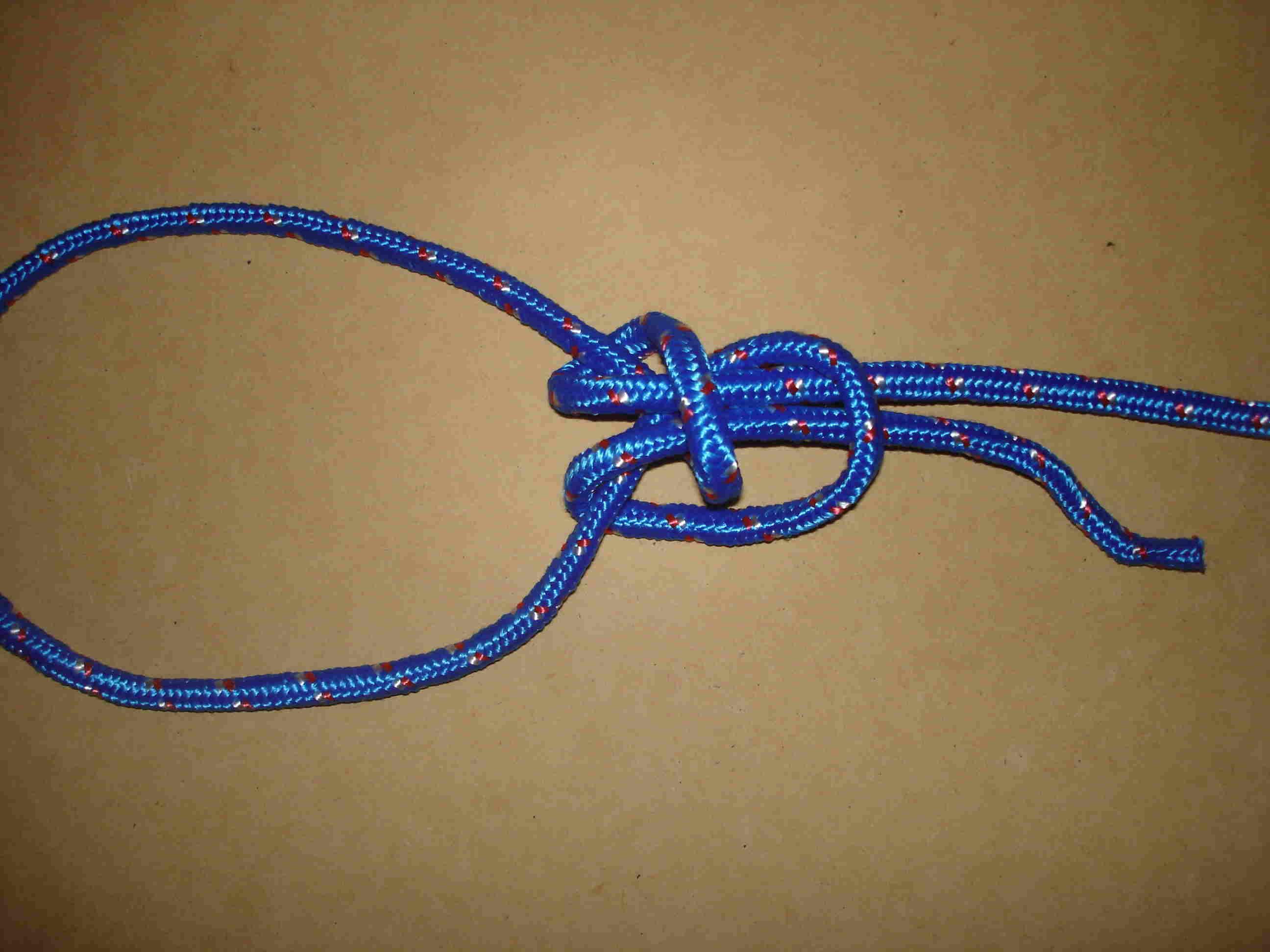
One can quibble re “noticeably” : I argue that in fact
the different loadings are quite noticeable, though
you might take a different sense for it and cite some
dramatic case. (Of course, now, we first have to come
to some agreement about the general fig.8 form
we’re differently loading!) Of the “perfiect form” --which
I think Grog’s Animated Knots presents–, loading
its “strong form” --my label for loading ends that will
bear against their twins, and which to the extreme ends
of the knot–, the knot will be compressed to appear to
be at about a 45-degree angle to the axis of tension;
loaded by the other ends, the knot remains roughly
aligned/parallel to this axis, and the outer reaches
show a lack of tension on these parts.
But, I think that all this is arguably within what you
might regard as substantially the same knot-appearance.
That is fine, I haven’t thought about the loops around the eye of a Butterfly being ‘collars’ , however I suppose they are. As for the ‘butterfly’ part of the name I gave, it was just a tribute to the Butterfly (where my pictured loop came from and some are saying still is) rather than saying the knot was different from a Butterfly.
Anyway, the name really doesn’t matter to me, pick something yourself if you like If others like it, they will use it.
(Note to self: suggest a name for the next knot I make something with ‘Mobius’ in it, names just seem to be plaguing me at present one way or another. Maybe watch out for the “Mobius Bowline” ;D)
I took the tension to 120kg in my 3mm braid and then released it. I watched the knot closely and the loaded side of the near symmetrical nub squeezed together a bit more than the unloaded side, though it did not move otherwise. There was no tail slippage as far as I could detect. I could untie the knot afterwards. I find just about any knot a bit difficult to untie after load in my 3mm material (eg. even a Zeppelin Bend), so getting it undone at all is something I suppose.
I was going to break-trial it again using the same piece of rope. I know that is not the way to do it really, pre-strained rope isn’t a good idea. Anyway, the rope broke at a place well away from the knot at ~132kg. That gave another opportunity to untie it. Again I was able to do so.
So is it easy to untie? It gets a pass from me at the moment, though that assessment may be unreliable in other rope materials and sizes.
Please don’t nit-pick about how I displayed my pictures. If you tie my knot and cinch it, the way I showed it is the way it wanted to sit. How many knots displayed in the forum are in significantly different forms than how they look when they are loaded… nearly all of them
xarax, I assure you I didn’t try to blur my pictures. They do not looked blurred when I look at them It was an old piece of rope I was using, is that why it looks blurred?
Have a look at the following picture, is it blurred to you? It’s a new piece of rope and new background, is that better?
Xarax I don’t know if you actually aren’t seeing this or if you have some purpose in refusing to acknowledge a fact. There is no good reason raised at this point for there to be any disagreement about the facts of this knot part or these two configurations. Nobody disagrees that this knot part can contort and behave differently under different combinations of tension and angle applied to its 4 ends. A 2x4 can support much more force loaded axially than beam loaded, and acts sometimes as a stud or as a joist . A bolt is still just a bolt though if it shear loaded, or stretched, whether pre-loaded or not. Arguing in a serious way about labels is a fools game. I’d rather argue about facts. The loading facts are not particularly in dispute(not fully understood either, but not in dispute) as far as I can tell.
But NOW you’ve gone and seemingly intentionally failed to clarify, refused to establish, or if I give you the benefit of the doubt, are maybe simply wrong about a simple fact, either because you actually don’t see it or because you have some purpose which the fact does not suit. While this might seem wise to you, dodging facts to me does not seem likely a useful way to find truth. I think it’s much more helpful usually to establish facts than to argue about words.
The (false) fact I’m referring to the possible implication that this knot part, aside from loading or what exact angle we lay the ends at , is actually different, and that’s just wrong. If the loop is cut and the 4 ends are all cut the same length you cannot distinguish one knot from the other. They are INDISTINGUISHABLE. This is a fact and not open to interpretation of the minds eye or to any number of words of extreme wisdom.
I have one of each sitting on each of my two legs. I tied them both as regular ABL’s, but capsized one of them to the other form to produce it in the “right” way. I have spread and opened each so that they clearly retain the essence of their dressing but are now easily vissible. One has the loop toward me the other has the loop away. They are now turn for turn, crossing for crossing, over for under exactly the same knot part. If I cut all the ends short, there would be no difference at all and they will then simply be exactly the same knots. I could take a picture, but what it would it prove? That I can tie the same knot twice? You have to do it yourself.
Without loading, this loop is just as happy to have its eye legs at the angle mobius shows as any other angle. Yes the “butt cheeks” of the loop legs tend to slide apart, but that’s true with normal loop loading or ring loaded, so is irrelevant. There are actually at least a few dressings for this knot within either of the “two” capsized “variations”. I don’t think that changes their names, although I think it does change their properties, but if someone wants to give those different names too, I cannot argue factually against that. It’s impossible.
And, as I’ve said, I’m happy to call this loop by a different name, after all I cannot keep calling it “this loop”, my vote, and it can be neither right nor wrong no matter how close to a Zen master one thinks they have become, is that it would contain butterfly as its middle name, but that is just my “vote” (maybe better to say it’s what I’ll call it for now since I don’t need to take a vote about that anyway).
I will also add that I’m pretty sure there have been plenty of cases in the wild where the ABL was loaded with all the loaded legs in in parallel, in fact it’s quite normal. The difference in those cases are that the legs leaving together would, being part of a loop have both been tensioned instead of only one, but the directions would not have been different. If only one parent line is loaded and the loop legs are parallel, then it is guaranteed by 1st and second laws that the three loaded legs are all parallel (unless the knot is accelerating). If the unloaded parent is slack or made slack by the loop load, surely the angle of this dangling leg will not then be so relevant as the fact that it is not loaded.
So it seems to me the angles are not the real issue here at all in the difference in performance, but which of the 4 legs is not loaded is the issue. Of course angles matter more as the loop gets shorter/fatter/more ring-loaded/less parallel, but even then the only part that’s hard to imagine ever seeing with the other knot is the which leg is unloaded.
Well X if you have force on a stationary thing in 3 directions with equal force on two of those, then the third force must bisect the angle of the first 2. It cannot be avoided. It is simple vector addition and that addition must add up to zero. Now if those first two legs are parallel then the bisector is obviously parallel. The only way this can be not true is if the 4th line is in fact NOT unloaded, but has at least SOME load. Sure, sometimes the 4th leg has some load.
I can’t help you. You will find the light when you are ready.
Read again my trash ! :) Dumb and naive people may be more correct than you think ( or you can imagine...) :)
If the loop is loaded by, say, 2 units of force ( that is, 1 unit and 1 unit on each eyeleg ), and the angle between the ends is 120 degrees, each end is loaded by 2 units of force.
However, if the same loop is loaded by the same load ( 2 units of force ), and the ends are parallel, each end will be loaded as much as each eyeleg, that is, by 1 units of force, 2 ( = two ) times less than previously !
What "part" of that you do not understand ? :) :)
but I will try anyway although I know that you must find the light for yourself. Your post is far to imprecise to clearly describe something such as vector addition. I think pictures suit your communication style better than words when it comes to technical detail.
I was not arguing about the values of the forces, but the angles. 120 degrees is a huge angle for a loop (at least a couple of adjustable loops will slip FAR before that) and I will assume you were only using that to demonstrate a point. That’s fine. I cannot clearly decipher your words but if you have three legs tensioned at 120 degrees to each other all three will have the same force (unless the knot part is accelerating). If one of those is doubled (two standing ends) then obviously each half of the doubled line will have half that force. If that agrees with what you said, then great. Of course if two legs are at 120 but unequally tensioned, the third leg then will not be at 120. Let’s restrict ourselves though for the moment to cases where the two eye legs are equally loaded.
But this was not my point. My point is that if two equally loaded eye legs are at 120 degrees the one tensioned standing end must point straight between them. If two eye legs are at 10 degrees and equally tensioned, the one tensioned standing end must still point straight between them, now only 5 degrees off of each from parallel, and in either case (10 or 120) the standing end at least is at the same angle relative to the knot structure. As for the eye legs being at various angles, well small angles are not uncommon at all, but large angles on the mobius correspond to a non-straight parent line on the alpine. So, as I said, the important difference is not the angle of loading so much as it is which line is not loaded, and even that can be reconciled by situations for either which would be outside their idyllic knot tyers view of their use, but not outside of realistic expectations. Ropes are quite often improvisational tools.
The difference in the end, comes down to not even angle or loadings that are possible or even will certainly happen, but that for different configurations different angles and loading are more convenient or likely.
It is the relationship between the possible loadings and angles to the manipulation of our attached object and rope that has changed. We have to do different things with our things to create the same loadings and angles for the two configurations and so the configurations are in that way different, but do not change names simply as/when or because the angles and loadings change, well they could I guess, but…
b[/b]
What this loop’s knot surely shares with its twin loop’s identical knot, is that both can tolerate a wide range of abusive loadings BEYOND their ideal use in a particular configuration while still holding. THIS is maybe the most important property of this knot beyond it’s TIB nature, and anyway, both of those properties are the same exactly BECAUSE the knot part is identical. Differences in these LOOPS will bring some differences in behavior, but the identicalness of these KNOTS (parts) will bring the most important properties especially in a and even because of situations where the knot part loadings become indistinguishable too. The same cannot be said of the eskimo bowline.
The community should straighten out its grammar if there is to be any consensus on such things:
From wikipedia, butterfly loop entry:
The butterfly loop, also known as lineman's loop, butterfly knot, alpine butterfly knot and lineman's rider, is a knot used to form a fixed loop in the middle of a rope.
So does the knot make the loop or the loop makes the knot? I don’t really care. I’m happy to just call this loop a Mobius (B.) Loop, but I if people’s minds really thought entirely of the loop and the knot as indistinguishable, then the sentence would say “knot WHICH FORMS a loop a in the middle of a rope”. It is not a tool used to make a loop, it itself forms (in the sense of takes on the form of) the loop because the loop is part of the it. And yet, I’d be surprised if a single person here would have even stumbled in the slightest on that sentence as it is now, if not for this conversation at least. Why, because the grammar parses fine at a very subconscious level, the way that it is written now.
Wow xarax ok, so you want to talk about 4 leg loading? That’s fine(and I did some). I don’t disagree with your “point”. If we’re talking about 4 leg loading then I think we’re already talking about unusual cases and once we go that way it becomes all the more easy to find analogous (I almost said parallel ;)) loading scenarios as I hinted at, especially in improvised versa-tackle like constructions as just one example.
If you take the standing end, wrap it back around the bottom door knob and off to somewhere else to load it again, then that bottom loop is loaded by 4 lines in parallel, and it makes little difference at all which way the knot part is oriented. Does our Mobius B. loop suddenly transform into a Schrodinger loop when this is done? I say no, because it’s not the loading that defines the configuration. It’s still a Mobius B. loop (if it was to start with) (and yet the knot part itself is now indistinguishable in all respects).
As an end loop I think kind of by definition you have 3-line loading, and as a midline loop you often (usually?) do too, but of course you can use either as a mid-line loop too if you want and you can load it from 4 legs if you want. Anyway, I kind of covered all that pretty well I think.
As I said it’s not so much the different loadings and angles that make it a different configuration as it is the potential for how to create those loadings and angles in relation to manipulating our things that makes it a different configuration. We can with either one, produce most any loadings and angles if we try hard enough, although some are easier to imagine than others.
Anyway I started this by saying that difference in angles in particular, especially angles, are not the main point and I still certainly stand by that. Any 3-leg loading with near parallel eye-legs has nearly the same angles, ie 0 and 180 and this is probably the most common loading scenario there is for either form. You kept talking about loading angles. Yes there are still differences in those 3-leg loadings and I never said otherwise.
I have no way to conveniently test 4-way loading on my test rig at the moment, so I tested the Mobius Loop (or Mobius B. Loop if you prefer ) end-2-end with no load on the loop. As I expected, the knot collapsed to a Butterfly, at around 80kg load.
The Mobius Loop wasn’t designed to handle end-2-end loading and it doesn’t. That is so if you are not happy about rope parts ‘twanging’ under load and the knot taking another form even if that form is the Butterfly Loop. You cannot have it both ways, so the Mobius Loop ‘fails’ under end-2-end loading for me.
Perhaps interestingly, I can untie an end/eye loaded Mobius Loop loaded to near break force (132Kg with a break force ~140Kg), yet the Butterfly Loop I inadvertently ended up with tonight was rock solid after 80Kg and I can’t untie it by hand.
LOL, just as well I thought the trial I did was relevant, and who knows, someone else might think so too I did the test because I was interested to see just how versatile I could be with the loading of the Mobius Loop. It changed form about 80Kg, so it showed some resilience to collapse. Nothing is perfect and I didn’t expect too much.
I have already trialled the knot eye legs-to-ends (I guess we could call that a 3-way loading) several times, all were at break load or near to it. The knot has stayed stable in every trial, however that is only for my material (3mm ‘smooth’ 16 plait braid).
Apparently the barrier between these states of the system is not so high in some directions.
The test is in particular interesting because it also tells us something about the other knot that uses the same knot. This capsizing must also occur if a normal Butterfly is ring loaded heavily with no parent loading. But again that this capsizing does not fail is not some accidental discovery at this point in history. If it did fail, this knot would not be a knot that gets talked about so much.
But, we are only allowed to think about what these knots do when they are used according to the 10 ten commandments of The Great One (except he decries that we can consider 4 leg loading), so with that considered, this might not really be so interesting after all
Nothing in itself but whether a knot behaves the same way in rope is an open question. In practice rope is likely to be used so this is potentially important.
I wonder too how much difference pre-tightening the eye legs makes. It is obvious that SOME pre-tightening is required, to resist capsizing. The question is, does more help more. Mobius you gave these loops a firm tug of the hand before doing this?
 If others like it, they will use it.