I think that it is high time that antagonistic statements cease. They really serve no purpose except that they can show mean spiritness. Sometimes it it is better to lead from the front than to slog through the mud from behind.
Sorry for the divergence from the OP.
I find that the OP double loop knot has merit if the SP and WE are tied to each other using a bowline-like method. Essentially turning it into an end of line double loop. Not necessarily the best of breed, but another to use if someone likes the way it performs with the spread and splay of its loops.
I can see Practical “decorative” usage attributes as well.
This knot is the only double loop I know that is both symmetric and has loops that don’t communicate. Still, I can’t think of an application in which I’d prefer this knot over some other double loop knots I know. If someone knows of an application, please share so we can discuss, thanks.
I have used ABOK 1097 for one of the slings in a Plummer System climbing rig. I wanted a short side loop coming out perpendicular to the vertical foot sling. I wanted the tied slings to be more or less permanent.
I had thought of this in regards to a “frog” climbing system where both feet/legs could be used to propel upwards as well. Not my personal pick though. Take a Prusik sling and tie this knot or type into the bottom, wrap around rope to be ascended and in conjunction with the other friction hitch to harness it will allow for the use of both legs.
Picture example here> http://www.onrope1.com/store/images/products/f40.jpg
Hello knot4u, there quite a few relatively symmetrical double loop knots, see here > http://www.layhands.com/Knots/Knots_DoubleLoops.htm. What one will choose is a matter of need(s) and perhaps other criteria.
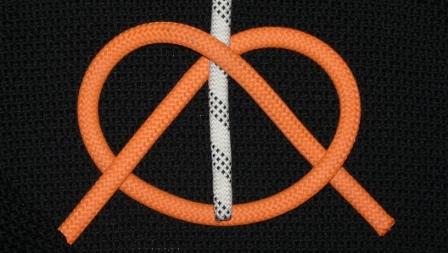
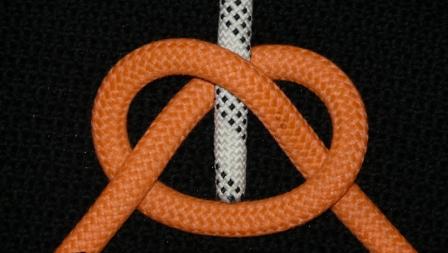
Just to be clear, the original knot is NOT the same as ABOK #1097. Note that ABOK #1097 is NOT truly symmetric, while the original knot is truly symmetric. Ashley says that #1097 is difficult to untie. In contrast, the original knot is NOT difficult to untie.
These are some pretty neat advantages. I wish Xarax would point out some advantages so I’m motivated to test a knot instead of summarily dismiss it.
OK, but just to be clear, no knot on that page is truly symmetric.
I have thought of this loop only after a quarrel with knot4u, about the Karash bowline-like loop, in the “theoretical” discussion about the bowline. As a sailor, there is only one thing I really fear while at sea : a man falling overboard. In such a case, which has never happened to my boat - and I almost “pray” not to happen ever - a double loop, tied on spot and quickly, might be of some help. Learning how to tie a simple double loop as a rescue harness, is a safety measure for the psychology, at least, of the inexperienced crew. I believe that this loop can serve this purpose sufficiently well, because, as I have said, it is the simplest possible double loop and the most easy to memorize - essentially just a double line overhand knot .
See the video (1) for an application proposed for the Karash bowline-like loop. (1) Exactly the same thing can be tied with the even simpler double loop presented in this thread.
The same loop was also presented by me some time ago, with an explicit reference to the fact that it might well be considered as the simplest possible double loop, as it is nothing more than a double-line overhand knot. I had even published two pictures showing this (see the attached pictures). I hope that each time somebody succeeds in getting me banned from the forum, somebody else will succeed in re-discovering something I have already said… Peace on the Forum !
You brought up life saving. So, a full vetting of your assertion is in order. I’m curious what others think about the Bipod being used as a quickly tied rescue harness in comparison to other double loops.
In theory, the Bipod appears like I should be able to tie it quickly. However, in practice, it’s not a quick tie compared to other double loops like the Butterfly Double Loop or the Karash Double Loop. Thus, the Bipod does not come to mind when I think about tying a double loop “on spot and quickly”.
Also, as others have noted above, the Bipod may require securing the working end to the standing end in order for the Bipod to work properly. This addition places the Bipod in the complex category and, of course, increases tying time.
I would better describe the original idea as : "What is the most simple, most easily memorizable double loop, that can be taught to an un-experienced crew, tied easily and quickly, and offer some psychological - mainly - feeling of security ? Because, real life saving, and real security on board of a ship, is a greatly bigger issue, and I am not qualified at all to offer any advice on it…
I guess it depends on tying experience and dexterity. I have not tied the double loops you mention so many times, as the one described here, to be able to compare the tying times of all those loops objectively. Also, and that is the most important point, I think that, conceptually, this "double-line overhand knot based loop’ is simpler than either the Alpine butterfly or the Karash double loops.
For the Karash bowline-like loop, which, of course, is a very secure knot, I have observed that, 1, it may happen to pull the wrong segment of the double eight knot by mistake, and, 2, after the pull, the knot does need some careful dressing, to be set properly. The Alpine butterfly double loop is easy to tie with a number of different techniques, but it is not that simple : The inexperienced tier can learn one method by heart, but, as he can not follow the paths of the ropes inside the knot s nub, he can not have a simple mental picture of the knot, so he will probably forgetthe method after a while.
On the contrary, with this simple double loop we are talking about, once one understands the main concept, gets the “double-line overhand knot” mental picture of the loop, he would probably remember it for a longer time, and it would be easier for him to tie it under stress, in a short notice. That is nothing else than my 2 pence opinion, of course, I can not prove it ! Only experienced. long time rescue teachers could possibly say something we could depend upon here…
1st. With marine ropes, a further connection of the two ends together, is seldom necessary. I do not tie this connection - but perhaps I will, if I will have enough time at those crucial moments…The original loop would probably be deformed a little, under heavy loading, but it will not slip altogether !
2nd. As you have noticed in the video I am referring to, to tie the complete rescue harness, one has to tie an additional knot, even in the case of the Karash bowline-like loop.
It looks like a three-part crown, ABoK#1097, indeed. Tie both those double loops, and see their front and their back side, to notice their differences.
 discussion about the bowline. As a sailor, there is only one thing I really fear while at sea : a man falling overboard. In such a case, which has never happened to my boat - and I almost “