Identify unknown slide and grip hitches

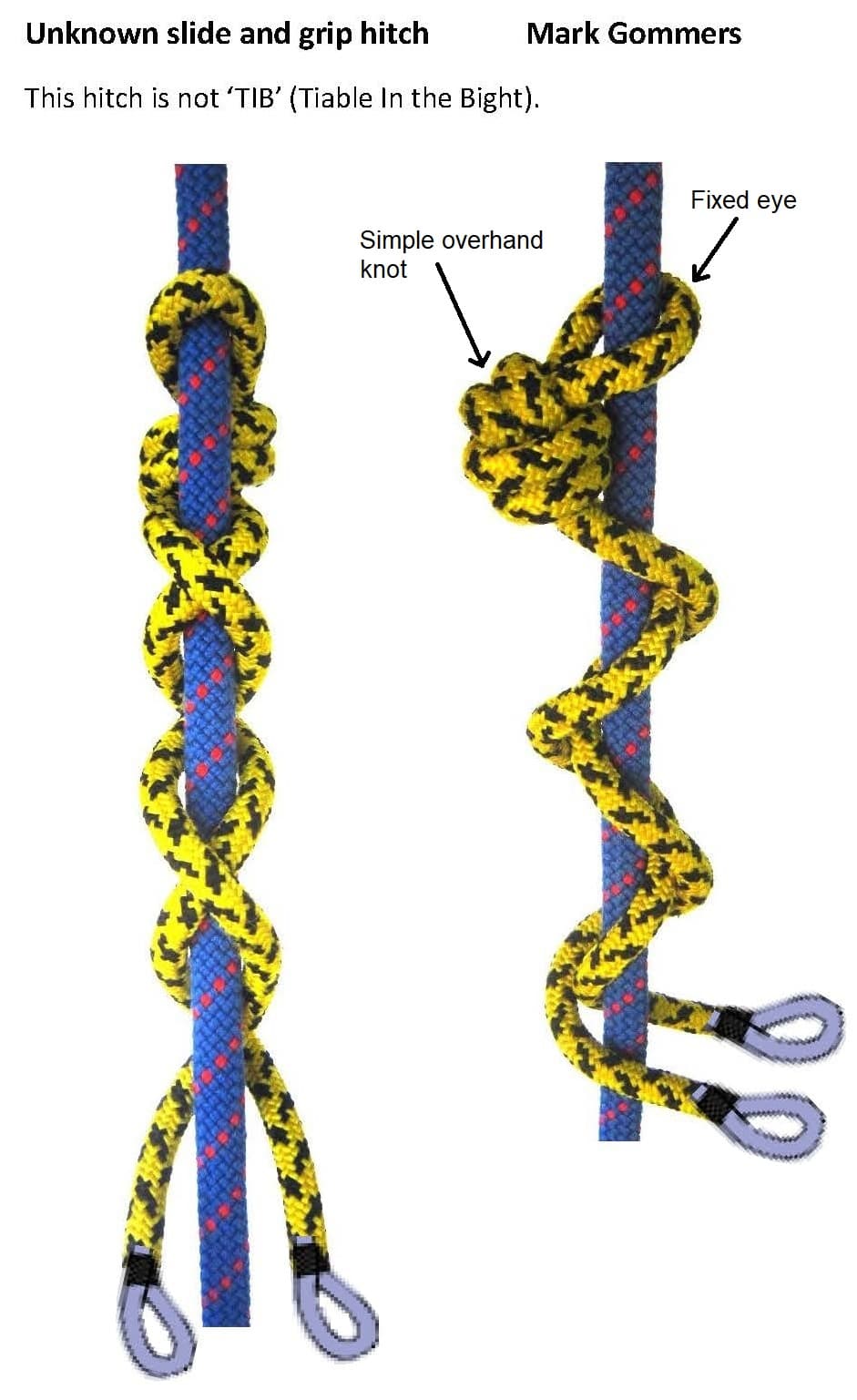
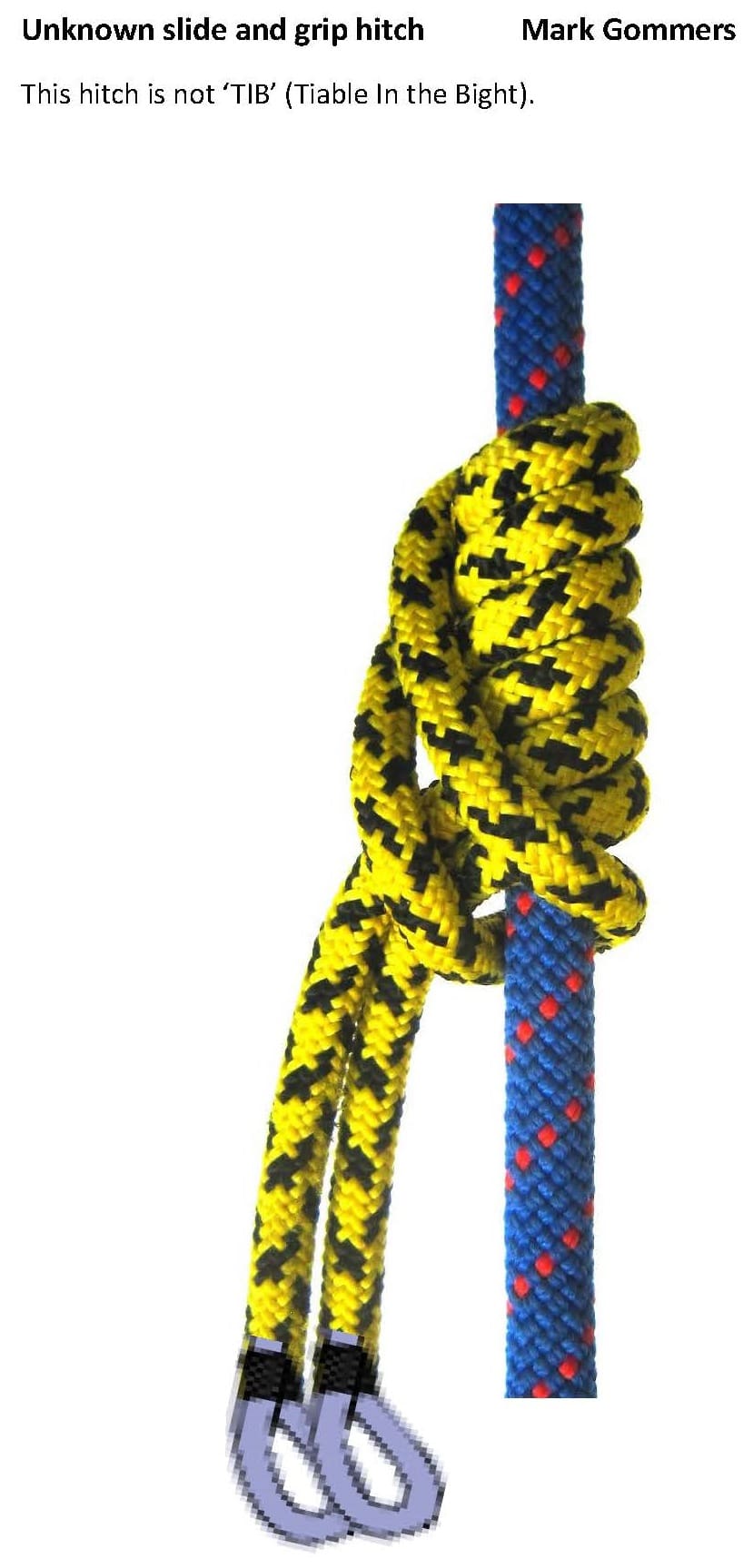
I am presenting 2 slide and grip hitches.
I am unable to identify them - and cannot determine if they are original creations.

Both hitches are not ‘TIB’ (Tiable In the Bight).
Access to an end is required to tie the hitches.
A hitch that is ‘TIB’ can be tied without access to any end (either the hitching cord or the host rope).
If access to an end of the host rope is required, then the hitch is not ‘TIB’.
Example: #1763 Prusik hitch is ‘TIB’.

NOTE:
It is well understood that it hard to make a claim of originality with knots.
Many historical claims have been overturned or a prior discovery was found - predating the original claim.
Also, I don’t have access to every book in print on the subject of caving, and Arborist tree climbing.
For example, I don’t have Robert (Bob) Thrun’s book titled ‘Prusiking’.
I have tried to purchase this book - but it is out-of-print (I would very much like a copy).

I have checked the following books:
Vertical (Alan Warild 1988)
On Rope (Allan Padgett and Bruce Smith 1988)
Ashley book of knots (Clifford Ashley)
The art of knotting and splicing (4th Ed Cyrus Day 1988)
Knots (A.F. Aldridge 1918)
Ropework (James Drew 1942)
An overview of climbing hitches (Arborist News magazine article, Mark Adams 2004)

Could not see the presented hitches in these publications.

If anyone can identify these hitches, please post your reply in this thread topic.
If they cannot be identified - then I might be inclined to make a claim of originality (after a reasonable time frame).
Only in the fullness of time can a claim be regarded as ‘beyond reasonable doubt’.
However, even after lengthy periods of time, claims can still be overturned!


Unknown slide and grip hitch_A_WEB.jpg

Unknown slide and grip hitch_B_WEB.jpg

Hi Mark

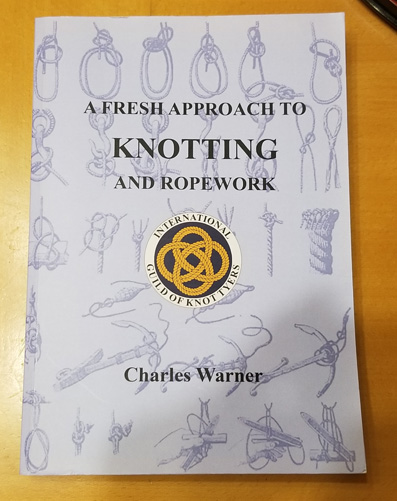
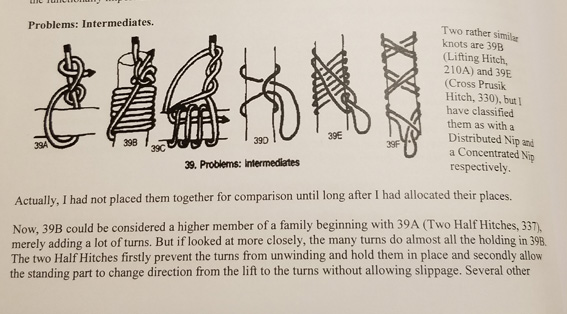
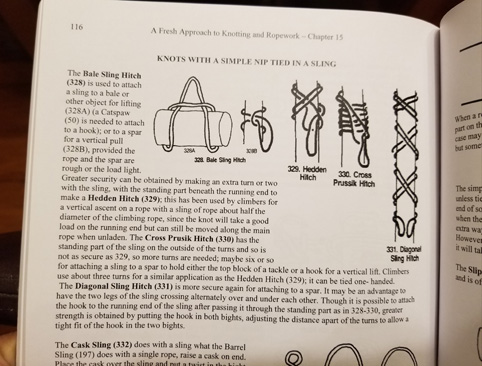
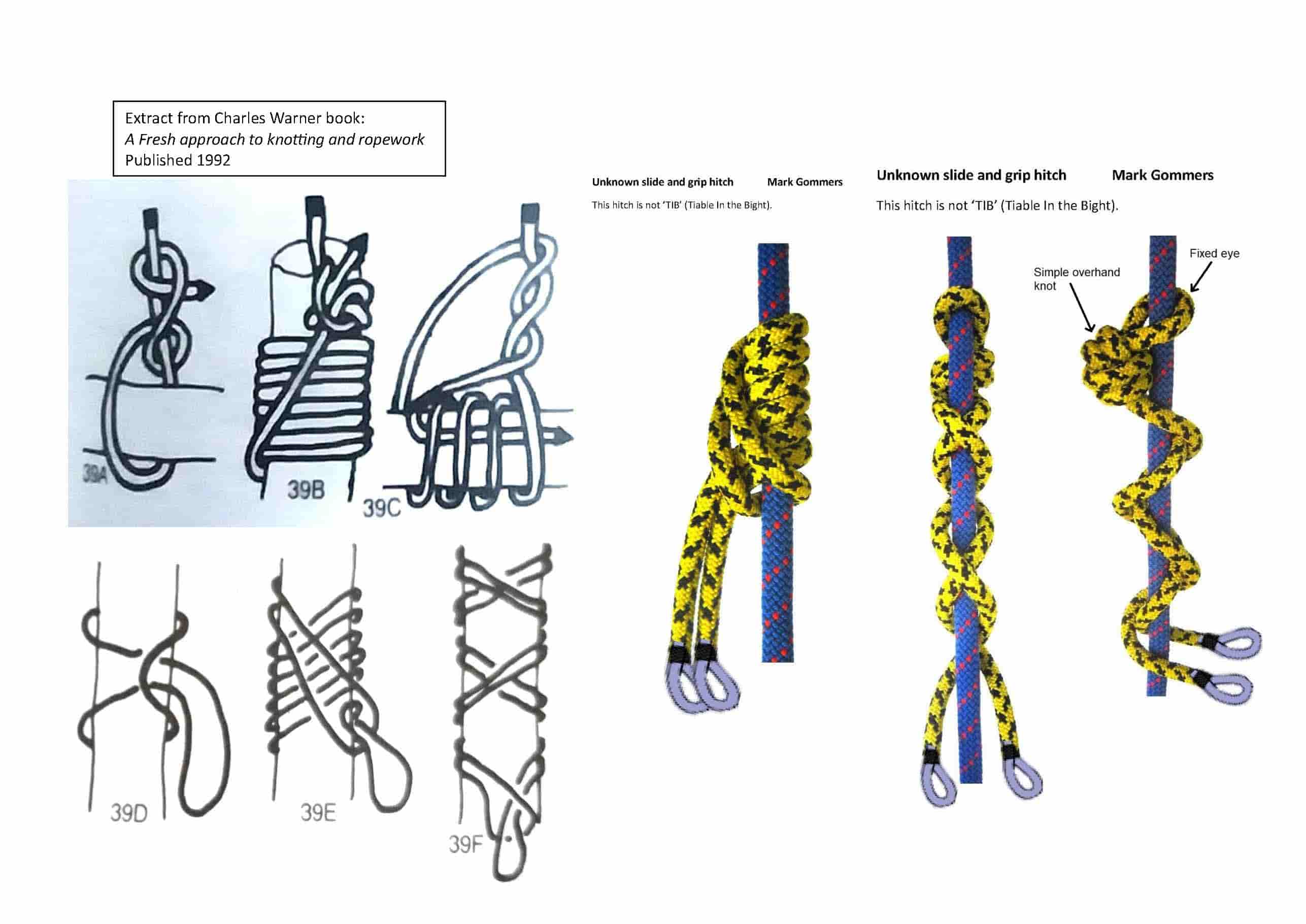
I found they have been mentioned in page 34 and 116 in “A Fresh Approach to Knotting and Ropework” by Charles Warner :-

Happy Knotting
yChan


a1.jpg

a2.jpg

a3.jpg

Hitch “B” looks like a Klemheist hitch. (Machard)

Hi Mark

I found they have been mentioned in page 34 and 116 in “A Fresh Approach to Knotting and Ropework” by Charles Warner :-

No - the images from Charles Warner are not the slide and grip hitches I presented.
As I explained, both hitches I resented are not ‘TIB’.
That is, you can’t tie these hitches unless you have access to an end.

I recommend that you tie the Charles Warner hitches - and then tie my presented hitches.
Hold them side by side.
You will see that they have a different geometry.

Commentary:
When I tied these hitches a while back, I immediately thought to myself that it would be very unlikely that they are original creations.
I thought; “Surely someone on planet Earth has tied them before”.
I have since purchased the book ‘Prusiking’ authored by Bob Thrun.
They aren’t in that book either.

Of note to Dan Lehman if you happen to be reading this post:
The fact that yChan did a search and replied could possibly mean that he thinks it important to determine the historical origin of a knot.
If it wasn’t important, then why bother searching and posting?

And Scott fact checked yChan (and correctly pointed out that the Charles Warner hitches are a ‘Klemheist’).
Again, why do a fact check if it isn’t important?

If I hypothetically made the claim that I am the original creator of my presented hitches - who really cares?
Does it matter?

Another hypothetical:
What if Dan Lehman makes a claim that he is the original creator?
Would proof be required to substantiate the claim? Does it matter?

And one more:
What if I made the claim that Einstein never invented/discovered the general theory of relativity, and it was in fact someone else?
Would it matter?

I concur in this correction --which suggests commentators
need take care in analysis!

Of note to [b]Dan Lehman[/b] if you happen to be reading this post: ... And Scott [i]fact checked[/i] yChan (and [u]correctly pointed out[/u] that the Charles Warner hitches are a 'Klemheist').
As said, "need care in analysis" :: SS369's ref. to "hitch B" (YOURS) post INcorrectly supports yChan's mistaken assertion re the Klemheist :: look carefully, and see that the top's U-fold end surrounds the object-rope, not --which Klemheist does-- the twin S.Parts. --interesting, that. (For an NSE (="TIB") version, start with a larkshead/girth around the object rope and reach away to coil-to this initial structure, which takes the place of the simple U-fold turn of the non-NSE structure Agent_Smith asks about.)
If I hypothetically made the claim that I am [u]the [b]original [/b]creator[/u] of my presented hitches, who really cares? Does it matter?
Likely this will depend upon the perceived value of the knots --and esp. your presented like-a-klemheist hitch looks to be worth evaluating.
Another hypothetical: What if Dan Lehman makes a claim that he is the original creator? Would proof be required to substantiate the claim? Does it matter?
Well, as you see here even, it takes some careful analysis and so on. (In km160:44, Lindsey Philpott bemoans the effort it would take him to search his vast (!! "nearly 2_000") to verify the supposed new knot at km160:10.) As to "matter", it might do so re a feathers-in-one's-cap sense for Dan, for ; but for a better sense of *history* for some knot that has become used/useful, Dan's having drawn the knot in year-X cannot matter, but then some work that reached out to a popular magazine or book or word-of-mouth in an industry (caving, say).
What if I made the claim that Einstein never invented/discovered the general theory of relativity, and it was in fact someone else? Would it matter?
Well, in the USA we have some equally idiotic claims. Sadly, it matters, politically. )-:

–dl*

I never made a specific reference to any specific illustrations from Warner.
(Edit note to Dan: This is simply a statement of fact - with no intention to discredit or denigrate anyone - facts don’t care about feelings!).

Obviously, illustration 39E is a ‘Klemheist’ (climbers adopted this form to be a ‘Klemheist’).
I am of the view that it was illustration 39E that yChan had mistaken for my original 2nd image.
I believe Scott also knows that image 39E is a ‘Klemheist’ (Machard).
Edit note to Dan: Again - Scott was (more likely than not) referring to an image in my original post ("image B’).
Although his post followed on from yChan - so it is also possible that he is responding to yChan and pointing out that Warners illustrations are completely different).

NOTE: Ashley illustration #1762 (published 1944) is topologically the same as Warner’s illustration 39E (Klemheist).
(Ashley #1762 is a mirror of Warner 39E - but this is irrelevant because all knots have a mirror reflection.
The mirror reflection is the ‘same’ knot - it is simply the opposite chirality).
If anyone wants to argue this point, it would mean that all knot illustrators/authors would need to
publish both chiral versions of each and every knot).
Knot tyers have a strong tendency to tie and present their knots in a particular chiral orientation (‘handedness’).

Illustration 39F was possibly miss-identified for my original 1st image.
Ashley #1758 is very close to Warner 39F.

Illustration 39B is nothing like what I had originally presented.
Ashley #1760 is likely Warner’s illustration 39B (again, the chiral opposite).

I therefore am of the view that yChan was looking at Warner’s illustrations 39E and 39F.
I don’t think yChan was contemplating Warner’s 39B (its not even close to any of my original presentations).

The point is that none of the Charles Warner illustrated hitches are what I have presented.
Also, Warner appears to not realise that Ashley #1762 and his own illustration 39E are the ‘same’.
Ashley #1762 was published in 1944. Warner’s book was originally published in 1992.
A criticism I have of Warner’s work is that he does not make a distinction between hitches that
are ‘TIB’ and those that are not ‘TIB’.
His 39B is not ‘TIB’ - whereas his 39D, 39E, & 39F are all ‘TIB’.
[there are other characteristics of hitches such as single leg versus dual leg loading - which I wont go into here].

Again - my original presented hitches are NOT ‘TIB’ (Tiable In the Bight).
That is, in order to tie my presented hitches, you must have access to an end.

Per Dan,
I am claiming that I discovered the Lehman 8*.
I am the original creator of the Lehman 8.
Do you care that I am making this claim?

  • Joking of course

And who said otherwise?!

[quote]I therefore am of the view that yChan was looking at Warner’s illustrations 39E and 39F.
I don’t think yChan was contemplating Warner’s 39B (its not even close to any of my original presentations).
[/quote]
The point you seem to be responding to is my note
that contrary your “fact checking yChan” attribution
to SS369 he was in fact responding to your OP query
and repeating yChan’s mistaken view by remarking that
“Hitch “B” looks like a Klemheist hitch.” --clearly referring
to YOUR 2nd hitch & your query about it. (Well, I guess
that it is true that it L00Ks like a klemheist.)

Again - my original presented hitches are NOT 'TIB' (Tiable In the Bight). That is, in order to tie my presented hitches, you [u]must [/u]have access to an end.
To which I proposed an amended Query-Hitch-B, where[i] Noue'SansExtrimites (NSE=TIB)[/i] exists --with perhaps some added gripping therein, but maybe less gripping release!?

And do you accept this note as discovery of a “new”
knot? --clearly by amendment of the one you presented,
but clearly with a significant difference (NSE)!?

Per Dan, I am claiming that I discovered the Lehman 8*. I am the original creator of the Lehman 8. Do you care that I am making this claim?
Well, it's[i] 'Lehman8'[/i] --no gap. Aside from showing good taste, your claim stands in need of context :: e.g., are you aware of [i]"Lehman8"[/i] and taking challenge that it first came from me? --otherwise, my goodness, what a strange name for a knot hailing from a Gommers agent! (Per some maybe PM reply a decade plus ago on (IIRC) Rockclimbing.com, one fellow reported that he had in fact used the [i]Lehman8 [/i]--so, it got SOME currency via my in-forum (maybe some on-line image file of another) promotion.)

–dl*

Dan,

You seem to read/interpret peoples forum posts from a very narrow literal point-of-view.

Look - I’ll make this very clear for you.
Scott knows what a ‘Klemheist’ slide and grip hitch geometry looks like.
If Scott was referring to my originally posted second image (hitch ‘B’) - he is correct to say that it LOOKS LIKE a Klemheist.
(It does “look” like a Klemheist).
IF he was referring to Warner’s illustrations, then he accidentally typed “B” (we all make typo/spelling mistakes Dan).
I know that Scott actually understands that the Warner illustration 39E is a ‘Klemheist’.

IF Scott was referring to yChan’s post about Charles Warner’s illustrations, then he would be referring to illustration 39E.
I am prepared to cut people a little slack - and I can see past simple typo errors or miss-spellings, or honest mistakes.

There is no way that someone could intentionally identify Warner’s illustration 39B as a Klemheist - unless they were actually totally incompetent.
Scott is NOT incompetent - he is very experienced and has worked in the tree climbing arborist industry - he is NOT a novice.
So it is more likely than not, that Scott was referring to my original posted image (‘image B’ in my original post) - and that he noted that
it LOOKS LIKE a Klemheist (but he knows that it isn’t actually a Klemheist hitch).

You (ie Dan) on the other hand, seem to fixate on typo errors, obvious miss-spellings, and what I refer to as honest mistakes.
Its in your nature to do so - its in your ‘DNA’ so to speak.
And so you engage with that mindset - which is unfortunate in my personal view.

Now - with regard to yChan:
Okay - Mr yChan thought he had identified my original presented hitches in Charles Warners book.
yChan pointed to some illustrations that are on pages 41 and 137 of Warners self published book (1992).
Specifically, yChan pointed to pages 34 and 116 (which correspond to pages 41 and 137 of my purchased book from Warner).

Now, at the top of page 41 (per yChan’s page 34) - there are illustrations numbered from; 39A - to - 39F.
I am of the view that yChan likely thought illustrations 39E and 39F were my original presentations.
I don’t know this as 100% fact - but - it is reasonable to assume that yChan was contemplating 39E and 39F.

Warner illustration 39B is nothing like what I had presented (not even close).
And Scott - was either referring to my original post (my image ‘B’) - OR, he was responding to yChan’s post (and possibly meant illustration 39E).
I cant be 100% certain…
As stated, Scott absolutely knows what a ‘Klemheist’ hitch looks like - and YES, my originally posted “image B” does LOOK LIKE a Klemheist (but in fact isn’t).

For reference, please examine the attached image below.
A reasonable person would think that illustration ‘39B’ is nothing like what I had originally presented.
A reasonable person could possibly mistake illustrations 39E and 39F as being my original presentations.

Now, with regard to your comment…
per Dan Lehman:

To which I proposed an amended Query-Hitch-B, where Noue'SansExtrimites (NSE=TIB) exists --with perhaps some added gripping therein, but maybe less gripping release!?

And do you accept this note as discovery of a “new”
knot? --clearly by amendment of the one you presented,
but clearly with a significant difference (NSE)!?

Sorry - I cant see how Warner’s illustration 39B can be ‘TIB’ (Tiable In the Bight).
You would need access to an end to tie Warner’s 39B.

And per your comment: “And do you accept this note as discovery of a “new” knot?”
I honestly don’t know how to respond - because I’m not sure if you are joking?
Also, I am having trouble interpreting the meaning of what you wrote.

I would add that I am somewhat critical of Warner’s work - particularly in view of
the fact that he makes no distinction between hitches that are ‘TIB’ and those that aren’t.
[some examples: A ‘Klemheist’ hitch is ‘TIB’, and so is a ‘Prusik hitch’.
A ‘Blakes’ / Prohgrip hitch is not ‘TIB’.]
Warner_page 41 comparison_WEB.jpg

As w/Mark, I see these images on different pages ::
what printing/edition of CWarner’s book do you have
–different pagination and position of things!? (I’ve
ones of two re-printings, 1995 & 1998.)

And Scott fact checked yChan (and correctly pointed out that the Charles Warner hitches are a 'Klemheist').
Scott wrote a simple line, leading to a big burst of hot air; surely he can clarify what he meant to say in writing his [i][b]"Hitch "B" looks like a Klemheist hitch. (Machard)[/b]" [/i] ... that he's referring to the OP's "hitch_B_" image (not CWarner's) and ... which could mean "looks like ..., but I'm not sure" or "looks like, but clearly isn't" or <?>. Words can work in good ways, not just to confuse.
The point is that none of the Charles Warner illustrated hitches [is] what I have presented. Also, Warner appears to not realise that Ashley #1762 and his own illustration 39E are the 'same'.
Charles wasn't interested in origins, being a believer that "all simple knots have been tied by someone ..." --a sort of philosphical position (with which I've taken issue :-).

But “none … is …”?! You quit too early --to wit

am somewhat critical of Warner's work --particularly in view of the fact that he makes no distinction between hitches that are 'TIB' and those that aren't.
BUT he does answer the now infamous "Hitch B" part of your query :: smack opposite (in OUR printings) those hitches you're ranting about --verso facing recto-- comes #326, the (first of the series) Multiple Pile Hitch! Bingo, with then some rantings about loading (angle) and all. But that hits the structure in major part. (And with access to the object end, it can be NSE.)

–dl*

Dan,
With regard to your rantings and allegations of hot air:

Your cherry picked pull quotes missed this comment from me:

So it is more likely than not, that Scott was referring to my original posted image ('image B' in my original post) - and that he noted that it LOOKS LIKE a Klemheist (but he knows that it isn't actually a Klemheist hitch).
I assume that English is your first language? How could you have missed this?

And this rant:

those hitches you're ranting about --verso facing recto-- comes #326, the (first of the series) Multiple Pile Hitch! Bingo, with then some rantings about loading (angle) and all. But that hits the structure in major part. (And with access to the object end, it can be NSE.)
A [i]slide and grip hitch[/i] is not 'TIB' if access to ANY END is required. That is, if access to the end of a host rope or the end of a host post/stump is required (in my view) it disqualifies the hitch from being 'TIB'. You (Dan) however, may have a different view of what constitutes 'TIB'. Your definition may allow for slipping a hitch over one end of the 'host'. My definition forbids this 'loophole' [u]in relation to slide and grip hitches.[/u] Of course, we might need to define what I mean by 'slide and grip hitch' (a classic example of which is a 'Prusik hitch' - appears in Ashley at #1763). I might herein defer to that fine fellow Bob Thrun and his classic book titled 'Prusiking' (where the title is referring to the act of ascending a fixed rope by various means). [u]EDIT NOTE:[/u] There are several categories of 'hitch'. Slide and grip hitches are but one category. Arborists, climbers, cavers, etc, have a specific operational need to be able to attach and form a [i]slide and grip hitch[/i] to the mid-point of a host rope. That is, this class of users need to be able to form the hitch [i]without [/i]accessing the end of the host rope. Warner's illustration 326 (Double pile hitch) isn't intended to function as a 'slide and grip hitch' - and yes - it requires access to the end of the host spar/post. ...

Apart from your purported “Image B controversy”: [and yes, I love controversy, and I suspect - so do you :slight_smile: ]

To steer this topic back on track:

As it currently stands, it appears that no claimant has leaped forth to claim my originally presented slide and grip hitches.
They remain unidentified :slight_smile:

To clear some things up…

Yes, I did know that “Hitch B” that Mark posted was not the Klemheist (Machard).
I have tried Hitch B and found it lacking grip at times and would not stay neat.
It has probably been tried by others (?) and dismissed because of the inconsistent nature.

Hitch A (Mark’s) looks similar to a VT with an additional OH.

As for TIB ability, well, if that is required, so be it.

Originality? We shall see if anyone comes up with verifiable claims.

Let’s play nice and see where this can go.

Any testing done Mark?

S

1 Like

in reply to Scott:

With regard to my originally posted "image B’:

With 6mm hitch cord on 11mm host rope = grips too well - harder to release and slide compared to ‘Prusik hitch’ (#1763)
6mm on 11mm host = 54.55% ratio

With 8mm hitch cord on 11mm host rope = grips well, but much easier to release and slide.
8mm on 11mm host = 72.73% ratio
If this ratio was increased to 75%, I theorise that it would release and slide more easily than at 72%.
I did not experience any significant distortion of the geometry during loading/unloading/loading repeat cycles.

The relative ratio between the hitching cord and the host rope plays a significant role (as does the ‘stiffness and outer sheath’ characteristics of the hitching cord).

NOTE:
My originally presented "hitch A’ is significantly easier to release and slide relative to "hitch B’.
This is due to its geometric structure.

SLIDE AND GRIP HITCH DEFINITION
A slide and grip hitch enables progression up and/or down a fixed host rope.
The hitch grips when loaded, and slides along the host rope when unloaded (in a repetitive cyclic sequence of loading-unloading-loading-unloading, etc).
Although most slide and grip hitches are asymmetric (‘directional loading’ only) - some are symmetric and work bidirectionally (eg #1763 Prusik is symmetric).
The ease with which a slide and grip hitch releases and slides along a fixed host rope is a fundamental property governed principally by its geometry, diameter relative to the ‘host’, and stiffness.
NOTE: All slide and grip hitches require ‘tuning’ - which means adjusting the number of wraps formed around the host rope.
This ‘tuning’ modifies the efficiency of how the hitch performs under cyclic loading while ascending/descending a fixed host rope.
The act of ‘tuning’ does not alter the fundamental base geometry. Adding or subtracting wraps simply modifies the hitches grip and releasability.
An example is a #1763 Prusik hitch - which can be modified by adding or subtracting wraps - but it is still fundamentally a Prusik hitch.

Tree climbing arborists and cavers are a class of users who have a long history of developmental work in searching for efficient and effective slide and grip hitches.

EDIT:
Image added (showing 8mm hitching cord on 11mm host rope).
I found 8mm cord to be easier to use than 6mm cord.


Unknown hitch B_WEB.jpg

Hi Mark.

Regarding my trying Hitch B. It was some time back and I had my rope tied to a branch in the yard where I generally give ideas a go and do my unscientific testing. I found in my testing, using 10.5 static rope with 6mm accessory cord. that with no tension or weight on the trailing rope below the hitch, the hitch would bend the parent and deform. Perhaps if there was a longer length of trailing rope it would have weighted it some to resist the bending/deforming action.
I have not tried it on dynamic ropes, but, in my mind it seems the action might be worse. (?)

I’ll try it again in the future. For now I’ll use a Prusik for my needs.
Slide and grip hitches are very material/size ratio and environment dependent.

I wonder how well either of your offerings will perform in drop tests?

S

Regarding my trying Hitch B. It was some time back
I actually first tied and experimented with these hitches [u]June 02, 2024[/u]. I cant really make any claim of originality prior to that date.

Although Dan will likely comment that there are no academy awards, citations, or Nobel prizes, for making new knot discoveries.
per Dan:

But if the sole point of such claims is first-to-the-knot, that is not all so important, ipso facto. If we find the claims are credible, the knot worthwhile, then I think we should have credit enough for all.
(Which begs the question: What is the point of this forum?). I am quite sure that yChan will jump up and down and make noise if someone tried to claim all of his presented knots :)

I recall a post from Bob Thrun (in relation to the Zeppelin bend) where he stated;
“I think I may have been first to tie and present this bend” (or words to that effect).
Why would he post such a claim?

Scott, if you tied and used my originally presented ‘Hitch B’ prior to 02 June, 2024, then I cant make any claim of originality!

With regard to “drop testing”…

I have to say that no slide and grip hitch is suitable in human fall-arrest (ie to arrest a falling mass).
A number of people have done ‘drop tests’ on slide and grip hitches (eg Richard Delany from Rope Test Lab in Australia).
It has been conclusively shown that slide and grip hitches disintegrate (textile on textile burn through) in drop tests exceeding factor 1 (using a 100kg mass).
I personally drop tested a 3 wrap Prusik hitch (#1763) using a 100kg mass at factor 1, and it disintegrated (refer image below).
I extrapolate this result to any slide and grip hitch that is subjected to a fall factor exceeding 1 (with 100kg mass).
This is due to the textile-on-textile burn through.

I am also a rope access operator, and we use gadgets such as the Petzl ‘ASAP’.
These devices are designed to arrest human free-falls on a rope (the rope is typically EN1891, 11mm diameter, low stretch).
Link to ASAP: https://www.petzl.com/INT/en/Professional/Mobile-fall-arresters/ASAP-LOCK


Purcell-drop-test_WEB.jpg

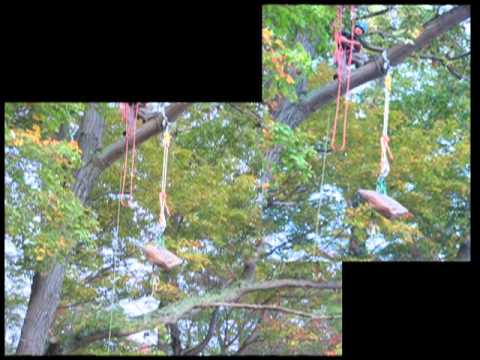
Here is a video where the ProhGrip/Blake’s is seen to hold
past FF-1. One might challenge the strict FF-ness (given some
flex in the tree and so on), but certainly the knot is taking quite
some force!

IMO, one might get better than worse results with a sort of
“Dog & Tails” or Penberthy (simple coil w/ends joined) structure,
hoping to distribute the gripping force better !?

–dl*

To Dan and any other potential layperson reading this post:

The link to the video that Dan posted is an ‘outlier’ test.

I note the following:

  1. The hitching cord was 9.0mm diameter (which is unusually large compared to what the vast majority of user groups would use)
    Most climbers (for example) use 6.0mm diameter accessory cord (+/- 1mm).
    Most professional VR teams use 8.0mm cord on 11mm diameter low stretch rope.
    The host rope used in the video appeared to be of a much larger diameter than 11mm (thereby decreasing the bend radius and aiding heat dispersal).

  2. The tree climbers only used a 180lb drop mass (81.6kg) - which is significantly less than the normal 100kg drop mass specified in relation to low stretch ropes)
    An average tree worker, with all PPE and tools would weigh at least 100kg - or more (think helmet, hearing protection, full body harness, fuelled chainsaw, hand saw, various devices, etc). Rope access operators almost certainly weigh more than 100kg with all their PPE + tools.

  3. The tree climbers did not have a rigid anchorage point above (it was attached to a tree climb - which flexes).

Dan, I think you searched for a video - and found one - in an attempt to contradict my warnings about using slide and grip hitches for human fall-arrest.

I stand by my caution and warning to NOT rely on a slide and grip hitch for any life critical fall-arrest applications.
Legally (and with regard to duty of care) - you would be wise to follow suit. Keep in mind that these posts on this forum are published to the world!

There are specific standards that are published to cover devices that are designed to arrest a free-fall on synthetic ropes eg; EN 353-2, ANSI Z359.15, etc.
NO SLIDE AND GRIP HITCH WOULD PASS THE DROP TESTS SPECIFIED IN THESE STANDARDS.

Scott may not like me saying this BUT;
I have to say that tree climbing arborists are one of the last remaining class of users who still heavily use and rely upon hand tied slide and grip hitches.
Virtually the entire rope access industry and vertical rescue (VR) operators have long since moved on and use properly certified and fit-for-purpose devices designed to arrest free-falls.
Virtually no one at a workplace relies on hand tied slide and grip hitches anymore… (except tree climbing arborists).
Sorry Scott!

Hi Mark.

I take no offense with what you’ve written. What industries do over time, well they evolve. I might use S&G hitches mostly when I rock climb. Sometimes as an arrest on a construction project when hand hoisting.

To date, I have not invested in any mechanical/professional S&G or fall arrest gear. Many times the fall arrest gear/extra safety gear is provided by the general contractor on industrial projects (By law).

So far, so good, I am still breathing. If the needs arise I will purchase what is needed.

I’ve search for your two and I have not found them .

S

I personally drop tested a 3 wrap Prusik hitch (#1763) using a 100kg mass at factor 1, and it disintegrated (refer image below). I extrapolate this result to any slide and grip hitch that is subjected to a fall factor exceeding 1 (with 100kg mass).
That's quite some leap --from a particular test to such a broad assertion!

… which showed a hitch holding.
There are other similar tests, to wit ::

seems to have FF-1 & even FF-2 tests, w/success, in the materials used.

Dan, I think you searched for [information]
And now another (and another, though I think w/lower FFs (1/3)).
in an attempt to contradict my warnings
... to simply to see what evidence there was to support whatever assertions. To see what was failing (the hitch, the hitching rope, the object) and why.
NO SLIDE AND GRIP HITCH WOULD PASS THE DROP TESTS SPECIFIED IN THESE STANDARDS.
Again, this is a broad assertion --of hitches & materials.

[u]Scott may not like me saying this BUT;[/u] I have to say that tree climbing arborists are one of the last remaining class of users who still heavily use and rely upon hand tied slide and grip hitches. Virtually the entire rope access industry and vertical rescue (VR) operators have long since moved on and use [u]properly certified and fit-for-purpose[/u] devices designed to arrest free-falls. Virtually no one at a [i]workplace [/i]relies on hand tied slide and grip hitches anymore... (except tree climbing arborists).
And arborists get on; is there a mechanism that could replace the knots for their application?!

–dl*

To Dan:

It is sad to see such a reckless and irresponsible position that you are taking on this matter:
(ie using slide and grip hitches in life critical fall-arrest applications at a workplace).

You are broadcasting your assertions to the world - which is a potential breach of duty of care.

And; this thread is now being de-railed.

I am going to start another thread topic on this subject (under “Knotting concepts and explorations”).

I wont discuss this particular matter any further in this thread… instead, preserving it for new knot claims.

“Assertions” you say?! Where are there any assertions?!
Can anyone find any assertions by me in this regard?!

In some older mountaineering literature,
one can find an assertion about using a slide-possible
Tarbuck Knot in fall-arrest situations. I’m looking for
any testing to back up its promised benefits, so far
w/o luck. The K.Tarbuck booklet emerged ca. 1960.
The knot disappeared when kermantle ropes became
common.

–dl*