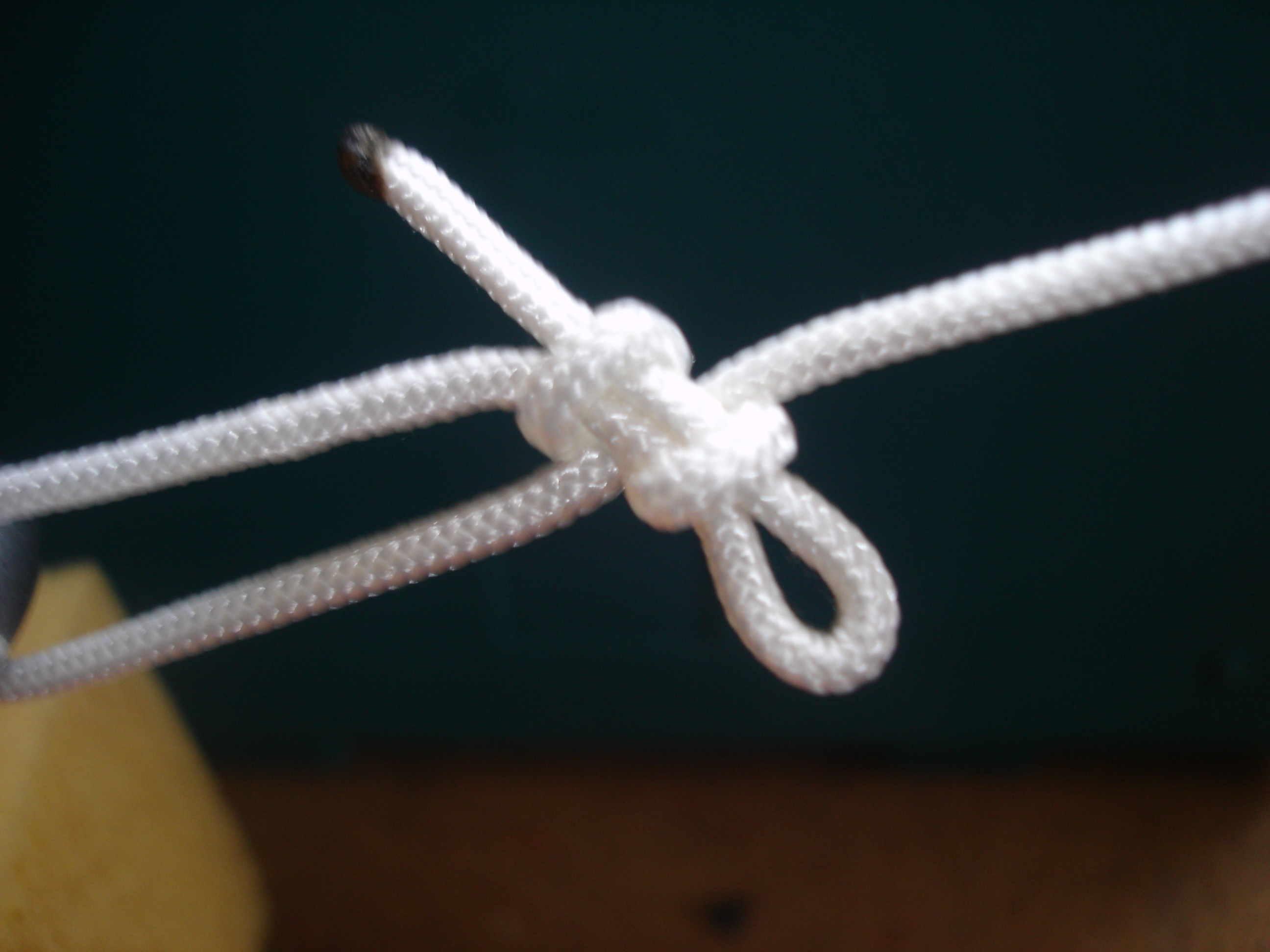
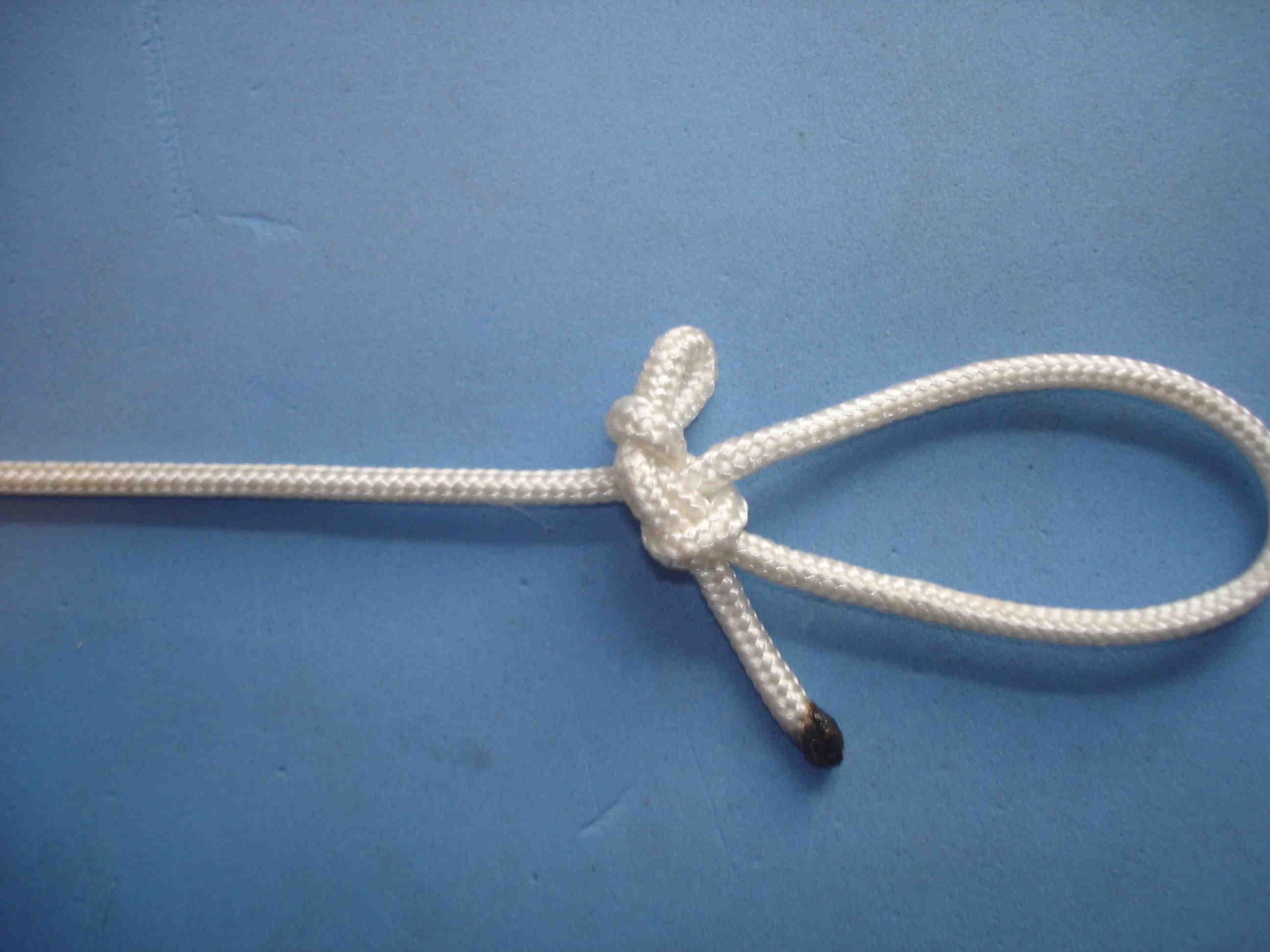
Here is a knot inspired by the Pretzel loop. It is unlikely to be new, someone must have taken a clove hitch and made a slippery loop by feeding a bight through it. Regardless, let’s call it a ‘Slippery Clove Loop’ for here. Edit: I see someone has done this loop before The knot I trialled was probably first called an “Exploding Clove Hitch” by Neil Compton in the “Knot Bible”, from sources given here.
I was intrigued to see whether other crossing structure loops would ‘misbehave’ in my rope material. As is turns out this one did not. I think that is only because the clove allows the nub to be cinched well before load.
The second image is poor again (oh well, eventually a new camera or more photographic expertise will come my way ), however it shows the knot I trialled on my test rig reasonably well.
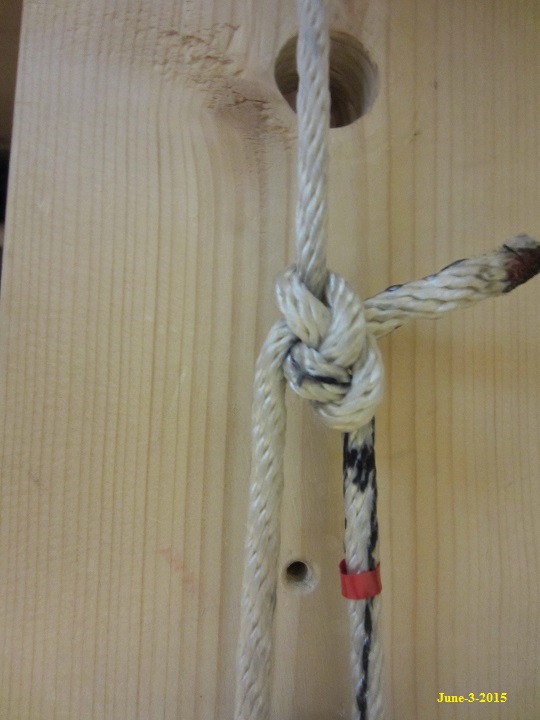
The 3rd image is after I took the same knot to 115Kg. It held it’s form as far as I am concerned and was very easy to untie afterwards.
Cheers,
mobius
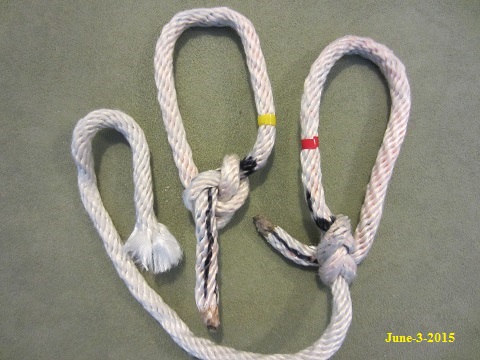
Edit: added a 4th image, different only because the bight goes through the clove from the other side. Might be better (or worse) for some reason, though the knot seems to sit better after cinching to me.
Edit: This 4th form is the version xarax shows elsewhere as an “Exploding one-way hitch”
This much-compressible / easily-flattened material you use allows the segments of the nub to be re-arranged, it fills the gaps between them, and it makes even mediocre nipping / gripping structures able to confront the slippage of the penetrating lines. In my stiff, slippery climbing ropes, which retain their almost circular cross section, this knot does not work as well.
FWIW: My 3mm poly braid is stiff (more so than kernmantle) , slippery and retains it’s circular cross section as well, that was one of the main reasons I chose to trial knots in it. That, and I could break it safely if I wanted to with a small scale test rig.
If we relax the TIB condition ( which led me to the Pretzel loop ), we do not even need to tie a double overhand knot -based nipping / gripping nub, as shown in my previous post (1) : the single overhand knot is enough. If we let the penetrating line enter into / exit from it as shown in the attached pictures, i.e., so that the overhand knot “works” almost as a Clove hitch ( which, as we know, is a very tight knot when tied around ropes ), we get a quite satisfactory, simple and stable solution (*).
All those nubs need not be clinched hard around themselves before they become loaded ! The only thing we should pay attention to, is to dress them correctly, so they will remain “balanced” when they will be pulled by their three limbs ( and they will nor rotate around themselves, or capsize ). As the nubs becomes more convoluted, they become more stable, but they also consume, within their own segments, a significant portion of the tension that would otherwise reach the penetrating line and increase the friction forces which will immobilize it.
When we find such a tight nipping / gripping nub, the next thing we may think and try is to use it as base for a secure fixed eyeknot, by adding a collar, a-la-bowline - because it is natural to imagine that an already very tight nub, helped by a collar that reduces the tensile forces which reach the last segment of the Standing Part, would be an ever more secure solution. However, the fixed end-of-line loops, in general, and the bowlines, in particular, do NOT work like this. In the adjustable loops, we need as tight nubs as we can get, even if they may become almost jamming, because we have one, only, line of defence against the slippage of the returning eyeleg, while in the fixed loops, where the penetrating line can follow a much more convoluted path than an L-shaped one, and we can also have collars, it is the other way around ! The nipping structure of the bowline, the knot tied on the Standing Part before the eye, is based on TIB knots, which do not “close” around themselves, and run the danger to become difficult to untie. That is why we should better avoid ANY not-TIB knot on the Standing Part before the eye ( that is, a not-PET solution ), but we also be careful when we use such a knot even on the Standing Part after the eye - during a heavy loading, even the tension delivered on the nub through the returning eye leg ( which is 50% of the total ), can force the nub to clinch around itself too tightly, and become difficult to untie.
(*) To be precise, the nub of the adjustable loop shown in this post has the geometry of a Clove X hitch ( X = crossed continuations of the ends into the nub ) - which, topologically, is not equivalent to the unknot any more, as the parent Clove hitch, but to the overhand knot. To some knot tyers, it would be easier, perhaps, to start from a Clove X hitch, and penetrate it by the returning eyeleg, than to start from an overhand knot.
Hi All,
I have this convoluted wan’t slip adjustable here, can support heavy load and easy to readjust loop.
    First picture, with 7 and 8mm  solid braid nylon rope, I mark the tail with tape, yellow is loses dressing, red tight dressing.

    First test pull as hard as I can, take a picture of both eyes still on tension, then I release it and take a picture,
    also check it, it was super easy on yollow tape loop, just easy on red side to untie.
    I reload the loop and pull it until it break, the yellow tape side' eye broken, and easy to untie the red side's eye.

    second test with 8mm rope, have the same result. for safty reason,I wrap a heavy blanket over the hook and rope, so can't  observe any thing. can't tell you anymore.
      謝謝  alan lee
Yes, this is a much tighter/secure adjustable loop ! However, I still think that it has some segments which are not utilized very much - as this “lower” collar, for example. I believe you can simplify it even more - but, at the end, I believe you will arrive at loops with simpler, less convoluted nubs, based on the double overhand or the single overhand knot :), like those at Replies#13 and #23 (1)(2).
You can also try to figure out TIB solution, like the Pretzel loop. Do not underestimate the versatility and beauty of TIB knots !
P.S. I believe that this braided rope you use is very “compressible”, and it is nipped / gripped rather easily. With a stiffer, kermantle, not so “compressible” rope, which retains its round cross section and it is not so easily squeezed and not so much “flattened”, to be maximally effective, the nipping / gripping nubs cannot afford to have any “redundant” segments.
I’d probably go with a Trucker Hitch. I’d use a Span Loop as the “sheave” because you want things to stay in place once tension is lost. (A Bell Ringer is not an option.) With a Trucker Hitch, the adjustability is possible while the rope is under tension. Also, the security is absolute once you tie things off.
A minor downside is that you have to plan ahead and tie the Span Loop “sheave” at a good location. Otherwise, you’ll have to untie and start over.
When you have a “sheave”, you do not need to tie things off… Just pass the Working End through the bight for a second time, and in between the tip of the eye of the “sheave” and the tip of the bight of the previous passage. You form an opposing bights locking mechanism, which is most secure, without any additional knot.
You should use the “Advanced Search”, in this Forum s Search engine, or in Google s.
Search for the words “Pretzel loop”. You would find many posts referring to this knot… Then, going backwards in time, you will find the original post.
I think it is neat knot. It is easy to loosen and untie, when it is not under load. It is post-eye-tiable. It is also tiable-in-the-bend, if you use slipped loop in the working end.
I made a short video about this knot: https://youtu.be/u2me7yxoBR8
Though I am not aware of any special name for the knot, but yes, it is convoluted. It is easier to untie than Pretzel loop in my experience.
 The knot I trialled was probably first called an “Exploding Clove Hitch” by Neil Compton in the “Knot Bible”, from sources given here.
 ), however it shows the knot I trialled on my test rig reasonably well.