Mostly, knot books ( and sites ) seem to mimic other knot books ( and sites ), in erring…
With much line diameter difference, any bend is going to look awkward. Did you have some elegant exception in mind outside of a hitching solution?
Hi Seaworthy,
(the “standard” Lapp knot: http://davidmdelaney.com/Lapp-knot/Lapp-knot.html )
I suspect that is something similar to the structure visible in the first image at the bottom of this post (to get the bend mantain the standing part in blue,cut the eye and use the second leg of the eye(in red) as the other standing part),but I expect to be disproved…
http://igkt.net/sm/index.php?topic=4321.msg27309#msg27309
As a bend it seems to be really good and secure, but do not use the loop version illustrated there if you do not want to risk of heavily imprecate while trying to untying it…(in fact even the bend can be a little difficult to untie, also for this I expect to be disproven …)
(for the record,in the second diagram there,is illustrated that can be seen as a loop version of #488.The offer for try the “Tresse”(the term is by alpineer,which has presented the Tresse Bowline) version is still valid, the difference between the two is(apparently) minimal (continuation of the standing part over itself vs under it self).)
Regarding the Zeppelin topic, it may be interesting to this thread:
http://igkt.net/sm/index.php?topic=2159.msg15189#msg15189
Bye!
Dan, firstly, thank you for all the info. It has been very interesting reading your responses.
I will have a play with all 4 twin overhand bends.
It is still used for very thick line. Best bend for that, as far as I am aware.
Yes, agreed. But I am raising this issue because very few people using a DSB are at all aware there is a second version. So how can they make informed decisions?
If only one version is taught or displayed anywhere, why is it the worse one?
Ah huh! EXACTLY!!!
That is what I am jumping up and down about on this thread. I bet he ties #1434 (ducking for cover if not LOL), that all books teach, as does everything online and sailing school and even this website to Sea Cadets. #1434 can certainly slip in even double braided polyester. It is the un-snugged version of 488 and therefore not pre-tightened properly if it is only tightened and left in this form.
Maybe 1434 never slipped in natural fibres and so it was deemed adequate.
The big question I am raising in this thread is why is it taught exclusively now?
Really fascinating stuff! Thank you. Such a pity the report was removed from view.
My theory is that these knots may have been inadequately pre-tightened or not snugged properly before load was applied.
Hi Dan
I have been looking at the lapp bend.
Could you please tell me if I have interpreted your instructions correctly?
The single I am reasonably confident with, the double not so:
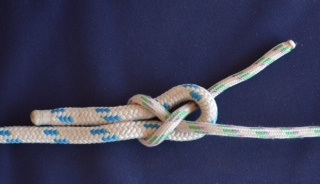
Sorry, can see I stuffed up the double (wasn’t paying attention).
The image I have attached below is simply the 488 with the standing part and tail reversed and with the tails still coming out on the same side.
The bit I am confused about is “BUT on both turns around the bight, tuck the working end through the bight (otherwise, you’ll have a jamming knot!).”
Is a diagram or photo possible please or a link to one? Or now that I have this image any other way of explaining the tucks?
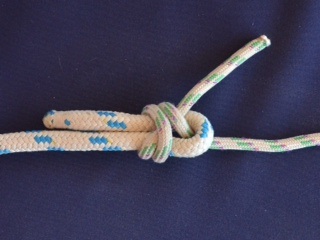
Oh, skip that LOL, the light just went on. I just had to tuck the end through the bight as you said :). Sorry, my brain just froze completely. I am not used to following knot instructions, but looking at images instead.
I will take a photo in a moment and post it.
I will give both a try on our winch later (making sure I don’t use the end of my yankee sheet for the jamming version) and report back.
Now, if nothing else I am sure I am providing you with some entertainment :).
Take 3 of the double lapp is attached in the next post what I assume is its jamming form. When going to tuck the bight in I realised in take 2 I had not started the first pass over the top.
The tucked version will also be posted.
Anyone going to put me out of my misery and tell me if these are right before I test them? 
Double lapp jamming and non jamming versions attached.
Before I go test it, is this finally correct?
If I just followed Dan’s instructions it would have made it easier :).
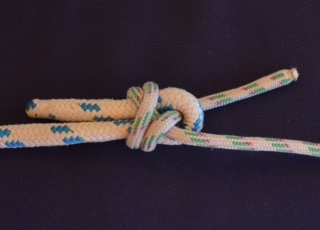
Interestingly, did anyone notice that the first version I posted of the double lapp was in fact correct for the jamming version, just unsnugged?
ie It was based on the 1434 version of the DSB, not the 488. When finished, just rolling over the first turn in my first version produces the correct bend.
It is still too early in the morning to go test anything as the sheet winches are right above our cabin and my better half is asleep.
So, I have been playing with the single and double lapp bends in the same diameter line. I am extremely impressed. I will explain why I think these bends may be brilliant (they need proper load testing beyond my scope to check security, but I am very optimistic).
The big reason is that when pre-tightened up by hand as much as possible (so that the working tail ends up perpendicular to the two standing ends), when tension is put on the two standing ends everything just pulls together tighter. So when the tension is released, the knot is still snuggly set. On the other hand, the sheet bend, having had pressure put on to open up the apex of the bend slips a bit to set, and then has a big gap created in the apex, making it very easy to undo when the tension is released, but also making it extremely prone to coming undone on its own. Just holding a standing end and flapping it around a few times can undo the sheet bend.
Secondly, the lapp bend is quicker to tie than the sheet bend, as the tail never needs to be fed under any component, just through the bight, which is a much easier alternative. For those with clumsy or cold numb fingers, this is important.
Looking at it, I can see absolutely no drawbacks with it compared to the sheet bend, except perhaps that a bit more care may be needed to pre-tighten it so that the working tail ends up perpendicular ie it needs to be snugged well (only takes a couple of seconds, so no big deal). The sheet bend has no such problem as it naturally slips anyway when load is put on it.
So, if the above is correct, other than when you want to untie the bend very quickly after load has been applied, when would it be more appropriate using the sheet bend? Why is the lapp bend not currently commonly in use? No sailors I know have heard of this bend. Is seems better, so what is the catch? (Other than needing a diagram to learn how to tie it :))
PS You have successfully distracted me from the burning question on hand of why 1434 is presented as a DSB rather than 488. But my current question still stands :).
“The sheet bend family” doesn’t look so awkward,
and goes some way. But, yes, it does really become
such a joining that one might prefer to see it as
hitching --indeed, I like to refer to a special
class of rope-2-ROPE joints as “bight hitches”,
with the bigger rope pretty much playing an
object rather than doing much participation
in the knotting. (It’s a slippery slope, though,
as to what forms one might see as being such
“objects” being hitched to. The bight (open or
closed --i.e., an eye) seems apt for the treatment.)
AND I think --w/o good knowledge-- that one
marine application would be messenger lines
–the hauling of ever larger lines by another
(of which I’ve read of breakage, so it mustn’t
be entirely trivial!).
–dl*
Yep, reading “in slow motion” as it were would
be a help to many, here (who whine about photos)! 
And I might’ve noted the relation of #488 reversed,
though I was focused on the non-jamming version.
WHICH, incidentally, can --again-- be guarded against
that jamming : i.e., while the wrap-all wraps prevent
one from the forcible loosening method of pulling
apart the bight legs to prise in some hitching SPart,
one might build in resistance to jamming 'a la
sheet bend at the bight tip where the hitching
line enters (as I also suggested, above).
NB : I find it helpful to treat even eyes as though
they are “open” bights --i.e., a bight with one leg slack–,
as the focible loosening method just noted will work
best if the draw of the hitching SPart has pulled
that “slack” (tail, if “open” bight) leg a little over
the other leg, and reversing that movement in
forcibly untying I think gives one a little extra
movement (potential).
–dl*
Suitably chastised :).
Blame Grog for my inability to read instructions :).
I will move this discussion onto an old lapp thread. Any suggestions which one is most appropriate?
I have just trialled the jamming version on our sheet winches and results will be buried in this thread.
Will do non jamming version later. On the move shortly
Hi Seaworthy,
That was an interesting thread.
Maybe you already know Asher’s Simple Simon Under.
Here it is ; a loose an a dressed version.
Are you able (time, interest) to test it with your gear?
I would love to know it’s behavior vs the Double sheet bend. (slipping, jamming)
ths.
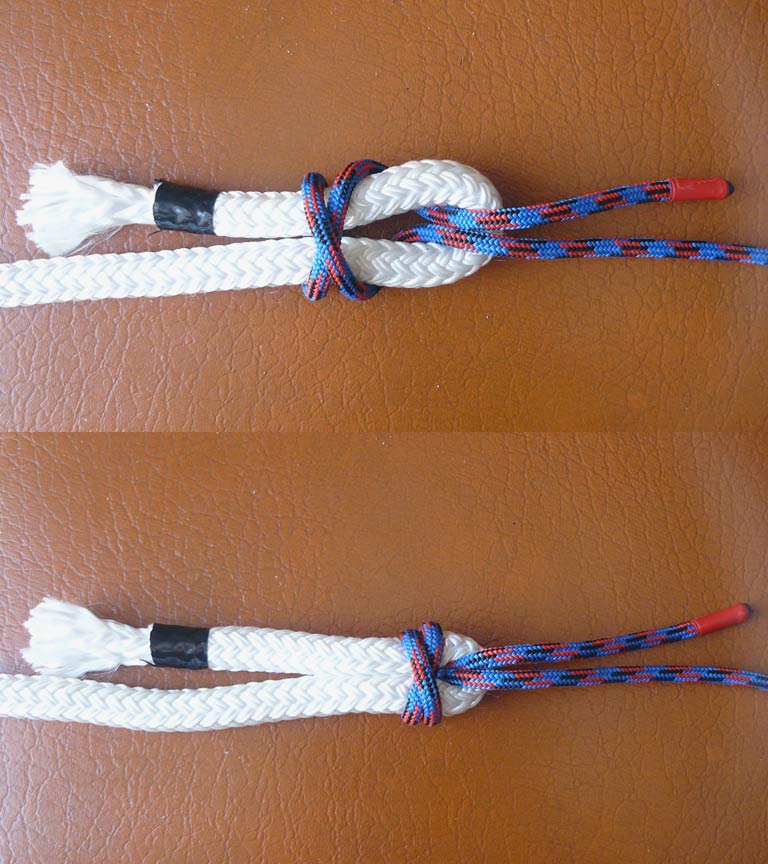
Very happy to do that. My gear is very limited though, but a double sheet bend slips if tied as 1434 (16 & 10 mm double braid polyester was tested), so it has its uses.
I am using a ‘Lewmar 55 two speed sheet winch’ to winch the heavier line and tying a midline bowline on the other and looping it around an adjacent winch. I am winching by hand, maximum amount comfortably. It is not even vaguely near the breaking strength of the line. Wondering if I can put a load cell in the set up, or if more room between the winches is needed for this, but that would need to wait until I had a delivery address at the end of the year. I measured the amount of stretch in the line over 10 cm this morning using a ruler (gives a rough idea of relative load for each trial). I will make it 20 cm next time.
I had only had a chance today to do one quick trial on a double lapp jammable version. 5-10 trials of each would be good to make results more reliable. Slippage can just be measured with calipers by looking at tail length before and after the trial.
Before I set up proper trials I will have a carful read of Evans Starzinger’s pdf to see exactly what test procedure he used. I also need to get hold of some new line (lots of old stuff only on board).
Anyway, I am not familiar with the Asher’s Simple Simon Under, but will test it out with interest. Roughly what diameter line would you like tested? It is most likely it will perform differently for different sizes.
Roughly what diameter line would you like tested? It is most likely it will perform differently for different sizes.The rope's ration in my pictures is around 2/1. Anyway pitch in anything you have at hand! It's the slippage that is of interest for me. Thanks jr. Ps Harry Asher also devised the Simple Simon Over and the Simple Simon Double.
Forgot the images ;D
20 -25 results would be much better, IMHO. If you want to study their statistics, I recommend the Weibull distribution. Evans is a statistician, so he may help you on this, too.