I kept my reply short because it was off-topic. No offence meant and none taken. I’ve studied the pictures you provided of the Eskimo bowlines, and to me it seems to be AT LEAST two different knots going under the same name. I’ll think about it a bit more, perhaps take some pictures, and when/if I think I have a good answer, I’ll post a reply in the thread
“Re: What defines a Bowline? - structure, characteristics, topology”
Thanks.
I believe that the left- and the right-hand “Eskimo” bowlines are less “similar” than the “corresponding” left- and right-hand common/standard bowlines. Also, the position of the Tail End ( which is the second leg of the collar around the eye leg of the Standing Part ) “over” or “under” the continuation of the returning eye leg, plays a major role - among other things ( re. slippage or stability ), it alters the topology of the knot.
( I have cited two posts where the “Eskimo” bowlines were seen to have some relation, via the corresponding Sheet bend bowline, to the Sheet bend(s), so the discussion was not completely off-topic… :))
One has to weight all those things, as well as the way each knot is tied-in-the-end, to decide on the issue of the names. Personally, I have not made up my mind yet - but perhaps this is due to the lack of interest, and the absence of arguments on the issue ( despite my repeated efforts to stir a discussion ).
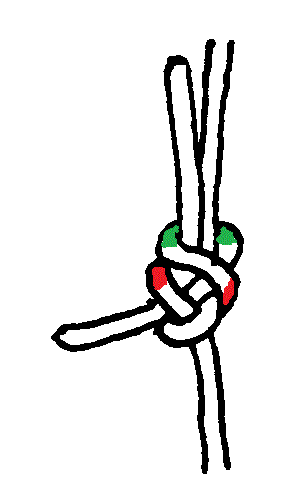
#488 and #1434 are different knots because of their geometry,but topologically they are the same knot,ie they can be arranged in the one or the other form without anything to untie.Another form,similar to #488 but topologically different is illustrated here(is a slipped version): http://igkt.net/sm/index.php?topic=4880.msg31884#msg31884
If you can do that, please show me how.
Edit: Oh, never mind. No need to bother you with that, since after some study I see from Seaworthy’s pictures that the knots #488 and #1434 really are identical. I thought that what Seaworthy was talking about was the variant of a double sheetbend which Svensson mentions, which really is topologically different. Turns out Ashley mentioned it too, and he gives it number 1435.
So, please pretend that I was talking about the difference between #1434 and #1435 all along, because that’s what I (foolishly) THOUGHT I was talking about. Possibly because Sam Svensson thought it worth mentioning in his book. #1435 is #1434 with one tuck less, as Ashley says.
Anyway, to make everything perfectly clear, at least in my mind, ABOK#1434 is a twice-tucked double sheetbend, while ABOK #1435 is a single-tucked double sheetbend, that both Ashley and Svensson say are quicker to make than the twice-tucked one. Svensson also says the single-tucked one easier to untie, doesn’t jam and is less bulky. It seems to me that it resists slip better as well.
Sorry about my misunderstanding.
Twine
PS The picture you linked to is a slipped version of ABOK #1435, and if it wasn’t slipped, it would be a perfect picture of the knot I thought we were talking about all along.
Take the “turn” (invisible, in the “back view” of the draw by Ashley (below)) corresponding to the portions of rope that I’ve marked in red, and take it over the (half invisible) “turn” corresponding to the portions of rope that I’ve marked in green;dress and set.Ashley himself says:“It is the same knot as the Double Sheet Bend(# 1434).Frequently it will pull up into the form here illustrated,which is equally secure.”.
P.S:I saw your EDIT, but it can be useful for other users ( and..I was about to post when I saw it!)
Yes. What you say is true. Please forgive me for putting you to all that trouble. I really should have been quicker with my EDIT, but instead I spent too long thinking about how to write it. At least, your proof is valid, and Seaworthy, who started this thread, might benefit from studying it.
Unlike the other sheet bends, simons, lapps and zeppelin mentioned here#488 is the only one that resisted slipping against pulling with bare hands using fishing line (imagine the orange rope to be monofilament)
And #488can be found in fishing nets sometimes.
But, it has been deemed insecure itself in some line
and there is at least one other net knot introduced
to handle such lines. I found maybe just one bit
of netting with this novel knot, and otherwise got
some info from a Danish net maker about it --or about
a quite similar structure.