# In search of the goldilocks bend! (joining abseil ropes)
**URL:** https://discourse.igkt.net/t/in-search-of-the-goldilocks-bend-joining-abseil-ropes/4083
**Category:** Practical Knots
**Created:** [3 July 2011 14:53 UTC](https://discourse.igkt.net/t/in-search-of-the-goldilocks-bend-joining-abseil-ropes/4083 "2011-07-03T14:53:39Z")
**Posts on this page:** 20
**Page:** 1
### Author:  [@agent\_smith](https://discourse.igkt.net/u/agent_smith)
#### Post date: [3 July 2011 14:53 UTC](https://discourse.igkt.net/t/in-search-of-the-goldilocks-bend-joining-abseil-ropes/4083/1 "2011-07-03T14:53:39Z")
This is a topic that has done the rounds all over the internet and seems to fuel endless campfire debates at climbing areas…
What is the best method of joining 2 climbing ropes together for a retrievable abseil (‘Rap’ for you Yanks)?
I started a thread on this topic a few years back..but don’t recall any definitive commentary from IGKT members (particularly those with climbing experience).
Essential characteristics:
1. Ease of untying after loading;
2. Likelihood of translating around a 90 degree edge from low set anchor;
3. Relative chance of success in tying knot correctly (difficult to quantify);
4. Stability and security, including when joining ropes of different diameters (Note; Strength is not an issue in my view).
So here are some knots to ponder over:
1. The Rosendahl (my personal all-round favourite) - ABoK N/A;
2. The offset double overhand bend - ABoK N/A;
3. The offset overhand bend - ABoK #1410 (aka offset overhand ring bend);
4. Offset stacked double overhand bends;
5. Reef (re-tucked) - ABoK N/A (thought I’d throw this one in as it appears to have some merit) Note: This site wouldn’t allow a 5th image…
6. ?
7. ?
I have purposely omitted the Double Fishermans (ABoK #1415) - due to its difficulty in untying and tendency to get stuck at a 90 degree edge from low set anchors.
http://
http://
http://
http://
* * *
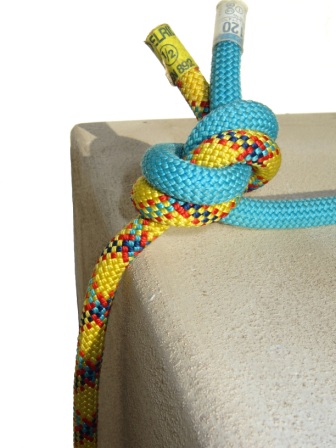
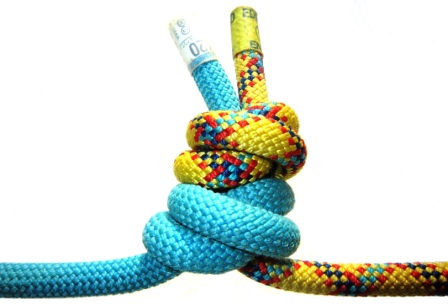
---
### Author:  [@TMCD](https://discourse.igkt.net/u/TMCD)
#### Post date: [3 July 2011 15:04 UTC](https://discourse.igkt.net/t/in-search-of-the-goldilocks-bend-joining-abseil-ropes/4083/2 "2011-07-03T15:04:24Z")
The best bend for climbing IMO, would certainly be the Zeppelin Bend and I don’t understand why more climbers don’t use it. It’s security and strength are legendary, the tails could be taped to the SE’s if that’s a problem. Another bend I would like to see tested for it’s strength and security would be the Tucked Sheet Bend. Most Sheet Bends as we know, simply aren’t secure or strong enough for climbing when one’s life is on the line. But the TSB seems strong and it’s an ideal candidate for testing because of the snagless nature of the knot.
---
### Author:  [@Dan\_Lehman](https://discourse.igkt.net/u/Dan_Lehman)
#### Post date: [5 July 2011 06:25 UTC](https://discourse.igkt.net/t/in-search-of-the-goldilocks-bend-joining-abseil-ropes/4083/3 "2011-07-05T06:25:43Z")
> [@TMCD post:2](#):
>
> The best bend for climbing IMO, would certainly be the Zeppelin Bend and
> I don’t understand why more climbers don’t use it.
> It’s security and strength are legendary,
> the tails could be taped to the SE’s if that’s a problem.
Climbers do well enough with what they have,
and Rosendahl’s bend has no good support for your
assertion about strength; security is prima facie suspect
compared with the grapevine bend (aka “dbl.fish.” )
which if anything is deemed at times too secure.
“Legendary” is too like “mythical” and “imaginary”; let’s see
the facts!
And taping (!) tails to SParts of a knot where those two parts
are at right angles is hardly a winning argument. (Indeed,
one of the benefits of the fisherman’s knot is that its tails
lie alongside the SParts.) (I’m not aware of rockclimbers doing
any taping of tails; commercial fishers, yes.)
> Another bend I would like to see tested for it's strength and security would be the [i]Tucked Sheet Bend.[/i] Most [i]Sheet Bends,[/i] as we know, simply aren't secure or [u]strong enough[/u] for climbing when one's life is on the line. But the [i]TSB[/i] seems strong and it's an ideal candidate for testing because of the snagless nature of the knot.
Any knot that is not offset is prone to hanging up on an edge.
(Agent\_Smith shows only one of two likely dispositions of
Rosendahl’s bend --the better one, for not hanging up.
And pretty much any knot is strong enough,
as the materials are amply strong. Especially as
the stated criteria don’t include strength, but seem
especially aimed at abseil-ropes joining (and one
obvious misssing one: able to join ropes of different
diameters (at least to 7mm + 11mm).
# –dl\*
---
### Author:  [@Dan\_Lehman](https://discourse.igkt.net/u/Dan_Lehman)
#### Post date: [5 July 2011 06:46 UTC](https://discourse.igkt.net/t/in-search-of-the-goldilocks-bend-joining-abseil-ropes/4083/4 "2011-07-05T06:46:17Z")
> [@agent\_smith post:1](#):
>
> This is a topic that has done the rounds all over the internet
> and seems to fuel endless campfire debates at climbing areas…
Fulled by limited attention and wit. There have been some
inroads made, though, recently (hammering enough times
to make dents).
> What is the best method of joining 2 climbing ropes together for a retrievable abseil ('Rap' for you Yanks)?
“ARJ” (“abseil-ropes joint/joiner/joining…”) I call it.
> [u]Essential characteristics:[/u] 1. Ease of untying after loading; 2. Likelihood of translating around a 90 degree edge from low set anchor; 3. Relative chance of success in tying knot correctly (difficult to quantify); 4. Stability and security, including when joining ropes of different diameters (Note; Strength is not an issue in my view).
Egregious omission : capability of joining 6-7mm and 10-11mm lines!
And, for that matter, lines of differing natures other than diameter
(and possibly in addition to diameter).
Make it “offset water knot”, perhaps : “ring bend” by some
conventional/historical senses ought to be a hitch,
not an end-2-end knot; and “ring” has a good sense as
a type of object. (But this “ORB” should nevertheless
get the point across in the rockclimbing world, once
“offset” is understood.)
And that’s clearly --by the same simple nomenclature–
“offset grapevine bend”.
Nothing “stacked” really, just an EDK (OWK (ORB)) with the
ends stoppered with an overhand.
Here is the simplest and likely best (partly for the
simplicity, using well-known knotting movements)
–the offset water knot with the thin tail stoppered.
NB: it’s not quite so simple as I make it, as the
particular orientation of the knot might help (but
all should work --TWO are shown here!), and the
particular orientation of the thinner (or more flexible)
line AND \>\>it\<\< being what is stoppered matter
(matter maybe not in ultimate success, but it should
be better).
# –dl\*
---
### Author:  [@xarax](https://discourse.igkt.net/u/xarax)
#### Post date: [5 July 2011 11:53 UTC](https://discourse.igkt.net/t/in-search-of-the-goldilocks-bend-joining-abseil-ropes/4083/5 "2011-07-05T11:53:22Z")
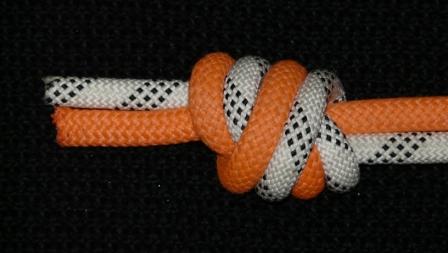
Although I have no climbing knowledge or experience whatsoever, I think that those two “not-offset” bends can offer something along the lines described in this thread :
1. The double line / double overhand bend ( See (1), and first attached picture).
2. The Salty Cracker / ABoK#1031 bend ( See (2), and second-third attached pictures)
Now, if we insist on using an “offset” bend, why we do not just tie an one-sided double overhand bend ? ( See fourth attached picture)
1. [http://igkt.net/sm/index.php?topic=2804.msg18471#msg18471](http://igkt.net/sm/index.php?topic=2804.msg18471#msg18471)
2. [http://igkt.net/sm/index.php?topic=2804.msg16650#msg16650](http://igkt.net/sm/index.php?topic=2804.msg16650#msg16650)
* * *
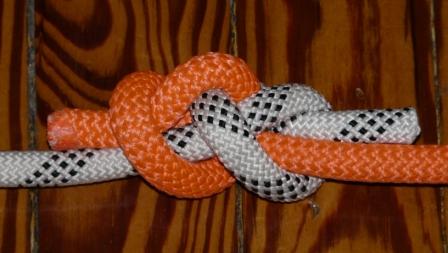
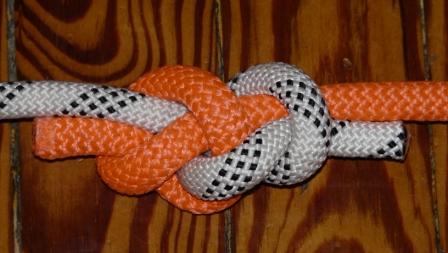
---
### Author:  [@Morgoroth](https://discourse.igkt.net/u/Morgoroth)
#### Post date: [5 July 2011 16:30 UTC](https://discourse.igkt.net/t/in-search-of-the-goldilocks-bend-joining-abseil-ropes/4083/6 "2011-07-05T16:30:31Z")
Sorry, I’m confused, which is the Offset Grapevine Bend?
---
### Author:  [@TMCD](https://discourse.igkt.net/u/TMCD)
#### Post date: [5 July 2011 18:10 UTC](https://discourse.igkt.net/t/in-search-of-the-goldilocks-bend-joining-abseil-ropes/4083/7 "2011-07-05T18:10:59Z")
> [@Dan\_Lehman post:3](#):
>
> > [@TMCD post:2](#):
> >
> > The best bend for climbing IMO, would certainly be the Zeppelin Bend and
> > I don’t understand why more climbers don’t use it.
> > It’s security and strength are legendary,
> > the tails could be taped to the SE’s if that’s a problem.
>
> Climbers do well enough with what they have,
> and Rosendahl’s bend has no good support for your
> assertion about strength; security is prima facie suspect
> compared with the grapevine bend (aka “dbl.fish.” )
> which if anything is deemed at times too secure.
> “Legendary” is too like “mythical” and “imaginary”; let’s see
> the facts!
>
> And taping (!) tails to SParts of a knot where those two parts
> are at right angles is hardly a winning argument. (Indeed,
> one of the benefits of the fisherman’s knot is that its tails
> lie alongside the SParts.) (I’m not aware of rockclimbers doing
> any taping of tails; commercial fishers, yes.)
>
> > Another bend I would like to see tested for it's strength and security would be the [i]Tucked Sheet Bend.[/i] Most [i]Sheet Bends,[/i] as we know, simply aren't secure or [u]strong enough[/u] for climbing when one's life is on the line. But the [i]TSB[/i] seems strong and it's an ideal candidate for testing because of the snagless nature of the knot.
>
> Any knot that is not offset is prone to hanging up on an edge.
> (Agent\_Smith shows only one of two likely dispositions of
> Rosendahl’s bend --the better one, for not hanging up.
>
> And pretty much any knot is strong enough,
> as the materials are amply strong. Especially as
> the stated criteria don’t include strength, but seem
> especially aimed at abseil-ropes joining (and one
> obvious misssing one: able to join ropes of different
> diameters (at least to 7mm + 11mm).
>
> # –dl\*
I have real life working experiences with the Zeppielin Bend, pulling out Ford F250 vans mired in a foot of mud on more than one occasion. The bend didn’t slip an inch, and held beautifully under extreme load and torque pressures that were experienced in wet, sloppy, heavy caked mud. Rest assured, the Zeppelin Bend is a fine all around bend that is arguably the best bend we have today.
---
### Author:  [@Dan\_Lehman](https://discourse.igkt.net/u/Dan_Lehman)
#### Post date: [5 July 2011 20:13 UTC](https://discourse.igkt.net/t/in-search-of-the-goldilocks-bend-joining-abseil-ropes/4083/8 "2011-07-05T20:13:46Z")
> [@TMCD post:7](#):
>
> > [@Dan\_Lehman post:3](#):
> >
> > [unneeded text omitted!]
>
> I have real life working experiences with the Zeppielin Bend,
> pulling out Ford F250 vans mired in a foot of mud on more than one occasion.
> The bend didn’t slip an inch, and held beautifully under extreme load
> and torque pressures that were experienced in wet, sloppy, heavy caked mud.
> Rest assured, the Zeppelin Bend is a fine all around bend that is arguably the best bend we have today.
I rest assured that one could’ve had the same experience
with Ashley’s #1408, 1452, 1425, the carrick bend, and
many others. (But I don’t understand “torque pressures”
for an end-2-end joiner --the line was seriously twisting
at the knot?)
# –dl\*
---
### Author:  [@alpineer](https://discourse.igkt.net/u/alpineer)
#### Post date: [5 July 2011 20:26 UTC](https://discourse.igkt.net/t/in-search-of-the-goldilocks-bend-joining-abseil-ropes/4083/9 "2011-07-05T20:26:55Z")
> [@TMCD post:7](#):
>
> I have real life working experiences with the Zeppielin Bend, pulling out Ford F250 vans mired in a foot of mud on more than one occasion. The bend didn’t slip an inch, and held beautifully under extreme load and torque pressures that were experienced in wet, sloppy, heavy caked mud. Rest assured, the Zeppelin Bend is a fine all around bend that is arguably the best bend we have today.
It depends on the application, and we’re talking climbing knots here, specifically the best knot for tying and retrieving abseil ropes. Climbers are efficiency minded, but with safety as the overriding factor when choosing a knot and it’s properties (in this particular case, for tying two ropes together quickly for abseiling and being able to retrieve them with a minimum of effort). The two knots shown by Dan Lehman are Quick to tie, Simple to tie, Easy to tie, Easy to untie, Easy to Remember and Ample Strong, Safe, Secure, and Stable for this job. You’d get less than this from another knot.
alpineer
---
### Author:  [@xarax](https://discourse.igkt.net/u/xarax)
#### Post date: [5 July 2011 21:02 UTC](https://discourse.igkt.net/t/in-search-of-the-goldilocks-bend-joining-abseil-ropes/4083/10 "2011-07-05T21:02:47Z")
> [@alpineer post:9](#):
>
> You’d get less than this from another knot.
How are you so sure about this ? Do you know all the possible bends that could serve that purpose, and have compared those two knots with each one of them ? 🙂 I like myths, too, but not myths about climbing knots.
---
### Author:  [@alpineer](https://discourse.igkt.net/u/alpineer)
#### Post date: [5 July 2011 22:40 UTC](https://discourse.igkt.net/t/in-search-of-the-goldilocks-bend-joining-abseil-ropes/4083/11 "2011-07-05T22:40:22Z")
> [@xarax post:10](#):
>
> > [@alpineer post:9](#):
> >
> > You’d get less than this from another knot.
>
> How are you so sure about this ? Do you know all the possible bends that could serve that purpose, and have compared those two knots with each one of them ? 🙂 I like myths, too, but not myths about climbing knots.
Allow me to ask you this Xarax, what is the simplest knot structure that can be tied(and maintained) in the end of a single piece of cordage and with a minimum of hand movement and mental focus. The answer is the same for two ropes (pair them together and tie them as one). It’s the Overhand form. The two knots shown in Dan Lehman’s post are based on the Overhand structure, and simply “paired” Overhand Knots with a single Overhand Stopper round one strand. Anything fancier has to be justified in light of it’s intended use. Please note also that an abseil knot is a temporary means of fixing two ropes (not intended to be permanent).
Climbers need also to consider worst case scenarios. Imagine you are on a mountain and you need to abseil to retreat quickly due to injuries, storms, lightning, impending darkness, what have you. And let’s say you(others) are in a state of shock or have difficulty focusing on self-rescue. Simplicity is appreciated most at these times. There is no myth here. Anything simpler would necessarily be a single rope of 2 x length (no knot needed).
alpineer
---
### Author:  [@xarax](https://discourse.igkt.net/u/xarax)
#### Post date: [5 July 2011 23:21 UTC](https://discourse.igkt.net/t/in-search-of-the-goldilocks-bend-joining-abseil-ropes/4083/12 "2011-07-05T23:21:54Z")
```
Thank you, alpineer,
```
I have not been able to quantify what we mean by “simplicity” in the field of practical knots. Of course, it is something very different from simplicity of mathematical knots, where, again, there are problems if we go further than the naive enumerating of knot crossings. In practical knots, we have to take into account the simplicity of the mental picture we start with when we tie a knot, the simplicity of the required dexterity of the hand and finger moves, etc.. In general, we must be very careful when we speak about simplicity…There are some attempts to measure simplicity by enumerating the number of steps that a Turing machine executing an algorithm will need to describe a phenomenon, but this has not gone beyond measuring the simplicity of simple mathematical formulas.
The two knots posted by Dan Lehman are not simple overhand bends ! They are contraptions based on the one-sided overhand bend, more or less clever than many others we could imagine. ( I myself have proposed the one-sided double overhand bend, for example. ) What I found a little unbalanced/annoying in your reply was not the essence, but the tone : You seemed too sure about the uniqueness of the particular solution, so sure that you have used capital letters to show it ! 🙂 Of course, I am in no position to lecture to you about climbing knots ( and to nobody else, I am afraid…) , but I felt the obligation to put a small question mark alongside the big exclamation mark ! 🙂 Again, I had no intention to criticize the essence of your suggestions.
---
### Author:  [@alpineer](https://discourse.igkt.net/u/alpineer)
#### Post date: [5 July 2011 23:45 UTC](https://discourse.igkt.net/t/in-search-of-the-goldilocks-bend-joining-abseil-ropes/4083/13 "2011-07-05T23:45:40Z")
Xarax,
Capital letters were used to highlight the words, not to inflict tone.
Btw, you must be hovering over your keyboard. I came back to my post to add something and you’d already responded. You’re are obviously a faster typist than myself. Please, give a slow typist a chance.
---
### Author:  [@xarax](https://discourse.igkt.net/u/xarax)
#### Post date: [5 July 2011 23:56 UTC](https://discourse.igkt.net/t/in-search-of-the-goldilocks-bend-joining-abseil-ropes/4083/14 "2011-07-05T23:56:36Z")
> [@alpineer post:13](#):
>
> Please, give a slow typist a chance.
🙂 And you should also take into account the fact that I was, simultaneously, responding to the other thread, too !
Do you consider the one-sided double overhand knot a “fancier” solution ? I would say that it is “simpler” than the two overhand+the stopper knots mentioned above. What about the Salty Crackers -ABoK#1031 alternative to the fisherman s knot?
---
### Author:  [@alpineer](https://discourse.igkt.net/u/alpineer)
#### Post date: [6 July 2011 00:10 UTC](https://discourse.igkt.net/t/in-search-of-the-goldilocks-bend-joining-abseil-ropes/4083/15 "2011-07-06T00:10:59Z")
The Offset Double Overhand Bend uses more rope than is necessary and is unnecessarily bulkier (and is therefor more likely to get caught On or In some natural terrain feature) than the Offset Water Bend (a.k.a. EDK). So why would you use it? Because it’s prettier? Not a good enough reason. It also takes more hand gymnastics to tie. It’s not that it couldn’t work Xarax, but it’s not the better choice for this one very specific job (i.e. abseiling).
alpineer
---
### Author:  [@alpineer](https://discourse.igkt.net/u/alpineer)
#### Post date: [6 July 2011 00:21 UTC](https://discourse.igkt.net/t/in-search-of-the-goldilocks-bend-joining-abseil-ropes/4083/16 "2011-07-06T00:21:03Z")
> [@xarax post:14](#):
>
> > [@alpineer post:13](#):
> >
> > Please, give a slow typist a chance.
>
> 🙂 And you should also take into account the fact that I was, simultaneously, responding to the other thread, too !
> Do you consider the one-sided double overhand knot a “fancier” solution ? I would say that it is “simpler” than the two overhand+the stopper knots mentioned above. What about the Salty Crackers -ABoK#1031 alternative to the fisherman s knot?
By “fancier” I mean more complex (though t’is a pretty thing to behold) than compounded Overhands. Considering ABoK #1031 and the Fisherman’s, I use ABoK #1031 Bend for tying my abseil backup hitch loops (I like it).
---
### Author:  [@agent\_smith](https://discourse.igkt.net/u/agent_smith)
#### Post date: [6 July 2011 05:03 UTC](https://discourse.igkt.net/t/in-search-of-the-goldilocks-bend-joining-abseil-ropes/4083/17 "2011-07-06T05:03:27Z")
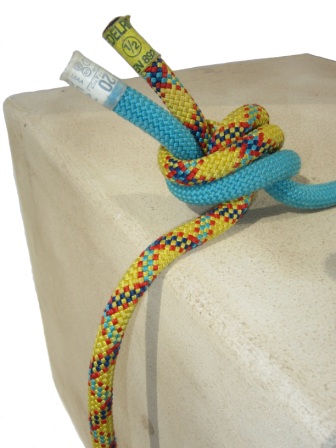
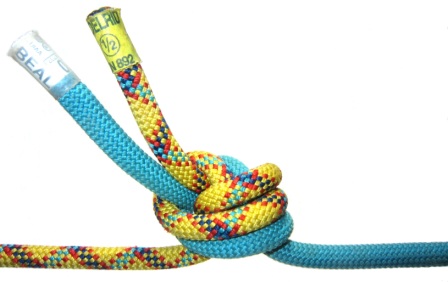
Here’s another variation of the Offset Overhand Bend (aka Offset Ring bend)… Could this the Goldilocks Bend?!
I like this one because:
Relative ease of tying - only adds one ‘binding loop’ to the existing structure (an idea borrowed from Dan Lehman’s ‘End Bound Double Bowline’)
Secure and stable up to 3kN (tested by load cell today - as a double strand to duplicate double rope abseil descent - since force would be split between 2 rope strands)
Translates around a 90 degree edge due to its small profile - unlikely to become stuck at a 90 degree edge from low set anchors (similar profile to Offset Overhand Bend #1410)
Easy to untie (bounced my 100kg body mass for 30 seconds - no problem untying after loading)
Works well with different rope diameters (I played with 8mm and 11mm cords - seemed to bind well)
http://
Comments please…
By the way, I’m not convinced of the criteria “relative ease of tying”…a climber by definition is already competent in tying a range of knots (eg Prusik hitch, Double Fishermans, Clove hitch, Tape knot / Ring bend, Figure 8 loop and rethreaded method of tying, Bowline variant (eg my EBSB variant), French Prusik, Double figure 8 loop (AB0K #1085), etc etc. Some of these knots are arguably ‘difficult’ to tie. It comes down to practice, practice and practice. Anything is hard at first (eg learning to drive a manual car) - but over time and with practice, it becomes ‘easy’.
Statistically, more climbing is done on nice sunny crags with easy access in comparison to high altitude mountaineering in gales force winds, subzero temp and with oxygen starved brains…in any case, the high altitude mountaineer still had to tie and use some knots just to reach the summit. I don’t accept that one knot from a repertoire is going to be more or less trickier than another. One could argue that a double F8 loop (ABoK #1085) is ‘tricky’ to tie. One could also argue that tying a figure 8 (ABoK #1047) into ones harness is also ‘tricky’ (its a 2 step process).
Be that as it may, my current ‘Goldilocks Bend’ is the image shown below.. aka ‘End Bound Offset Overhand Bend’ (mouthful of words).
Mark
* * *
---
### Author:  [@xarax](https://discourse.igkt.net/u/xarax)
#### Post date: [6 July 2011 06:11 UTC](https://discourse.igkt.net/t/in-search-of-the-goldilocks-bend-joining-abseil-ropes/4083/18 "2011-07-06T06:11:06Z")
> [@alpineer post:15](#):
>
> The Offset Double Overhand Bend uses more rope than is necessary
More rope, relatively to which knot ? Is the supposed economy of rope length a virtue for climbers ? Who continue to tie the double eight bend…
> [@alpineer post:15](#):
>
> and is unnecessarily bulkier (and is therefore more likely to get caught On or In some natural terrain feature) than the Offset Water Bend (a.k.a. EDK).
True. It is bulkier, although not very bulky, because, when tightened, it takes a cylindrical, elognated form.
> [@alpineer post:15](#):
>
> So why would you use it? Because it’s prettier? Not a good enough reason. It also takes more hand gymnastics to tie.
> alpineer
Is it prettier ? I would not go as far as to use the word “pretty” for it, no…but, of course, it is less ugly than the two knots mentioned above ! 🙂
I think that it is a “simpler”, easier and quicker to tie knot - actually, it can be tied with less hand gymnastics in one move, although it is more difficult to dress correctly.
Again, I repeat that have not made any suggestions bearing any knowledge and expertise of climbing, like your suggestions.
---
### Author:  [@xarax](https://discourse.igkt.net/u/xarax)
#### Post date: [6 July 2011 06:21 UTC](https://discourse.igkt.net/t/in-search-of-the-goldilocks-bend-joining-abseil-ropes/4083/19 "2011-07-06T06:21:48Z")
> [@agent\_smith post:17](#):
>
> Here’s another variation of the Offset Overhand Bend (aka Offset Ring bend)…
I see it as halfway solution between the simple one sided Overhand bend and the double one sided Overhand bend. It is less bulky than the later, but more asymmetric, too. As it is a one piece knot, I like it more than the compound knots proposed by Dan Lehman…
---
### Author:  [@agent\_smith](https://discourse.igkt.net/u/agent_smith)
#### Post date: [6 July 2011 06:46 UTC](https://discourse.igkt.net/t/in-search-of-the-goldilocks-bend-joining-abseil-ropes/4083/20 "2011-07-06T06:46:02Z")
Thanks xarax, I like it too 🙂
I haven’t seen it published before..or anywhere on the net (have you?).
I want to be up front and admit that the binding loop idea is borrowed from Dan Lehman (who in my opinion is a great thinker and contributor to world knotting knowledge).
I’m not sure what the proper naming convention ought to be for this particular knot (bend).
Dan appears to favour the term ‘offset’ to indicate any knot/bend that is what you call “one-sided”.
My view is that the ‘off-set’ structure is a crucial form for any knot/bend that must translate around a 90 degree edge from low set anchors.
I haven’t done enough rigorous testing of ABoK #1410 (offset overhand bend) particularly with wet/icy ropes and with climbing ropes that have a slippery, tightly woven sheath (all climbing ropes differ in their sheath texture and structure from one manufacturer to another). It is possible that one day I may encounter a particular combination of factors that causes ABoK #1410 to become unstable at relatively low force. The crucial force threshold will be on or about 3kN (approx 300kg) - this assumes worst case scenario of 2 person accompanied descent (ie assisted abseil) with some bouncing/cyclic loading en route. Therefore, any joining knot (bend) must remain secure and stable up to at least 3kN under all conditions…
Math note: The 3kN downward force is applied on double ropes - that is, 2 ropes share the force of 3kN (1.5kN per individual rope strand). The Bound Offset Overhand bend would only be subjected to half the load.
I think that the ‘binding loop’ that I have added to ABoK #1410 increases its security and stability (I’m not sure what term Dan Lehman will want to give to this structure).
Perhaps a better name should be ‘Bound Offset Overhand bend’… need advice here.
Mark
[Next page](https://discourse.igkt.net/t/in-search-of-the-goldilocks-bend-joining-abseil-ropes/4083.md?page=2)