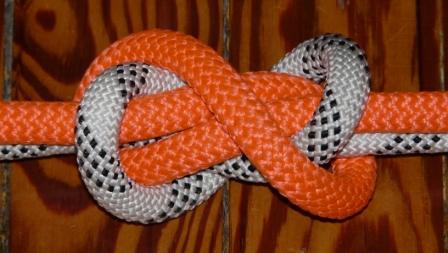
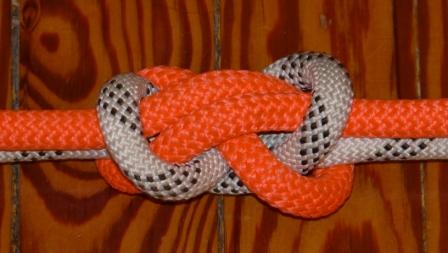
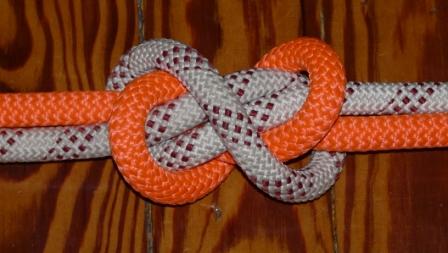
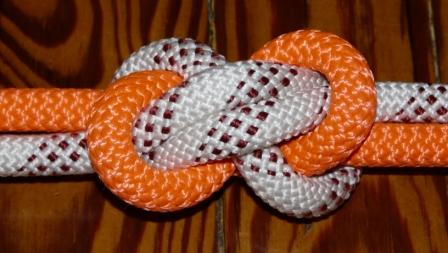
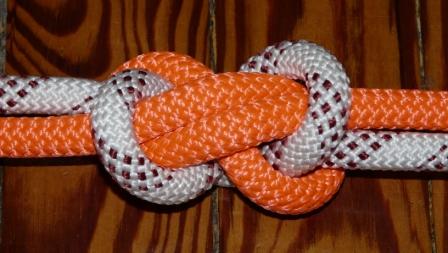
The 88 bend. Also shown at (1). It starts from two interlocked “8” shaped slip knots. An un-tucked, simplified 88 bend, the “S88” (: simple 88) bend, is shown at (2).
The fact that the two identical links, that are interlocked in the 88 bend, are slip knots, makes this bend also suitable for a bowline-like end-of-line loop. As such a loop, it could be named “4 collars/nipping loops” bowline, or “2 collars+2 nipping loops” bowline, or “22 bowline”.
P.S. 2011-10-30 : This bend is identical with the A 24 bend, named “Tweedledee bend”, by Roger E. Miles : Symmetric bends. (How to Join Two Lengths of Cord), 1995.(p. 86, p.106)
People are more likely to take the time to evaluate bends or loops if you first show that you are taking the time to seriously evaluate and test knots (ease of tying procedure, memorability, security, jam resistance, etc.), and are not just posting endless pictures of knot permutations as if you are showcasing decorative ideas in the Fancy & Decorative Knotwork board.
In other words, do you expect others to give these knots more than just a glance if you’re not willing to give them more than just a glance before posting them?
Hello Xarax,
I personally thank you for posting the “permutations” as you explore them.
I don’t know that too many here do as you are doing even privately.
In the beginning, I came across, developed, invented, discovered a double loop knot by chance and fiddling while relaxing and so began my membership here in the forum and then the Guild itself. I had sought out the answer to “Did I invent a new knot?”. After much searching, purchasing books, digging and inquiring, I was finally informed by a much more involved and learned knot person that the “Scottknot” had been developed already. Probably by the same methods that you and I have done.
This is the place of all places for this and I hope that you’ll continue to post the high quality pictures (Thank You!) as you find another permutation. They are worth thousands of words, to me at least.
Perhaps what you are showing us has been done somewhere, sometime, but if it hasn’t or no one has seen the pictures we’ll never know.
BTW, some of these knots you’ve tied could almost be worthy of post in the Fancy and Decorative Knotwork board.
This thing about jamming is so subjective though pretty important most of the time, but you really can’t tell if a particular knot (one that is supposed to be able to not jam) will jam unless you subject it to its most extreme use.
For instance: I had to combine two sewn tow straps to achieve the needed length to pull a piece of equipment from a mud hole. Knowing that I was about to yank and jerk and strain these two I decided the simplest way to join them was to thread one strap through the loop of the other and then the other through the other’s loop. Essentially the way you’d join two rubberbands. So simple..
Yet after the loads were applied and the equipment was salvaged, I attempted to undo the knot and failed to do so.
Just recently after a couple of years of sitting in the barn happily coupled to each other, I took to nearly destroying those two straps with pliers and spike, but finally divorced them. I noticed that though I did not exceed the breaking limits of the straps the loops had fused together and thus jammed in a seemingly “un-jammable” bend.
None of these knots has a proper “Fig.8” in them – just something
that has an ‘8’ shape. In this case, it’s a Constrictor (and, with the
Clove, thus 1 tuck shy of symmetry).
Note added at 16-7-2010
With an International audience, date forms should be of yyyy-mm-dd format,
to avoid confusion. (“16” can only be a day, here, of course.)
the IGKT is by definition an international thing. off the top of my head there are regular contributors to this forum from France, UK, US, and Canada plus a new one from Russia. No doubt there are lurkers from elsewhere and regular contributors that haven’t yet declared a country of origin.
whenever you post to the internet you should assume an international audience
Dear Sir, I have got a practical problem, and after some trials I discover “Aphrodite” last week independently. Very nice knot!
It was interesting for me if somebody discover it before me. In that way I find out your Post.
The second question was if you have any experience with using Aphrodite in my practical application. Probably not, but maybe I’m in wrong. So, Aphrodite, in my opinion, is the best solution to tie a net by means of static climbing rope, climbing net. The shape and Aphrodite properties seem to be very close to perfect solution. The only disadvantage is a big rope consuming. What do you thing about net application? “Aphrodite” is very nice but maybe “The Oyster” is closer to this knot. You was first, it is your choice
Looking at the knots you are posting here, especially the recent “oyster” knot, it strikes me that you are close to discovering what could very well be called, for all intents and purposes, a Matthew Walker Bend. Though, I think, such a thing would rarely be practical, it would nonetheless be attractive.
I have tied again all the knots that I have published here, and I have discovered a minor mistake at the pictures of a family of knots that I should gave corrected in the first place, so that the representation of the loose/initial form of those knots resemble closer their tightened/final form.
There are two similar knots in this family, where I interlocked two 8 s to make a bend (hence their name, 88 bends).
In the first case, there are two riding turns around the knot s nub on the outside side of its shell. In the final tight form of this knot, we get a nice compact bend/stopper, with beautiful curvilinear rope paths, that I have named “Aphrodite” at first ! But, because this bend turned out to be the most tightly jamming knot I know,(!), I renamed it “The Oyster”, for obvious reasons…The standing part paths are wide, around three rope diameters, a characteristic that I considered very interesting. I must point out, though, that I have not succeeded, to this day, to discover a simpler method of tying this beautiful, compact bend/stopper.
In the second case, the strands that were going -previously, in the “Oyster”- around the knot, now stay inside its nub, as two “embraced” rope strands. Unlike the “Oyster”, this bend is easily unloaded and untied - it is not easily jammed. I have named it the "F88’ bend ( because, in a simplified form - where we un-tuck the tails of an F88 bend once-this knot produces an interesting Carrick-like bend that I have named “S88” bend : simplified 88 bend).
In the corrected loose form of those knots, one has only to grasp the two standing ends/tails pairs and pull them apart, to tighten the knots, without the relative position of the strands inside each pair be changed, in any way, during the whole dressing procedure.
P.S. 2011-10-30 : This bend is identical with the B 5, N-fold, N=3 Threefold bend, by Roger E. Miles : Symmetric bends. (How to Join Two Lengths of Cord), 1995 (p. 87, p.108). Miles suggests that " the easiest way to tie [ those N-fold bends ], is via the Ashley illustration (ABoK#777)" (p.124).
P.S. 2011-10-30 : This bend is identical with the A 24 bend, named “Tweedledee bend”, by Roger E. Miles : Symmetric bends. (How to Join Two Lengths of Cord), 1995.(p. 86, p.106)
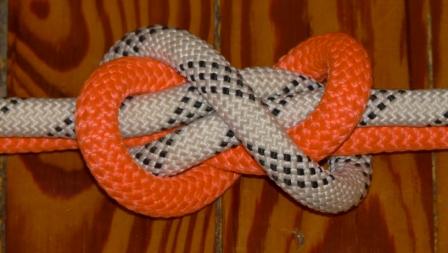
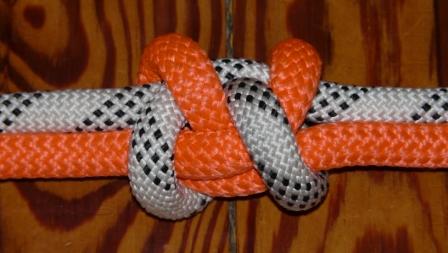
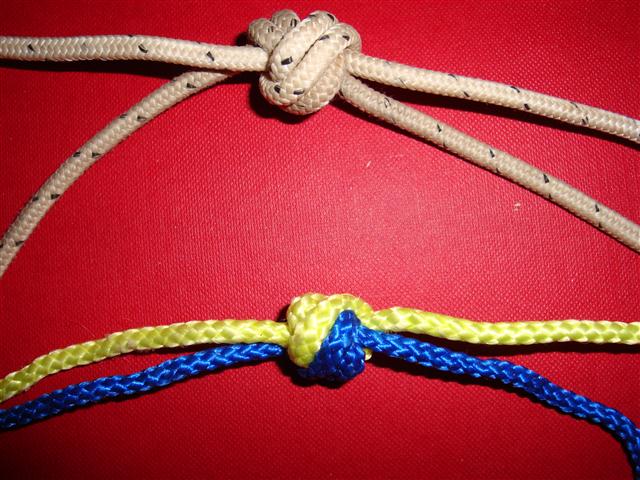
The old pictures of the same knots, that should now be replaced with the above, were the following ( See attached pictures). Notice the relative positions of the two rope strands of each standing end pair, in the new and old pictures, and the final, tightened, forms of the bends. In the new, corrected pictures, the one is above the other, in the old there were side by side. Big difference ! In the new pictures the standing ends (and the tails) stay in this position right through the tying procedure, to the final, tightened knot form, without any additional dressing.
Hey Xarax, excellent pictures! I like “The Oyster”.
I will add this to my repertoire. Knot tying is a personal expression of what one likes, it stimulates the mind and provides great satisfaction. I like to recognize my work in the wild, I saw some today that are a couple of years old, still functioning. I will be sure to leave “The Oyster” some where on the water front for you. It could make a pretty loop too!
Xarax, thank you for re-posting your pics. Some folks would like to imagine your pics have no value, but your pics certainly do. This forum is more valuable with your pics here. For example, your pics (now removed) of the Gleipnir made that knot click for me, and now the Gleipnir is one of my favorite knots. After that, I started to pay more attention to the knots you post.
Since we/I have jump into interlocking overhands I thought I would move the answer in the thread over in “Wanted : A bend for very stiff ropes” http://igkt.net/sm/index.php?topic=2154.msg16306;topicseen#new to right here. Could be here and there, but this is my choice.
Xarax:
I am surprised at your disliking this “bend”? LOL To create what I mentioned in the other thread, the re-tucked ABOK2421 twofold overhand bend, AKA two strand Mathew Walker knot, all that I have done was to chase the working ends through the middle paralleling the first go. Gently pulling and snugging on both SP and WE as I pressed the coils into place.
Not necessarily the easiest to form up in the way of bends, but some just take a little work.
Close up picture has SP and WE indicated.
Mind you, this has not been loaded very much, just opposing hard pulls by hands.
Tie it single, pull it closed some leaving room for the re-tuck and then take each WE and follow its respective part inside the collars so they, the working ends are side by side.
See if this picture helps any.
Newly tied two colors, imposed on the original picture and labeled parts.
It do look symmetrical.

 But, because this bend turned out to be the most tightly jamming knot I know,(!), I renamed it “The Oyster”, for obvious reasons…The standing part paths are wide, around three rope diameters, a characteristic that I considered very interesting. I must point out, though, that I have not succeeded, to this day, to discover a simpler method of tying this beautiful, compact bend/stopper.