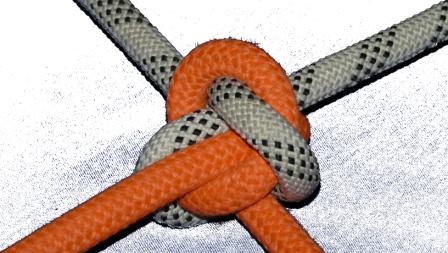
If you were drawing images, you could sometimes get the
harder-to-discern-but-more-realistic image to succeed by
supplementing it with indicators of flow through the knot
(say, by numbering parts 1, 2, 3, … ).
Sometimes, looking at a knot in an ambiguous image, one can
arrive at a new knot by (mis)connecting parts! --which leads
to an interesting question about “invention”.
This knot can be seen as an interlocked variation to a sort of
“mis”-oriented fisherman’s knot --the overhand components
being tied differently. Which knot seems quite secure, albeit
somewhat awkward/bulky. This interlocked variation might achieve
some bump in strength, but looks to be jamming, and more bulky.
I would not characterize the fisherman s knot as an “interlinked-overhand-knots” bend ( like the Zeppelin and the Hunter s bend, the Ashley s, the Alpine butterfly and the Shakehands bend.) In the fisherman s knot, the inter-connection is too simple, something resembling more of an inter-penetration: the two overhand knots do not have their curved rope segments interlinked the one with the other , and only the standing ends are penetrating the one into the other s knot nub.
Because of the fact that the curved segments of the one overhand knot are found in an elbow configuration with those of the other, this bend is bulkier than the fisherman s knot. However, its curves radii are much wider, and this is what moved me, in the first place, to search for it, and for the other bends of this thread.
A different dressing for the most symmetric interlocked-overhand-knots bend, the lR-uL (shown at Replies#1, #3, #6, #8). The two pairs of ends are perpendicular and in touch to each other. I do not know if this dressing/form can be maintained under heavy loading, but it is interesting nevertheless, because it reveals the symmetry of this bend in yet another way.