In another post (http://igkt.net/sm/index.php?topic=6207.0) I discussed a way of tucking the tails to increase sheet bend security. Mark Gommers’ contributions to that thread got me thinking about similar tucks for the bowline.
The common or sailors bowline (ABOK 1010) does not readily permit simple-simon-like tucks of the nipping loop (because the working end from the nipping loop is used to create the eye of the bowline), but it does permit many different ways of tucking the working end from the bight (as assembled in Mark’s excellent treatise An Analysis of the Structure of ‘Bowlines’). Indeed, some applications of the bowline absolutely require such tucks or other means to secure the knot against slippage of the tail, or various forms of capsize.
I was at first surprised to find the equivalent structure to the bight-tail tuck I discussed for sheet bends, in a bight-tucked bowline described by John Smith in 1987 (Knotting Matters 19, 2). Not the John Smith of 1627 (A Sea Grammar) or 1919 (Rope Knots and Hitches). I have copied Smith’s diagram below, because I think this is in fact a very good bowline for many uses. It is a puzzle to me that this knot is seemingly dismissed in Mark’s analysis. The reasons I think it deserves wider use are:
(1) It is very easy to tie. I find myself making mistakes, or struggling with loose added bights, in more complicated multi-stage tucking manoeuvres.
(2) It does not suffer the structural flaw of the Yosemite finish to the common bowline (but see below).
(3) It is very effective against sustained ring loading.
(4) It is effective against tail slippage and bight (collar) straightening.
(5) It is said by Smith to be effective in springy lines like shock cord. I have not tested it in very slippery lines, which should preferably be spliced.
(6) Perhaps controversially, I think it is either-end loadable. The thumb knot formed by the bight tuck seems to secure the nub during loading of the tail, as effectively as does the nipping loop during loading of the standing part. All curves within the knot seem no more severe than in the common bowline, but I have not tested breaking strength.
(7) It is easily untied after moderate loading, perhaps enhanced because there are two rope thicknesses through the collar.
(8) To be effective against severe cyclic loading it needs a further lock (such as a half hitch or overhand knot of the tail made around the standing part). In some applications it is an advantage that this lock is made around the standing part, rather than taking up space in the eye. This also makes the knot resistant to tail loading at any angle to the standing part (a half hitch is ideal from 90 to 180 degrees). Smith shows that without an added lock, tail loading at 180 degrees can cause the collar to roll over, yielding a different (but still non-slip) loop knot. The tuck also reduces the potential for jamming of the lock after a heavy load on the standing part and the eye of the bowline.
(9) It is PET and (not simultaneously) TIB (if that is needed).
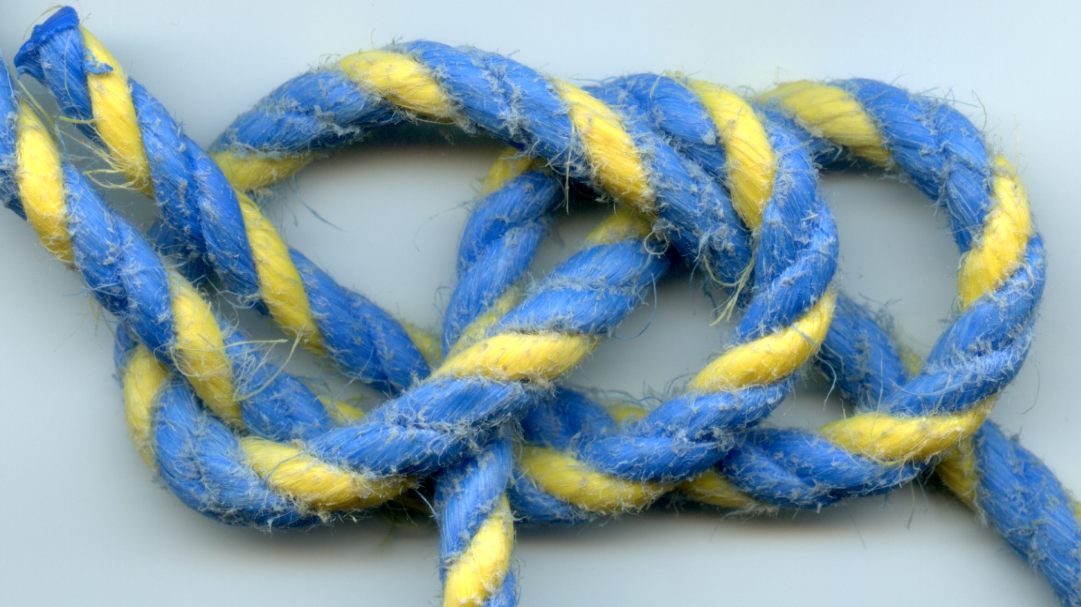
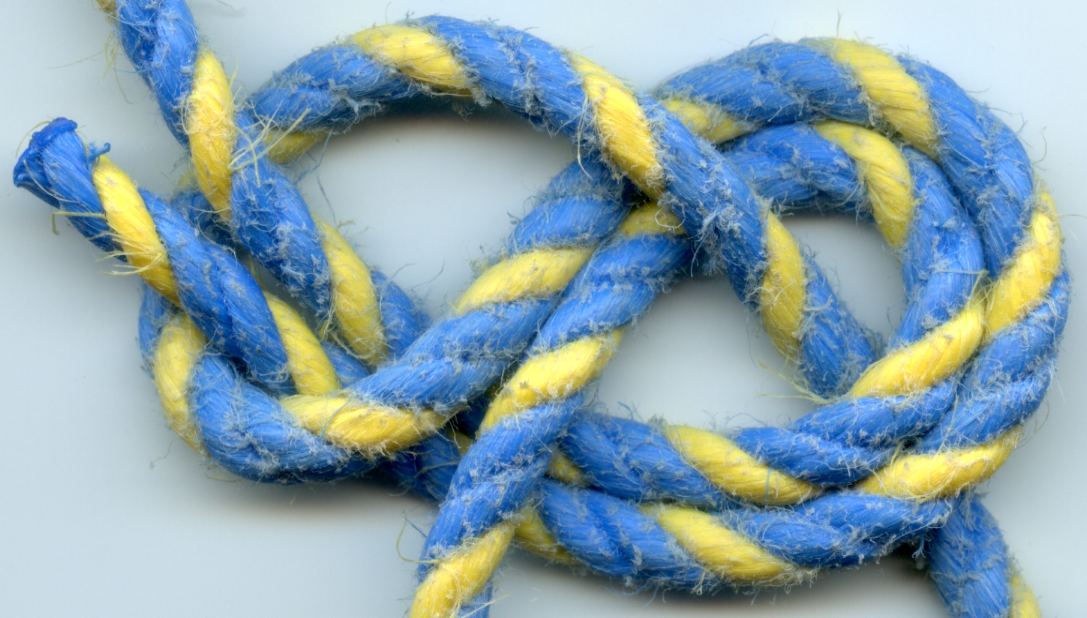
(10) It has a form that I think is quite easily inspected to verify the knot (photos below with added double overhand lock).
The disadvantages include corollaries of point 8 above. Very importantly, this overhand tuck must not be tied in a bowline formed with the tail on the outside of the eye (the so-called cowboy or cowboys or Dutch or left-handed bowline, ABOK 1034 1/2 ). A bowline with the tail on the outside of the eye has a nub structure like an oblique (sometimes confusingly called left-handed) sheet bend, with the tails from the bight and nipping loop on opposite sides of the knot. In this structure, an overhand tuck can easily be manipulated such that the nipping loop encloses only one arm of the bight (collar); and that flaw could be fatal.
To avoid this flaw, if starting with a cowboys bowline, a figure 8 tuck is required: as in the Yosemite finish! But if starting with a common bowline it is the figure 8 (Yosemite) finish that is at risk of a fatal failure through a simple rearrangement that leaves the nipping loop enclosing only one arm of the bight. This issue has already been discussed in the thread about tucking the tails to increase sheet bend security.
That thread also emphasises that tucks which simply fold the tail (without forming a thumb knot or figure 8 lock, typically by passing the tail around the entry arm of the bight) do not secure against bight straightening. This is as true of bowlines as it is of sheet bends. For example, Alfred Alston’s lock (ABOK 1015) and Scott Safier’s lock do not secure against bight (collar) straightening. Even the ampersand bowline is not immune from bight straightening, although it has considerable resistance because the tucks add a loop in the working end, around the nipping loop and the proximal part (ongoing leg) of the eye.
 :-