Since I’ll be exhibiting at Maker Faire in the Bay Area where the Mythbusters will be roaming around, my kids were wondering if there were any knot “myths” we could suggest, given the opportunity?
A common myth is that the fig.8 loop is more secure ( re. slippage and strength ) than a secure bowline ( a bowline where the Tail End is re-tucked through the nipping loop for a second time, after it has made a second “collar” around an eye leg. ( See an example, chosen at random  :), of such a secure bowline, at the attached picture )
Another common myth is that a double bowline ( ABoK#1013) is more secure than the common, single nipping turn bowline.
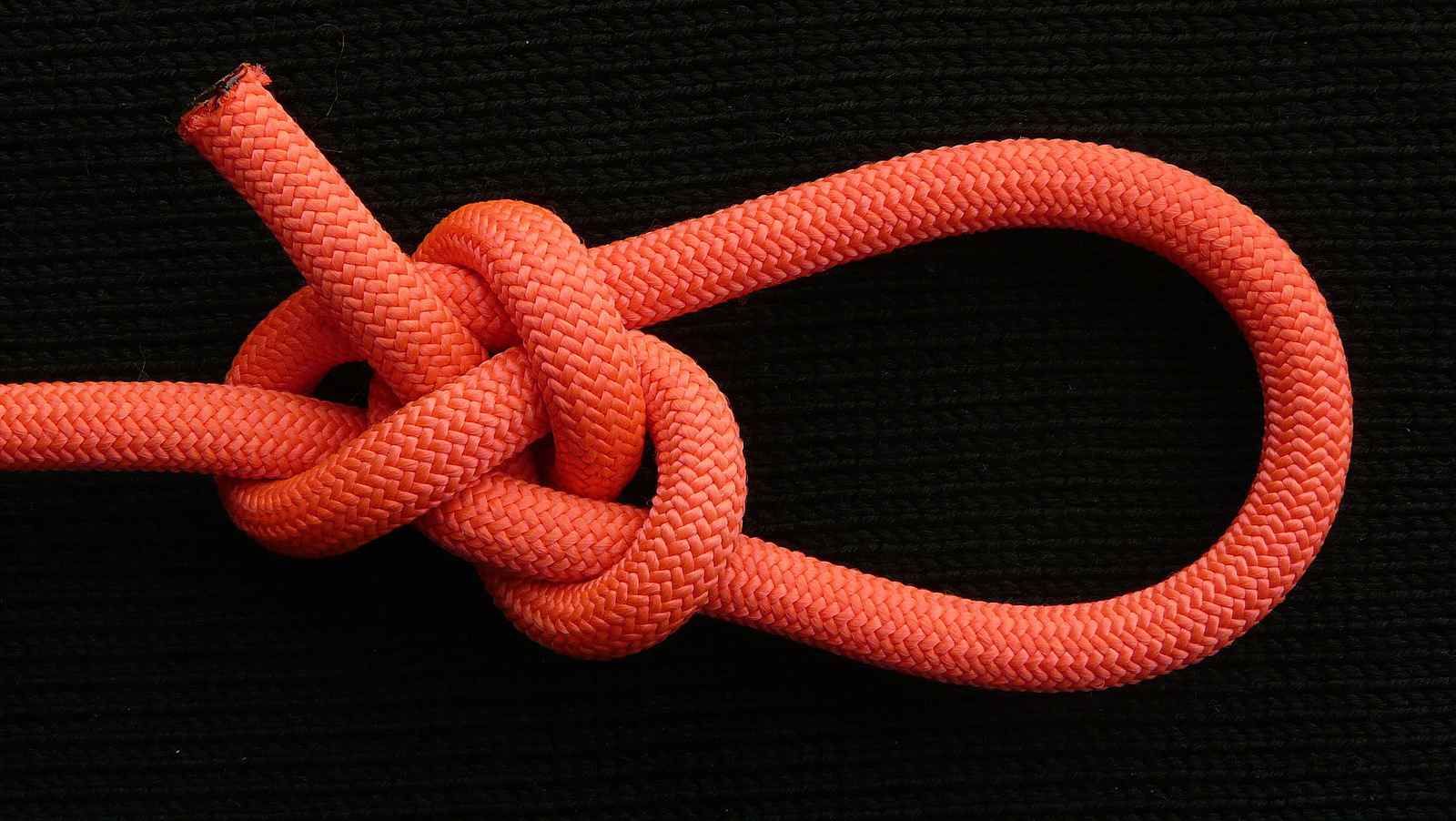
Here you go:
http://igkt.net/sm/index.php?topic=5278.0
Trucker’s hitch myths.
Have you seen, Mythbusters? The style of myths they bust are usually of a larger or more storied types. Something like: shoelaces and a glepnir as as good as zip ties for impromptu handcuffs or Houdini used the bowline because it can be undone with the tips of your fingers while underwater bearing your body weight. That sort of thing… 
Yes, I have seen them - but I believe the “bowline” and the “fig.8” knots, used by sailors and climbers all over the world, are famous enough, to attract the attention of a large audience. Besides, people are always interested in destructive tests of things, because of the noise ( bang, goup, snap, dong etc.) and the danger involved…
It’s a tough sell but I think the trucker’s hitch could make a sub-episode. They could try to measure who’s the strongest cast member first (tug of war plus spring scales), then see what he can pull, try to find a pulley for end and work on removing friction on the other. Play with how much he can pull in various orientations, Jamie can explain the pulley physics which he likes doing, try tying off in different ways under different loading arrangements. Maybe face off against a strong-man in a truck pulling contest? It could be made fun, but it’s true it doesn’t have the “Mythical lore” factor of some things nor probably as much audience recognition as some.
I suspect that they also like getting a few myths that they can confirm, and basically, with the right caveats, this one can be confirmed.
Or, that this is supposedly a myth!
Fact will show that the fig.8 IS more secure …
in HMPE under load, if not also otherwise (in slack,
commonly used kernmantle cordage). And there’s
the evaluation criteria to consider : e.g., would it be
decisive if slippage only took longer to occur, vs. the
decision based on slippage or not?! (For critical uses,
the latter would be more desirable.)
–dl*
My understanding is that none of all those “simple” knots is secure in HMPE - and there was this report that the triple Fisherman s knot, a knot much more convoluted than the fig.8 bend, is not secure either !
On the other hand, an early but prolonged slippage could protect the rope from an abrupt rupture ( i.e., work like an ABS brake…), AND it may warn the user to unload it, if possible.
EStar got slippage in things that must’ve held,
in other HMPE cordage --his was relatively thin,
and maybe that matters (surface-to-core ratio
being high (as “surface” must have some
element of depth, that presumably scales inversely
to size). But I think that the fig.8 eyeknots held
(as did a water bowline-like knot).
On the other hand, an early but prolonged slippage could [i]protect[/i] the rope from an abrupt rupture ( i.e., work like an ABS brake...), AND it may [i]warn[/i] the user to unload it, if possible.IMO, "prolonged slippage" sounds a LOT like "[b]heat[/b]" --dangerous in most fibres (and esp. in dynamic loading)!
–dl*
True - but “prolonged” means also that the generated heat can have enough time to be dissipated along the fibres, so it will not remain concentrated at any fixed, small area, and melt the material. To stop a motion, you need friction, and friction generates heat. Would nt it better if you spread this heat along a larger area, and for a longer time ? That is what ABS does ; it makes a larger area of the tyres come in contact with the surface of the road, by simply allowing them to revolve a little bit, and so utilize a greater portion of their treads.
My understanding is that none of all those "simple" knots is secure in HMPE - and there was this report that the triple Fisherman s knot, a knot much more convoluted than the fig.8 bend, is not secure either !
What report was that, about the tripple fisherman’s bend is not secure in HMPE?