Thank you Paul,
I look forward to the results.
Just as a rider to your comment on blocks and tackles - some yachtsmen here now use the Double Overhand Knot in the end of their sheets in preferrence to the Fig 8.
Gordon
Thank you Paul,
I look forward to the results.
Just as a rider to your comment on blocks and tackles - some yachtsmen here now use the Double Overhand Knot in the end of their sheets in preferrence to the Fig 8.
Gordon
Oh, the Marl vs. Overhand thing is for lifting/pulling loads inline/not perpendicular pulls, not rigging bod. i assume rest is self explanatory? And have own catalogs of gear candy stores to ponder(?).
i am incognito here; probably better known as TheTreeSpyder in Lakeland, Fl.
Here is my explanation of Bowline on Karabiner for personal support. If rigging and tighten line set, bowline on krab not too bad; stays unleveraged. But, body movement, long term unchecked position can leverage flow of force off the long axis of krab. Ushering force along long axis leverges short axis (minimum). Ushering force through short axis of device; leverages the long axis (device carries maximum force of load x distance; so less safe). Then ther is gate pressures etc. Best to think of krab as open hook, with fancy mousing, carry at back throat. Snaps are self righting, not problematic with bowline, in fact cinching hitches might not self correct! And be permanent, where krab allows taking off end to free.
Please note my remarks about this knot, and pointers to improving it for both strength
(what you can check by testing!) & ease of untying: vice the “strangle” common form,
use the “Fisherman’s Bend”/“Anchor Bend” hitch form. Let’s not wait a hundred more
years or so of repeating the same things w/o looking around; now is a good chance
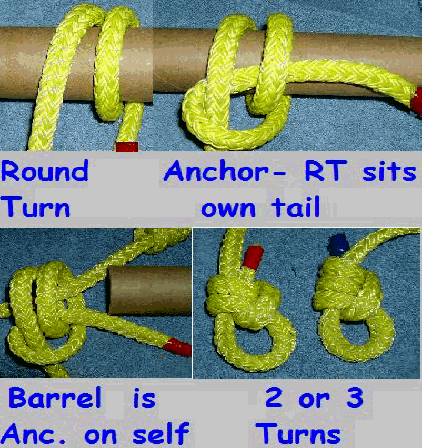
to test & see. (You can find images of this Anchor-Hitch Noose (mis-)labled as a
Barrel Hitch or … . (I don’t regard nooses as knots but as structures that
contain some knot–in this case, the Anchor hitch or, above, Strangle hitch.)
Here is a link directly to an image with 2- or 3-turn AHNoose:
www.mytreelessons.com/photogallery/Img36.gif
(And, yes, you might enjoy browsing KC’s full site.)
Dan:Thanks for the testing link. … Failures are often started by a loop in the knot strangling the rope, and
Yes, we have tucked the rope back into itself. But we have never tested it that way and have therefore never approved it for critical applications.Upon a failure of this sort of quick-splice (witih but 2 tucks) in some logging activity, there was testing done that showed that the tucking in 5/8" laid PP rope was quite strong (the opp. attachment in device broke, not the splice, so we can only guess) in slow-pull, but could slip out in shock loading. Three tucks wasn't tried, but in typical brain-closed conclusion, the common eye splice (per strand) was rec'd. But here I'm only suggesting the single tuck be incorporated as a [i]security[/i] measure, though it might serve a little even in strengthening some structures --i.p., doing so with a Clove Hitch vice half-hitches (2 tucks) or with a single HH (maybe just 1 tuck) might get one the nice [i]effective-loop[/i] distribution of the load to all four legs of the Clove!
they sell anchor straps just for fall protection applications. We use them, too. ... We use them in some applications, and they are out of scope for these tests.Ah, but in making attachment to whatever connection point these straps provide, you might then be coming into the scope of Gordon's suggested (and my amended) noose-hitch use (which is unlikely for direct attachment to the I-beam, but so too is the Clove unlikely for attachment to a 'biner-like metal ring/clip) !
i’ve argued and wondered; tossed back and forth with Dan; if crossing the Turns on Noose is same, better or worse; in static or dynamic tests. And/or if Crossed Turns of Anchor to self to form Noose then, constitutes a different name.
Another aspect of lifelines/ safety systems is elasticity. Here we jsut get focussed on the pure strength/macho numbers factor. This is opkay for static situations on the end of the line; but as we go to a dynamic/ fall situation we must then consdier dynamic properties of the support system. The dynamics needed can be given by a seperate link in the system (like a stitch pack that shears so many stitches and holds on to the rest to give dampening to shock loading but still hold); or by the rope device itself. This is where the elastic properties of rope come in to play.
If we use an elastic rope on a 5:1; it will probably work agianst us; in that we have to stretch the rope as we pull the load, so have to pull extra distance. But falling into an elasticy/dynamic line can save your organs and back from getting ripped up, so in this case the elasticity works for us! Falling and being caught by a static/stiff line can be like being caught by cable; it’ll catch ya; but probably very suddenly and sharply. i look at the unforgiving strength hold of the tensile rating as the macho part of the rope, and the elastic dampening of the forgiveness but still hold as the feminine side! Thus when all we do is talk about tensile strength and tensile strength preserved; i think we are missing a large portion of what is going on in a system.
This elasticty is like tensile strength is dependant on the materials and consturction of the manufacture. Elasticity also depends on how much elastic line is in a system and the percentage of the rope capacity used. So, being caught by a 1’ line is harsher on your body(and equally/ oppositely the support) than falling into a 50’line; because the 50’line has more elastic length/rubberband to dampen your fall. As a rule of thumb; if we fall into 10’ of line it will produce a line tension 2x of falling into a 40’ line(4x length gives 1/2 rope tension in dynamic events). Or (in these nominal lengths and weights) we must drop the weight to 1/4th; to drop line tension in half; dropping load in half or doubling rope length gives about ~30% line tension drop, not 50%. The other factor is how much of rope tensile rating is used. So, the more shock on a given line, the more elasticity in response. So, if we double a line over, we double the tensile (approximately) but the elasticity drops more; because each leg of the line now carries half the weight of the loading! And this does not count towards extending the line length; for more elasticity. But, if we go the other way, reduce line strength or double load line; we will get more elasticity; but also reduce our CtF(Cycles to Failure) of the line. This more elusive elastic property is the first to fade out as a rope degrades do to exposures and useages.
In trees we use these factors to be aware of the dampening of body shockloading line; and/or a load shockloading a support in rigging. The thumb rule numbers say that a 6’ drop without much elasticity will save you; but rip out spleen. Also/or in rigging; we can fail a wek support by shockloading too much, without elastic or other dampening of the force. Statically a 1:1 will place 2x load on support; while a 2:1 will place 1.5x load on support, 3:1 1.33x on support etc. so a higher ratio is easeir to command and places less force on support. But, if a load impacts, the 1:1 offers more elasticity/dampening of force and the higher ratios become less friendly/shock both ends of system more; inclucing the support.
Sorry for the delay in getting started on the testing. Other contractors working in close proximity to us on the same project have recently had four falls, one fatal. Sorry to say, he had decided not to tie off that day. Two others were seriously hurt as a result of not tying off correctly. The other was back to work as soon as he could re-rig new equipment, since any fall results in all your equipment being impounded for further investigation. He was the only one of the four using the equipment correctly, and he had no injury. So three of the four are either seriously hurt or dead, apparently as a result of someone not following his training. All of this has pushed knot testing down a bit on the list of priorities in favor of spending more time just making sure that our people are not making similar errors. (To be fair, it appears that one of the injured ones did tie off correctly and that his injuries were caused mostly by his buddy, who did not tie off correctly, falling on top of him and knocking him off the steel more than 400 feet in the air.)
But now I have time to return my attention to the subject of testing. I greatly appreciate all the help you have all given me. It will result in a much better test plan.
I have done some quick tests of the Double Overhand Noose. It is a great knot and I’ve added it to our tool bag. Much thanks for the idea of using it to tie a rope to a carabineer. It is correct that you need to keep your loads correctly aligned when using a carabineer. We normally used a captive carabineer for that purpose, but this does the same thing. It eliminates the need to drive a roll pin into the carabineer, and therefore eliminates a possible FOD hazard when working in places were FOD is a serious concern. (Foreign Object Debris, for those of you not working in the aerospace business.)
This note is getting too long. I’ll post another one to address some of the fall protection issues you have raised above. In fact, look for it in a new thread.
Paul Kruse