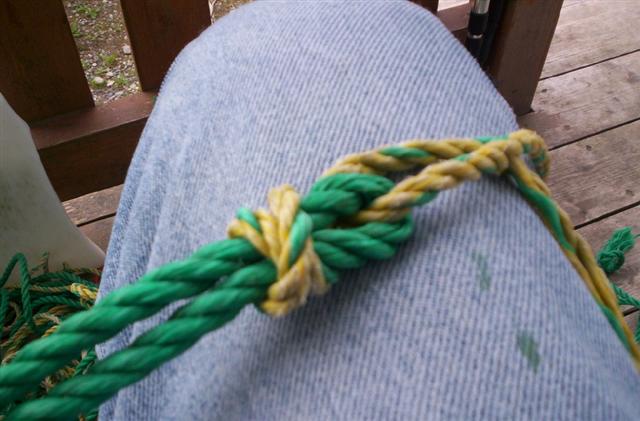
Fascinating Dan - where are the ends?
Derek
Fascinating Dan - where are the ends?
Derek
I can only look at the image and guess at where the ends are,
but one is pretty surely down-right of the single part hanging
down, from the 2nd “Half-hitch” made with a bight; the other,
I think, will be of an Overhand eyeknot seen on left side of
the orange tube, which appears to lead around to pass through
its eye rightwards, back around the pole, and then finish from
the left with a turn crossing itself as though to tie a Clove H.,
but instead passing out to do that to the initial departure from the
pole (aka “Two Half-hitches”, which are finished with a bight).
As for that other (hoped-for) photo, I think I’ll have to go take
it (I know where it is/was), and might have only a sketch; it was
a much tighter binding – this one is rather loose.
Btw, NEPCO --maker of this “Muletape”-- recommended joining ends
with a Blood knot tied in doubled material. A competing vendor’s
recommendation was for the Ring Bend, also with doubled tape.
I had another scouting run on the Lobster House docks,
this afternoon. There was nothing new in the mooring
hawsers. (But there was much new dock planking, worth
a photo for the grain, and wood knots.) Nearby, I salvaged
some polypropylene kernmantle (3/8") rope from a stack of
skids/flats/pallets. I didn’t mind taking the stuff, for obviously
the users had little regard for it: the rope was untied by a
knife – cutting what had been a Trucker’s Hitch right
below and somewhere above, respectively, the reaved eyes.
Goodness, can these fellows not figure out how to UNtie the knot?
(The eye was a mid-line Overhand eyeknot.)
I also got two small pieces of 5/16" laid CoExOlefin rope,
from ends that were anchored to pallet support pieces
with a Clove Hitch and essentially a Slip-knot (i.e., the
end was run back to be nipped by an Overhand in the
SPart). It took some hard pushing of unfeelingly cold
(barely 50^F & damp & some breeze) thumbs to loosen
the Overhands.
Some candiates for this thread - found holding down wood pallets stacked probably 20 high on a truck.
Any ideas what they are? I think the one in green is some kind of cinching knot, but I’m no expert.
http://img706.imageshack.us/img706/4638/p00096.th.jpg
http://img34.imageshack.us/img34/3052/p00095.th.jpg
http://img687.imageshack.us/img687/2105/p00093n.th.jpg
SirC,
Good question! I think the green one is an attempt at a trucker’s hitch tied using a slippery overhand knot, the line continued to an anchor point (not shown) brought back up through the slippery loop and finished around the loop with three half-hitches. The red/black? Not enough detail about the ends to tell…
Hope this is right?
SR
Here’s another glimpse of The Wild:
www.slack.co.uk/m9/cretem9/large-90.html
(Crete, 'tis said.) The ring painter neverminded the cordage!
As for the knots, I’m at a loss for all of 'em, though the rightmost
one which is the most entangled I’m maybe least curious about
– of the “tie lots” sort (but, my, oh my, what a tangle!).
Like SR, I can’t discern the red-&-black knot.
As for the other, it appears that a Slip-knot eye is indeed used
in some Trucker’s-Hitch tensioner, but the tie-off Half-hitches
are going the wrong way from the usual – back upwards vs.
downwards. This suggests that there is a 2nd rope-sheave
through which the rope runs additionally to this one, and
then it is tied off going upwards as shown (the 2nd sheave
being somewhere beneath what we see). !?
Or maybe not: I thought I saw 3 lines bending around the
white wood, but maybe there’s but 2. And the Half-hitching
could be directed upwards from the usual Trucker’s Hitch,
the end making a Half-hitch directly upon reeving through
the sheave around other line, rather than around itself.
Thanks for the observation.
Got rope?
I recall reading of some climbers/cavers making huge abseils off of
tall cliffs, and having 600’ spools of line, among numerous smaller
coils of rope – and thinking “Wow, what a load … !”.
Here, for one lobster fisherman, a couple 2_000’ spools of LARGER
rope (5/8") constitute less than what I understand the full length
of one “trawl”/“string” of groundline-connected pots will be – about
a mile ! The New Lady pics are from years ago, printed 4x6" prints
photo’d for e-presentation here. That showing the Emerson Cordage
spools (of a new, “sinking” 4-strand rope, as is the white-grey rope
on the gravel lot) is current, of the replacement boat Coppa-setic
(“Coppa” is the owner, though I think another man is who captains
the boat now). New regulations to protect the Right whale required
groundline to sink or be boyantly “neutral” and so not rise up in
arcs between pots (the snoods, being short (13’ and shorter recently
for whatever reason), are of boyant coextruded PP/PE fibre).
The Clove hitches in the orange 3-strand PP “snoods”/“gangions”
were quite firmly set, perhaps from usage. The tail was always
tucked immediately away from the knot rather than going across
the body – which I found in some other beachcombed line and
which seemed a less secure-in-positioning attachment. They use
a different hitch, now (sort of a near Reverse Groundline hitch,
where instead of finishing by tucking the end out through the
initial turn, it is tucked down through the lay of the groundline
– and works best if loaded across the knot, it seems (this
being in a sense how the Clove structure is loaded in a Buntline
Hitch, to explain – contrasted with that of Two Half-hitches).
I also note that although 4-strand rope enables even tucking
through --i.e., 2 strands on either side–, these fishermen prefer
tucking it under a single strand, which I think is a better nip.
Dan,
Your photographs are quite stunning - thank you! I think that they would also make for great jigsaw puzzles - very interesting shape/color combinations. I only saw one tuck of the end of a line and it appeared to be under two strands - you mentioned the normal tuck being under one strand of four - was your observation the more typical and this observation of mine atypical or am I not looking correctly? If this line was found in the USA it would appear that fishermen have access to something not normally seen by many of us on the West coast - 4-strand line! I have seen much of it in Europe and UK but never here on the left coast - is it a typical line usage? Thanks again.
SR
Yes, good point: not only the colors, but also things like lay and
marker strands and … , ways to discriminate the per-piece parts of
the image (vs. those impossible puzzles that essentially have only
shape as the clue (re this: I’ve a great one of corks --top view–
that has survived the past two family Christmases UNcompleted)).
I only saw one tuck of the end of a line and it appeared to be under two strands - you mentioned the normal tuck being under one strand of four - was your observation the more typical and this observation of mine atypical or am I not looking correctly? If this line was found in the USA it would appear that fishermen have access to something not normally seen by many of us on the West coast - 4-strand line! I have seen much of it in Europe and UK but never here on the left coast - is it a typical line usage?
Let me be clear: the first three photos are e-pics of 2000? film-pics,
and are of the New Lady’s (floating) PP & CoEx groundlines, which
are 3-strand (and this is determinable from marker strand); the Clove
H. w/end twice-tucked in orange snood is tucked the only way one
can w/3-strand rope --between 1 & 2 strands.
The fourth photo is direct (digital) of the present /coming (i.e.,
those spools) cordage in use subsequent to fishery regulations to
protect the Right Whale (which feeds grazing w/open jaw and
so can snag buoyant arcs of groundline); there’s no need for the
4-strand so far as I know, and somewhere I read data that showed
it to be a little less durable. This is the only place I’ve seen it (but
it’s nearly the only place I do much looking). (I did find one 3/8"
piece of quite soft-laid 4-strand along a roadway in Va. once.)
There is I think some information about the changeover of cordage
(from buoyant to sinking/neutral) in Maine, main source of the
issue, with some photos; I don’t recall noting (or not) 3-/4-strand
aspect. And at this volume, I think dealings are measured by
weight not length.
I’m sorry I didn’t better note the Everson spool label; I can now
only read the “5/8” & “2000” but not composition; looking at a
close-up photo I have of the colorful orange-white stuff it must
be white PES mixed w/orange CoEx PP/PE & maybe the bits of
black are pure PP. Maybe 4-strand is supposed to endure the
passage through the V-squeeze of the pot hauler better!?
Across the narrow channel on which New Lady floated lies the
Lobster House (restaurant --year round–, com.fish. docks);
there, I found two 3/8"-ish ropes in a modified form:
it was common to see an orange kernmantle w/parallel core
fibres (orange also) used for net mending and general tie-down
(of netting onto skids/pallets/flats; of things on board), which
construction is seen in various sizes and much in a bluish green;
and there is a hollow braid (small hollow, though) of adjacent
yarns/strands of white polyester & black PP – giving a zig-zag
appearance.
Well, the new-to-my-note cordage had for each a more substantial
core – 5 slightly twisted strands (3 blue-green, 1 charcoal & black,
1 black (!!?)) in the orange vice parallel fibres-- ; and SOME core
(pure polyester fibre --I’ve whipped the evidence, darn), with one
black PP set replaced with the blue-green to mark the difference
(I presume). It wasn’t clear to me that the original of this black
& white cordage had a specific purpose; I only saw it used to
tie down pallet’d netting (and rather crudely done, chopping
such tie-downs vs. untying them (making me feel no regret
or scruples on acquiring samples)).
In the case of these orange ropes, I can count individual fibres
(monofilament) and get an idea of sizes between them – i.e.,
was much added by the 5-strand core vs. parallel fibres, and
are the mantles the same, count-wise (I will presume that the
fibres are the same thickness!). To the eye, they look the same,
as do the mantles of the black’n’white cordage.
Before & perpendicularly docked at this small dock to the New
Lady (now Coppa-setic) is a conch-fishing boat, and they use
mostly nylon(?) kernmantle of thin laid yarns, diamond braid
mantle and parallel core. Sizes range from 7-9mm, I think.
I recall finding 30 smallish spools of 1000’ of such cordage
– quite a bundle, too! This fisherman has used round pots,
with concrete-rim ballast, heavy monofil top rim guard against
conchs crawling up & out (they apparently are willing to crawl
over and fall down into …), and a 3-leg bridle to haul straight
upwards (in contrast to a 2-leg one to haul from an end of a
usually oval’d pot, appropriately designed to hold catch when
in that disposition).
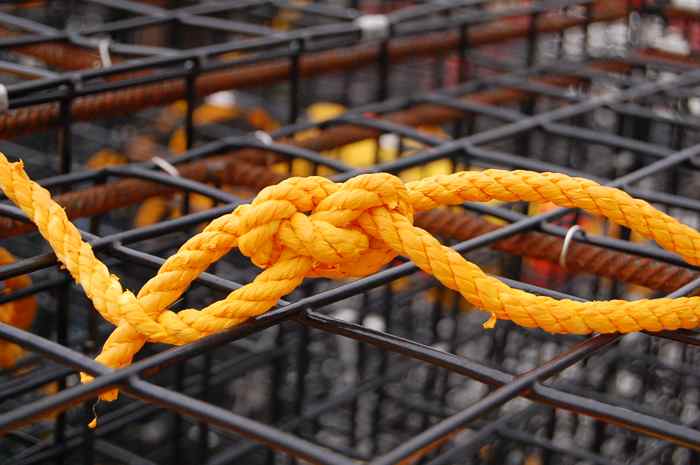
Here are two photos from Bivalve / Port Norris, South (New) Jersey
– yes, the very place Ashley mentions on pp. 6-7 (Port Norris is a
small town within a mile of the (nearly?)nobody-lives-there Bivalve
commercial-fishing area). The first is of a knot seen in some newly
affixed haul lines for <??? (what nature of “pot” I’m yet to learn)>;
the 2nd shows a stack of said wire pots. The knot clearly has the
loose structure of a Bowline, but with the lay-tucked tail
will not achieve that geometry. (Tucking the tail through the lay
is a common security measure in commercial-fishing knotting.)
What puzzles me about these “pots” is that:
they have no opening but for the gate that one can see
kept closed by the bungee-cord-&-hook, which means that
it is only opened manually by the fisherman (and there are
no conical ingress openings for things to enter and be trapped)
they have “re-bar” (concrete reinforcement iron bars) trim
added EITHER at the top or the bottom of pot (or else the
pot assumed either orientation vis-a-vis this re-bar; now, the
re-bar can be seen as ballast and also as structural reinforcement
– and is what is tied to, e.g..
they have those odd wire-mesh “pontoons” at the bottom (or,
depending on actual disposition and that re-bar positioning,
… who knows!?)
My GUESS is that:
these are nests / holding pens for oyster trays;
that oysters are inserted into each of the 3 shelves and put
out into local water to feed and grow (and … ?), and to be
easily harvested later via the buoyed haul line.
the re-bar was put on initially for strengthening the top
for the sake of hauling; and some then decided it could
go at the bottom for ballast ; the two pots on the right
side are like this, with a 4-leg (tied to corners) bridle
(and the re-bar at bottom yet has that center span which
is the tie-to point for the re=bar-at-top pots)!?
and the “pontoons” of smaller-mesh wire keep the shelves
off of the bottom.
(I asked one Merewald staffer and she said “crabs” and I
knew I needed to ask someone else.)
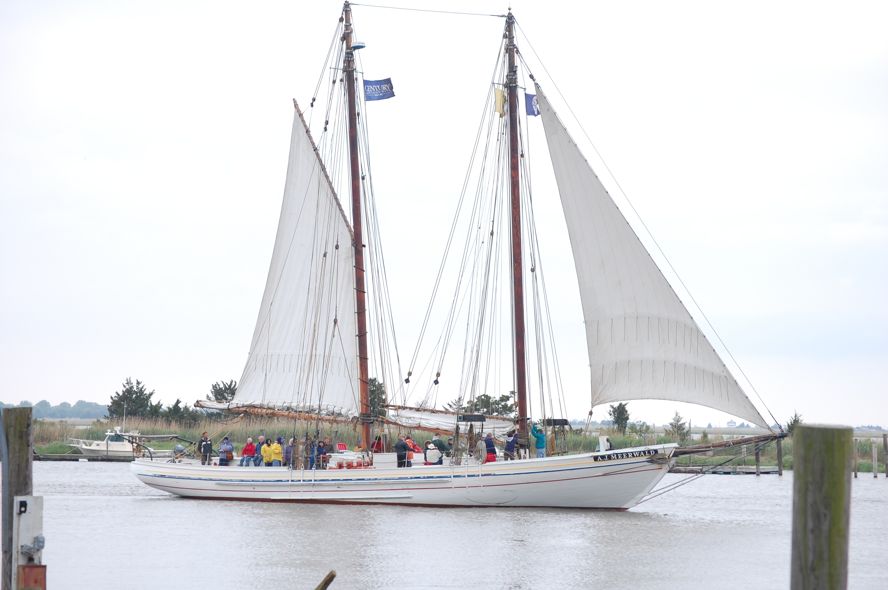
Two bonus pics, of the Merewald[=>Meerwald] in sale (gaining central
sail by participant labor & staff direction), add to the flavor of
the venue. (Much of Bivalve though is crabbing.) The Meerwald
and its docks are recipients of some state (I think) preservation
funding. The boat makes its rounds on the eastern seaboard:
Philadelphia, Salem (up the Delaware from Bivalve, Bridgeton,
but near), Burlington, Atlantic City, Beach Haven, Jersey City,
Alpine, Greenwich (near Bridgeton/Port Norris (site of an old,
authentic “tea party”), with a tiny maritime museum), Edgewater,
and Cape May (wow – for August & 1st week September)
(and with some “Nautical Knots” teaching).
(Btw, I noted some new spools of manila 3/4"? rope @dock;
maybe there isn’t synthetic look-a-like rope used.)
[6/04 edit to correct ‘Mere’ to ‘Meer’ for the the AJ Meerwald vessel]
Looks like the Merewald found some wind that day! I gather that the southern New Jersey area was once known for oyster fishing - could there be a new industry starting up? Those pots do look rather ‘new’ to my untrained eye…
SR
http://i567.photobucket.com/albums/ss113/2wood/rope%20and%20leather/018.jpg
http://i567.photobucket.com/albums/ss113/2wood/rope%20and%20leather/019.jpg
http://i567.photobucket.com/albums/ss113/2wood/rope%20and%20leather/002.jpg
http://i567.photobucket.com/albums/ss113/2wood/rope%20and%20leather/008.jpg
http://i567.photobucket.com/albums/ss113/2wood/rope%20and%20leather/011.jpg
http://i567.photobucket.com/albums/ss113/2wood/rope%20and%20leather/013.jpg
http://i567.photobucket.com/albums/ss113/2wood/rope%20and%20leather/015.jpg
I had to do something after my computer got fried by lightning so I took pictures of the electic company replacing the transformer 20 feet from my house. They couldn’t use their cherry picker due to really soft ground. They used block and tackle. They used a square knot, truckers hitch, cow hitch, line splice, loop splice and an overhand knot to form a loop. The superviser said the rope was a manila nylon blend but I’m not so sure about that. The splices were already in the rope and I didn’t want to ask who did them because I wanted my electric back on.
In the Tropico Gold Mine - Rosamond, California. Go here . . . http://picasaweb.google.com/aknotter/100613TropicoGoldMine#5482727540300381266 for a closer look. Go here . . . http://picasaweb.google.com/aknotter/100613TropicoGoldMine to see all the pix.
I don’t understand what’s being done here (or exactly what is done),
but it was certainly worth the photo. It’s some sort of union of multiple
lines, which are knotted themselves, and then seized w/Half-hitching.
Naturally, I couldn’t just walk off with the heap and sort it out later.

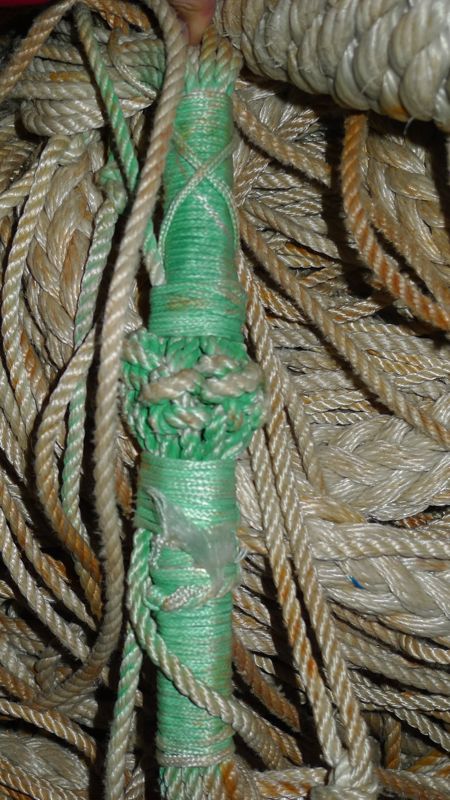
It was suggested at KHWW that this is really a knot tied in the wild
I have tried unsuccessfully to fwd pictures of rope I found last month while beachcombing south of River of Ponds, Newfoundland & Labrador.
They are rejected for being too big. I cropped but this did not work. I do not have the computer skills to do much else. If anyone wants a look they will have to contact me through my email address [profile] and I will fwd direct. D
p.s. Hurricane Earl roared up the west coast yesterday. I wish I could hit the beaches today!!
Hello DEE,
if you have Windows XP and want a free image resizing program go to this page >
http://www.microsoft.com/windowsxp/downloads/powertoys/xppowertoys.mspx
Scroll down the right side of the page till you find >
“Image Resizer
Download ImageResizer.exe
521 KB 2 min @ 28.8 Kbps”
Download and install.
From there on out, if you want to make an image smaller all you have to do is right click on the image or images (can do batch resizing) and pick from the small window that will open, what you want to do.
Make sure to click on the small window where it says “advanced” and put a check in the square that reads “Make pictures smaller but not larger”. Then click “OK”.
I usually will make a smaller copy of the picture as to Not ruin the original.
The program works for Windows 7 as well.
Totally safe and totally free. Best of all, it works flawlessly every time.
Hope this helps.
SS
Thanks for the info. I will try it. You will know if I was successful if pictures show up… D
Fisherman’s Knot from west coast of the island of Newfoundland.