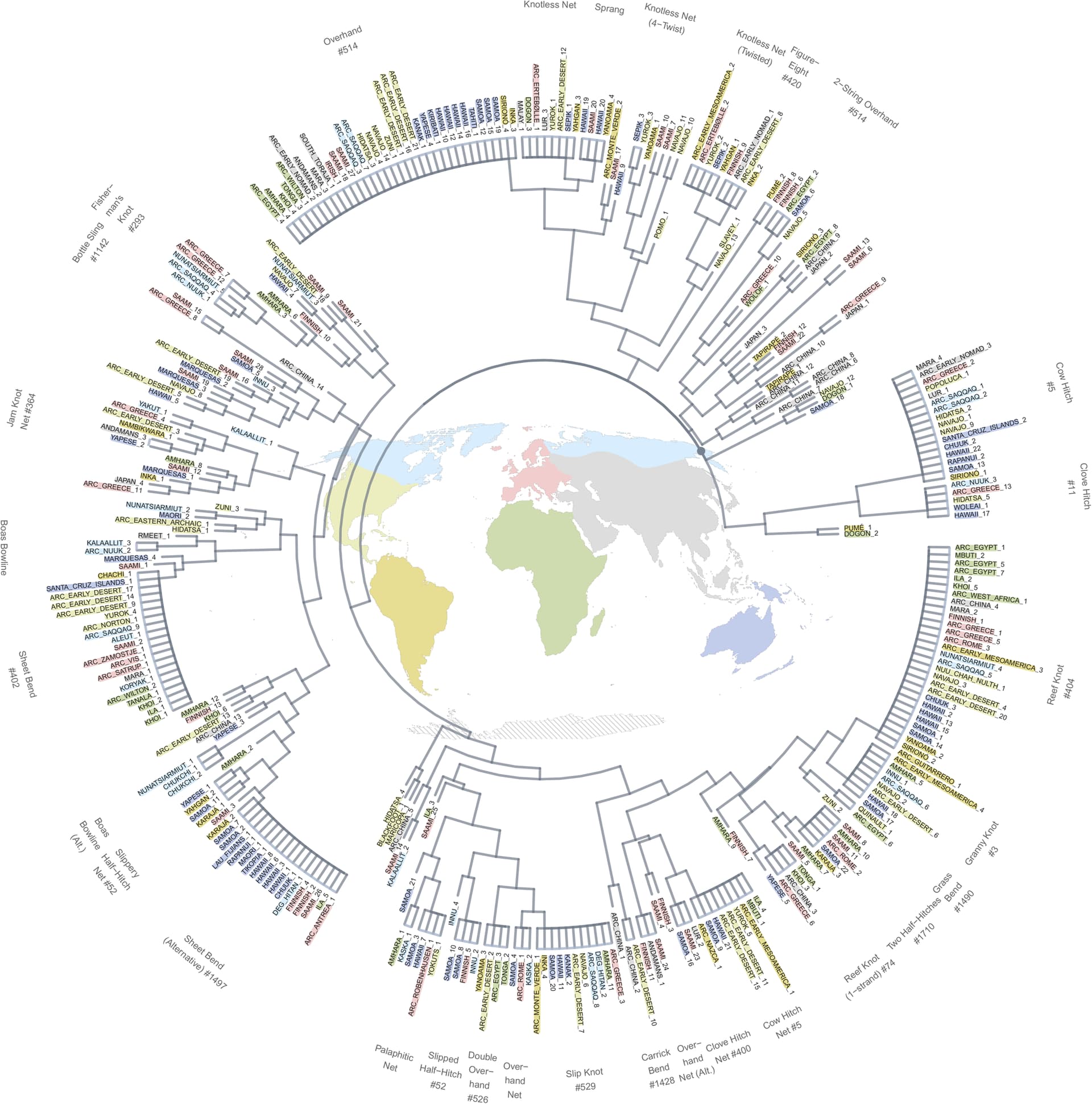
An important cross-cultural analysis of knots. 338 distinct knots across 86 cultures, including a phenogram based on a Gaussian algorithm to code a knot by its starting position and enumerating all crossings, both over- and underpasses. R scripts are used.
Overall, “The most commonly recurring knots across cultures are the sheet bend (clusters #402 and #1497; documented in 29 cultures), overhand knot (#514; 24 cultures), reef knot (#75 and #74; 23 cultures) and cow hitch (clusters #5; 20 cultures).
And…”However, there are several knots that have a more unexpected ubiquity that cannot be explained by their simplicity. Notably, the sheet bend knot (ABoK #402 and #1497) is more complex than the reef knot—it has one more crossing and is asymmetrical (Fig. 1D–E), yet it is the most commonly recurring knot in our dataset.”
And, “Yet it is also worth noting how some knots common in contemporary use are missing from the dataset. For example, even though the bowline knot is today considered one of the most useful knots (it forms a secure loop that does not slip under load, yet is easy to untie), and despite its topological similarity to the sheet bend, our dataset includes no bowline knots (other than its Arctic ‘Boas bowline’ variant, and some other knots with bowline-like features, such as SAAMI_21 and ARC_EASTERN_ARCHAIC_1).”