Thanks for re-activating this topic.
My usual audience of one (Dan) was missing in action  Normally, he would weigh in with counter arguments (which is a good thing).
Unfortunately, some people think that when Dan and I have opposing arguments, they consider it to be 'bad'. That is, some consider disagreements as being 'bad'. I see this as an opportunity to advance our collective understanding - and that's 'good' (not 'bad'). Dan and I have had many deep dive discussions over the past 20 years or so - none of it being 'bad'. One day, we might even meet face to face in person and start a YouTube video channel
Not really - because it is possible to tie many 'bends' using 'bights' (ie U folds). Form a 'U fold' in one rope, then form a 'U fold' in another rope. Now unite the two 'U folds'... technically, this enables a joint without access to either 'end'. But, this comes down to how you wish to define what the word 'end' actually means.
I added this exclusion clause (ie excluding 'joints') - because I knew that Dan would make the argument that a joint can be formed by uniting two 'U folds'. These 'U folds' could then be exploited as 'eyes' - enabling attachments (eg carabiners).
All hitches - by definition - require a 'host'. In the case of a Clove hitch, a carabiner can be a 'host'. Removal of the 'host' triggers structural collapse.
The "mixing" of eye knots and hitches is an irrelevant concept. The definition of mid-line does not need a requirement to be "tied around and object".
I think the essence of having the status of 'mid-line' is that the knot is through loadable. Through loading means force propagates from S.Part to S.Part along a straight line axis. ie.... the S.Parts are axially aligned.
I don't see 'TWATE' as a requirement - rather as a by-product.
Example:
Refer to the simple Bowline (Ashley #1010) photo below. A simple #1010 Bowline is through loadable. The 'eye' is also loadable. The knot remains stable and secure when though loaded and also when eye loaded. But, the knot isn't 'TWATE' (Tiable Without Access To either End).
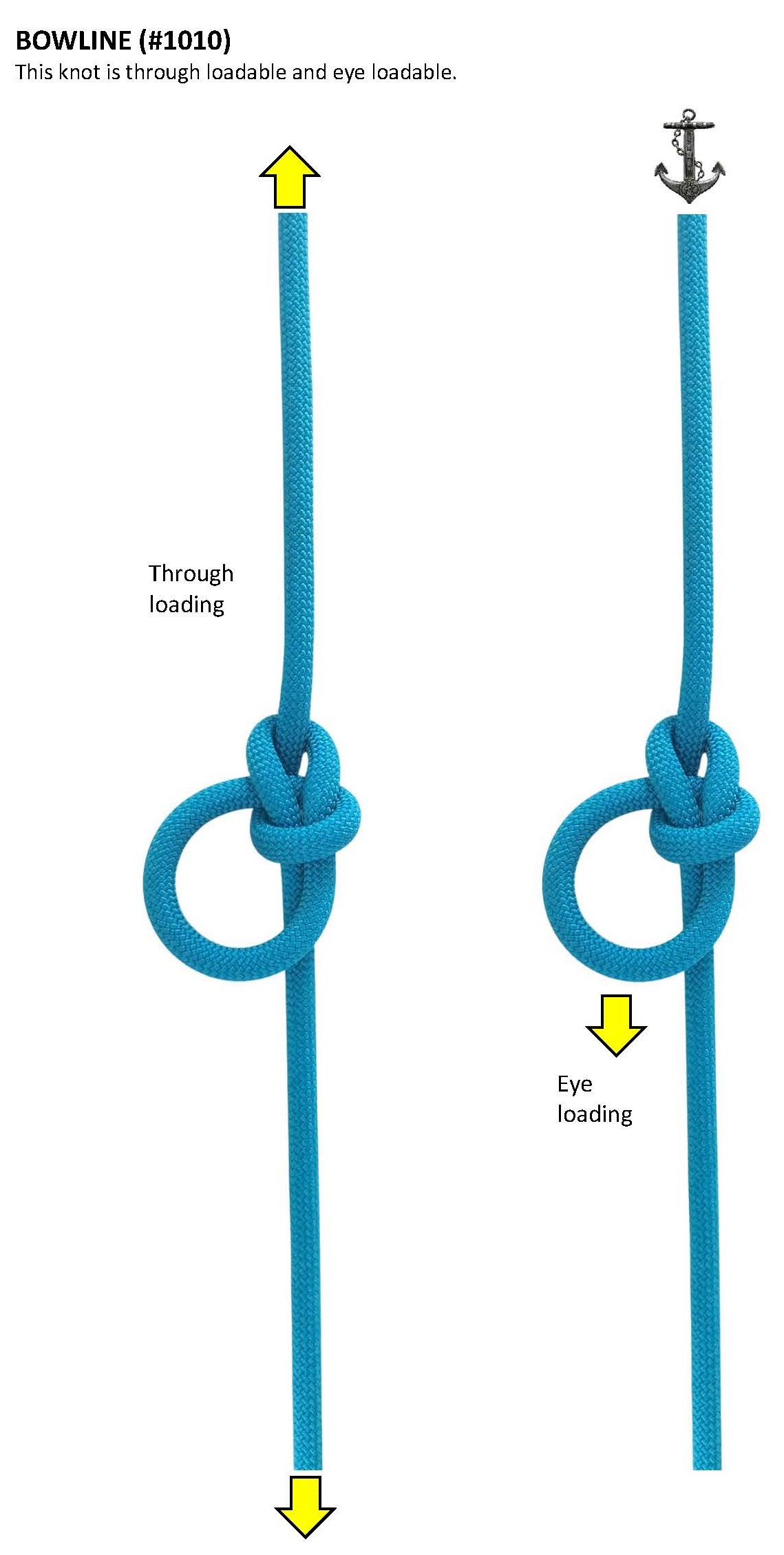
These terms have long been known and defined.
The properties of 'stable' and 'secure' are distinct.
In the case of 'mid-line' knots, a key requirement is that they must remain stable when through-loaded. This is why I am of the view that an F8 eye knot must be excluded from the definition of 'mid-line' knots.
An F8 eye knot (Ashley #1047) becomes unstable when through loaded. In contrast, a Butterfly (Ashley #1053) remains stable when through loaded.
A Clove hitch is also stable when through loaded.
And so a question that must be contended with is whether 'TWATE' is a requirement for assigning the status of 'mid-line'. Dan might weigh in here... he might declare 'TWATE' to be a requirement. If so, this would exclude the simple (#1010) Bowline from being a contender for 'mid-line' status.