To further the exploration of what a 'Mid-line' knot is...
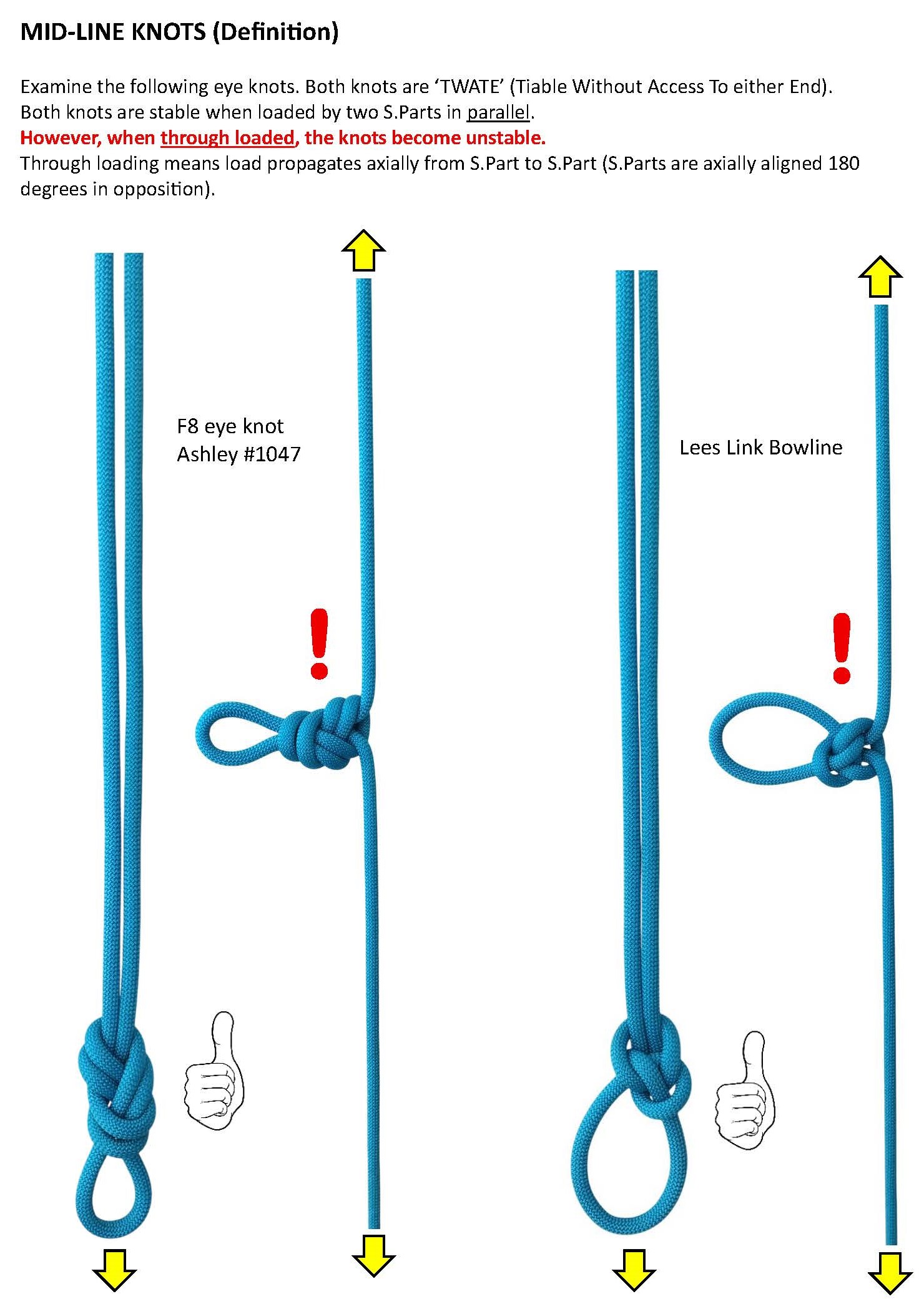
Examine the photos below.
In the first (upper) photo, there are two (2) eye knots that are TWATE (Tiable Without Access To either End).
These eye knots are stable when both S.Parts are loaded in parallel. However, when the knots are through loaded (S.Parts are axially aligned 180 degrees in opposition), they become unstable.
My position is that these eye knots should be excluded from the definition of 'Mid-line' knots.
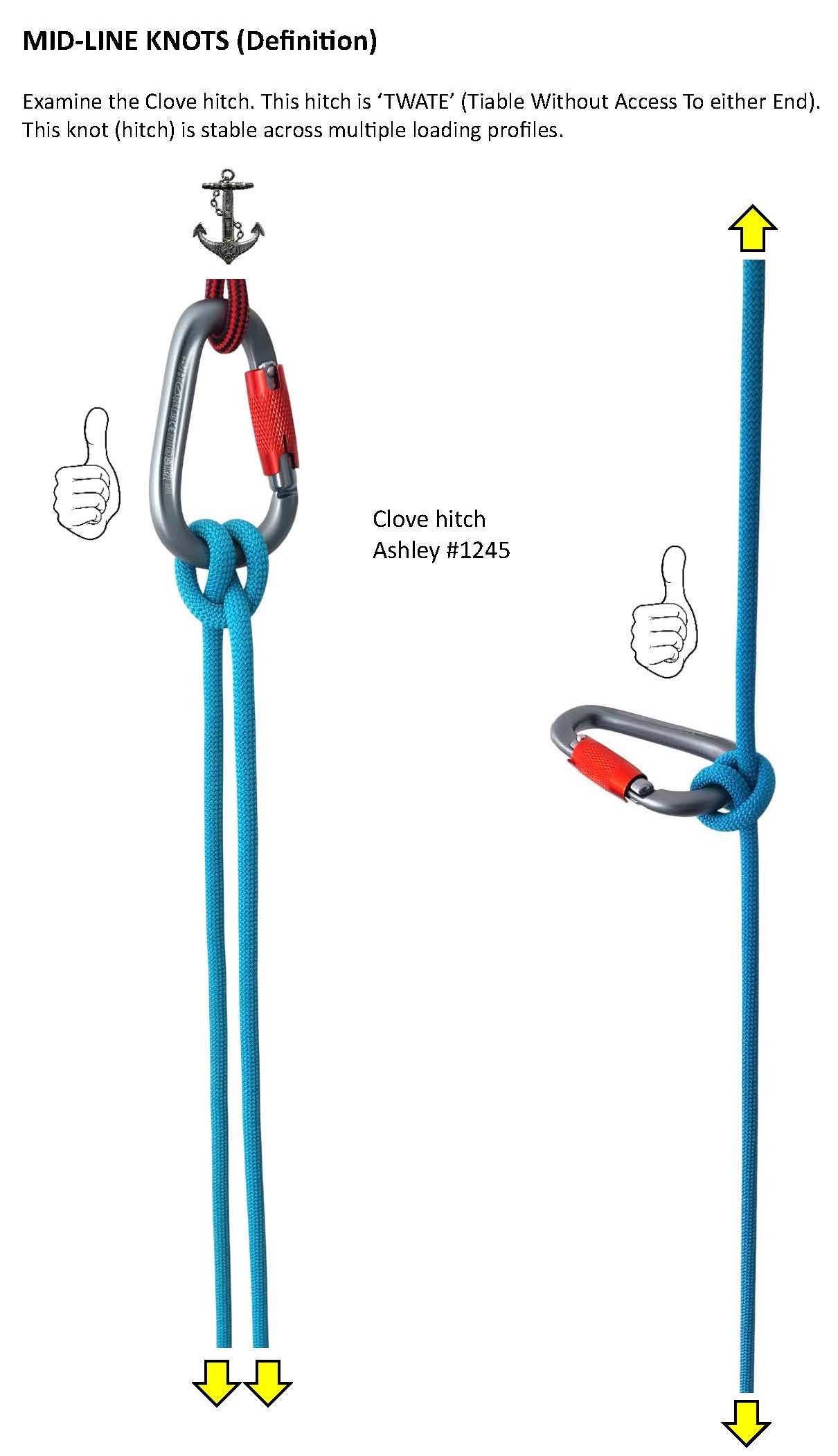
In the photo below, the Clove hitch is examined.
This 'knot' (ie hitch) is TWATE (Tiable Without Access To either End). It is stable across multiple loading profiles.
My position is that this 'knot' (hitch) is 'mid-line'.
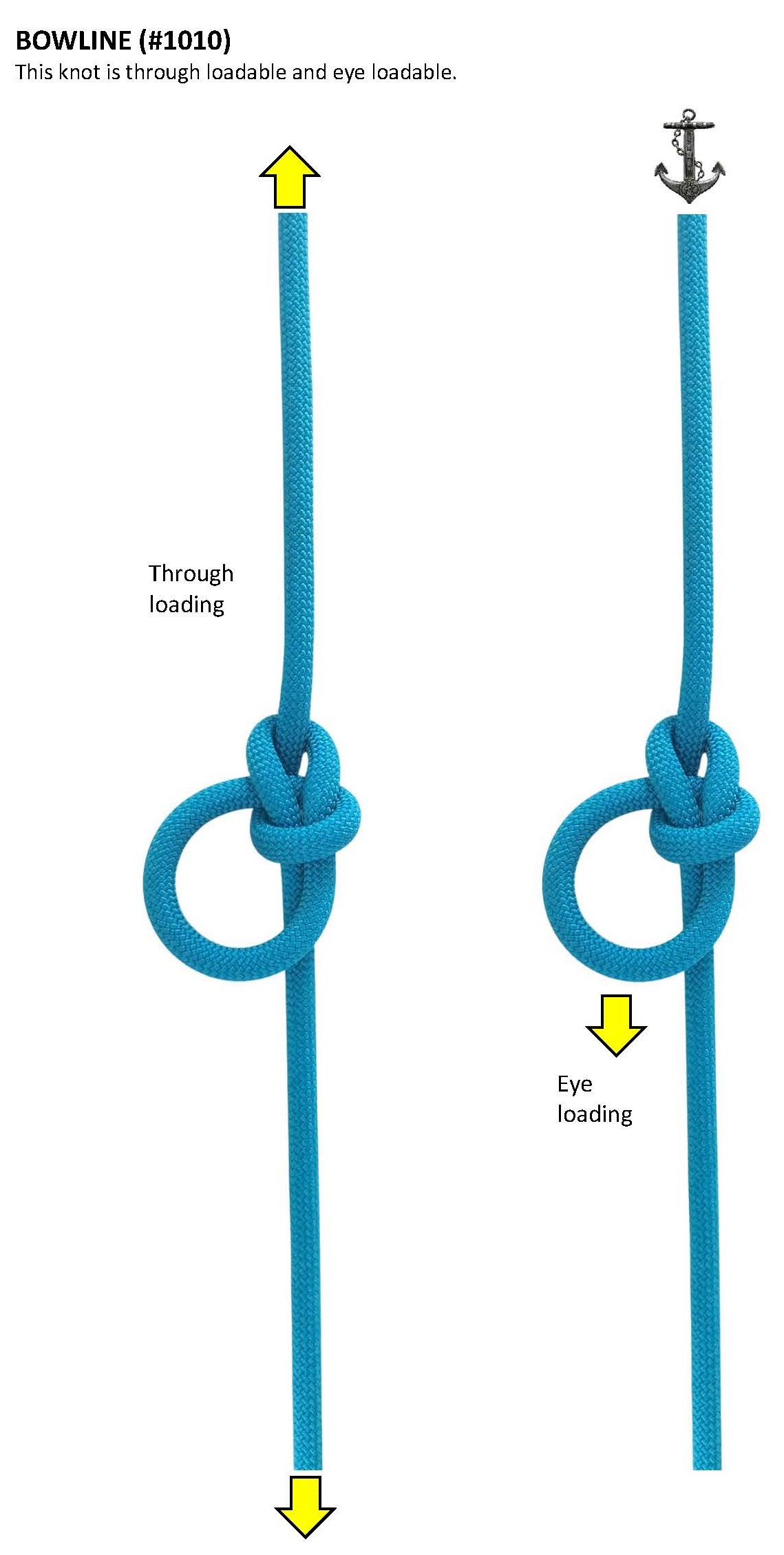
The following image explores the simple (#1010) Bowline. This knot isn't 'TWATE' (Tiable Without Access To either End).
However, it is stable when through loaded.
If 'TWATE' is a requirement, this knot would be excluded as a mid-line knot.
My current position:
A 'mid-line' knot is both 'TWATE' and stable when through loaded.
Joints are excluded from this definition.
EDIT NOTE:
Dan will make his counter argument.
In doing so, I would like to reach agreement on the definition of 'stable'.
That is, what do we mean by 'stability'?
Here is my definition of 'stability / stable'...
A knot is 'stable' when its geometry does not alter or distort when subjected to a defined / specified loading profile. The alteration or distortion can compromise the knot as load is increased. In the case of 'mid-line' knots, they must remain stable when through loaded.
In my view, a directional F8 (Ashley #1058) is deserving of the title 'mid-line' knot. It is both 'TWATE' (Tiable Without Access To either End) and through loadable. The 'eye' can only be loaded in one direction... Bi-directional eye loading should not be a requirement.
I would point out that a Clove hitch has no 'eye' - but I regard it as a mid-line 'knot'. Therefore, an 'eye' is not a requirement to be 'mid-line' knot.