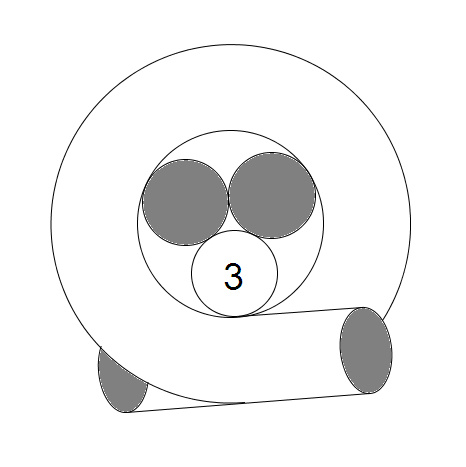
In the case the arrangement of the three rope diameters into the nipping loop is the one shown at the attached picture, the location 3 should better belong to the 1st rope segment that passes through this nipping loop, i.e, the eye-leg-of-the-bight.
Two reasons :
- The leg that comes loaded from the bight has not formed a U-turn / a collar yet. Therefore, any nipping action on it, at this stage, would probably be wasted - the gripping force of the nipping loop would be unable to confront the full 50% of the load by itself. It is better if the greater part of the loading is first absorbed at the collar s rim, and the nipping loop takes action only afterwards -when the loading would have been already reduced at the collar quite a bid, and it would be much lighter for the nipping loop to bear it successfully.
- Each time, and at each point, the working end passes through - and is gripped by - the nipping loop, friction absorbes a great portion of the total tensile force. We can say that each one of those times and places is a line of defence of the knot, that protects the tail from slipping out of the nipping loop. It is better if those successional lines of defence are arranged according to the degree of their effectiveness, from the weaker to the stronger one. This way, under heavy loading, the most probable case would be the one where all those lines of defence would be utilized at the same time, i.e. the total load would be dissipated on the entire length of the line prior to the tail. So the segment of the line between the eye-leg-of-the-bight and the tail would participate in its entire length, and it would always be tensioned, : there would be no slack - a sure recipe for a tight, compact knot, with all its parts collaborating together in the effort of the knot to secure the tail from slipping out of it.
So, when we have three rope diameters going through the nipping loop, it is better if the diameter that is located in the “blind spot” ( the location of the nipping loop where the working end is gripped less effectively - the 3, at the attached picture ) would be the one corresponding to the first passage of the working end through the nipping loop - and so on.