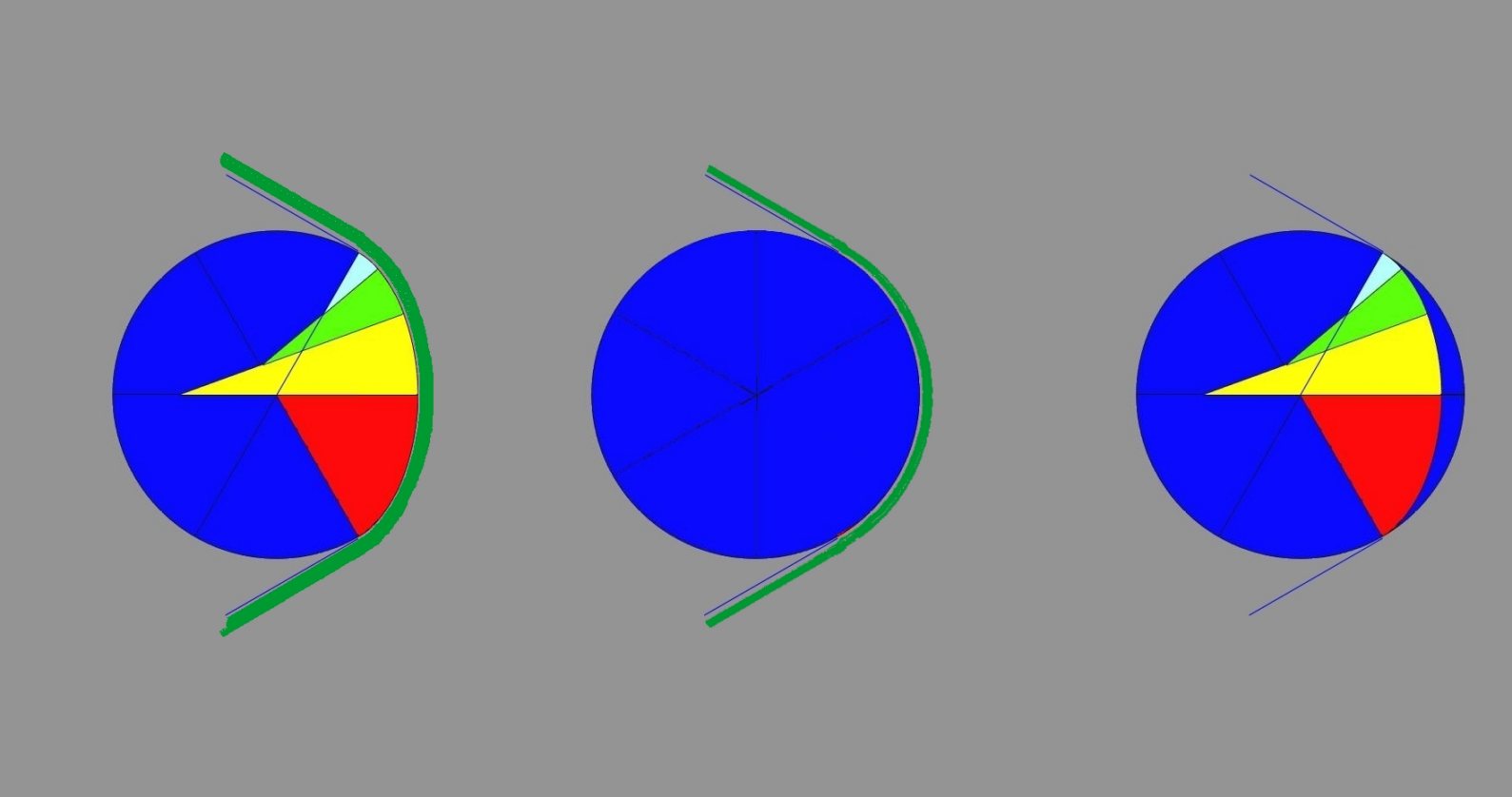
i think that rope forces can be defined by interactions of 180 degree arcs mostly in my chase to see them.
i break everything down to straights and 180’s when viewing
even came to define straight as simply arc_0 x 180 (making all arc reference neatly)
.
This even goes to directionality of the forces as straights are distinctly different, their Equal/Opposite forces are in Opposite directions and only the minimal 2 points, that are equal
180 arcs by contrast have forces pulling both ends same direction, AND create a center cumulative 3rd forcePoint
but due to frictions NO 2 forcePoints the same unless ends sharing load as ballast to each other
also note it takes 3x 180 arc center forcePoints collectively to make a stable 2 dimensional force triangle to really begin to withstand sideForces well as Killick or Friction Hitch for ABoK’s lengthwise pulls not serving properly across host mount.
.
This model has been re-affirmed formally over years more and more the more i understood math of 20yr.old doc for frictions (and view arc mid point on own) :http://web.archive.org/web/20190404092216/jrre.org/att_frict.pdf on capstan math (note original site now MIA and had to post from 2001 WABAC/wayback machine that luckily mr.Peabody left behind!)and also to see rope forces as a linear force input for hitches and Bends and other knots used as them.
All feed from LINEAR force input from SPart to their internals>> a definitive start/peak force and degrading of force pathing to Bitter End
EXCEPT, binding knots that force feeds from within domain of encased host RADIAL force outward, looking to be more even around, force not traveling so much from begin to end but all around until Bitter Ends escape this wrath.
.
i think these things are the most definitive of knotting, at least as the start.
.
May the force(s) be with you;
as you chase them thru the pipe-line to apply!
“The solution of the classical Euler-Eytelwein problem formulated as 2D problem
is generalized in the current contribution into the 3D case under the
restriction that the rope is represented by the spiral line and the sliding is
appearing only in tangential direction according to the Coulomb friction law T = μN.”
When I read your post struktor - my initial thought was that you had typed those words from your own original work and research.
But then I noticed that you had simply copied and pasted from a paper authored by Alexander Konyukhov and Karl Schweizerhof.
It might be best to make it more clear that you had copied and pasted someone else’s original work.
Providing a URL to a paper from which you copied and pasted is (in my view) a form of obfuscation as to who is the real source of original thought.
Note that this is not my original work - the capstan equation and the capstan effect has long been known and understood.
Indeed, Ashley published a knot which draws upon the principles of the capstan equation at illustration #2047.
In a mathematical sense, the radius of the cylinder around which the rope turns has no effect on the holding force.
However, that’s pure mathematics rather than real world experience.
I have found (by empirical means) that passing a rope around a very large tree definitely improves holding power in comparison to a very small tree (particularly with rougher bark).
That is, a simple U turn (180 degrees) of a rope around a very large tree provides better holding power compared to the same 180 degree U turn around a very small tree.
Friction dominates…
An interesting test could be setup using a #206 Crossing hitch (aka Munter hitch) - around a 10mm diameter carabiner versus a larger diameter tube (both metal surfaces would have to be of the same type and frictional properties).
Nevertheless, I do understand the mathematical principle of the capstan effect.
note:really mean #2047 (?) shows as turns on squared /not round, chapter_27 Occasional Knots fave of tapered grips, Windlasses, pipe wrench, deadman anchors, parbuckle and finishing with miraculous ingenuity of Chinese Windlass(that folds Nature rules back on self to compound effect!). i think capstan math would only find on ‘sharp arcs’ of corners perhaps on square/rectangle, not straight runs between, thus more turns needed than other rounds shown?
Struktor: If talking about the same thing i think i’ve seen this as linear drift degrading radial math and so more on smaller hosts when looking at tight list of turns.
.
But think these are attacks on the specific number of math more than pattern of compounding frictions and counting in arcs of half circles shown (as model at least). But really because of the decades catching hundreds of pounds of wood slammed into rope controlling friction on limbs or thru small pipe as shown(playing some days with this thru rack, fig8 etc.) and the differences shown adding turns feel real as (att_frict) best explanation of what was witnessed and with friction hitches as well.
.
i believe in hitch and bend usage, have a linear force thru rope that starts high and degrades to Bitter End, but not in easy math of distance travelled, but of compounding math of degrees of contact shown. Perhaps not fully in numbers shown, but 3 half arcs to make RT on brake device is more than 3xTurn of 1 arc. Translated to slippier materials of rope on rope inside of knot is closer to 1arc x3 =3arc friction but still a compounding effect the more turns or higher CoF allowing functions to express more powerfully. In making the spreadsheet i took route of realizing flat friction CoF, then multiplying by Pi to get a ‘radial CoF’ per mated materials (instead of calc each time) then multiplied by number of half circle arcs as finish to show simple logic of this hopefully.
.
But, hanging 100# on a limb, still pulls 100# on limb even after these frictions. The center of the arc pulling in load direction as both ends are pulled in load direction. Distinctly different than straight line that ends pull in opposite direction and only 2 forcePoints of Equal/Opposite not the 3rd cumulative forcePoint in mid arc. In this way i believe the directional forces are more definitively correct than tension in model that is still usable for on the spot judgement calls more than math homework.
.
Euler Number is built on/towards logarithm of 1 used for calc of exponential expanding population growth, disease spread, compound interest, frictions here etc. It is also used in what is called the most beautiful equation in math , as is Pi; both are in this stable calculation of compounding frictions that is pretty close to this ‘beautiful equation’.
.
arc benchmark functions:
0arc as extension (straight line)
1arc as re-direct(Turn)
2arc as grip(Full Wrap?)
3arc as more 2 dimensional grip (RT) and brings end back around to ‘most probable service’ point more than 2 arc.
.
arc benchmark functions also fits by geometric dimension
.
Ages ago, Dan (da’man) Lehman challenged me on 360 vs. 540 degrees make an RT in my drawings etc. i think my answer more of the same now, but better words for it! Can’t even remember if he was strongly, personally picking a side or just making me think for all these years, but thanx either way!
.
Arcs can apply radially at right angle to host mount like spar, or arcs can express more linearly like trace thru rack, Surgeons , Tresse legs etc. But paper claims same compounding frictions by degree. So does show slices thinner than half circle arc, but mainstream is counting the half circle arcs AND this keeps the directionality of the force more properly in model i think. Thus in the greater than 2arc grip of 3arc i also see stable triangle of grip force line emerge from collection of arc centers.
.
Not closely related, but another big piece is using a HH as not termination of force but when used as a pass thru of force can be directional converter of errant lengthwise to correct right angle on host strategy (like Killick converts from Timber or in other lengthwise pulls of friction hitches of not the tresse more splice like lengthwise pulls on host columns Personal definitions of Hitch and Bend are also to this more electrical schematic force flow of termination or pass thru of force respectively.
.
Insufficient in my view.
You could [u]easily [/u]without much effort add the words:
[i]Sourced from paper written by: Alexander Konyukhov and Karl Schweizerhof[/i]
But, it really depends on what impression you intend to form in the casual readers mind…
If the tables were turned and it was me that sourced other peoples work; I would have made it more clear (but thats just me).
note:really mean #2047 (?) shows as turns on squared /not round,
Irrelevant.
Yes, Ashley illustrated this termination hitch around a rectangular object but, it works just as well on a round object (eg a tree).
In this case, its the geometry of the hitch that I refer to... not the shape of the host object.
One could also point to: #1721 #1732 #1793
Its all the same concept…
Capstan equation applies to turns around a circular/round object but, as stated, #2047 could also be tied to a round object.
i think the ‘arc(h)’ in architecture is to have no straight lines except for pure inline load and control legs/ supports etc., but specifically not the spans between, thus archways, arch bridges, domed ceilings, and the slanted sides of top keystone/capstones to initiate arch to receiving piers if any rise to arch, then abutment braces against side forces outward.
.
i think the degrees of contact mentioned in articles can only be fully met by the magic of round and not just 4 straight runs to 4 protruding corners and thus round is required geometry for windlasses, capstan, bollard for contact and smoothness of change sine to cosine. Straight sides of square/rectangular would have no more to do with capstan math than straight line feeding off of capstan, all would be on sharp corners.
.
But also the cosine forces after 0degrees help press rope into support also, but then into the sine force as well. Sine reciprocates hug to host and pressing rope into cosine force until just hugs at no cosine of 90 degrees In most Natural harmony of capitalizing on both forces at once in a kinda very unique mix of using the yin and yang of the force both together/ and onto each other as unlike any other shape will render.
.
i think we use PI in the capstan calculation to purposefully suit to 4 equivalent squares within 1 square with 21% shaved off/at each exposed corner for about 4 -0.84=~3.141592..
Radial contact would support the rope thru the arc at each point, square does not.
Radial contact gives the smoothest hand off of cosine to sine instead of employing only 1 cosine on straight runs and sine/cosine mix on corners i’d think.
i think this is why rope is round, and ship parts cut from squared cants of log to round etc.
Lowering thru 2 turns on a squared timber with real weight feels like sharp corners on rope to me also.
.
.
On page 14/16 in att_frict flat regions of rope over aren’t counted only the radial degrees of corner contact.
Flat seems to in some ways be the opposite geometry of round, thus reverse some strategies that are bad in round to capitalize on in flat rope/web, like Overhand Knot base, negligible loss of efficiency on arc due to virtually no rise off of the host mount by flat device, so virtually no leverage-able thickness on the arc of deformity, where round rope too is deformed around but then rises up leverage-able length of it’s diameter as a distance off of the round host mount on said deformed axis, usage of What Knot etc.
From all these angles the round profile is a distinctly different geometry than flat to work with in supporting architectures.
1 basis for defining all these in 180arcs; besides att_frict.pdf paper and observations;
is to the mechanical logic of rope (as part of non-rigid/flexibles) only resist/conduct physical force:
on the pure inline axis of the flexible device/rope;( NOT the cross axis )and only in the tension direction on that inline axis
So work knotting in single inline loaded axis models only.
.
So, can pull tension on the load axis, or do a 180arc around so can pull tension on the same load axis
just in opposite direction on that same axis, so find simple(un-compounded) arc as a mechanical redirect
other directions than straight or 180 for forceFlow would constitute another system on another line axis by this model.
.
So we have loaded force along the line, or U turn 180 back as only knot move to stay on that inline loaded axis with force flow thru rope as pipe.
So work knotting in single inline loaded axis models only.
that incurs, but can’t resist sideForces on it’s own/as a flexible(only rigids can resist side forces on own)
side forces against a line>>Flexibles only support tension force, so any sideForces will try to pull towards more mechanically efficient centerline
if anything moves from this >>The now closer sideForce to centerline and softer line angle BOTH give some tension relief to system.
(compression direction on same axis, by contrast, gives sideForces that push away from center)
.
Geometry models in 90degree arcs, so 180arc = 2x90arcs for proper pair of equal/opposite halves that make up the whole.
And converts 1 dimension line element of 2 equal force/opposite direction forcePoints
into 2 dimensional, 3 LINEAR forcePoints, in same direction, none equal (simplest model / pulled from 1 end only)
The gentlest gradient slide smoothly thru changes of cosines and sines from Zer0 to full force(or reverse) of arc
is simply most perfect deformation (least efficiency/strength/capacity loss) for maintaining same axis per model, but reverse direction on that axis.
.
So, i think this is how all this works in linear/hitches(termination) and bend(pass-thru) usages of rope
or at least a better model that reveals many things closer to actual in examination and understanding thru model.