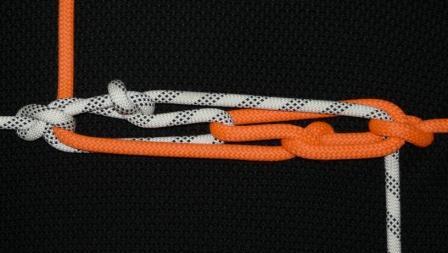
Greetings; long time since I have been here, so hello. Anyways, the other day I was looking for a way to put some tension in a guy line for a high direction anchor. What I came up with was the versatackle with the addition of a prusik to lock it off. Image below, and of course the carabiners can be eliminated. More loops for added MA could also be used. I found the prusik for locking off to work out quite well.
Versatackle: http://notableknotindex.webs.com/Versatackle.html
In think that if you tried these things with actual weights
and saw the effective MA, you’d not want to go further
in adding loops and removing 'biners (even adding loops
WITH 'biners). Try it and see how LITTLE MA you actually get.
In your (OP) image, I’m presuming that the rope isn’t fixed
but flowing through both “Anchor” points --otherwise, that
upper line is rather pointless. One possibility is that when
hauling on the end one will simply rotate the anchor-to-anchor
circle rather than draw it tighter --it’s a matter of relative
friction at various points.
I think that the very idea to use climbing friction hitches, to absorb some portion, at least, of the total amount of the tensile forces, at some points of the mechanism, before or after the Versatackle s “opposing bights” lock, is very good. However, as with the Verstackle you have an already complex knot, if you add even more things, you run the danger to end up with something a little more secure, but much more difficult to tie - an unpractical “a-gly ta-gly”…
The subject of adjustable binders/tensioners, that exploit the benefits of a mechanical advantage, is very interesting - but not very well studied… So, there may be many surprizing effective knots awaiting us in the future. The Gleipnir knot is a marvellous binder discovered just a few years ago, that makes use of a mechanical advantage, in order to lock the two tails into the nipping loop more effectively. Just a few months ago I was surprized when I found that the Cube bend ( M. B28 ) could be transformed into such a secure most simple binder (1) ( See the first attached picture):
One other means you can use to ease the load the final lock should bear, is an even greater mechanical advantage. See the second attached picture : If you pass the two tails ( vertical segments, in this picture ) in between the two opposed bights, as in Versatackle, you will get a 6 : 1 mechanical advantage - and the tails would not even be forced to bear the 1/6 of the load , because they are nipped already at their previous U turn - before they arrive at the point of the final lock. Very efficient tensioner - but very complex, too…Who is going to tie this thing a second time ?
I have also seen that if, at those U turns before the final lock, we use double round turns instead of single bights, we can stabilize the whole mechanism, and, at the same time, absorb a significant portion of the tensile forces - so the load we have to lock at the very end is diminished. See such an attempt at the third attached picture - which, although it achieved a secure lock, it had not escaped the danger of looking more like a ugly tangle, than a practical knot !
So, many possibilities lie ahead - just keep tying and trying - and keep it simple !
Wouldn’t you have to start with a Versatackle to call this setup a Modified Versatackle? I don’t see any Versatackle. Holding tension with an ascender-type hitch is common practice.
Why would you say this is not a versatackle? I learned the knot from your website. Is it because I do not have enough loops or the use of biners? I used the biners because my drawing to does not permit looping through the knots. I attached an image with more loops if that makes it more correct.
In my simulation software, the carabiners used as a 2:1 pulley yields about a 1.4:1 MA.
As for the anchor points, we were building a ladder gin as in image below (we anchored to ladder and part of the fire rig). We really did not need much MA if any.
At any rate I will put you down as a No, I do not find this useful
So, this is purely hauling-in-direction-of-movement
(no redirection, as in your image) pulley, reduced to 1.4:1 ?!
That’s maybe a little greater loss than I was thinking
(thinking about 1.6:1), but … .
Anyway, it’s s simple system that I think you should make
some in-actual-materials testing of, just to give yourself
some Real-Feel™ sense of it.
(I will hang dead weights, and then might give them some
bit of starter movement to break inertia (such a surge of
force is possible with manual hauling, of course), and see
how things go, whether movement continues or ceases.
And with some different (new vs. old, even) ropes!)
As for the anchor points, we were building a ladder gin
as in image below (we anchored to ladder and part of the fire rig).
We really did not need much MA if any.
How much MOVEMENT do you need?
For your OP image hints of a 2:1 through top-directional
which (if I’m figuring it correctly) is a theoretical 4:1
–moving twice the original span to raise it half way–,
and it pretty simple to construct.
I guess I failed to articulate properly. I have trouble communicating my meaning sometime. The versatackle is not being used as a haul system, rather a tension-er to hold the ladder in place at a 70 degree angle with respect to its platform. The haul system is at the top of the ladder as shown in the pic.
The guys at work thought it was a goofy rig also so I think I will just chalk it up as one of many of my bad ideas.
By the looks of the platform & ladder, you don’t need
a tensioner for primary positioning, with the ability
to set the rope slack with ladder upright and then
ease it down into tensioned position;
but having the versatackle on one side,
as a fine-tuning adjustment would be good, I think;
the many strands in the v. should spell low stretch
after setting (as must be the main lines of support).

 sense of it.