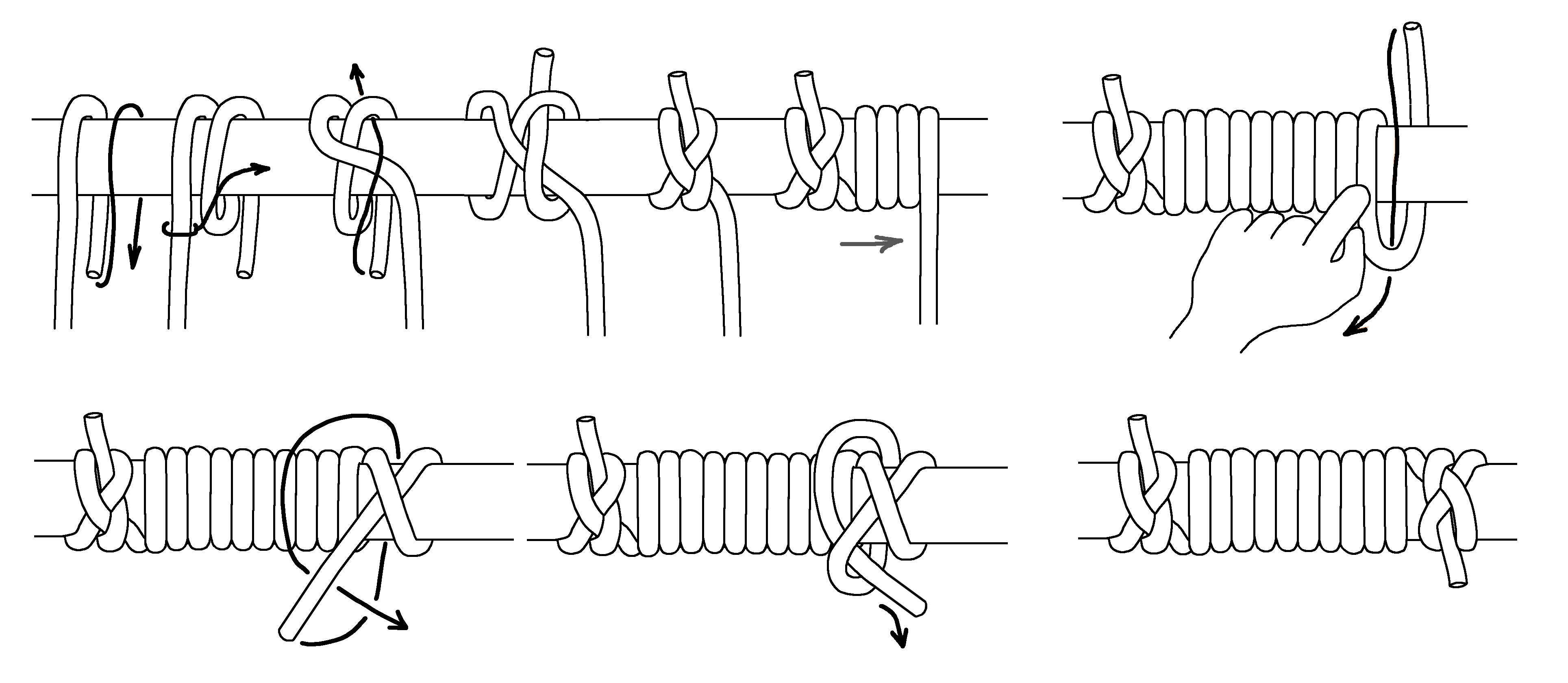
It takes me awhile to understand Dan's written descriptions. I know I am mostly a visual learner. I found myself tying the beginning Reversed Ground Line Hitch in a way that probably does not make Dan happy, but it is what seems easiest to me. But then I worked on the ending Reversed Ground Line Hitch. I now see how you can lock the wrappings in place with an initial Half Hitch. The secret is to keep it out a little away from the wrappings. Then I find myself tying a second Half Hitch (in the opposite direction) which gets placed between the first one and the wrappings to complete the ending knot.
It would not be difficult to tie repeated ending Reversed Ground Line Hitches right next to one another to get a whipping similar to the repeated Constrictor Knot whipping shown above.
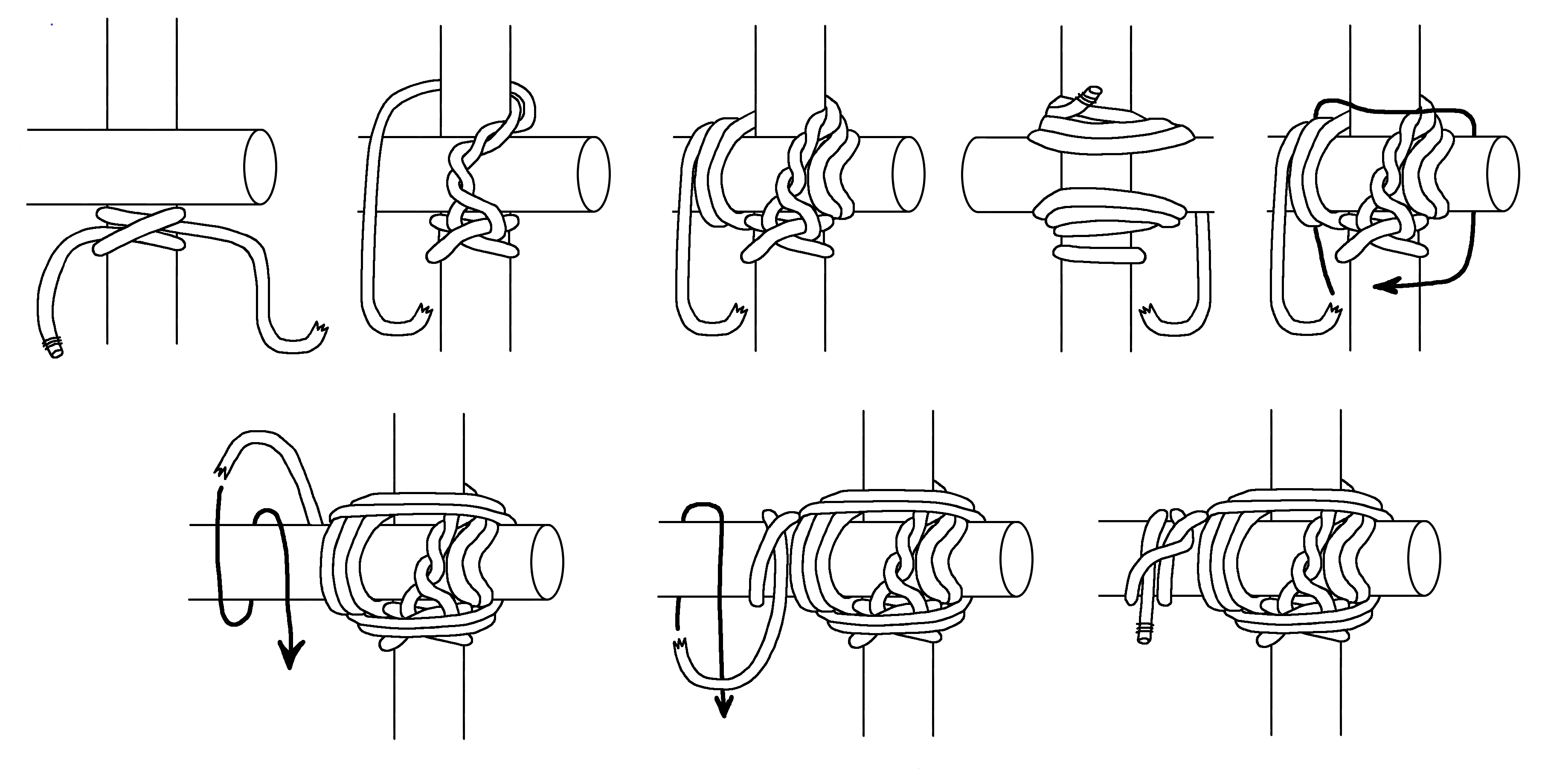
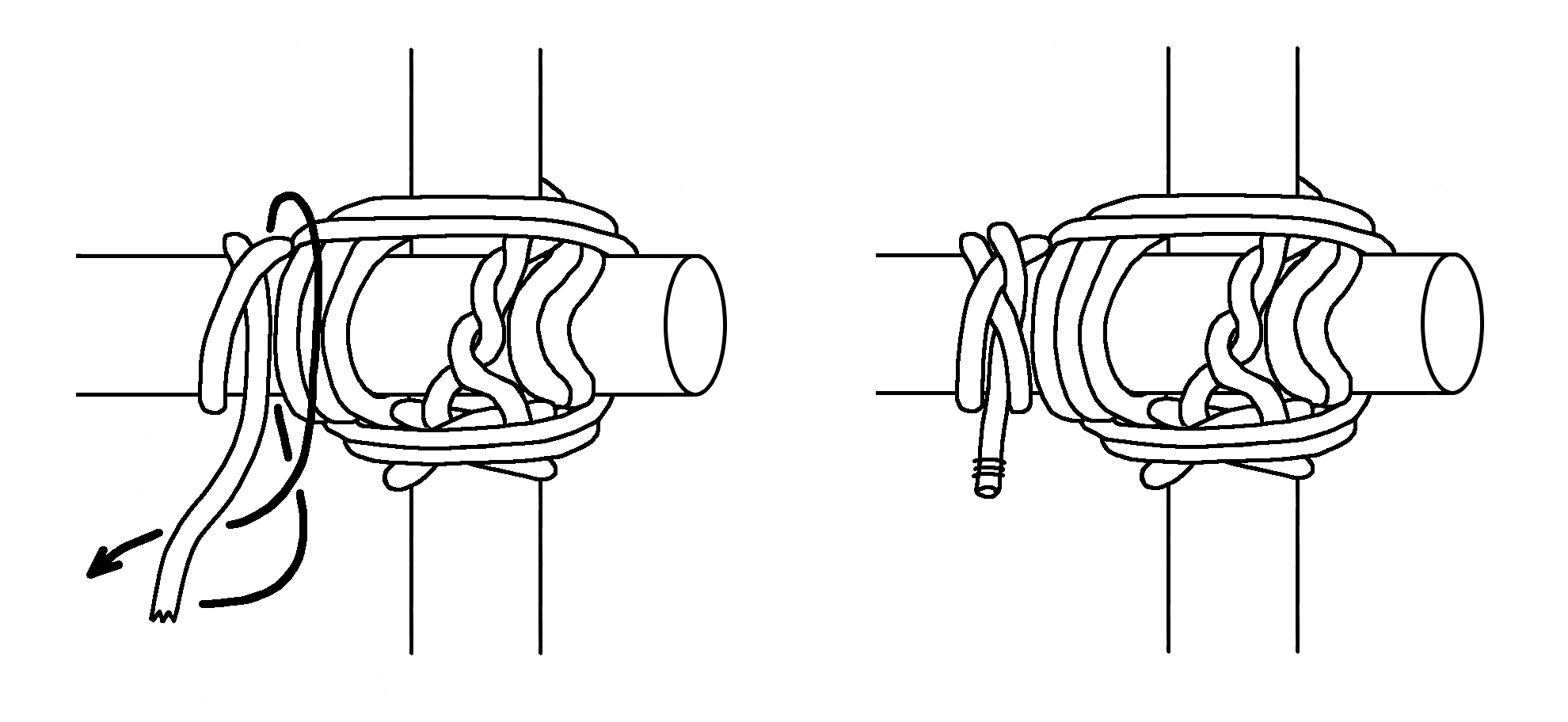
Here is a review of the traditional Square Lashing, which usually begins and ends with a Clove Hitch. Since the free end of the beginning Clove Hitch is twisted around the standing part and buried with the frappings, I see no reason to move to anything more secure here. Use a Constrictor Knot or a Reversed Ground Line Hitch at the end of your lashing if your cord is slick.
By the way, Larry Green and Gerald Findley in the references above offer a Mark II Square Lashing which ends with a Square Knot (rather than a Clove Hitch). I find this alternate lashing harder to tie by myself because it involves wrapping two cords at the same time. I find it harder to keep them both tight, but two scouts working together could easily do so.
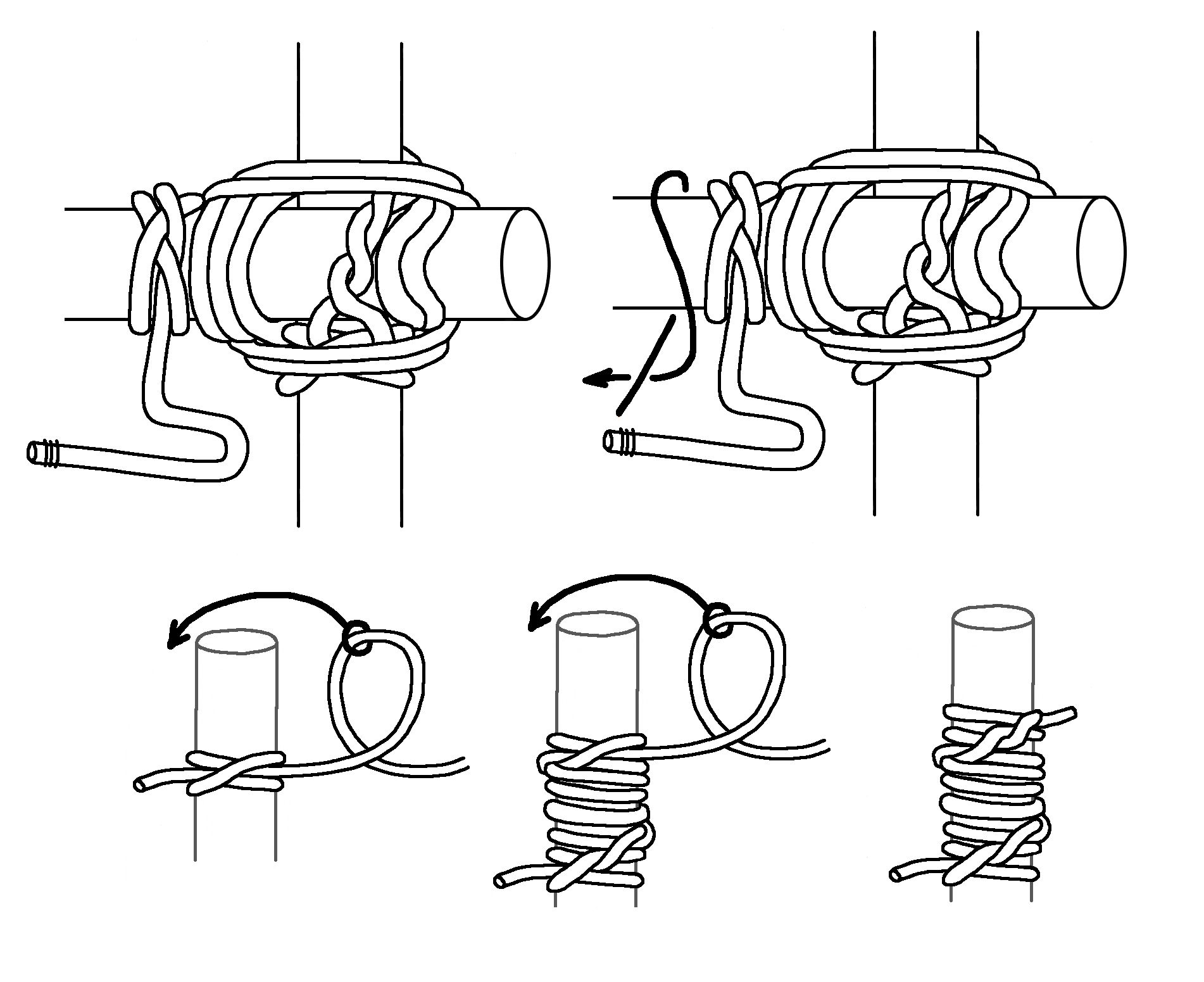
Often when scouts tie a lashing, there will be some cord left after they finish the lashing. If you let them, they will cut off the excess every time. Pretty soon all of you lashing cords become too short for new lashings (with slightly larger poles). I always had the rule that “Only the scoutmaster cuts rope.” {Of course, if you are making a small model using string or jute, then sure go ahead and cut it. But rope and larger cotton lashing cord is expensive.} If you have a lot of excess, you can just wrap it around an unused section of the pole and end with a Clove Hitch. If you have just a little extra, use a few Half Hitches. There is actually a name for this in Ashley, he calls it French Whipping [ABoK #3450]. These extra Half Hitches probably do very little to increase the security of the lashing. They mostly just save rope.
Hi dear all
The Clove Hitch applies to all the lashings is good, no reason for replacements. Other replacement hitch applied to the finishing end is insignificant to the lashing. When we finish with the frapping, we add a Clove Hitch which holdfast the former dressing. Then some wrappings or Half Hitches and at last finished with Clove Hitch. After complete the lashing, excess lines are treated in three ways without cutting.
1). continue wrap round the horizontal pole and finish with Clove Hitch.
2). coil the line and knotted to the adjacent pole.
3.) make a Sheepshank (multi diameters) and knotted to the adjacent pole.
In case of tying a Square Lashing on round poles or scout staves of smooth surface. The first Clove Hitch can be replaced by Constrictor Knot. Due to the first Clove Hitch is the only support knot for the ledger (horizontal pole), so a Constrictor Knot is good for the purpose
In my boy's age, some sixty more years ago, I am right-handed. In tying a Square Lashing, I used to do the ends/lines of the first Clove Hitch goes through the 2nd quadrant then to the 1st quadrant and so on, instead of the going to the 1st quadrant then to the 2nd quadrant (that is from knot books, except ONE). During my tying, my left hand/fingers are going to press the line to the pole and my right hand is going to work on the line. But for general case (mention in books), first going to the 1st quadrant then to the 2nd quadrant, I need to cross my hands that discomfort me. I myself believe that this is for the left-handed. During my teaching, I expressed my point and let them try and choose their own tying method.
Happy Knotting
yChan