Finally anyone can call a knot whatever they like - the Zeppelin Bend or the Rosendahl Bend? The former is probably better known but so what? Ashley has enough duplication to satisfy anybody methinks.
I seem to have lost your reference to “naming knots”, but I do not think that the issue is so simple as you put it. As the late Desmond Mandeville once said: “a nameless knot is merely a muddle of string”. Blaise Pascal added: “let’s define the things first before we start quarrelling about them”. When there is a unique identificator for all knots (or at least the knots under discussion), then it is clear what we are all talking about. Theoretically they should be the same things. But you must, however, first establish that common nomenclatural framework. So, yes, anybody can name knots whatever they like to name them, but when they tread into shared pastures, all parties must compromise or perpetually have their interfacing frustrated - a fate, as you point out, Clifford Ashley also suffered.
I do agree re nomenclature but I also think that this is unachieveble. Before I retired a very senior civil servant I worked for had the notion that every business we dealt with should have a single unique identifier. This, it is easily demonstrated, simply will not work when one deals with the same business across a number of different areas. And it became unnecessary once a computer could link all of the identifiers (eg knot names) no matter which one was used.
To do this we had a project to index Ashley ( http://igkt.net/sm/index.php?topic=1305.0 ) which foundered through lack of interest (I assume) but which could have been the basis to add knots not in ABOK. So no matter what name you have it should have been possible to at least access all other known names for that knot - adding names as they became known. As a project it would also have gone some way to deciding how many knots are actually in ABOK (recording but not counting duplicates, fastenings which are not knots and composite designs consisting of many knots used together - once identified as such anyone can include or exclude the latter). Perhaps it will gain a fresh impetus one day!
I see. Unsolvable nomenclatural/identificational issues, you say, create problems when one object has to become known across multiple domains. For me that is so hard to imagine, as you, “Barry”, are “Barry” at home, “Barry” here on this forum, “Barry” elsewhere. Where do things go awry? When multiple instantiations occur? In that respect you differ from knots, I presume. This is the point I was trying to explain to Dan Lehman above. Knots may appear different, but they are intrinsically the same kind of thing. If you allow a classification to run across all possible knot-appearances then the lifespan of the universe will be quite insufficient catalogging whatever you meet. A pity your ABOK project floundered over the head of such matters.
On a different strand, we got away bleddering pretty well on this thread about “new hitches”, but what is the status of mr. Chan’s Alove? Is it a new discovery? Is IGKT going to issue their Certificate of Newness? Is the New Knot Claim Assessment Committee ready to proclaim its verdict by now?
Thanks for following up on the knots as seeds of knowledg idea. I was suprised at myself when the idea popped into my head. I’m glad it seems worthwhile to someone else too. And thanks for the Peter Suber link too.
The Terminator Gene is also a product of Monsanto. Do we really want some of the people that brought us Agent Orange to play around with the crops that feed us? Sure they do already with pesticides and herbicides (Food Crisis all over the world) but the Terminator Gene and the bacteria gene in corn and potatoes has the potential to spread and propagate itself, the ‘living pollution’ could be irreversible.. I’d rather not be a Guinea Pig. No one really knows what this all does to the soil in a lot of cases..
I think most people would think this kind of Intellectual Property right claim shouldn’t hold for seeds or knots. Or a lot of other things. I can’t remember where I read the discussion that patents were changing from processes to the finished product. This means that no one can find a more efficient way to do certain things, stifling innovation. If I can find the article I’m pretty sure the examples illustrating the insidious change made sense (at the time..)… I’m pretty sure it was one of the Multnational Monitor guys, who right about Pharmacuetical Prices. It may have been Dean Baker at cepr it seems like something learned from stumbling upon their articles.
I think “Yes, we can!” has been around for a long time. I read somewhere that Obama was basically copying Cesar Chavez of the UFW. Someone interested in real change and with far fewer Wall Street advisors.
When [url=http://www.amazon.co.jp/Beyond-Fields-Struggle-Justice-Century/dp/0520251075]Barack Obama adopted 'Yes We Can' as his 2008 campaign theme[/url], he confirmed that the spirit of 'Si Se Puede' has never been stronger, and that it still provides the clearest roadmap for achieving greater social and economic justice in the United States.
This other quote from Vandana Shiva, about seeds being passed down through the centuries might also have parellels with knot knowledge.
Farmers everywhere have been saving seeds for centuries, preserving the most durable ones for replanting. Women farmers in India were no different; that is, until 1995. That year India signed an international trade agreement giving multinational corporations permission to patent, own and sell seeds. As a result, seeds are becoming the private property of a handful of corporations, transforming the tradition of saving seeds into a subversive political act.
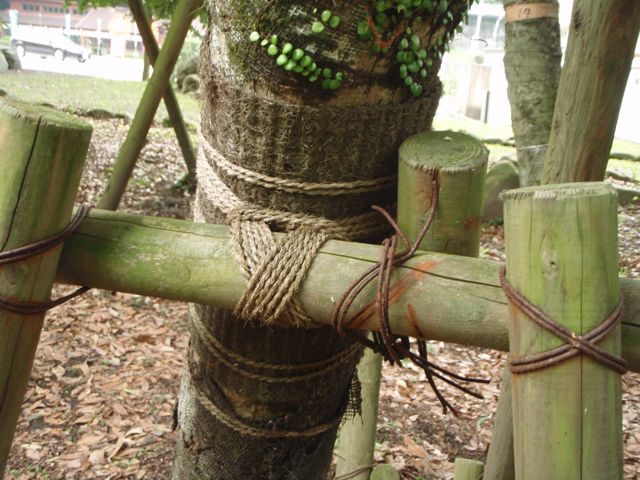
I’d just like to say that in spite of teaching style disagreements and various arguments I’m impressed with the free exchange of knowledge on this board and appreciate the opportunity to learn from everyone that contributes knowledge here. I intend to follow this advice upon which Joop Knoop and Dan Lehman agree. I will go direclty to the source. The Japanese Fence Knot is everywhere. Landscapers have to perform it for a certification test. I’ll post yesterday’s pictures of yet another example of a tree supports involving the ‘Otoko Musubi’(Ibo Musubi, Tsuno Musubi, Kakine Musubi). I think an object having a lot of different names is a sign of the importance placed on it. Either that or regional isolation in the past.
I’m also glad to see that Sweeney is concerned about patents…
I think you are so right about patented genetic mutations - I have noticed that sellers of F1 hybrid houseplants forbid propagation (though quite how they enforce that in the case of a private buyer is beyond me); and the EU forbids that sale of "old" types of seed (ie from varieties which were grown before tests were done) unless a hugely expensive testing process is undertaken. Looking wider music piracy is an interesting example as more companies are trying to get buyers to legalise what they do by making the price attractive - they still have copyright however.....
It’s an interesting, timely issue. The plumbers on the construction site were talking about how many guys had work back in the lead-and-okum days. Now with PVC pipe and glue 2 guys can do the work of ten. I don’t think you saw plumbers on prime time news hours complaining about the loss of work from this advance in technology but Sony and other entertainment corporations get plenty of airtime to rail against, and try to control, technology. They might just be obsolete with the new ‘delivery system for’ or ‘communication of’ entertainment. Maybe we’re heading towards more collaborative forms of entertainment that can’t be controlled for a profit with TV and Radio. I can only hope the artists/producers and fans/consumers end up in better positions…I don’t know much about the topic, I just think seeds and songs might illustrate why I hope that knot techniques and knowledge remain open and ‘free as in freedom’..
BambooFenceKnot, thanks for the images and your thoughts. I will respond later in more depth, but I think we are discussing “ideas as memes” here. Richard Dawkins also once adopted that approach to knots. Unfortunately I do not have the details at hand here where he mentions 2 researchers noting the usage of the Trucker’s Dolly as an evolutionary meme. I will excavate the reference later today/tomorrow.
Great to find somebody, in Japan, who sees similar mechanisms at work and manages to leverage them into a more generic context!
As threatened I’d be back with some more ideas on Knots and Memes. The reference to the trucker’s doily still eludes me,
but there are some other net-references to memes and knots, which can readily be posted.
The [b]Windsor Knot[\b] being transmitted as cultural entity:
I do not think this idea is a good one. To see why, consider the meme of a "reef knot". This meme can be passed on across five consecutive generations by drawing a diagram of a knot, then by knotting a rope, then by a textual description, then by making a computer model - and then by making a sculpture.
However, in such a case, it is not the behaviour that is being copied - the behaviour associated with making a computer model of the knot is not remotely similar to the behaviour associated with writing a textual description of it.
Since imitation is, by definition, copying of behaviour, the term cannot legitimately be applied to such cases.
The copier may not even see who they are copying. Rather they may reconstruct the behaviour of tying a knot from the knot itself. Is it still imitation if you reconstruct a behaviour from an artefact produced by that behaviour? If so, it is hardly a conventional form of imitation.
In my view, it is best to avoid any mention of imitation when defining memes - the idea is irrelevant and causes confusion. The copying of heritable information is the key underlying phenomenon - the details of how that copying is done is a side issue.
As for Dan’s question in the Scouting Ashley thread: how to prevent sick knot memes from spreading?
Joop, please nb: this forum’s HTML formatters do not use '' but rather ‘/’.
Seems you have much of former, hence, misformatted.
Also, there are some potential shortcuts in termination, which can be exploited
or not: e.g., I’ve found (the accidental way) that an ‘[/i]’ closure will also close
underlining (so some few keystrokes can be spared). There are likely other cases,
and I think that closing a quote will terminate within-quoted text formatters.
BTW, I’ve not usually used the clickable formatting buttons (which seem to
just spit out some formatters between which one must then move to write), but
type them. If you’re clicking and getting the backslashes, then … hmmmm !
Oops, I did it again and I’m not even a blond Britney, but a bald Joop…
Soooo sorry for this confusion, but then again, isn’t confusion just part & parcel of our subject? Right, Dan?
Anyway, what I tried to post earlier today was:
The Windsor Knot being transmitted as cultural entity:
Tim Tyler on the Reef Knot being transmitted, not by means of imitation, but by means of representations across successive generations. Barking at Sue Blackmore, a devout follower of Richard Dawkins: [http://alife.co.uk/essays/misunderstandings_within_memetics/]:
I do not think this idea is a good one. To see why, consider the meme of a "reef knot". This meme can be passed on across five consecutive generations by drawing a diagram of a knot, then by knotting a rope, then by a textual description, then by making a computer model - and then by making a sculpture.
However, in such a case, it is not the behaviour that is being copied - the behaviour associated with making a computer model of the knot is not remotely similar to the behaviour associated with writing a textual description of it.
Since imitation is, by definition, copying of behaviour, the term cannot legitimately be applied to such cases.
The copier may not even see who they are copying. Rather they may reconstruct the behaviour of tying a knot from the knot itself. Is it still imitation if you reconstruct a behaviour from an artefact produced by that behaviour? If so, it is hardly a conventional form of imitation.
In my view, it is best to avoid any mention of imitation when defining memes - the idea is irrelevant and causes confusion. The copying of heritable information is the key underlying phenomenon - the details of how that copying is done is a side issue.
Per knot, I find the hitch not so good --vulnerable
to distorting and even slipping (around relatively larger
objects). Stopping short of the final tuck is much
better; and if a further tuck is wanted, take the tail
OVER the non-SPart wrap and tuck back under.
“Get to …”, you’ve already gotten there --the blue
arrow and Spar hitch (which is a better knot than
the picket-line/ground-line hitch). To that, I said,
one might take the tail for another tuck,
over and then tucked under the non-SPart turn
around the spar --which is the part your knot
tucks under last.
But “better” judgments so far made here are coming
without any specified constraints on a particular use
–on materials & tying need.