.
On first impressions, I’m uneasy on the idea that you need end-access to the standing part of the rope. Maybe it could be presented differently.
I don’t think that two sets of gripping coils is needed. If you are dragging something heavy, you’re going to want to minimize the number of times you need to pass the rope under the object.
If your rope was attached to a tractor far away, you would not have ready access to that far end of the standing part. You’d only have end access to the free end or working end near you.
On the coil issue, if your log is really slick enough to require multiple coils, I’d prefer to have them mostly in one area and leave the towing end loop to mainly steer. Having two coiled areas would make it harder to transport slack to where it is needed as things are tied. As an aside, I’ve had luck with multiple coils finished with a Gnat Hitch.
Firstly, welcome to the forum, 75RR.
As far as your hitch is concerned, I do not see it being very useful to tow logs, as it requires too many wraps around the log, and if you have a log so heavy you need to tow it, and can’t tie any other hitch more secure than a timber hitch, then you probably don’t want to tie something this cumbersome. However, there are many applications of a knot like this. The first one that comes to mind is lifting beams at a construction site. These metal beams are likely very slippery, so you need some multi-wrap hitch in order to have enough tension friction to hold the beam. this knot seems ideal for something like this; the two separate sets of wrappings keep the beam roughly vertical, and then it is sufficiently strong to hold these beams. Also, in many cases, these beams would be lifted by a crane, which would have heavy duty cables attached to it instead of a rope, so you would want to tie the rope off to something else anyways.
Overall, if you could tie this knot without the standing part of the rope, and preserve the simplicity to tie it, it would be an ideal knot for many more situations. This is my attempt to tie something similar without the standing part, but i wouldn’t trust it, as the tail is not very well secured.
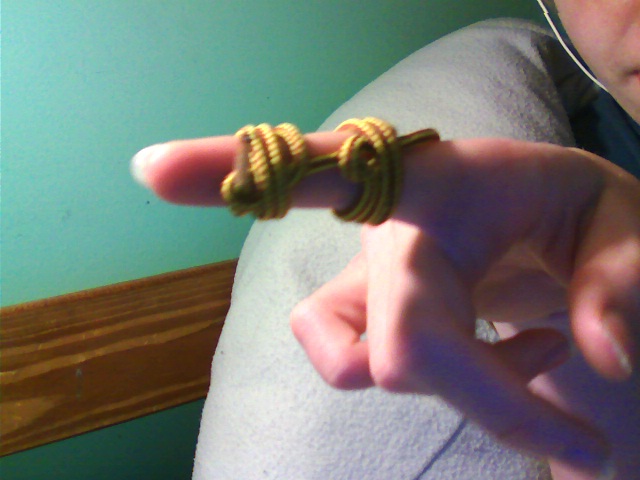
It would do best to lose “Killick hitch” from association with the
log-hauling activity : because, so far as I’m aware of historical
indications, the K. hitch (there are many expansions for “k”!)
originated --and so is properly constrained to be-- as a sort of
anchoring hitch to a stone ; the desired quality (my surmise)
was both grip and staying tied (jamming), which the collaring
of parts of this seen-as-two-structures (i.e., timber & half-hitch_
attachment arguably did, in natural-fibre rope, swelling in water.
So, depending upon the orientation of the two parts --i.e., turned
as for a cow / clove hitch, one can see the K. as whichever
of them, with the tail “dogged” for its security. (The cow offers
better jamming as described above, IMO.)
Separating the component parts and then seeing in that some
other function, where these parts are indeed spaced apart,
I currently take as a confusing shift of reality, courtesy of knots
books (whose accuracy is suspect).
I have named it the Caber Hitch.
What problem calls for this as a solution?
As Roo remarks, an obvious limitation to this proposed structure
is the tying, as you’ve shown it (and otherwise). Why would
someone go to the trouble of this, vs. the quick & simple throwing
on of a timber hitch + half-hitch? (Apologies to X1 if I should
say “nipping turn” --the graphics are the same, here)
Frankly, I find the base structure (left side as presented) to be
an unhelpful bit of knotting : many wraps, with suspect security
to a strong pull, and dubious gain of those wraps for gripping!
So, all this … leads to a fundamental question of this structure’s
genesis : why … ? You wrote that you wanted “to make the
half-Hitch grab a little more.” Did you have real slipping issues,
or imagined ones? (I’m guessing that in most cases where the
structure is used, the conditions are such that it works --the
historical structure, i.e..) Working with this 2nd part near the
end of the hauled item, one might cast a pile hitch on, which
amounts to taking a bight around the object. This can be oriented
in a couple of ways. Lacking a nearby end --tying in the bight
of the object, so to speak–, one might try just tying off the
wrapped bight in an overhand eyeknot qua stopper, and
orienting the bight-wrap so that the hauled line is between
object and the other end (and can’t prise the other over the
stopper, thus).
–dl*
Ah, yes, it would be worrisome (esp. to those below the hoisted hammer!).
There are some special simple ways of this : sort of a clove structure
around the hammer head (i.e., on both sides of the shaft, going around
the hammer & claw, say), tail stoppered, and then the half-hitch up the
handle serves primarily to orient upright & hold. (A pile hitch would be
possible to cast on, though seems like overkill --or showmanship!)
Having said that, I imagine the bark on most logs ...... is worse than their bytes.
Near the end of the object, extra half-hitches can be put on,
and they should give sufficient grip, in combination, and will
be more quickly done (and TIB --tiable in the bight, no ends);
for that matter, a rolling hitch could be put on over the end.
... , which involved putting almost my full weight on a suspended broomstick tied with this hitch, ...
I’m thinking that this had the potential of gifting the world
with a terrific news item for Halloween!
;D
Constructive comments are already above --there are aspects
of the structure obvious upon visual inspection, such as the
tying and rope consumption.
And the real knot or knot-structure is something tangible
–not an ethereal “essence” to be discerned from an ivory tower,
but material in hand under physical forces : to this thread, then,
comes the issue of hitching what to what. One can experience too
easily the “YMMV” syndrome. To kd8eeh’s suggestion of construction
worker use in hoisting slick beams, I cannot imagine anyone making
such a risk --one would want a failsafe structure, not one dependent
upon friction (and some user’s correct tying).
But, yes, I did try the OP’s structure, using a thin, flat-aspect nylon
braided commercial-fishing binding cord around a relatively fat, smooth
wooden dowel --3cm (1.25") diameter. Your structure held, tenaciously.
Moreover, some mused candidates of mine --sequence of half-hitches
with various anchor hitches-- ultimately slid. (In some cases the pull
on the connecting part to the next hitch ultimately delivered force to
the not-intended-to-be-so-gripping anchor hitch, and then the entire
structure slid.) [re “flat aspect” : this binding cord can be seen as a
sheath, coreless, so it will compress to a flatter aspect than rope;
and this flatness makes some knots work better!]
But for a task of hauling logs, or … whatever, I expect to meet need
with structure; should we consider using the Prohgrip here : it uses
less material (and your in-place-of-half-hitch part itself could be all
that is needed, should this sort of attachment be wanted --use a stopper
knot vice connection to some anchoring hitch). One finds that these
coil away from pull (“near-loaded”?) structures give strong grips.
–dl*
Let me add that I’ve discovered ways to put in something
like the OP’s in-place-of-steering-half-hitch structure that is
TIB (Tiable Inthe Bight), and seems to suffice --at least, as judged
by the same materials/test that I used above.
At first, I tried wrapping a bight --SPart and U-turn tail–
where the OP takes the working end (to be SPart), and then
tucking the bight tip into the U-turn loop, thereby coming
down over the SPart and containing it. But the nip afforded
by the U-turn isn’t so great --and sort of depends upon,
gets better only upon, this forward structure’s slipping and
thus hauling upon the part of the U-turn connecting back
to the “anchoring” hitch.
So, critiquing that, I made the U-turn into an overhand eyeknot
to be used qua stopper, and brought the wrapping bight around
–with just 2 wraps (= 4 strands seen on opposite side from the
one shown, which number is already kind of busy)–
to lock the bight around the stopper. This seems to hold nicely.
From here, one could hitch the SPart into the overhand’s eye
with a sheet bend (TIB) and thereby load both of the
wrapping bight legs. But this seems maybe less gripping, as I saw
there being more extension/opening of the wrapping, and more
loading of the connecting part to the anchor hitch. It also held,
but I’m not sure it was holding with equal tenacity. (Things can
look good up to some point, and then increased force might show
it all to slip --hard to assess friction hitches, for sure!)
Still, this all might be too clever by half, valuable more to arm-chair
theorists than to practical concerns. Again, why not tie just some
friction hitch directly at this point of attachment?
–dl*
ps: Btw, I should also remark that the OP’s graphic is well done.
I don’t usually like illustrations to include rope-likeness to show
braid or twist, but this does the latter w/o consequent busyness;
the structure remains clear. I could do with just the final image,
but might suggest a paring down to, say, #1-2-5-8. (#2 should
be sufficiently edifying to omit corresponding #6)
My two sense, I would introduce this as a common whipping opposed against a common whipping.
And drawing the second hitch tight would tend to introduce more slack in between the two ends, instead of removing slack as the diagram seems to suggest, wouldn’t it?
It depends upon how one does this,
but you’re right at pointing to the implication of
the images --i.p., the wavy rope connecting the
hitches in Steps 5..7 and then its straightness in 8.
If one grasps the 2nd-tied hitch at its sides/wraps
and pulls it away from the anchoring hitch, then
the connecting part will be drawn taut while at
the same time its loop closes on the SPart,
which when loaded, ultimately, will impart direct
pull (in part) on the connecting part.
–dl*
I grew up in western Oregon logging fir timber (cat/bulldozer and rubber-tired skidder) with my father and cutting firewood for my extended family grandparents on both sides of the family, grand aunts, and ourselves – four households total. Let me weigh in on a couple of things.
First, hauling and skidding logs are completely different activities. In “hauling,” the logs are loaded on a log trucks or railroad cars to be sent to sawmills, chipping plants, or pulp plants. Dragging trees from the location where they were felled to the landing ( place where logs are piled and loaded onto trucks for further transport) is known as “skidding.” Skidding is done by putting a noose made with steel cable or steel chain (a choker) around the large end of the log, then lifting that end off the ground (if possible), and then dragging it to the landing with either rubber tired skidders, bulldozers, and in some cases, high-lead logging equipment. Nobody skidds logs with rope, and hasn’t for more than 100 years.
On my admittedly informal testing, which involved putting almost my full weight on a suspended broomstick tied with this hitch, I found the Caber to be more secure than the Timber Hitch.The forces that come to bear during skidding logs are on a completely different order of magnitude (numbered in tons) than anything that you will achieve suspending yourself from a broomstick -- I wouldn't dream of trying it.
Even to drag something relatively small like a telephone pole with a timber hitch and rope will require hundreds of pounds of pull on the rope just to get the end off the ground. But you have to put the rope on the log/pole before you can lift the end and drag it. I won’t say that it can’t be done with the OP’s new hitch, but tying that hitch on a telephone pole which is laying flat on the ground borders on the ridiculous.
As for its practicality, it is my understanding that when feasible, logs are generally towed/hauled with the end lifted, this avoids snagging, digging in and lessens ground friction.Exactly right. But the ends are lifted not so you can put a choker or chain or rope around the log. The cohoker or chain (or rope with a timber hitch) is put on the log and the machinery (skidder or cat or high lead) lifts the (end of) the log off the ground using the choker or rope with a hitch.
Since the log has to be lifted, tying a Caber Hitch should not be unduly onerous, given that it would only be used if the Timber Hitch were unable or unlikely to provide sufficient grip.It would be extremely onerous and in all practical terms, if a properly used timber hitch won't do the job, you are using the wrong equipment -- move to a chain or chokers made from steel chain or cable.
The use of a short rope to make the hitch (due to the need to end-access the standing part of the rope, as roo points out) which would then be tied to the tow rope, may be a little inconvenient.
All the above having been said, I like the looks of the OP’s hitch. It simply would not be practical for hauling or skidding logs in any way, shape, or form. Perhaps someone can think of another use for it
Being in the construction business, specifically having just built a fairly large pole barn made of 12, 14 and 16ft. 6x6’s, we successfully used the timber hitch + half hitch combo with great success. I tried using the Timber Hitch without the half hitch and it was a no go, the Timber Hitch would slide all the way off the post. You’d be surprised at how much more security that little ole half hitch gives you when towing a 16 foot 6x6 with a 25 horsepower tractor.
A TH and HH would absolutely pull a telephone pole anywhere you wanted it to go…as long as you’ve got just enough wiggle room to get the rope under and around the pole itself. No way in the world would the hitch that was presented by the OP be appropriate in these situations. The best way to beef up for a large pull if rope’s all you’ve got is to simply add more half hitches.
As much as I enjoy reading knotting experiences that do not come from my arm chair, or any other arm chair in the world, I wish to point out this :
There is a great margin of effectiveness in many practical knots, so it should be expected that professionals in different places of the world use different knots for the same purposes… We can not conclude that one knot is better than another, based upon what we see “in the wild”… because there are many ways to skin a cat, and tradition, learning from senior people at a very young age, mode, etc., all can influence the decisions a professional makes in choosing a practical knot.
I have tried to compare the different fishing knots used in different places of the world…It was amazing how differently the same job ( fishing the same kind of fish, for example…) was approached and solved by people belonging to different cultures, different traditions. If I say : " I was born on the deck of a fishing boat, and I tie fishing knots all my life, and I have been catching fishes during three quarters of a century in all the oceans in the world " , listen to my stories carefuly. If I say : " So, this is the best knot to tie a hook, or a snood on the fishing line ", stop listening, and do not believe me…
Something like this is happening on sailing ships. If you own a sailing boat, the very first moment you set your foot on board of another captain s sailing boat, you understand - or you should better understand, if you do not want to return to the shore by swimming.
So, as much as I respect the stories about what is happening “in the wild”, I want REASONS and EXPERIMENTS to believe that one knot is very good and another is not so - sorry guys !  Tradition should be respected, but it is science, and science only, which should be believed - and this only till it is disproved by a new experiment, and a new theory.
[quote author=75RR link=topic=4146.msg25569#msg25569 date=1356121503]
But the ends are lifted not so you can put a choker or chain or rope around the log. The choker or chain (or rope with a timber hitch) is put on the log and the machinery (skidder or cat or high lead) lifts the (end of) the log off the ground using the choker or rope with a hitchPrecisely. You have to get the choker around the log somehow. Sometimes, on uneven ground, there is enough room under the log to get the nubbin end of the choker around without digging, and sometimes you can drive/force the nubbin end of the choker through, if the ground is soft. But otherwise, you are left with whatever means at your disposal to make/dig/poke a hole/trench large enough to get the nubbin through. This can be particularly frustrating if the tree or log is laying on a branch parallel to the trunk -- also interesting from linguistic and zoological standpoints. Various references to the female and offspring of Canis lupus familiaris are essential.Is a trench dug under the log to get the choker around?
also interesting from linguistic and zoological standpoints. Various references to the female and offspring of Canis lupus familiaris are essential.
Language can be entertaining sometimes. ;-))
SS
@75RR,
Yes, the Timber Hitch + Half Hitch were awesome during the construction phases of my recent pole barn. I tried the Timber Hitch by itself and it slid up the 6x6, actually coming all the way off because the post was wet and slippery. We simply retied a Timber Hitch AND added a Half Hitch, problem was immediately solved. These 14 and 16 foot treated 6x6’s were VERY heavy and the tractor had to be used instead of manpower.
The OP’s hitch would be impratical because number one, the Timber Hitch/Halfhitch works very well and number two, his presented hitch is overkill of the highest degree IMO. I’m not saying there’s not an application where his hitch wouldn’t be the go to knot, but I like to keep things simple, safe and profitable on my jobs and that hitch misses on at least two of those criteria.
I’ve seen many of these “overkill knots” since I’ve been a member of this forum and there’s really nothing wrong with those because it just means people are getting creative. I do remember reading in ABOK and these knots take me back to that reading, where Ashley comments on the propensity of people to take extra turns, extra twists, extra anything, and he said very seldom do these extra’s help in the world of knotting.
Any bend is impractical because the Zeppelin bend works very well. Any woman is ugly because there is/was Monica Bellucci.
The timber hitch is the less clever hitch I know - and the series of the half hitches is the second one ! I guess that their combination can not go much further… It works very well, but what does this mean for every other hitch ? It may have been used “in the wild” by professionals at one or more points in space and time, but what does it mean for the knot itself ? There are brilliant things that are made by not so clever tools, and not so clever things that are made by brilliant tools.
There is a great margin of efficiency in knots, we seldom use them at 100% - so even if a knot is 50% “worse” than another, it would probably work very well, still.
The OP hitch tries to explore a clever idea, to secure a bight under some riding turns, and then pass the standing part through this bight. It is the same idea used by fishermen when they tie their hooks, and it is called “snell-ing” ( the Snell knot, in its many variations ). I believe that the great majority of the many hook knots use this idea, because it is structurally simple, sound, and efficient. There has been a number of interesting suggestions that can help this same idea to be implemented better ( alas, without any pictures…), but this only proves that the idea itself is fertile. And we should not pay too much attention to the initial “purpose” of this hitch ! It is the hitch that matters, if it is OK, I am sure somebody will figure out a purpose for it sooner or later …
It means that unless you can come up with something
“less clever” --which seems to mean “simply effected”–
to compete with this structure, don’t make any noise.
Which is why the zeppelin bend is sitting idle so much,
as various “less clever” solutions meet the needs.
(Still, there are some who believe that they have
reached the absolute end of the knotting alphabet
with the Z --or its Z-enith. ;D )
The OP hitch tries to explore a clever idea : to secure a bight under some riding turns, and then pass the standing part through this bight. It is the same idea used by fishermen when they tie their hooks, and it is called "snell-ing" ( the Snell knot, in its many variations ).
Well, it’s unlike any effective snelling I’ve seen,
as the SPart here will pry out the wrapped bight
–it’s backwards, in effect.
As for fence-post extraction, an concern might be that
pulling up from one side could be improved upon by
having a two-sided hoist, something akin to the old
barrel hitch (which in one form is an overhand knot
opened to have a barrel inserted down through its
“spine” onto its “belly”. Especially for pulling up some
smooth, metal posts, some sort of increased wrapping
as shown here might be necessary.
–dl*
Knot tying is not any “competition” (with “winners” and “losers”), and an effort/attempt to devise a new knot, however successful that might be proved to be, in not any “noise”.
So, I am logging timber in Oregon 100 years ago, and I like making noises - and I do not like people tell me which noises I should make… :)- and I want a hitch very like the hitch presented in this thread - based on the same idea. Which noise/hitch would I make ? As photography is already invented 50 years ago, I can show my hitch to the fellow loggers… so here it is : ( See the attached picture )
As I am not logging timber in Oregon 100 years ago, but still I like making noises, I will tie a Double Cow hitch, or two Double Cow hitches, and I will have an easy to remember and tie tight hitch, able to withstand a lengthwise pull even when tied around very slippery poles.