Newbie here, a couple questions regarding fishing knots

Hello TMCD,

You’ve added a twist now that we have to consider very carefully. Your crew will be doing this as well?
As I have said in my earlier post, I have seen the loss of life of two individuals and the memory of that event is seared into my own brain and I am sure a few others, so I have to say this: Better get this right please!
Never mind that you may have to spend a couple of hundred dollars to replace damaged tools.

Though the Guild is about knotting and just “trying things out” could be potentially dangerous, I want to implore you to seek out some heavy duty ratcheting tie-downs, especially for your crew. Get the kind that you can use the hook to make a loop at the ends and do that around the rack crossbars and both rungs at the front and both rungs at the rear.

I would open the front door and stand on the nearest seat to reach the front rack and the use the back door or bumper at the rear. If your crewman is too short, then perhaps he’ll need a ladder to tie down the ladder. Or just get on the darn roof.

I work in the trade and have to tie ladders all the time. Van, pickup, car or trailer, all of mine present the challenge. I use rope when I have to, but I add wraps at every cross bar and damn the time it takes!
One moment is all it takes.
Done.

SS

Hi TMCD,
I would add one additional requirement to Dan’s excellent list, and that is Security which should not be confused with ‘Tightness’.

In the slipstream atop a vehicle travelling at highway speeds, wind force even on an open structure like a ladder is substantial. Add to this massive turbulence, and you have a recipe for the creation of really serious ‘flogging’ which can be the downfall of even the tightest of knots. So you are also going to have to give a moments thought to making this binding SECURE.

First up - Cordage. For this job you need tightness, and although using very strong bungee cord it might seem that you have your ladders tight, think about when a gust of wind from a truck coming the other way hits your load. The elasticity in the bungee will allow your ladders to lift and in doing so will be subject to an even greater lifting force which can have the potential of ripping the bungee right off the roof rack. My advice would be to go and purchase a length of good quality 8mm braid. It will be way stronger than you need, flexible even in the cold, have good abrasion resistance and be very easy to tie knots in and ‘pull through’. Also, if you are doing this regularly, I would consider fixing a thick rubber pad on the vertical upright bar of your roof rack to give a bit of padding for your ladder against the metal of the rack.

Next, think about the forces that are going to be put on the ladder. As you start or stop, the ladder is going to want to slide backwards or forwards. As you corner it is going to want to slide from one side to the other and it may also want to slide crosswise i.e. front sticking out one side and the back sticking out the other side - a bit like a jousting lance. Then finally, the wind hitting the front of the vehicle is rushing upwards and trying to lift the front of the ladder up and into the sky. This last force can be substantial, so don’t block the flow of air through the rungs by putting planks onto the rungs forward of the screen - it might only be a small ‘sail’ but with wind speeds capable of exceeding 100mph the force that small sail can generate is massive.

With all this in mind, you can tie down your ladder securely and quickly with just three binding points, while ticking all the required boxes.

Start off by making a loop knot around the front upright plate (under the bar). I used to use an Eskimo bowline because it was so easy to make from a slipped overhand knot, but I now use a Carrick loop since I discovered the Chinese Button knot method of tying it (that’s another post). Make the loop small with about 2ft to 3ft of spare ‘end’.
Lay the ladder on the rack snug up against the side plate and take a bight of rope down between the rungs, forward under the rack cross bar, up between the rungs and pull the bight over the side plate. Pass the end up through this bight loop and half hitch the end back to itself to hold the bight loop in place.
Make a second bight loop in the SP and pass it over the other leg of the ladder, down and around the rack cross bar and back up across the ladder leg towards the side plate. Use the end again, to pass it through the bight loop and half hitch it to itself. Haul the bight tight by pulling on the SP.
Make a slipped OH loop half way between the front and back cross bars as the start of a tensioning hitch.
At the back cross bar, make a long bight, pass it down under the rung near the back cross bar, under the cross bar, out the side and around the side plate, under the ladder and back up the hole it just went down. Pull the bight right up to the slipped OH, pass it through the slipped loop and fasten it to self with two half hitches, having first hauled tight to tension the whole affair.
The only job left to do is to tidy up any remaining rope to make sure it does not drag on the road or get flogged by the wind. Either bag the xs rope and fix the bag to the ladder with a bungee, or coil the xs and half hitch it to the ladder.

Derek

TMCD,
I second what SS369 has strongly advised. Ratcheted strapping is the way to go here for the highest level of security and safety.

Welcome to the forum,
alpineer

While you could do this, or buy some sort of specialized clamping, it’s not as if all knotting solutions are inadequate. After all, this is a knotting forum. I use rope all the time on my van’s racks for all sorts of loads without problems.

The nice thing about purely rope solutions, is that if one part does break for some unforeseen reason, you don’t have a chunk of metal flying free. Plus, rope is just a more versatile tool, and it’s a tool that the original poster apparently already has.

“I can’t waste twenty minutes on a job trying to untie some crazy knot I’ve tied.” is one of the challenges imposed.
The other is the “crew” who may or may not be astute or considerate.
Considering the potential for an accident ,contemplating the forces aptly set out by Derek, I believe that the odds of a metal hook flying off and doing damage is in many ways smaller than an airborne ladder.

Yes, there are many rope options here and I like to think that the way I personally use rope for this purpose (when I do) is close to failure proof, it does take time and a knowledge, but most importantly it takes doing it carefully and responsibly. Five minutes tops.

If you are going to use rope, please use suitably sized rope of a type good for the task, add wrapping turns around the cross bars of the rack and ladder rungs, a knot that allows mechanical advantage like a pulley (or a ratchet) to be employed and then end it all with a binding knot that is secure and won’t take twenty minutes to untie.

So yes, there are there are knotting solutions to almost anything and yes this is a knotting forum and yes we all use rope from time to time, but I think that good advice is cheap and whether we are great teachers or knot I just don’t have that answer.
And TMCD, are you a good enough teacher for your “crew”? Will you inspect the tie-down each time?

SS

While ratchet strapping is ultra simple and disposes of the need to learn any knots, it is not without its own issues and limitations.

The webbing is generally very strong and has very little ‘elasticity’. When clamping down a load, the elasticity generally comes either from a long length of webbing over the whole load, or the sheets the webbing is fixed to, or some compressible aspect of the load itself. This allows tension to be built up in the webbing as the ratchet is levered round. This elasticity takes care of any small changes that happen as the load shifts during transit.

If you are fixing down a ladder with a very short span of webbing, there is virtually no elasticity in the system, so the ratchet stops as soon as the load is met. This means that the slightest shift of the hook or anchor or the load during transit and the strap tension is immediately lost. If the ladder then was just clamped against the rack, it then becomes free to slide back and forth because the clamping tension has been lost. Of course, this can be overcome by strapping the ladder with wraps of the webbing, but this requires thought and understanding which the simple ratchet is designed to negate any need for.

However, if the Police stopped me to inspect my load, I think I would have an easier ride if my ladder was clamped with a ratchet and webbing rather than with rope, but then what do the Police know about anything ?

Derek

;D

Not quite, but I did feel my echoes as I got near … . Which puts
me at the also-questioned Trucker’s hitch --my only diff. really
being that I figure one puts in a semi-permanent eye if that
suits a one-sized need; having to put in the as-needed (position-wise)
hauling eye each time I think would get old quickly (but, yeah,
I answered my challenge).

It could be put in, but I simply leave the tie-off to be with
a half-hitch after the one 2:1 structure, which should be easier
to untie. And the point to bringing the 2nd-eye’s tip up over the
ladder side is to have those two parts taking that hard bend,
and not the hauling tail which is making the most movement.

Those advocating a ratchet strap are of course tarnishing the
reputation of knots! --'bout as bad as advocating Velcro, eh?

:wink:

"Those advocating a ratchet strap are of course tarnishing the
reputation of knots! --'bout as bad as advocating Velcro, eh?

Wink"

Best practices are what I advocate, period. Wink

But, in the interest of this discussion I will describe what works for Me. I am not recommending this, just describing.
Here goes:

I have a suitable rope for the purpose.
BlueWater II 8mm (Elongation @ 300 lbf. = 6.53%, 600 lbf. = 9.19%, 1000 lbf. = 11.58%).
Though not recommended for rappelling or life support it is more than adequate for my tie-down uses.
It takes knots very well.

I have enough for the task.

I tie a larks head to the front crossbar, then go, neatly laid, around the rungs and the crossbar twice, then towards the middle of the ladder I tie a butterfly loop using both lines as one.
After that I wrap both lines around both the rear rungs and crossbar neatly.
Taking both working ends I thread through the butterfly loops and tension it all.
Splitting the working ends I tie them together on the crossbar first with opposite wraps, twice (holds the tension well), finally locking off with a Reef knot with an extra overhand knot.
Unties easily and holds.

I have roughly five feet surplus that I hank and tuck up high.

Five minutes, maybe.

The tightened wraps at the rungs/crossbar holds against the wind, vibration and the side loads.

I prefer the ratcheting tie-down for ease and safety. Two minutes, maybe.
If the tape is worn/cut or frayed it is canned.

Velcro has its place as well. Can’t see our astronauts tying anything quickly with those gloves on.

SS

[/quote]
Velcro, eh?
[/quote]
Didn’t think o’ that! ;D You could be onto something there Dan. (more wink)

I have just tried an experiment with a couple of metres of bungee cord (with no fittings attached) tied as a sling (as this was only an experiment I used a Zeppelin bend as it’s easy to undo but if this were permanent I’d use a grinner knot). I then added 2 carabiners to the sling (these are for climbing and way stronger than normal bungee hooks). I now have a sling which can easily be stretched around, through or whatever and easily removed. For the roof rack the bungee sling needs to be made to a length which will fit in whatever configuration is desired and of course at least 2 are needed - the carabiners are fairly expensive but will last several replacements of the bungee. The main advantages are elasticity, which should stop rattling, and ease of attachment/removal. Just a thought, no doubt to be shot down!

Barry

Hi Barry,

Grab hold of the end of the ladder sticking out the front and try to move it up and side to side - will it move? Is the ladder likely to see such forces in a 100mph wind (meeting velocity of two vehicles at 50mph)

Derek

Yes knot4u,
it is sort of a trucker’s hitch, but not a trucker’s hitch.
In my example there are other details that vary it from the T hitch such as the round turns at each bar/rung. The doubled rope presents the opportunity to split the load and increase the pressure to more of the contact points. Then it allows for the easy final tie off.

Some states have adopted safety regs that require the use of ratcheting tie-downs, so I would look into this if you care to abide accordingly. N.J. come to mind from a semi-failed memory.

TMCD : Whatever method you choose to accomplish your ladder securing needs, please use “overkill” methodology. It is very much worth your while. And perhaps someone else’s.

Derek, if two vehicles meet at 50 mph, all bets are off. :wink:

SS
.

Nope, the one with the biggest jousting pole wins by a few milliseconds.

Derek

I use a basic nylon strap and one of these.

http://www.masterlock.com/products/product_details.jsp?lockStyle=Keyed&typeOfEnvironment=Outdoors&lockUpValue=High&category=MLCOM_BikeLocks&modelNumber=MLCOM_PRODUCT_8196D

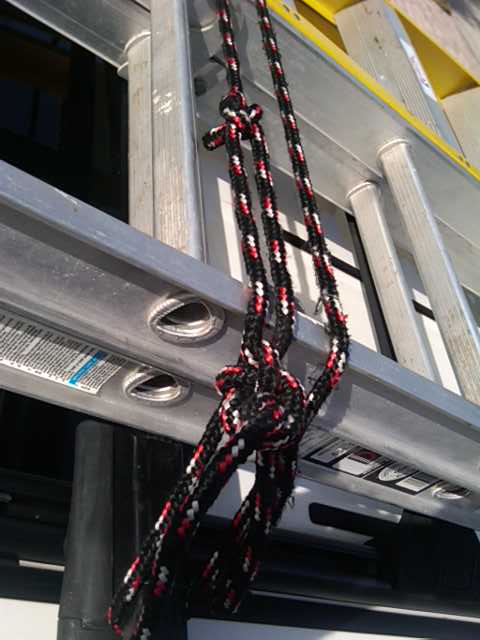
Here are some rope techniques I’ve used over the years w/o problems… Not saying this is how to do it. Each person needs to take responsibility, based on skill, material, equipment, type of rack, conditions, laws, etc., for assuring that their load doesn’t come free. I will say that, after securing, the ladders didn’t budge… Also, I no longer use rope. I use straps… That’s for another post.

  1. First photo is the trucker hitch w/an improved bellriinger as the loop knot. The improvement is that instead of two half hitches at the “top” of the loop, there are two. I started using this improvement for the first time when all I had was pollypro and continued using with other types of rope. Also, the knot is finished by a slipped half knot with an additional “half-knot” to lock it. Hard to see in the black line but it’s all I had handy.

  2. Anchor side of truckers hitch. Note wide part of step ladder is positioned aft.

  3. Photo of two truckers hitches; top one uses a butterfly loop; bottom one the improved bellringer mentioned above.

  4. Cinch strap made with a bowline in the end. Note doubled line over the load.


Cinch Strap Technique wBowline.jpg

Thank you Salty Cracker! I know several others mentioned the Truckers Hitch before you did, but you brought pictures to the table…which is exactly what I needed. I did google the TH and saw people tying it, there does seem to be a couple ways of tying it and securing it I guess.

I’ve got to figure the TH out, it’s one of the hitches I haven’t learned out of my book yet. The TH will be my method, I’m not buying more chords, bungies and lockdown straps(I hate these anyway). Thank you everyone for the comments, suggestions and well thought out responses. I look forward to being a member here, just get ready for some novice type questions and responses lol.

For roof mounted equipment, canoes, kayaks, ladders, folding tables, etc. I’ve switched to using tie-down straps with metal buckles. They still provide a 2-1 type purchase, like the tautline hitch, but are quicker. The first set came with my first kayak. Been using ever since.

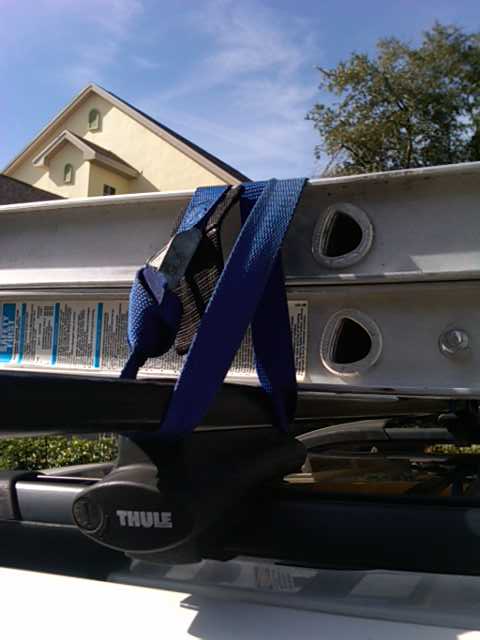
First photos are commercial, non-ratchet type cinch straps with two techniques that can be used for securing ladders to the rack. (Again each individual is responsible for assuring that their tie down prevents the load from coming free.)

  1. First photo shows wrapping one lead (taking a turn) of the strap over both ladders where their rails lie next to each other then under the rack and back up.

2&3) Second two photos show individual wraps (round turns) around outside rails of each ladder to add security in holding each ladder from sliding forward.

  1. Fourth photo shows straps used to secure a canoe & kayak… The canoe is secured first with the blue straps, then, the kayak is secured with the green straps over both the canoe & kayak. After tightening, grab each boat, one a a time, then push, pull, & shake the stew out of it, re-tightening as necessary until neither boat budges. For trips beyond the launch just down the street the bows of both are tied down as well.

Notes:
A) Straps, since they are flat and expose more material to sunlight, tend to deteriorate more rapidly than round rope.
B) Make sure that the straps lead through the buckles in the right direction. I’ve seen Scout leaders run them through backwards. If someone helps you… check behind them. Straps do not hold if run through the buckles backwards.


Cinch Strap wDual Anchor Wraps 2.jpg

Never saw that version before. What kind of knot was he tying to make the loop?

And…moving even further away from knotty solutions…
http://www.priceinspector.co.uk/p/Ladder%20CLamp/f/desc,True/

alpineer

Alpineer,

Now THAT I like! Thx…

SR