X: regarding what I meant by cow hitch, just tie the one in my picture and slide the tail loop around to the other side and up through the nip to the standing end. Then you will see. It’s ok, but it’s not as good IMO. I don’t like this potential to slip up to the collar position, so I’d keep it flipped over to the outgoing eye leg side.
Your answer about 3 vs 4 seems contradictory. I think you’re saying 4 is theoretically better.
alpineer: I didn’t mean quirky in a bad way, but I don’t know why you push him so agressively about this. Some people think B&W provides more contrast, depth, maybe focus on form, than color does. I assumed it was something like that.
X: I appreciate the arguments about the nipping u-turn. I guess I just don’t appreciate it as much until I get used to it. The TDB doesn’t need the end to hitch to anything except for slack security.
You mean :
2) Tie a double-line bowline
3) Tuck the two main loops through the “tail loop”.
Now, this knot has two problems : First, it has a 'lower" colar, around its eyelegs. Not good regarding ring loading. Personally, I have dismissed many much simpler TIB bowlines, just because they have this 'lower" collar. See, for example, the “Coming and Going”/ Jug sling bowline, and the Sheepshank bowline : http://igkt.net/sm/index.php?topic=4336 http://igkt.net/sm/index.php?topic=4680.msg30256#msg30256 http://igkt.net/sm/index.php?topic=4680.msg30260#msg30260
Of course, one can always “flip” / push this collar “upwards”, and transform it into a collar around the Standing/Tail Ends. In that case, you should add :
Push the “lower” collar ( the collar around the eye legs ) “upwards”, so it becomes a “higher” collar ( a collar around the Standing / Tail End ).
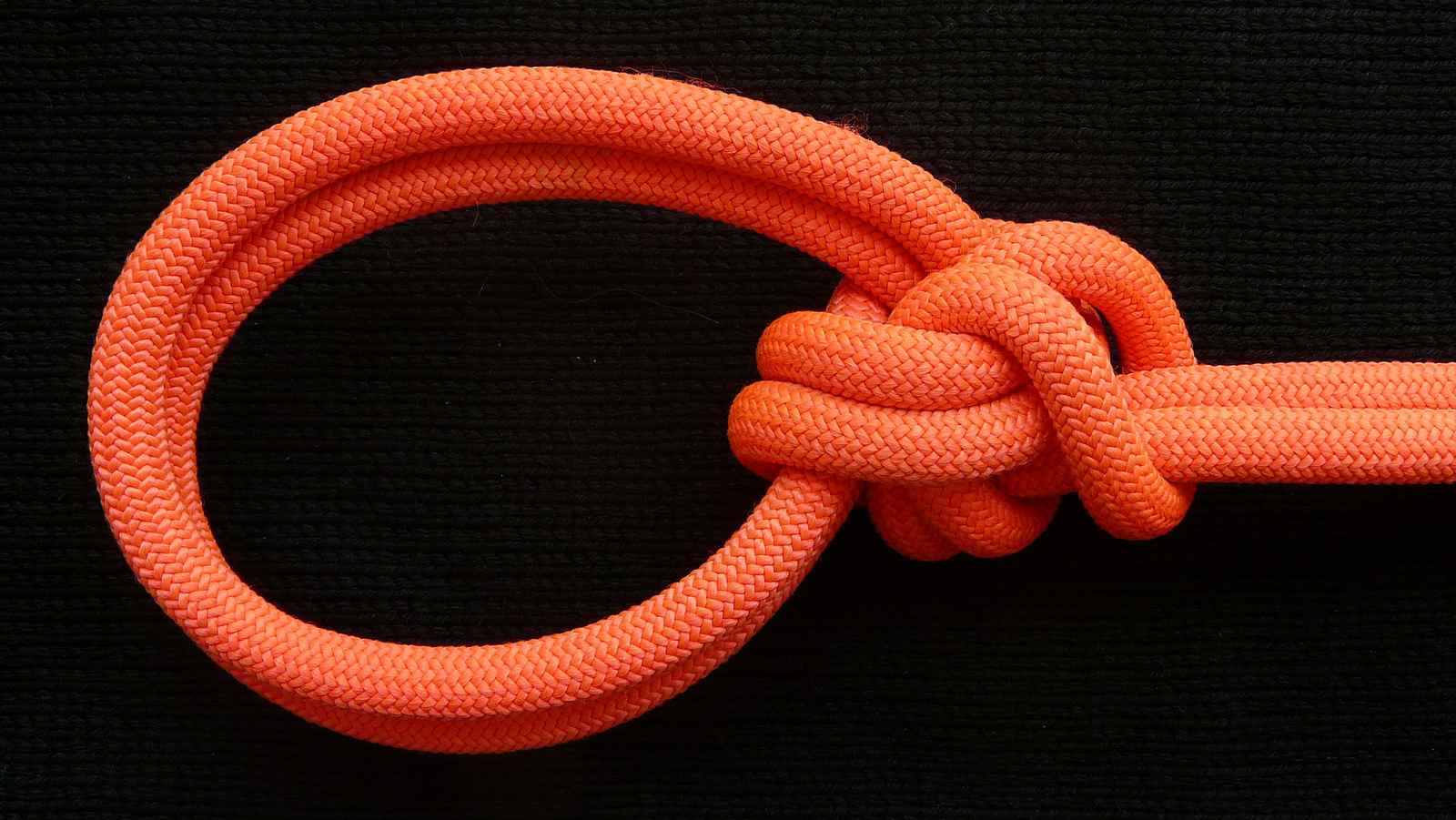
However, the second problem remains : this is a disproportionally ( regarding the benefits it offers ) bulky knot, which consumes a lot of rope-length. ( See the attached picture ). Its advantage is a very wide, four-rope diameters nipping loop, a compact/dense, globular and stable nub, and the straightforward, conceptually simple and easily learned and followed TIB tying method.
All of these are big knots using lots of rope length. I don’t think one version, so much more so than another for situations where you’d be looking for one of these.
Tie this, tail-collared bowline-on-a-double-line and the return leg u-turn version both before talking about the ring loading difference. Again, I think, depending on how you configure the ropes inside the nip, you might be surprised how similar they actually are. And I think when you ring load it, that configuration I mean will emerge anyway.
What happens is inside the nip, the lower “collar” parts/splits around the outgoing eye legs. This is especially true for the cowboy version where it basically doesn’t go go around those at all, but just emerges to either side of them from within the nip. It is not collared. That’s why it’s hard to tell the difference in the versions. The only difference is if the lower collar legs emerge on the same side of the outgoing eye legs, or on opposite sides. Either way, they don’t go around them.
Furthermore, there is no need to snug this end-loop up tight. This is two bowlines, those are its tails. The only reason it even needs to be looped around something is to give it slack security.
So as has always been true I think, use the cowboy version for ring loading. That doesn’t bother Tex at all.
I agree with your basic points about the purpose of the collar and I also agree with you, over D.L’s objection, that, in a normal bowline, the nip cannot work if there is no friction on the tail going through it. I haven’t convinced myself that some of these knots you show keep the nip doing its job well instead of cheating by overloading the collar, or the secondary collar formed by the end loop. Yes if that end loop torques the nip the correct way, it might work even better than a bowline (but not exactly the same as the bowline), getting a higher ratio of nipping force to collar tension, so I should play with it.
No, the loop shown at Reply#6 is not so big - it is only slightly bigger, and uses slightly, only, more rope-length, than the standard bowline-on-the-bight - which has the smaller volume of all the double-eye bowlines !
Tie your variation, with the “tail loop” retracted as “high” into the nipping loop as possible, and post a picture of it ! Descriptions of knots are always vague, and often misleading !
Yes, it’s more rope than a standard BoB, but I’m not using it to tie to a tarp eyelet. I’m using it because I need to wrap some rope around something. Still, you’re right.
Actually for this particular knot, so close to a bowline, I can understand the words better than the pictures (which I have to stare at quite some time to actually be sure about)
I just tied yours the “right” way (probably your way), standard instead of cowboy and it grows on me, but the tying method is twisting my head inside out. I’m sure I can get that wrangled down for, but the tail-haltered version will be more easy to remember and for others to learn. They’re both nice knots.
I did, and that is why I know that this knot, too, can be dressed in more than one ways - as it happens with all double-line knots ( the fig.8 eyeknot included ). They can be dressed in many ways, and, often-times, they can be dressed in ways we do not predict/expect/realize ! As I had mentioned time and again, those knots are the not-self-dressing-knots par excellence !