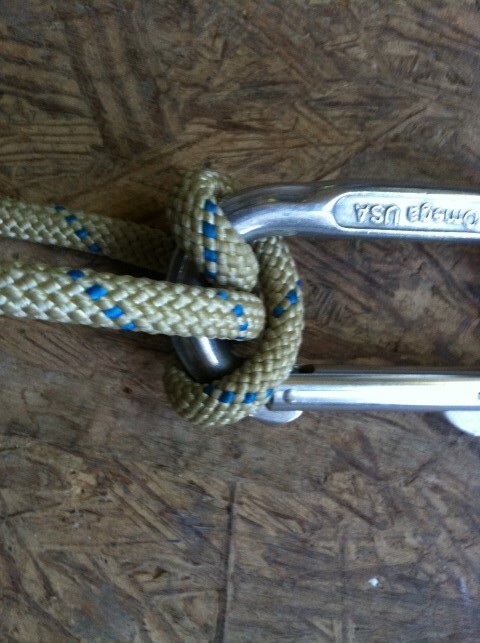
I was wondering what the influence was of the orientation of the crossing strand in the clove hitch on the knot’s behaviour and strength in the situation where both strands are loaded, as shown for the bottom biner in the clip.
See attached photo’s for the two situations.
The crossing strand on top is the situation closest to that of a single strand loaded. However, the two loaded strands pinch on the crossing strand.
Possibly this pinching might be relieved in the situation with the crossing strand at the bottom, where the two loaded strands pinch on the biner and not the crossing strand.
I am curious whether anybody has insight into the up and downsides of these two situations.
The crossing strand on bottom seems initially to be more secure because tighter grip, but that is just until there is slack at one of the strands, then it probably flip - that is not so secure any more [tested with small cotton thread onto slippery metal].
It is my opinion that the clove hitch in the picture named “crosses on top” is the preferred orientation. This tying method snugs up tightest when either loaded part is tensioned.
I have seen the opposite orientation loosen and develop wings as shown in the attached photo. These parts, when loose, can work their way over the gate and potentially open it when the tension is suddenly and unevenly applied.
Thanks for the clear exposition!
It was something I observed already myself when I jiggled the knot around, and it fully explains why the use of the clove hitch in such a setup seems not to be described anywhere.