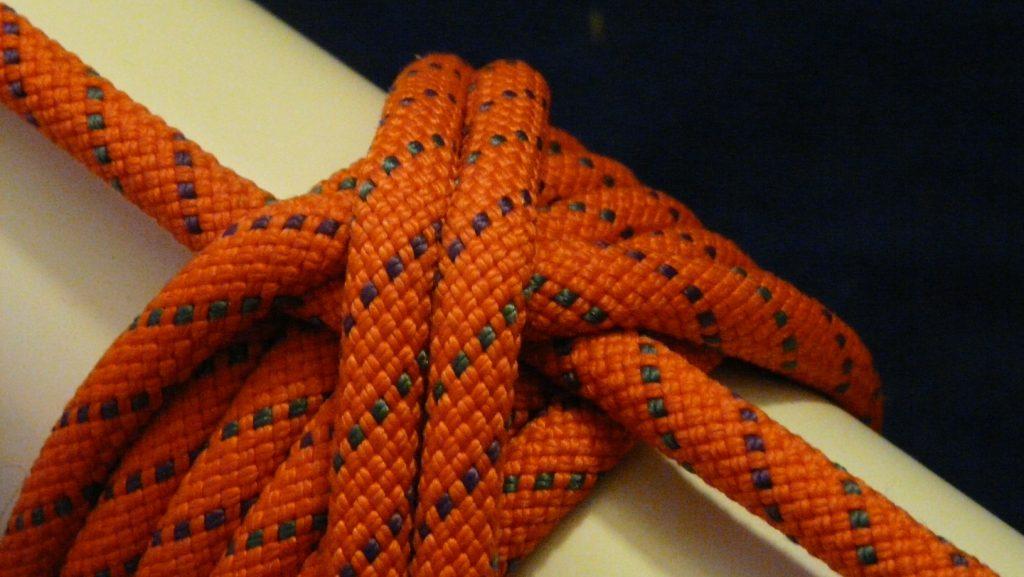
hi, isn’t the ossel hitch similar to gleipnir?
You are showing a reverse ossel hitch (should we want
a name for it). With the reverse loading, the nipping
comes of rope-on-rope, and so is independent of
the hitched object, though not as slack-secure as
the ossel hitch (presuming it to be on an appropriate
object --not one too big).
And, no, I don’t find these similar to the gleipnir binder,
though I suppose one could see the ossel as also
suitable for binding, albeit rather peculiarly small-sized
objects!
–dl*
It is easy to tie an ugly knot - what is really difficult, is to tie an uglier knot than this… 
As I understand, you are looking for a tight hitch, able to withstand a lengthwise pull, where the standing end is parallel to the pole s axis.
There is an inherent problem in this : When the standing end leaves the knot s nub being parallel to the axis of the pole, we can not pull it forcefully enough ( in order to pre-tighten and 'lock" the hitch around the pole ). On the contrary, when the standing end is perpendicular to the axis of the pole, we can manage to pull the standing end against the pole , while, at the same time, we leave the rest of the knot undisturbed - i.e., we do not pull and change the orientation of the knot s locking nub itself, something that could loosen the tight grip of the hitch on the pole. With tight hitches where the standing end is perpendicular to the axis of the pole, one can even use his two hands and feet to pre-tighten the knot on the pole - but he must be careful to not load his spinal cord ! ( I was not… :))
See the attached picture for some not-so-ugly hitches, with standing parts parallel to the axis of the pole.
The truth is the exact opposite ! Of course, if you want to have as few round turns as possible. With maaany round turns, you do not need aaany hitch ! We should only compare apples to apples, i.e., hitches with the same number of wraps. To be able to enhance the ability of a given number of wraps to grip a given pole, the only thing you can do is to have those wraps pre-tightened as much as possible. Knot tyers have not paid much attention to this, because Ashley s chapter on hitches is very poor, indeed - but we should remember that Ashley is dealing with manila ropes and wooden spars, where friction forces are much higher. (1)
So, you should tie it some more times … A not-very-tight, loose hitch that slips along a pole LESS than a very tight hitch ( with the same number of wraps, and on the same pole, of course ! ), uses GLUE ! KnotGod does not intervene in the workings of his creation - so I can not see what will make the one to hold and the other to slip… By the same token, the only way to loosen a hitch, and enable it to slip along the pole without removing one or more wraps, is to loosen them. If You do the opposite, It does the opposite, but you should always compare apples to apples, same number of wraps, same pole, same load, same direction of pull, etc. - in short, ceteris paribus.
If you are speaking about the Double simple-hitch-la-Gleipnir, I have seen that the second turn, that makes the “nipping tube” longer, offers more room to the standing part / tail twist - so those two segments embrace and remain tightly attached to each other, squeezed upon each other by this longer “nipping tube” and by the pressure coming from the surface of the pole. Remember, the simple-hitch-a-la-Gleipnir is superior to a simple Gleipnir hitch only if it is tied around a round object of a relatively small diameter.
That was my point at my previous post.
Yes, we can see a mechanism of self-locking here, because the oblique, long helical standing part goes over the round turns and squeezes them on the surface of the pole, so the friction forces between them and the pole are enforced. You can see the same mechanism in the multi-coil Clove hitch ( which is very simple, yet very effective in lengthwise pull ), or in the multi-coil Double Strangle ( shown at the attached picture). ( In those hitches, the oblique elements play yet another role : they squeeze the round turns and the standing part and the tail the one upon the other, so any pre-tension that will be inserted into the nipping coils during a pre-tightening phase will remain there, even before or after the final loading).