This seems to happen if the rabbit loses his sense of direction and goes the wrong way around the tree, which shouldn’t be too surprising seeing as this rabbit is already very confused to find himself going around a tree after having just gown down a hole. The interesting thing is that either way around he goes, his result path has remarkable symmetry.
Well I can’t tie it through or around something in the bight obviously. You can tie it in the end. I don’t get the big warning. It’s not a great TIE knot because going the wrong way around the tree does result in the box stitch loop (which isn’t so bad), but it’s not the only knot anywhere that can be tied wrong.
Hey if it makes you feel any better, both of your flat layouts told me all the same information for either TIB or TIE. Once you’ve tied a few of these the transformation of this information becomes pretty immediately clear, other than maybe getting confused about the direction around the tree, a type of information that our brains, or mine at least, do not seem great at holding on to. The problem of course is that you must find a reference point to remember it from. I think our brains are well adapted to remembering how to go somewhere, but it is rare that we find ourselves needing to follow directions around a mirror symmetric city to our own.
If you can not distinguish how to tie a common or an "Eskimo" bowline ( and you still see rabbits and trees... :) ), please, do NOT tie this loop !
I can distinguish those just fine and I think if you cannot distinguish between simplistic and playfully expedient speech then you should not respond to others with your (mis)judgements about their thoughts.
I will tie whatever knot I please however I please, and it pleases me to tie this one in the end. I also don’t need your warnings to figure out if I’ve dressed a knot into a different manner or form. I happen to have two functioning eyes (which informed me of the error, but not the error you seem to think, maybe because you don’t know how to tie the knot I describe) and I am sorry for those who do not. I also don’t engage the brain on every single turn of every single knot, because a, it’s not always necessary, b, it’s just a knot, c) the brain will engage anyway in a second or two when the eyes alert it.
By the way xarax it seems pretty clear that you find this knot much harder to tie in the end than I do, because I don’t find it to be very hard. Yes, if the hands are left to run loose for a moment without thought or practice there are some wrong ways to possibly do it, but I don’t find it to be such a monumental challenge, or really any challenge at all, as you seem you, which seems a little ironic to me, wouldn’t you agree?
When you will start tying a number of TIB knots using it, you will see that you would prefer it over any in-the-end method. As I said many times :
I have tied a NUMBER of TIB loops using it and you continue to make assumptions. I also am very aware of the correspondence between the steps needed to tie a TIB loop this way (even one I’ve only just seen) and the steps needed to tie one in the end. Maybe you are not. Tied TIB can still not pass the loop through another loop or a around a pole with fixed ends. Not everyone use biners for everything.
Well, I cannot speak for them either nor you for me nor can anyone really even speak for themselves as sometimes we get things and sometimes we don’t and with no clear for reason. This is actually a very well studied aspect of neural networks which all humans posses. What I know is I am very capable of getting such things, have in many other cases, and that certainly in this instance I do. I cannot promise to never be confused over such a thing at a later date and mental condition. Nobody can. But I will not forget what this PARTICULAR knot looks like dressed correctly vs incorrectly. As I already told you, I have seen it both ways.
Rather than calling it “identical”, people have noticed that the loop capsizes into the common Farmer’s Loop when the loop is unloaded and the parent line sees tension, as often happens in applications involving midline loops.
Surely you must have experienced this by now.
As for the TIB preview representation vs fully tied 2D representation, the ONLY difference on which side of the knot (usually SE) the end of the collar resides. That you cannot imagine that I might be able to imagine the loop of the collar being on the other side from one representation or the other, is very unimaginative of you.
If anything, the issue of how to dress it seems more ambiguous in the un-collared version, at least to my neural network but in either case is equally easy if you know which dressing you’re trying to achieve. I did not see anything in posts indicating that anyone thought the two ways of dressing it were the same dressing. Tying it in the end can be more “difficult” I think but not for the reasons you’ve stated.
When “the loop is unloaded” ? Wake up ! This is NOT an inline loop ! Does it look to you like such a loop ?
Oh, my KnotGod, what people “notice”, when they try, desperately, to deny the OBVIOUS !
Instead, they should do something else ! Or enjoy what they are doing, as they are doing it ! ( That is what I do, with ping pong… :))
LOOK at this loop ! I had provided many clear enough pictures, taken from different angles. Does it seems to you like an inline loop ? Does it seems like the ugly tungly Farmer s loop ?
I tied a loop that can be loaded by EITHER end, NOT by BOTH ends AND remain unloaded in the same time ! The PET loop ( which the Plait loop replaced in my pantheon, because it is not only PET, but also PETEE ), was also meant to be such a loop, which, if it was loaded only by its ends, and remained unloaded AS A LOOP, would deform into something else.
The fact that the Butterfly loop can do what you describe, does not mean that all loops should be able to do the same. The Butterfly loop, for example, is not PETEE, not even PET ( because it is two merged slipped overhand knots ), and so becomes difficult to untie after heavy loading.
Surely you must have experienced this by now… 
( Note : I had said it once again, but I will not say it again ! THERE IS NO “PARENT LINE” IN THIS LOOP ! It is symmetric, in structure and function of both the crossing knot that make it, and their limbs )
I think this is as close as we’re going to get to xarax admitting that the loop is a form of the Farmer’s Loop.
Aside from this, the very fact that the loop is presented as tied-in-the-bight and either-end loadable indicates that there is plenty of rope going in both directions that could therefore easily transmit tension before the loop sees load, even if this tension is unintentional, again causing the loop to assume its Farmer’s Loop origin.
I never noticed anywhwere where anyone in any comment seemed unable to recognize the different forms as at least differences in dressing. At most there was disagreement about the significance of the difference, either at a given moment or on the whole due to things like this capsizing. I find xarax’s false implication that anyone could not distinguish them, using this to defend his justification for arrogance and assumptions about the thoughts of others, I found it to be a backhanded jab at others weakly disguised as a compliment (maybe because even this, being better than greats, helps his own ego all the more).
It is not - as the Farmer s loop is not a form of the Plait loop, as you should say, if you believe in what you say !
You have not understood a thing about what I am saying all this time - difference of “topology” and “geometry”, remember ?
If you can not distinguish between them, ask Tex to help you :).
I wonder, do you consider yourself “a form of” Ashley ? The same kind of atoms, recombined in a slightly different way…
What one can discover ( or should I say : invent ), if he tries as hard as you to persuade himself !
The previous sentence is monumental ! A great piece of knotting litterature !
I dedicate it to Tex ! His neural networks would be able to digest its nonsense ( even if they can not digest his hormones), I am sure !
( Just edit it a little bit, because the word “directions”, the last time I looked at Google s translator, means something else… Both ends are going to / coming from the same direction. Wake up, or stop pretending you “see” things that do not exist ! The ends of this loop go to the same direction, it is not an inline loop, tied in the middle of a tensioned line, where the eye can be loaded, or not. )
Oh, my KnotGod !
What is the point of a knot being tie-able (un-tiable) from either end without a relic, if it is only to be tied in (at/near) the end of the rope (but never with the end of the rope, unless you’re a knot god like xarax)? Why, if I have the tail in my hand, would I ever untie the knot using the standing end, and if for some reason I did, then how could I still possibly care about the relic, being as now neither end of the rope is attached to anything, and both are now in my hands?
: Once again, I did not say this.
You did not say anything ( that makes sense…) !
You wrote this nonsense :
My Google translator tells me that “midline” is somewhere around the middle of the rope, that is, not near its ends. It does NOT mean the middle of a straight, tensioned by both ends line, as you thought when you were young, and you were parroting ABoK#1049 - ABoK#1056…
And you wrote ( you carved in marble ! ) this monumental piece of knotting litterature ( or should I call it “knotting poetry” ? ) :
However, you have not presented the knot whose the common bowline is the “origin”(sic) of, by loading it ( the bowline ) from both ends, and forcing it to capsize, while the eye remains unloaded. If you do this, “people may notice to what common knot the common bowline capsizes into” !
Do it, for the left-handed AND for the right-handed bowline… You may learn something !
I have presented many “new” knots in the “community” of this Forum - and I believe that some of them are interesting (1). However, in most cases, what I had received, as a feedback, was either SILENCE ( a term describing the results of ignoring, snubbing, etc ), or irrelevant “criticism”, like the nonsense I had received in this thread - together with some “polite” words of encouragement, by members of the “new” generation !
It is amusing what people may invent, to tell their own thing, to themselves and to an absent audience ! The new case is eye-opening, indeed : Follow the “reasoning” of roo, for example : Because a TIB loop can be tied with long ends, it can be loaded by those ends at the same time, by pulling them towards opposite directions, either intentionally or by accident, while the eye is not loaded. If that happens, and this loop capsizes into something else, it is something else s “form” ! Therefore, the Plait loop ( which looks like a plait ), is but “a form” of the Farmer s loop ( which looks like the farmer s, or the farmer cow s,… whatever ). A plait is “a form” of a …whatever ! ! By the same token, for example, the slipped overhand knot is but “a form” of the straight line ! I do not know if one can become a real knot tyer by reading those BS, but he can become a real philosopher, that is for sure ! All are One ! Peace on Earth !
The interesting thing is that those people who tell those things, pop out in the threads I initiate only when they invent such a BS, by which they believe they will force me to post only in the “Fancy and decorative” knots Forum ! Because they wish to keep the practical knots Forum as their backyard, or their store, where they can do whatever they like, or whatever makes some pathetic $, by themselves and for themselves…
Shifting the goalpost may be a useful manoeuvre for a politician, who wants to mislead his audience. It is NOT for a supposedly knot tyer, who, supposedly, is interested in knots as tools ! To try to convince yourself, and an non-existing audience, that a tool shaped like a plait, and a tool shaped like a …whatever ( that is, close to “shapeless”, or even worse… ), both do the same job, and that the one is “a form” of the other, is funny, but dumb nevertheless - and maliciously wrong, I would say. Who is the “stalker” of whom, I wonder…
I might favor “PET-2”, but now see the problematic
case of PET but not-PETEE but PET & EEL. I wonder :
why would one need PET-2 if not EEL ? (I.e., although
you can tie it with the tail, you cannot load the tail.)
Still, one might just question “PETEE” : a possibility,
but why have it, why use it --i.e., why not tie it PET-1
and be done, the -2 unneeded. Is one going to be given
rope coming-from-station-A such that you want -2 loading
for that, and will take finished other-end away for -1 loading
–and so you do need to tie it backwards, as it were?
(In contrast to just having the completed knot that
is EEL and not caring which end is which.)
IMAGES : from the side showing better the “plait”,
you have done some fine decorative knotting!
(If it is better to have as many characteristics as possible,
take the eye-appeal, too, then!)
I’ve seen plenty of “art” of late, and can see this particular
OP triplet of images --orange on black, pale yellow on maroon,
and grey-white on charcoal-- as much more satisfying and
pleasing than a great deal of what passes as “art” (anyone
for one of Koons’s Balloon Dogs, or a Hirst shark tank?
–or, just the X. backgrounds ALONE!!) !?
Maybe where this put as a triptych with graduated tightening,
closing of an exploded image, it would enhance the repetition?!
It could hang as seen here, vertically, or horizontally.
(Separately framed, the buyer can orient as she pleases.)

Right ! So what do we do ? Should we use only PET-2, and suppose that, most of the times, it will be EEL, too ? ( Notice that it can be PET-2, but, when loaded by the “other” end, it may well become unstable, it may deform, and even slip. The most symmetric, and so EEL loop that I know, is the Tweedledee bowline, shown in the attached pictures (1) - but agent smith believes it is too complex for climbers… Also, although its nub is made from two interwoven links topologically equivalent to the unknot, their 8-shaped form bothers me a little bit - their geometry is very close to the geometry of a fig.8 knot, and so I suspect that, under heavy loading, they may clinch around each other more tightly than we would had wished.)
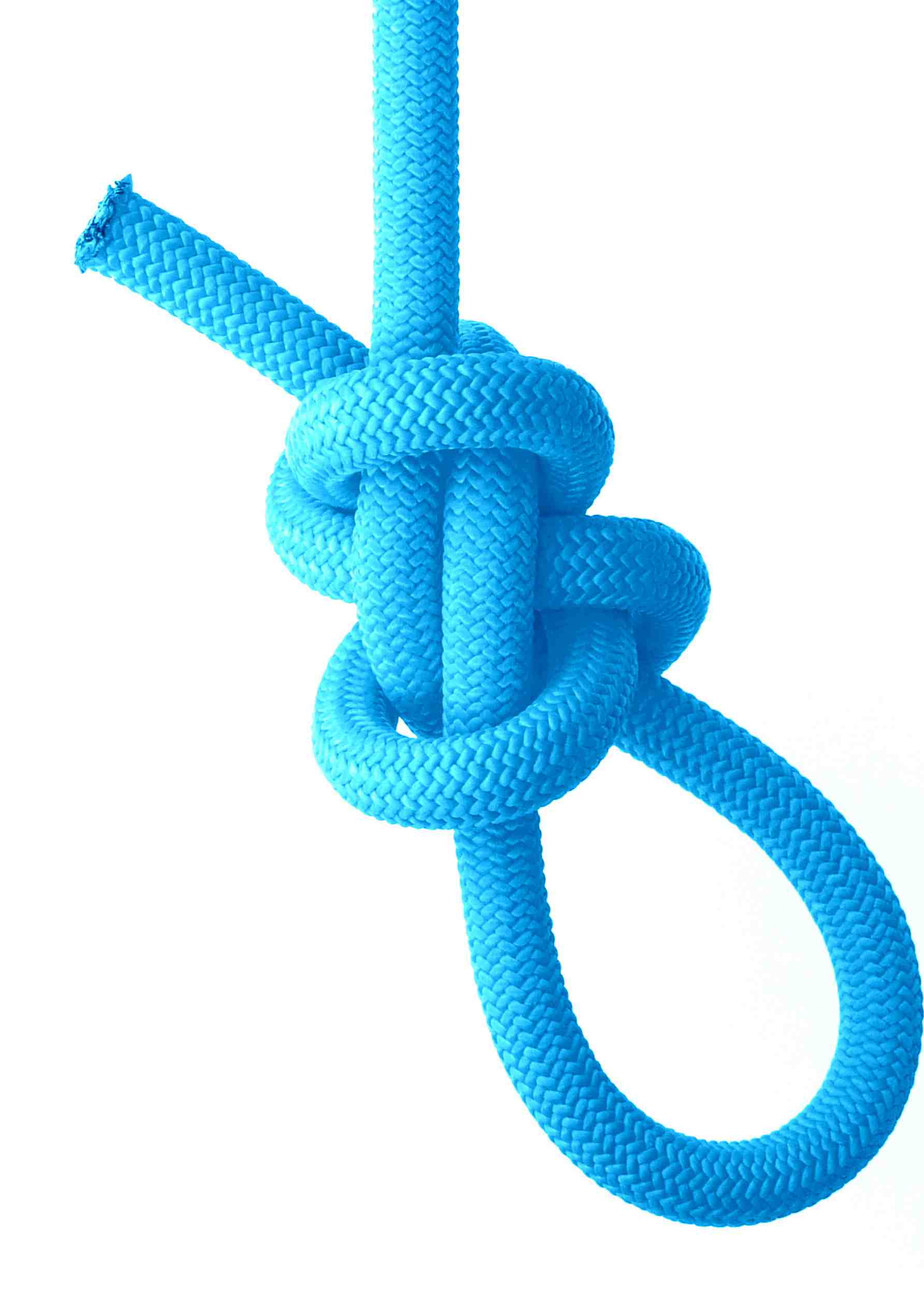
Imagine the eyeknot as a “relic” knot :), tied in the middle of a loose / unloaded line at a certain time, and waiting / wanting to be loaded, by the either end, only later - in other words, the knot may be tied before it is decided how ( i.e., by which end ) it will be loaded. If we do not know in advance, for whatever reason, which end will be loaded, we can not decide relating-to-which-end it should better be tied as PET- so it would be great if it is PET regarding both ends.
However, as I had explained in previous posts, there is yet another reason for a PETEE / PET-2 : I have seen that the knots which are not equivalent to the unknot, as the overhand knot and the fig.8 knot, under heavy loading, tend to clinch around themselves too tightly, and become difficult to untie, even of it is tied on the continuation of the returning eye leg ( as a 'collar structure" ). Therefore, to-be-sure that an eyeknot is easily untiable, it is a wise choice to avoid attaching the continuation of the returning eyeleg to the Standing par ( after / post the eye ) by an overhand knot or a fig.8 knot, or any other knot which is not topologically equivalent to the unknot, and prefer an “open” knot, which is topologically equivalent to the unknot - just as we did for the knot tied on the continuation of the Standing End ( before the eye ). If we do this, we have an eyeknot nub made from two knots interlinked to each other, which both are topologically equivalent to the unknot - that is, we have an eyeknot which is PET regarding either end.