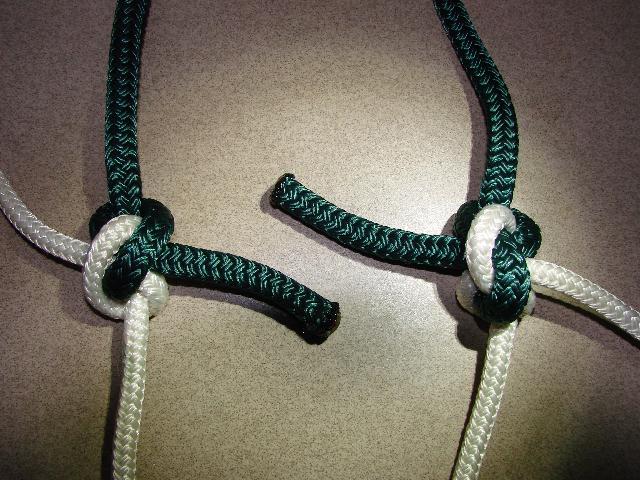
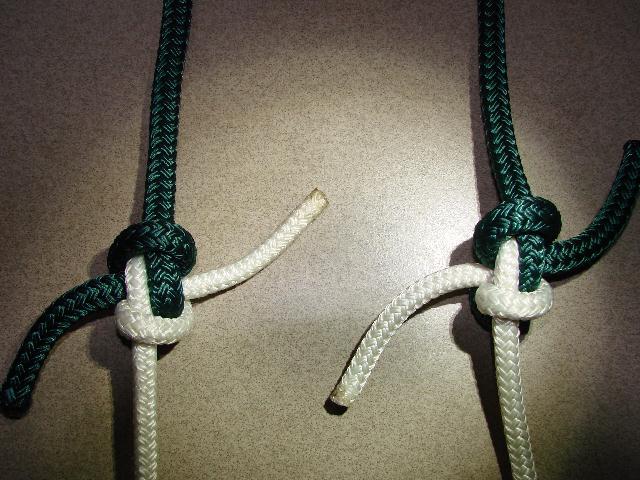
Apparently you’re replying to a vaporized post showing
simple knot misidentification, tsk tsk.
But, no, the “reverse” side is NOT the same --tie SmitHunter’s bend and see how it differs
(using differently colored ropes, that is!).
If you lay this knot next to the ABOK 1425a (Hunter's/ Rigger's bend)
one can appreciate how they are different.
But if you nix the “a” and compare this to Ashley’s #1425
–a much too ignored gem–, you should see their likeness
(and, overall, I think I favor Ashley’s). Mr. Gray (?) submitted
this end-2-end knot to the IGKT’s New-Knot Claims Assessment
Committee some decade or so ago; so, you have company.
It’s a natural result taking #1425 as a stimulus; and you
might play around with alternative exits of the tails vis-a-vis
themselves (something rewarding for SmitHunter’s, too!).
... on quick inspection this looks somewhat similar ...
[but] look at them side by side and I think you will be able to appreciate the difference.
I guess he did. (Before he got a citation like SS369 did!)
I’m still looking for all these proven uses of the zeppelin
–esp. after the one supposed to have spawned it was said
to be a myth! One might be chary of the looseness of the z. and favor Ashley’s #1425 for its tightness when set.
Or because one found it stronger, albeit slightly (as though
this could matter!). And I continue to be amused at the
worship the butterfly gets as an end-2-end knot when
Ashley’s #1408 is “clearly superior” --i.e., at least symmetric
and otherwise a match!? (Though we might find that some
orientations of the former make its asymmetry into a charm.)
The carrick bend is apparently favored by the rugged Alaskan
crab fishermen to join pot warps (when one line’s not enough);
I think that they might fancy the zeppelin (or #1452 [nb:
fifty-two, not twenty-five, here]); but maybe they take the
precaution of taping the carrick’s tails together --the sort of
securing I find in much east-coast commercial-fishing knotting–,
and then the adjacency of the tails is a plus.
Not every ends-joint is wanted to be (easily, or at all) untied.
The fisherman’s knot is de rigueur for much com.fish. work,
for it stays tied, is strong, presents ends along SParts for
easy securing, and is compact. Nobody in this business would
want any of these other end-2-end knots over the fisherman’s;
the dbl.harness might get some attention, though.
And, really, we should all ask : where do you get ANY indication
of the zeppelin bend’s strength? For the lack of evidence,
there is a LOT of noise out there, it seems to me!
Alaska crab fishing is even more dangerous than logging ! ( they are the two most dangerous occupations in the World - knot tying should be the least dangerous - but I do not know the dangers of “writing to a knot-tying site”=" trying to speak to knot-tyers"… Judging from my blood pressure when I read some “comments” coming from the bottom of this day s or last night s alcohol bottle, I reckon they are NOT negligible…
Tell us, great Alaskan crab fisherman, do you use the common Carrick bend, or the Carrick X bend shown at (1). Because I cannot imagine you pay any attention to the exact way the tails will be crossed, if you tie it by capsizing the Carrick s mat.
In the one passing glimpse of the tying (or so I think it was),
they had two men doing it, one holding one end folded into
the crossing-knot (“Munter”) form and the other reeving into
that the 2nd end --a tying method that allows further variations!
But I surmise that they went for the usually recommended version.
(The line is hard-laid, so capsizing the lattice form could be tough.)
Thanks. Is nt it strange, two people tying one knot ? ? It would need some precise (4 ! ) hands manipulation, and a good synchronization ( but that is not something those men are not accustomed to ! ). With some springy ropes, I find it difficult to tie the Carrick bend by myself - and there is no heave+sway+surge+roll+pitch+yaw of the floor ! ( not any sub-freezing temperatures, ice falling from above, etc…) ! Why are they tying those knots this way ?
[But, no, the “reverse” side is NOT the same --tie SmitHunter’s bend and see how it differs
(using differently colored ropes, that is!).]
The knot originally presented and the SmitHunter’s bend (#1425a) are the same on the ‘reverse’ side. Depending on how it is tied, one can produce enantiomeric (mirror image) forms but these are alternate representations of the same form. This knot differs from the Hunters’ bend (#1425a) on the ‘obverse’ side in that the parallel strands (Hunter’s bend) are wrapped around each other (forming an overhand knot).
[But if you nix the “a” and compare this to Ashley’s #1425
–a much too ignored gem–, you should see their likeness
(and, overall, I think I favor Ashley’s). Mr. Gray (?) submitted
this end-2-end knot to the IGKT’s New-Knot Claims Assessment
Committee some decade or so ago; so, you have company.
It’s a natural result taking #1425 as a stimulus; and you
might play around with alternative exits of the tails vis-a-vis
themselves (something rewarding for SmitHunter’s, too!).]
The difference between the bend originally presented and #1425 is that on the ‘obverse’ side the ends exit ‘thru’ the overhand knot in #1425 and ‘below’ the overhand knot in the presented bend. So I agree, there is a similarity to #1425 although they are different. #1425 is more difficult to untie which may be an advantage/disadvantage depending on the circumstance. Thanks!
I believe they are called enantiomorphic ( enanti = other, opposite side / opposing, morphi = form ).
They are called enantiomeric ( enanti + meri = composed by parts ) only in chemistry ?
Hi Matt53,I apologize in advance for how(and also for how incomplete) I am going to write
The falsely tied Hunter’s bend (or false Zeppelin) is so symmetrical that the reversed version is the same (other bends have this feature, for example the Hashley’s and the Double Harness with parallel ends);this knot can take two different forms: one similar to real Hunter’s (in this case, the difference resides in the fact that the standing ends are not interlinked), the other similar to ABOK #1425(in this case the difference lies in the fact that the standing ends are not crossed).In this thread http://igkt.net/sm/index.php?topic=4201.0 X1,for as I perceive,shows that such operation can be carried out also with the Hunter’s(given the similar geometry/symmetry);and you consider that the bottom side twist falsely tied Hunter’s bend http://igkt.net/sm/index.php?topic=3204.msg19170#msg19170 is the same of ABOK #1425(but if you run an ABOK # 1425, and then instead by the standing ends you load it by the tails, you may see a falsely tied Hunter’s with crossed tails!).
Luca, No need for apology. You bring up a good point- the falsely tied Hunter’s bend ‘becomes’ ABOK #1425 when the free ends and the standing ends are reversed. This does not seem to be the case with the knot presented in this thread or with the standard Hunter’s (#1425). Both of these seem to ‘pull apart’ when the free ends and standing ends are reversed.
Enantiomer(ic) is from Organic Chemistry (a long time ago for me!). I agree, enantiomorphic is probably a better term. My reference on enantiomorphic links it to crystal structure so perhaps there is an even better term out there!
I did not want to say only this(did you see that I have explained myself badly? Now maybe I explain even worse! So I apologize again!):that the falsely tied Hunter’s bend becomes(almost,as can be seen from the diagrams shown in the interesting thread linked by X1,an interesting story on logical consequences that I want to reread carefully) ABOK #1425,when the free ends and the standing ends are reversed;but more I wanted to emphasize the fact that there is no need to perform this operation in order to the knot assumes the two different forms(the one similar to # 1425A, and the other similar to # 1425):if you tie a"Falsely"as appears here(the simplest version):
you obtain the"1425-like"form.
However, once loaded, the bend has a tendency to take this form, but this not happens in a complete way without a manual intervention, because the knot jams before the process is completed,taking a"middle way"form.
So, for as I perceive, the Falsely, this jamming and poor knot, which is neither meat nor fish,unstable/bistable,is"conceptually"the real basic knot ,from which we can start to make other versions:
If you want that this basic bend spontaneously takes the"relieved collars with’parallel’ends"form before it jams, then the bottom side twisted version is for you(= #1425).
If instead you want to prevent this from happening, wanting to get an unjamming knot that keeps the “Hunter’s-like” setting,the top side twisted version(the knot that you present) is the solution(I know that basically I’m not adding anything to what one can read and observe in the threads linked above by X1 and me).
Given the similarity between the geometry of Falsely and that of the real Hunter’s , I might even venture that the Hunter’s is an interlinked overhand knot version of the former,but frankly I would not pushing me this far (and then the Shakehands,as we place?)because the difference that is generated in this case, is much deeper in respect with the twistings mentioned above:tie a Falsely(or a top side twist Falsely)with ropes differently colored,and look at the bottom side:if you then tie two Hunter’s bends,the one mirror image of the other,looking at the correspondents sides of these,you will not be able to find in any case a match between how they combine the colors of the two ropes and the direction of how the tails come out,with respect to the Falsely!
Let me reiterate, and I hope that given this you
DO tie them with colored ropes and so see the
truth --to be clear, I’m referring to what was shown
as 08 Final configuration reverse side (enlargement).JPG . SmitHunter’s bend is NOT this (although similar).
The position of the straight-in parts of the SParts is
reversed (re upper/lower, in the image).
Now, for some folks it’s possible that their reference
for what is SmitHunter’s bend is wrong, in showing
what is better called a “false zeppelin bend” ; but you
have ABOK which has the former correctly drawn.
In the correct knot, the overhandsinterlock with
their SParts’ turns, each into the other, unlike the zeppelin.
You bring up a good point- the [i]falsely tied Hunter's bend[/i]
'becomes' [i]ABOK #1425[/i] when the free ends and the standing ends are reversed.
Matt53, again, please note the subtleties here --this assertion
is wrong, as Luca indicates (slightly) in reply. The former
knot doesn’t interlock overhands no matter how one
loads the ends (in reverse, normally) --so it cannot be
the same as the latter knot, which is so interlocked.
Don, You are correct on both points! The reverse side of the Hunter’s bend and the current bend are similar but NOT identical. (see attached photos). The difference is that with the Hunter’s bend the free end exits opposite (contralateral) the standing portion of this same line that forms half of the ‘parallel formation’ on the reverse side of the knot. By contrast with the current knot presented, on the reverse side the free ends exit on the SAME side (ipsilateral) as the corresponding standing parts. I may not have described this clearly, but the photo of the reverse aspect of both knots side by side (photo 2) demonstrates the different direction of free end exit between the two knots. In retrospect this ‘makes sense’ because the overhand loop on the front side of this knot reverses the direction (relative to the parallel strands on the front surface of the Hunter’s Bend) of the respective free ends (see photo 1).
As you correctly pointed out the ‘reversed’ falsely tied Hunter’s and ABOK #1425 are not identical (although similar). As with the above situation, with the falsely tied Hunter’s the free end exit OPPOSITE the corresponding standing parts and with #1425 (if the standing and free ends are reversed to produce a configuration more easily compared with the falsely tied Hunter’s) the free end exit on the SAME side as the corresponding standing parts.

 ( they are the two most dangerous occupations in the World - knot tying should be the least dangerous - but I do not know the dangers of “writing to a knot-tying site”=" trying to speak to knot-tyers"… Judging from my blood pressure when I read some “comments” coming from the bottom of this day s or last night s alcohol bottle, I reckon they are NOT negligible…