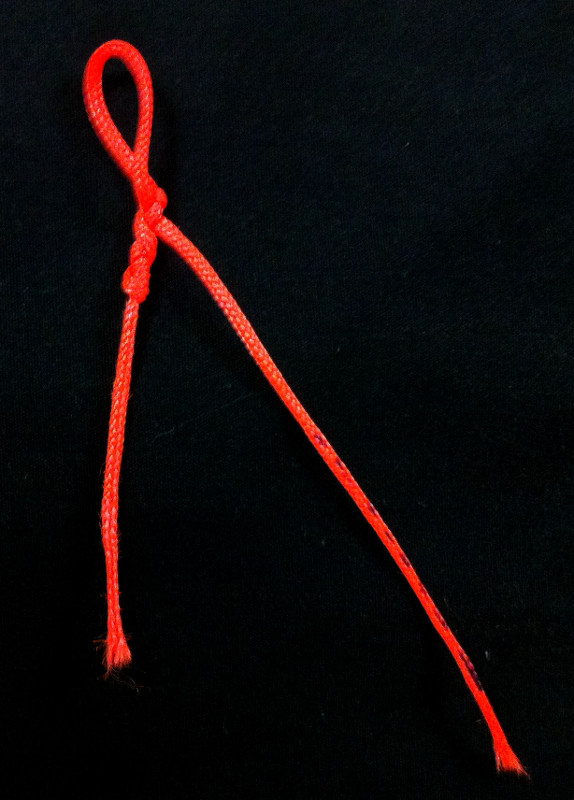
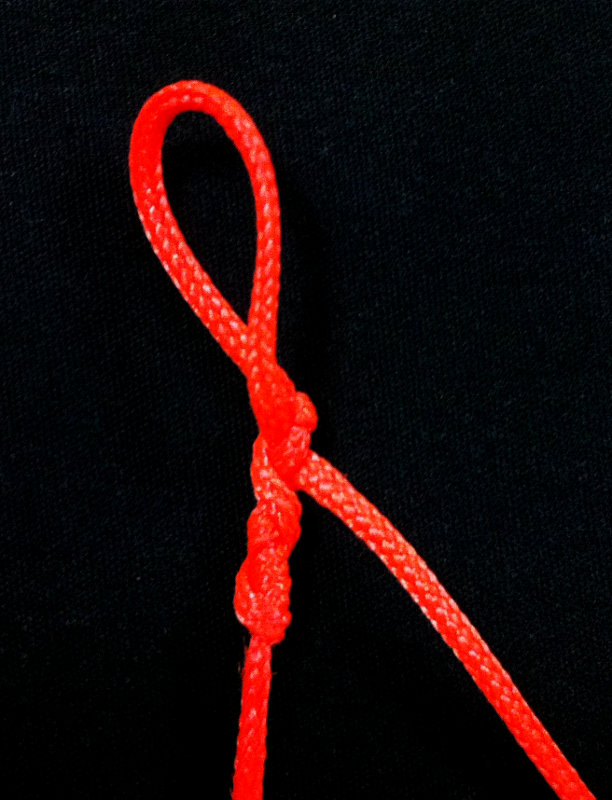
Here is a simple friction hitch I have been using for a belt for the past few years. I don’t know if it has been described/claimed before, but I find that it is very simple to tie/remember and in my (limited) experience seems every bit as reliable as a sailor or icicle hitch when used on lines/cylinders of the same diameter or larger. For obvious reasons, I simply call it the belt hitch, and will be using that name in this thread unless someone corrects me. See the photos in this post.
My reason for presenting this hitch is twofold, the first being to introduce what I think is an excellent friction hitch that is easily remembered, effective, and easy to tie and untie. My second reason relates to my ongoing tests of the Lazy Dog and other bends, loops, and interlocked loop bends. That thread can be found at http://igkt.net/sm/index.php?topic=4150.0 .
That is a rather long thread and in which I went through (re?)discovering what I call the lazy dog family of knots which are simply turns around turns. At the urging of X1, I began testing the loop and bend forms of these knots against some other “golden standard” knots for purposes of comparison against what might be termed more or less “known” quantities. In these tests, I noticed that in knots that have both a bend and loop forms, the loop forms tend to be stronger. From here, I posited that a stronger form of bend should be that of two interlocked loops, after which I started testing some examples of loop-to-loop bends. I had planned to move to larger line after I had finished with the admittedly small line that I was using.
When I was nearing the last set of tests on “size b” Chinese knotting string, it occured to me that since many pepole feel that gradual turns/corners going into a bend/loop tend to make it stronger, perhaps a loop or bend made from a friction hitch(es) would be strong also. So I did some tests using my belt hitch to make loops. The knot was tied by making 7 full turns (2520 degrees) rather than the three shown in the photos. This is when I entered the twilight zone…
I am posting the raw test results, since I don’t quite know how to analyze them. (Again, the string used was the same (from the same roll) as that used in the Lazy Dog tests mentioned earlier.) The results are as follows:
[tr][td] Line [/td][td] Belt Hitch Loop [/td][td] Distance From Knot [/td] [/tr]
[tr] [td] 22.1 kg[/td][td] 21.7 kg [/td][td] cm. [/td][/tr]
[tr] [td] 21.9 kg[/td][td] 21.5 kg [/td][td] cm. [/td][/tr]
[tr] [td] 22.1 kg[/td][td] 23.1 kg [/td][td] 4.5 cm. [/td][/tr]
[tr] [td] 23.1 kg[/td][td] 21.3 kg [/td][td] 2.7 cm. [/td][/tr]
[tr] [td] 21.5 kg[/td][td] 21.0 kg [/td][td] cm. [/td][/tr]
[tr] [td] 22.0 kg[/td][td] 23.2 kg [/td][td] 10.0 cm. [/td][/tr]
[tr] [td] 23.2 kg[/td][td] 23.2 kg [/td][td] 5.6 cm. [/td][/tr]
[tr] [td] 21.1 kg[/td][td] 21.5 kg [/td][td] 1.0 cm. [/td][/tr]
[tr] [td] 21.4 kg[/td][td] [/td][td] [/td][/tr]
[tr] [td] 22.8 kg[/td][td] 23.2 kg [/td][td] 6.0 cm. [/td][/tr]
[tr] [td] 23.3 kg[/td][td] * 19.8 kg [/td][td] cm. [/td][/tr]
[tr] [td] [/td][td] * 21.9 kg [/td][td] cm. [/td][/tr]
[tr] [td] [/td][td] 21.5 kg [/td][td] 0.5 cm. [/td][/tr]
[tr] [td] 22.0 kg[/td][td] 22.4 kg [/td][td] 0.7 cm. [/td][/tr]
[tr] [td] 23.7 kg[/td][td] 20.0 kg [/td][td] cm. [/td][/tr]
[tr] [td] 24.6 kg[/td][td] 21.8 kg [/td][td] cm. [/td][/tr]
[tr] [td] 24.7 kg[/td][td] ** 23.4 kg [/td][td] cm. [/td][/tr]
[tr] [td] 21.5 kg[/td][td] 22.0 kg [/td][td] 4.2 cm. [/td][/tr]
[tr] [td] 23.7 kg[/td][td] 21.8 kg [/td][td] cm. [/td][/tr]
[tr] [td] 22.4 kg[/td][td] 21.3 kg [/td][td] 1.8 cm. [/td][/tr]
[tr] [td] 22.6 kg[/td][td] 21.3 kg [/td][td] cm. [/td][/tr]
[tr] [td] 22.0 kg[/td][td] 21.0 kg [/td][td] 0.8 cm. [/td][/tr]
[tr] [td] 23.0 kg[/td][td] 22.0 kg [/td][td] cm. [/td][/tr]
Cells with empty cm. values indicate a value of 0.
Cells left blank indicate no testing was done.
- – The knot slipped until tight against the anchor, then failed.
** – Knot tied somewhat loosely – slipped to anchor, then failed.
I have since tested the Belt Hitch loop several times on several different kinds of cord, including a larger Chinese knotting string and two types of "poor man’s paracord, all with strengths between 70 and 100 kg. The incidence of “not-adjacent-to-knot” failures was present in all kinds of cord I have yet experimented with, with varying degrees of frequency. I made videos of some of these tests and posted them at : http://archive.org/details/Belt_loop_hitch_loop_test .
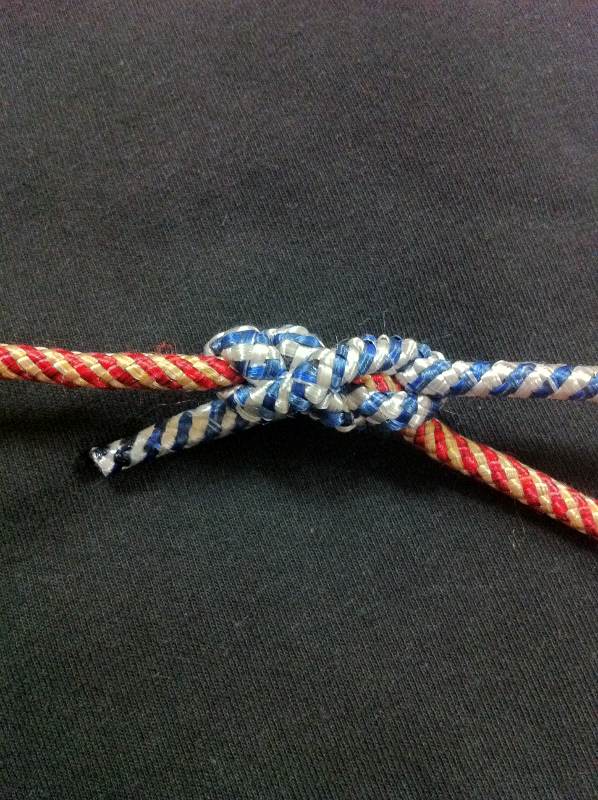

 I have, indeed, been testing it as a loop. I wanted to get an idea of its strength when used as a loop knot and tested to failure.