if i might just add CA glue ugliness as it place mainly with petroleum base rope
i got some 1mm polyester rope and nothing stick to it but CA glue ugliness work a charm and it is way better that burning them.
Charles.
if i might just add CA glue ugliness as it place mainly with petroleum base rope
i got some 1mm polyester rope and nothing stick to it but CA glue ugliness work a charm and it is way better that burning them.
Charles.
Another thought, if not knotting.
Fabric glue. Most dry fairly quickly.
Will these pieces be used again?
The priority is that they last for the rest of the session and they get to take them home at the end. When they come to the next course in scouts tehy might better appreciate why we are teaching them whippings after that 
Fabric glue might be too slow. I could probably tie a whipping in the time it takes for glue to set. That said, I am tempted with a little bit of CA glue and activator, although its not my favourite idea suggested so far.
a quick-drying fabric glue, clear, a little fumey;
it starts drying as it comes out of the bottle..!
i don’t know what the active ingredient is. wonder if it’s silicone-based,
guessing might be like a lite version of dip-it that soaks in a bit.
Indeed. I inherited a batch of ropes from the late
Bob Thun (a caver, and who first published his discovery
of what’s called (mistakenly, it seems) “zeppelin bend”),
and thought that he’d used chemical whipping, so nicely
shaped & un-sharp the end; but I believe now that he’d
actually melted them, but slowly & carefully. Melting, as
you note, can leave sharp edges which are unkind to both
hands and any rope they encounter in tying/untying.
To my observations, the most common ends-sealing
–might not call it “whipping”-- is black electrical tape (!).
And this stuff didn’t fall off immediately.
You didn’t say what your to-be-whipped rope is,
but if it’s synthetic (but not kevlar), melting is possible,
and the combination of wrapping the point YET to be
cut with tape and then HOT-CUTTING through the center
of the tape (sealing the new two ends) can work decently.
Maybe with a little rounding of the ends to try to take
away a sharp edge leads to a fair result.
The Boa knot? NOT. --too clever by half, this, and not
readily set tight (all those wraps to deliver tension).
West Country Whipping can be put on pretty quickly,
but the result is sort of rough, and one needs to make
careful whipping-length-of-end cord else you’ll be cutting
away more than needed.
Now, a sort of variation to this which puts in one side of
simple knots --not two, as WCW does-- can be done with
material efficiency; it’s something I came upon recently
and use with fair success. (Heck, I’m only whipping my
“play ropes” and not ropes put into serious usage (but
the play ropes can get a lot of tying/untying handling).
Working from the end inwards, grip the whipping end
against the rope-2-B-whipped and then cast a half-hitch
over-around the rope end; pull snug, and you’ve a half hitch.
Now, repeat the casting-a-HH but ensure that this wrap
is brought down just below (= away from rope end) the
first; set tight pulling back around rope, and then pull
back to yourself to tighten-lock this HH which now is
a simple knot / overhand form. And continue this casting
and setting --NB : nice thing to be able to haul hard to
set EACH time and not need to have one’s setting force
get transmitted through many wraps (friction quickly
reduces the force) !
One can tie off in various ways, e.g.,with a drop of that
clue to seal.
–dl*
/====
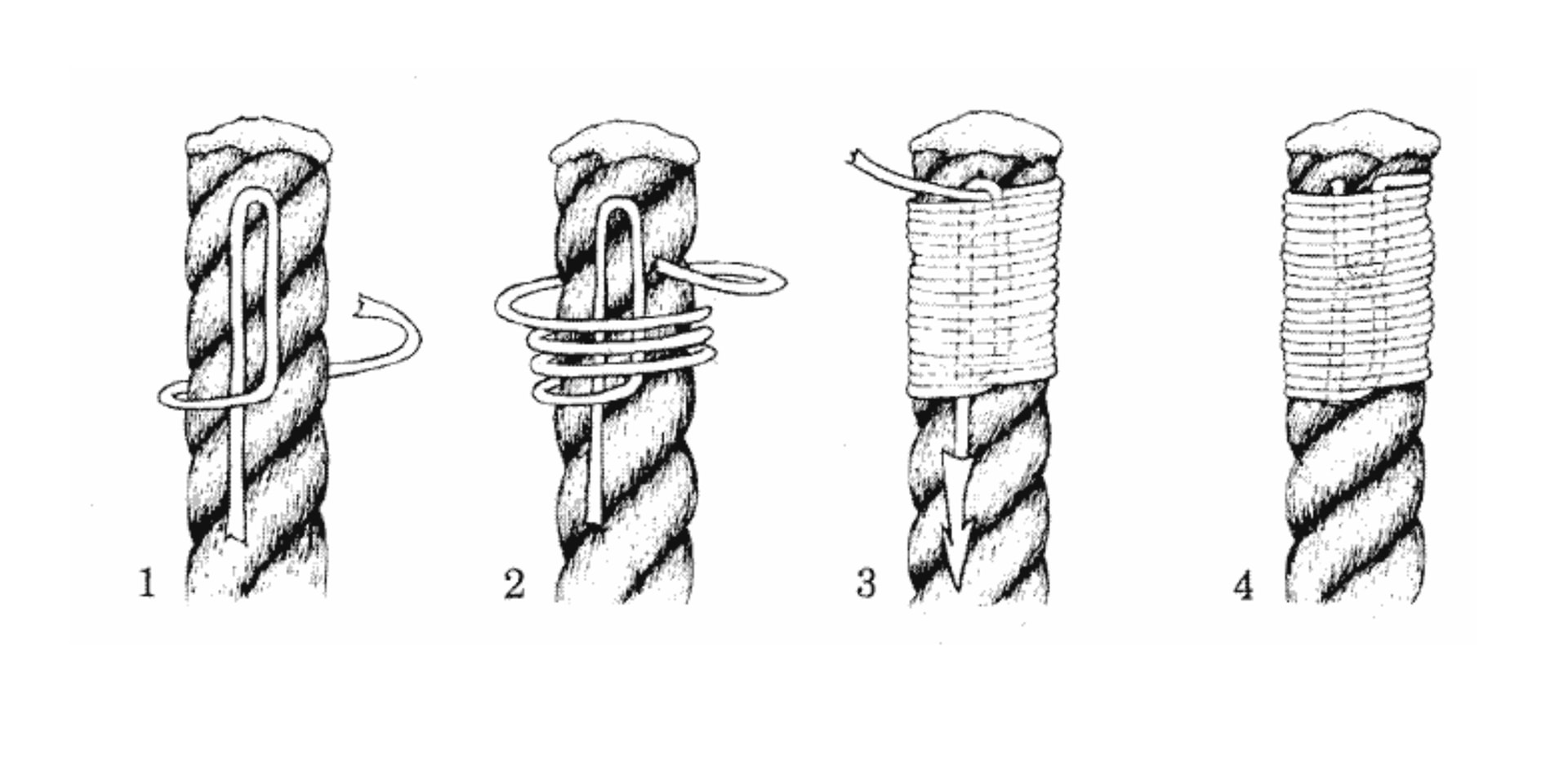
… can be formed such that after making the initial
wraps about half-way from one side towards the
other, go THROUGH the u-fold (what you’ve been
wrapping over) and then continue the overwraps;
this “through” tuck will prevent you from pulling
the elbowed ends out of a balanced positioning.
Frankly, I’ve too much forgotten about this simple
whipping, and will try to visit it in practice, as it
(1) is material efficient (just forming the u-fold),
(2) able to be put on with immediate tightening,
(3) and should be pretty secure as, unlike e..g. with
the Constrictor/Strangle, final buried tucks don’t
lead out but rather to their elbow’d u-turns under
the wraps.
A missed potential whipping quality here is the
ability to stay (partially) tied after some part gets
cut –West Country Whipping, e.g., is a series of
simple knots which can exist independently;
sailmaker’s whipping has those “frapping” parts
that might contain a broken strand --though these
parts are themselves most vulnerable to abrasion.
–dl*
/====
The rope is usually Jute, so unfortunately melting is not going to be an option.
The black tape is one thing I am going to try, once i have some fresh tape, as the stuff I have tried before was rubbish (I think it had been left out in the sun too long and had become brittle)
Ive never been much of a fan of the west country whipping. I find it falls apart too easily. Im probably not finishing it off well enough.
I wonder if a french whipping would be quicker to tie (I always used to get this mixed up with the west country whipping)… Its effectively taking the clovehitch to the extreme. Finishing might be an issue, without a needle, so perhaps end with a constrictor.
I guess with bow strings I often use a dab of CA glue to keep the ends from fraying, so perhaps I should give the idea more consideration here.
Thanks for the continued suggestions.
Nor the size of the 2-B-whipped rope and the materials
likely at hand for whipping.
I’ve found it fun to use parts of fibrillated PP (baling twine)
so to take advantage of its relative strength, slickness,
and esp. flatness --crossings don’t bulk so much.
ABoK #277 btw shows how to start the novel whipping
I described (or tried to) above, “casting a HHitch” over
the end and then dressing & setting that on the other
side of thumb-held HH. (What Ashley does --and IMO
he’s off his rocker in this-- is form an OH brought down
to lose complexity into a HH ; whereas I go in the opposite
direction, converting the cast HH into the OH!
I’ve used mason line & fishline for whippings, too.
–dl*
/====
Well, you might find --depending upon relative
whipping-vs-rope sizes-- that having that extra
twist of whipping will take the binding turns
at the ends ever farther from the tangent point
and so effectively putting some air into the
whipping (which could be prevented by pulling
somewhat down/against the rope, and having
tangent points either side).
Do note that it’s also possible to have WCW made
of Constrictor knotting ! One end will make a round
turn, crossing beneath itself, and thereby awaiting
the other end to come 'round and … make a Constrictor
knot-ing --the “ing” for being formed (the knotted part)
with two lines. But this might be too clever by half
a half --more to impress friends, with gratuitous bulk?!
(It remains a neat idea of complement a Constrictor
Knot in other cases as a way to dispose of tails; the
idea was given to me by knot-artist Lee Crawfort
(not sure if Lee’s still knotting, but looks to be “still”!).
(-;
Between 6 and 8mm rope 3 strand z lay.
The whipping twine I tend to pick up is Marlow waxed polyester, mainly because it is readily to hand. Thinknig about it, there is another idea to put a few turns around with the poly whipping twine and then just melt the ends of that. Sounds fiddly, but it might be worht adding the the list of things to try.
Teach this - so simple and you can do it before you cut to length. 10 seconds per end.
Or, you can wrap Across where you will cut with tape, cut through the tape, leaving both ends with taped sections and then flood the ends with thin “super’ glue.
This is exactly what we teach the older ones, but it’s a bit much to be teaching an 8 year old who has not learnt anything yet.
Perhaps you can find some simple aglets that will be simple and quick.
But, I think you are selling the young ones short regarding a simple whipping.
Even a slew of overhand knots could work.
Aglets would be quick, especially with a suitable crimp tool, but Im not sure how good they would be for knotting. We have already tried using heat shrink tubing which works relatively well, with the few caviates that I have mentioned about it before.
Its not really about selling them short. I am talknig about trying to cater for a wide range of abilities. Some have not yet learnt to tie their shoelaces, and others are champing at the bit to learn everything we can teach.
The idea of the ropemaking exercise is that it is one of the first things we do with them, so that they have a piece of knotting rope that is theirs, and they can use it to tie everything that we teach them through the course of the day. They can then take it away with them to practice and learn more.
I think it is fair to say that while you can tie a couple of simple whippings in 20 seconds, and I could do the same in a minute or so, but I doubt many of the children would take in what had happened. I also would neen anyone I was pressganging into helping out on a ropemaker to be able to work similarly as fast, which is what prompted me to start this thread in the first place.
Anyway, the ideas here are fantastic. I am going to try as many of them as I can and will report back with how things go.
Idea: Make up the giveaway ropes ahead of time. Hand them out during or after the rope making.
I like the idea, but the badge they are working towards has a requirement for them to make a rope. I am not a fan of having them make a rope, and then present them with a different rope and effectively say, “here you go, this is what you should have made”
Personally, I would rewrite the cub badge, to remove the “make a rope” section until they are at a point where they have learnt enough that they can easily finish the rope they make.
Thanks to Scott’s reminder, I put in a recent whipping
using the Common Whipping, with a single (what-I’ll-call)
interrupter --i.e., one pass of the whipping at the mid-way
point through the u-fold, to prevent pulling out the
later tucked end (the u-fold will pull only into this “i…”).
There are various combinations of techniques. In addition
to what I just described (using an “interrupter”), if one is
game for some brief laying of the 3-strand rope, one can
try taking a mid-way wrap through the lay, as a means
to preventing the whipping from sliding off. !? (I’ve not
yet tried this; I can see that getting this buried part to lie
proximate to other turns might be a challenge.)
So, waxed twine. I have used tea-bag strings, and rice-bag
strings (once I figure out how to unto them! --new, La Qilla
basmati awairs opening, but it might not have a string binding).
I wondered why polyester vs. nylon? Doing some searching,
I find little information. My thought comes from what I’ve
heard re conditioning a kermantle rope pre-use.
Repeated wetting will gradually reduce the length of the rope (sometimes by more than 10%),
So, my thinking runs “Use nylon for whipping (and some
other binding tasks) as it will tighten your work when wet!”
(I’ve seen lots of commercial-marine gear with what I call
a “Reverse Groundline Hitch” (shown in ABoK as a miller’s
knot, and at 3794/5 in its use to bind lines; surely, though,
Ashley shows it put on in the wrong direction, which will
require much care & working --rather, it goes on as a pair
of opposing HHitches, each locking the other!). And once
I watched a rigger building a net putting in the RGH with
just some mild tugs to set it ; yet what I’d seen in used
nets was quite snug & tight.)
But I found in a com.fish.gear store not nylon but
“polyester flat braid”. The flat aspect --a sort of
rectangular cross section-- accommodates the
crossings of the RGH nicely, reducing bulk ; it can
be simulated by pairing (non-flat) cords which
give a 2:1 cross section of sorts.
–dl*
/====
I’ve had very good results with constrictor knots for this purpose. A yarn from the very same cordage you’re working with would work well, but something like a fine seine twine would be very good if you happen to have some handy. Rub beeswax into the yarn or twine beforehand and the constrictor knot will hold forever. For extra security you could tie double-constrictors and/or tie a second knot.