transitive verb
1: to pass (something, such as a rope) through a hole or opening
2: to fasten by passing through a hole or around something
3: to pass a rope through
intransitive verb
of a rope : to pass through a block or similar device
Thank you for helping me out of what Reever refers to. At first I assumed Reever was referring to a name, but that seems to be wrong then. The origin of the knot and its name seem to be unknown. Now, I sort of assume that reever could be a person. Maybe somebody working on a boat, but I can not find reever on the internet in that meaning, which annoys me.
I have extracted some published information for you - so its all in one place and easier to investigate.
Unfortunately, I could find no historical information that points specifically to how the name “Reever” was assigned and by whom.
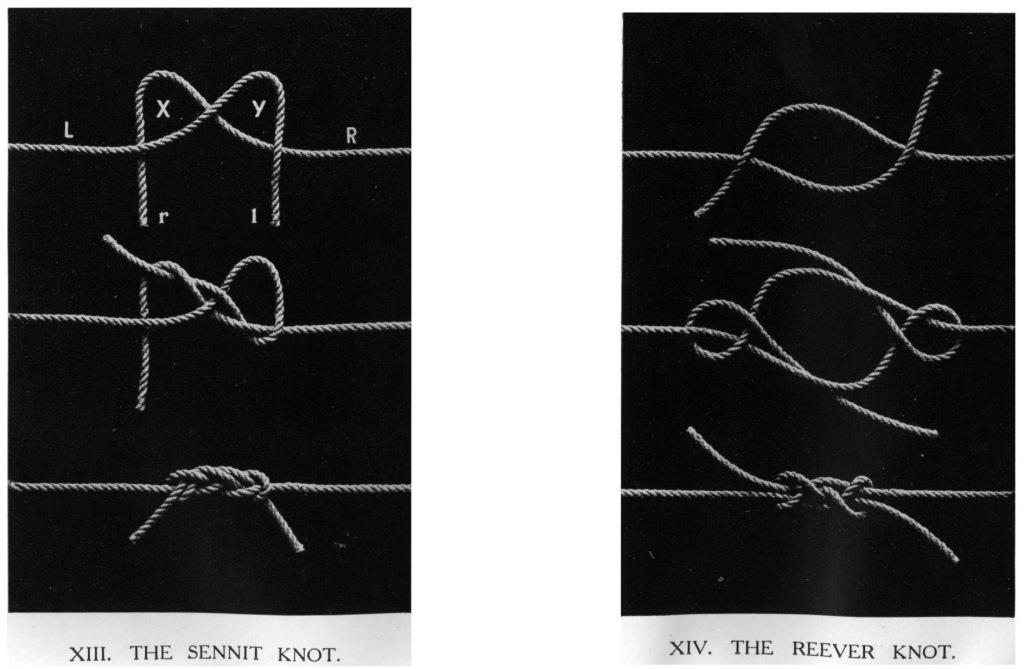
The earliest published data that I know of is from Wright and Magowan in 1928 (see attached extract).
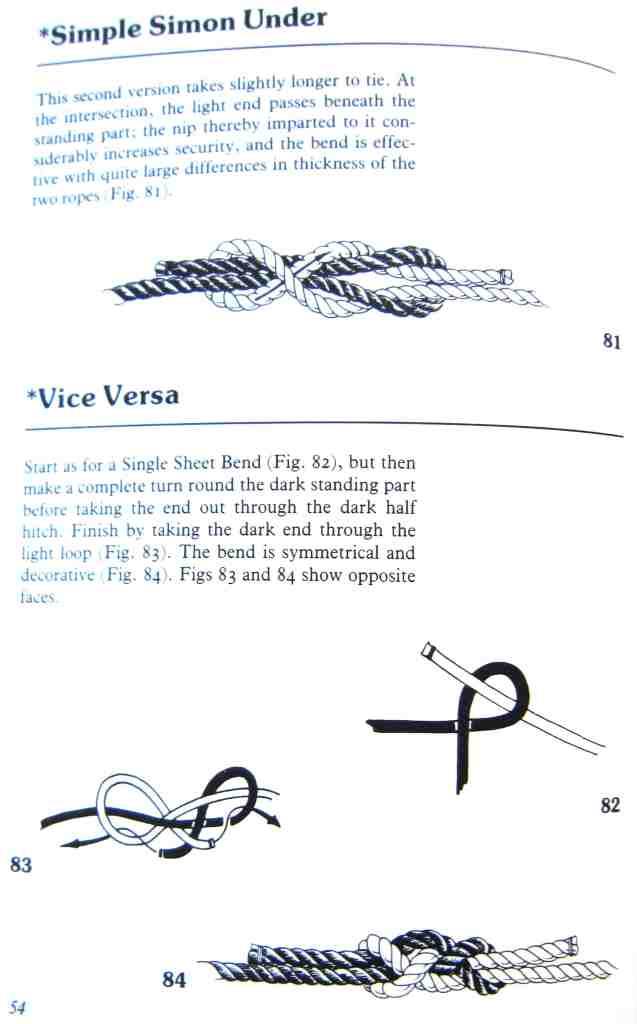
Dr Harry Asher published the “Vice Versa” bend in 1989 - it had an asterix (*) assigned to it which indicates a new discovery in his book. Asher doesn’t specifically state that he personally discovered it…one can only ‘assume’ that he did. Presumably the name ‘vice versa’ was a reference to one half of the knot being in one direction and the other half copied in the opposite sense.
The name “Reever” could simply be an attempt to describe the threading of the rope through and around itself in a uniform pattern?
There is nothing in Ashley to provide additional guidance…
EDIT: Had trouble with getting acceptable image quality…
OK. Then I guess it would be correct to write “reever knot” with a beginning letter in lower case. I always wrote with a capital “R” in the beginning before because I thought it was a name. It is sad that the history of the origin of the knot is unknown, for a curious me.
Regarding the Braided Machard, I think the complete use of the loop length, little extending beyond the hitch to clip into to, makes it function satisfactory more than the number of wraps and braids. Your tying seems to be a 2-6, wraps-braids, generally more wraps and less braids are used. The Valdotain Tresse, which uses a cord with an eye on each end is the same hitch, and is also dependent on the cord length, if it is fixed. I cut a loop apart and was able to make a more compact hitch by not being limited by a set length. A 4-2 and 3-3 where the shortest that would reliably grab each time, with the 3-3 performing easier.
This is an instruction video where braided Machard (Machard Tresse) begins at 3 min 38 sec: https://www.youtube.com/watch?v=_1RG-CSgGpc
Please, note that the ends should be alternatively below and above each other when braiding.
Brocky, i’m always thinking, the tail length in tresse’s is mostly to assert angle of pull
To the input, then thru chain.
.
To connive specific range of sine force from either competing side as grip from load/for load
and in high focus climbing hitches of precision, accuracy and durability etc. are tuned to user weight/style as well as the mated materials (cord to rope)
.
We ask more of friction hitch then just hold or release, let alone the interim between repeatedly then hold again
at lifeline security, accuracies and confidences.
We might ask more bull dawg hold or quick release of some, and even then is a 1way or 1x deal etc.
nothing else so repeated variances and usages especially at such risks/trusts i think
Truly wondrous knots!
Sure, I’ll help. To reeve, according to Webster’s Third New International Dictionary Unabridged, has this definition (a few more possible meanings are mentioned, but this is the best, I think): “To pass (as the end of a rope) through a hole or opening in a block, thimble, cleat, ringbolt, cringle or similar device.”
I suppose the reason for the name of the reever knot is that it can be rove through a hole or opening of that kind due to its being fairly slim. The knot itself is the reever, because it reeves through some device of the aforementioned kind.