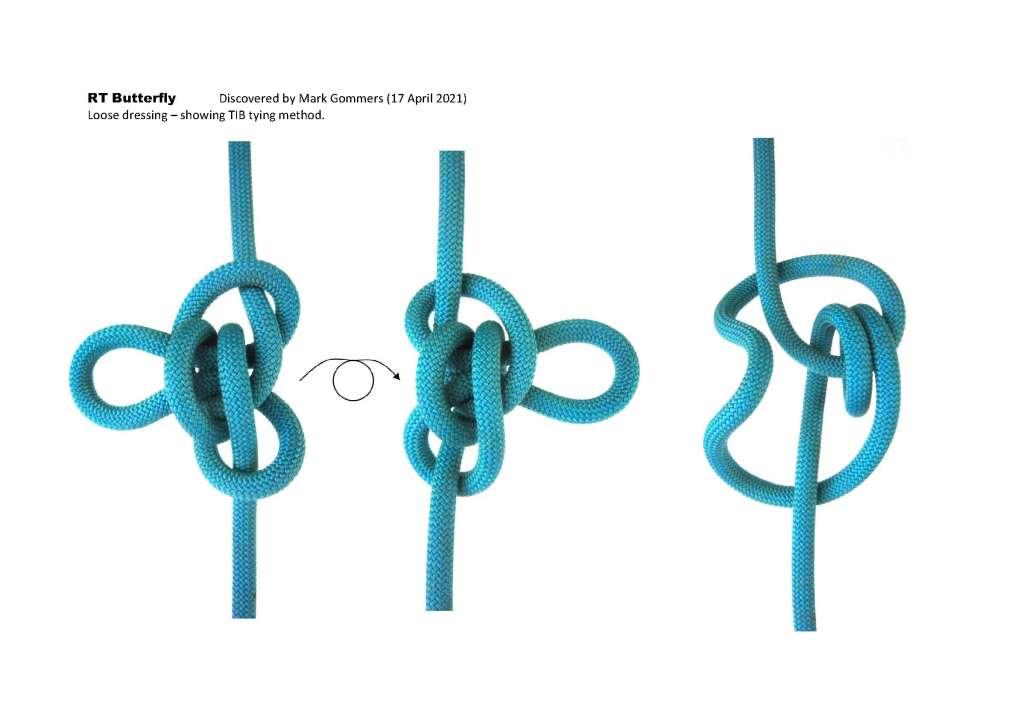
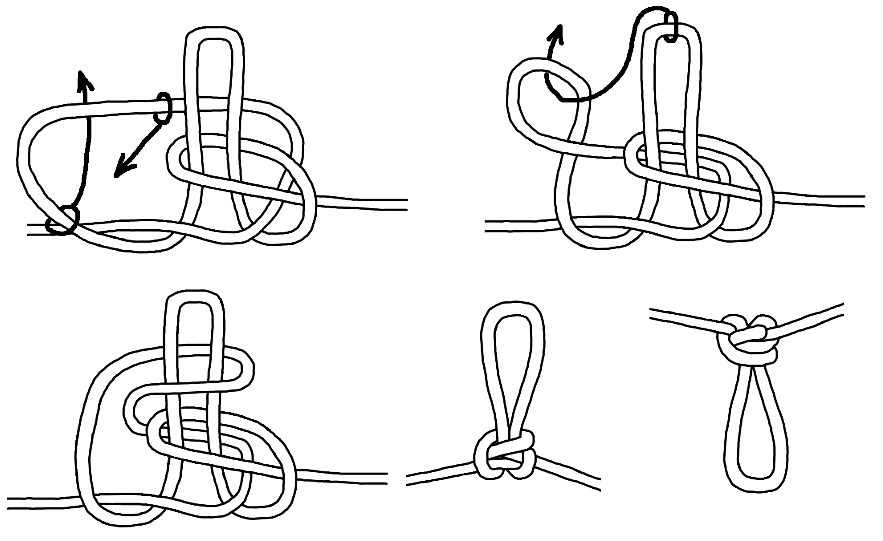
This is a claim of originality for the ‘RT Butterfly’ (round turn Butterfly).
Of course, such claims (in the fullness of time) often turn out to be re-discoveries!
I consider this mid-line eye knot to be remarkable on account of the following properties:
TIB (tiable in the bight)
EEL (either end loadable)
BTL (bi-axially through loadable)
Both eye legs arc around 3 rope diameters (which is quite remarkable).
I theorize that this knot is jam resistant across all loading profiles!
I am hoping that by advancing such a theory - someone will perform some load tests to either confirm or refute this theory.
Its not that hard to learn - as with anything new, practice is the key.
Hi Mark,
I discovered this knot and others, starting with two RTs on the hand and using the hybrid tying method as the basis for discovery. That was several years ago.
Hi Mark,
I discovered this knot and others, starting with two RTs on the hand and using the hybrid tying method as the basis for discovery. That was several years ago.
Thank you for your post.
Do you have some sort of proof (evidence) that you tied a structure [i]identical [/i]to the one I posted (RT Butterfly)?
Note: I am not being rude - and I am not attacking you.
I am merely requesting proof to support your claim!
Eg: Photos with date/time stamp or posts in this forum?
I have tied this in the past, although with a different tying method.
I use the coils around the hand method, going four times (or more) as I would tie the butterfly loop.
I?ve gone as far as 6 coils, but that is superfluous. But looks neat.
The RT Butterfly seems to resist jamming well and in the different load scenarios can?t be faulted. I can see it being useful in different circumstances.
IMHO Enhancing a structure and finding a new knot are two different propositions.
Xarax for example proposed many examples of “bettering” a knot with a simple retuck.
But I will refrain from adding a new turn to any of his helical -eye knots- and by doing this claiming a new find.
I salute agent_smith for his effort.
Keep them coming!
Sorry Mark,
I can’t offer you the level of proof that you’re requesting. I am very familiar with the (identical) structure though, and I will say that it’s a rather easy matter to discover/tie it using the hybrid tying concept (ie. loops around a hand with an “X” crossing form underneath).
Good luck with testing.
This is a [i]claim of originality[/i] for the [i]'RT Butterfly'[/i] (round turn Butterfly).
Who's making this claim?
I think that we can take Alan at his word of making
a discovery; his presentation is solid for "fact". As
to others having also reached this point in the knots
universe, their credibility seems adequate for belief.
What's at stake, here, anyway?!
Interestingly, I recently also fiddled something that
I on untying saw was a butterfly extended
with a further wrap & tuck of the eye bight! (into what
we’d prefer to see as a “directional”/“inline” eye knot)
“interesting” coincidence. But Alan has been indulging
in some of the various bights in-the-bight workings
before, getting to many different results.
IMHO Enhancing a structure and finding a new knot are two different propositions.
Yes, and it's a matter of how significantly different
(preferably "better"; but it might be per-use) the
enhancement is. There are so many things that one
can do to a given knot if one thinks of the variations
already known --e.g., putting in another turn (the sheet
bend into dbl.sheet bend)--, one can go on & on & ... .
But consider --odd, but seemingly so-- how someone
could write, re the [i]Prusik h.[/i], that "the 3-coil
Prusik wasn't yet invented" ! My favorite quick-tie
secure but forcibly loosenable end-2-end joint is
the "dbl. Lapp bend", which is this adding a full
wrap to a known knot, but which extension brings
much increased security & stability --so simple,
so "right there", but so ... far ignored in the literature.
?
I admit to puzzlement over this remark.
I know that English is your first language - and so it should be a relatively easy exercise for you to determine that it is I (Mark Gommers) who is making a claim of originality.
I think that we can take [b]Alan [/b]at his word of making
a discovery
?
I didn't see that Alan (I presume you mean Alan Lee?) - had also made a claim on the RT Butterfly?
Unless there is another Alan?
What's at stake, here, anyway?!
?
This is a puzzling remark.
In the first instance, I posted in a section of the IGKT forum which is titled "New Knot Investigations".
It is my honest belief that this part of the IGKT forum was established for the express purpose of investigating new knot discoveries.
Such discoveries are made by humans (ie people).
Many people have made discoveries - yourself included.
I note that the 'Lehman 8' is attributed to yourself (ie Dan Lehman).
Can you verify your claim for that particular structure - or should we attribute it to someone else?
Commentary:
I note that Albert Einstein is attributed as the discoverer of General relativity - which was verified with the transit of Venus and/or other stars as their light was bent due to the gravitational presence of the sun. Should we re-assign that discovery to someone else?
The dwarf planet Pluto was discovered by Clyde Tombaugh - should we re-assign that discovery to someone else?
History is full of such attributions - it is a part of the human culture to recognize individual discoveries - and I see no problem with the continuation of that tradition.
Xarax has many discoveries associated to himself, as does Alan Lee. Should we re-assign these discoveries to others?
Indeed - should the IGKT delete this part of the forum? That is, should the IGKT distance itself from any notion of personal discovery of a knot?
…
Yes, and it's a matter of how significantly different
(preferably "better"
I did in fact clearly state that the RT Butterfly makes a significant geometric improvement to the original #1053 Butterfly.
Both legs of the eye arc around 3 rope diameters - which in itself is remarkable. The same is true for both SParts.
Furthermore, the RT Butterfly is TIB - which is also remarkable.
I haven't seen such a structure that is; TIB, EEL and BTL (bi-axially through loadable) - that can be employed as a mid-line knot.
…
As for making claims and then verifying them - the IGKT does not have a defined policy on what constitutes ‘proof’.
In my case, I submitted clear photographic evidence…which (in my view) is acceptable proof - provided that it is published with accompanying explanatory text (eg posting the claimed discovery in this forum with photos).
And I didn’t look closely at the knots or the dates
of relevant posts --to see that yours & one of Alan’s
knots are slightly different, and you a few days prior,
in dates of posts.
Yes, and it's a matter of how significantly different
(preferably "better"
I did in fact clearly state that the [i]RT Butterfly[/i] makes a significant geometric improvement to the original #1053 Butterfly.
Both legs of the eye arc around 3 rope diameters - which in itself is remarkable. The same is true for both SParts.
Furthermore, the [i]RT Butterfly[/i] is TIB - which is also remarkable.
I haven't seen such a structure that is; TIB, EEL and BTL (bi-axially through loadable) - that can be employed as a mid-line knot.
??? There are numerous such knots,
sufficient to constitute a "class" of knots (though
I have trouble figuring out how to put it, in some
formal terms --i.e., how to deal with the various
loadings). Of course, the un-RT'd butterfly is one,
and then the variation in which one arranges for
the SParts to have like rotations (making one side
form a fig.8 vs. overhand).
Don’t you have 4 dia. for the SPart that turns
around the doubled other? --and the unadorned
butterfly three : the eye legs & opposing SPart.
So I see little difference --in such crude counting–
to the source knot, but just the doubling. Maybe
that doubling however has benefits to dressing
and so on. And to this Alan contributes another
orientation of the doubling, good.
I have recently developed a loop knot that is very similar to this RT Butterfly. I was exploring what Wright and Magowam call a ?Half-Hitch Noose? in the same 1928 paper where they introduce the Butterfly. They give one method for tying this knot and many other sources have a second method (for example the BSA pamphlet ?Knots and How to Tie Them?, 1978 copyright, where it is mislabeled as an ?Alpine Butterfly?). This is often now called a ?False Butterfly? because it is so often confused with a true Butterfly. It deserves a better name, since it is not really a bad knot. I suggest ?Twin Half Hitches Loop.?
I was exploring the standard ways we change a single Overhand Knot into a Double Overhand Knot, since this ?Half-Hitch Noose? has two Overhand Knots within it. I started out by converting both of the Overhand Knots in the ?Half-Hitch Noose? to be double, but it was a little bulky. I liked better making only one double. Here is one way to tie this by modifying the Wright-Magowan method. It is very close to the RT Butterfly and much easier to tie.
I have recently developed a loop knot that is very similar to this RT Butterfly.
I would respectfully disagree!
Your presentation does not offer any of the advantages of the RT Butterfly, and has a different geometry.
In the RT Butterfly, both SParts and both eye legs arc around 3 rope diameters - and both collars inter-link (rope segments cannot slip over the eye).
In your presentation, the SParts arc around only 2 rope diameters, and only one of the eye legs arcs around 3 rope diameters.
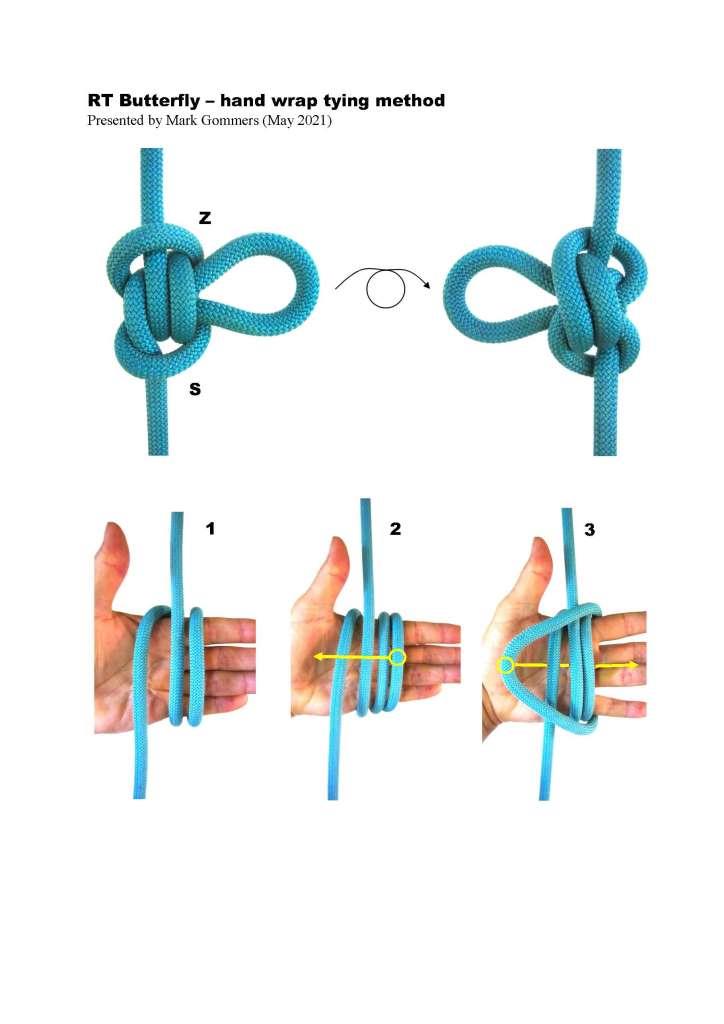
I now agree. I like the RT Butterfly alot. It took me awhile to see how to tie the RT Butterfly easily. I tend to favor the “hand wrap” method presented by Brion Toss (Knots for Boaters, 1990). I see now how to start out with 4 loops over my left hand, lift the 2 loops nearest to my thumb over the third loop, and then pull out the third loop (now closest to my thumb). I like to pull this through with the fingers of my left hand as I remove my hand.
No, I am not suggesting this. What I meant to say was that I use Brian Toss’s method for making a Butterfly Loop. I know that most other people use a different hand wrap method where they pull the loop out from their fingers and then stuff it into their palm. You seem to be using this method. (See also https://www.treebuzz.com/forum/threads/the-alpine-butterfly-vs-the-bowline-saga-continues.37316/ where Richard Mumford used this “move from fingers” type of method. Sorry he is so negative about Bowlines, but he does very thoroughly discuss the different ways you can dress a Butterfly and he does some very limited testing.)
I like to just reverse everything working from near my thumb as in the Brian Toss book (and not many other places do this). It results in the mirror image of the maneuvers other do. But then I can easily pull the loop through with my fingers as I remove my hand. Below is my sequence when I am teaching the Butterfly to others as I often do at scout gatherings.
By the way, in your page describing your hand wrap method above, the figure labeled 1 seems to only have three wraps when all of the later images have 4.
Here is the more common hand wrap method that you seem to be using.
Again, I would need more clarification about how you start your RT Butterfly hand wrap than is provided in your Figure 1. I think I understand Figures 2 and 3.
Following the general theme in this video with four coils on your hand will get you another way to tie the RTB. https://youtu.be/zg4bt1HeleM
With four coils on the hand, place the thumb under the first two coils and pick up the third while holding the three bottom coils in the other hand. Continue as per the video.
The way that I typically tie the RTB starts with just three coils on the hand and follows the hybrid tying theme. https://youtu.be/DYGdvL9-P30
Only one of the two coils at the bottom of your hand is used to complete the RTB. See if you can figure out which one and how to do it.